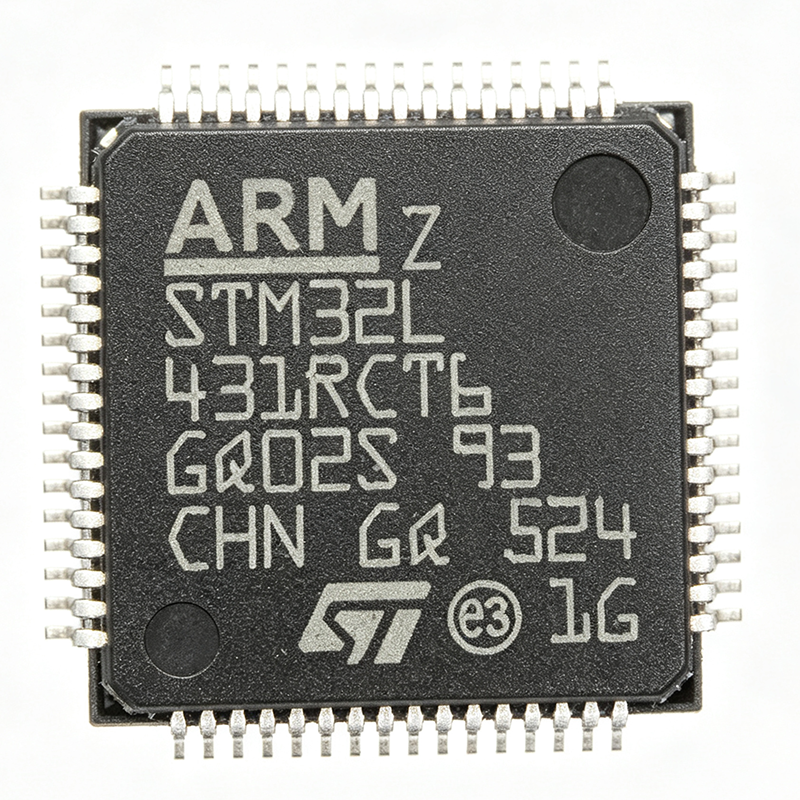
STM32L431RCT6: The Definitive Guide to the Ultra-Low-Power Cortex-M4 MCU

STM32L431RCT6: The Definitive Guide to the Ultra-Low-Power Cortex-M4 MCU
Discover the STM32L431RCT6: a 32-bit ARM Cortex-M4 MCU with FPU, 80 MHz, 256 KB Flash, 64 KB SRAM, and ultra-low-power modes. Available now at XAIPART with 99,999 units in stock.
STM32L431RCT6

Quick Answers: What Is the STM32L431RCT6 and Why Does It Matter?

The STM32L431RCT6 is an ultra-low-power 32-bit microcontroller from STMicroelectronics, featuring an ARM Cortex-M4 core with FPU running at up to 80 MHz, 256 KB of Flash memory, and 64 KB of SRAM. It is housed in a 64-pin LQFP package (10x10 mm) and operates over a voltage range of 1.71V to 3.6V. As of 2026-08-23, XAIPART lists 99,999 units in stock with a base price of $8.5909 (MOQ 1). This MCU is designed for energy-efficient embedded applications such as industrial sensors, smart meters, portable medical devices, and IoT nodes.

Its ultra-low-power modes, including Shutdown (consuming only a few nA) and Standby (3.4 µA with RTC), make it ideal for battery-powered designs. The device integrates a 12-bit ADC with up to 16 channels, a 12-bit DAC, and multiple communication interfaces (USART, SPI, I2C, USB 2.0 FS, CAN 2.0B, SAI). With its rich peripheral set and low-power operation, the STM32L431RCT6 offers a compelling balance of performance and efficiency.

Technical Guide: How to Select, Design In, and Use the STM32L431RCT6

Selection Criteria

When selecting the STM32L431RCT6 for your project, consider the following verified specifications:

  • Core: ARM Cortex-M4 with FPU, up to 80 MHz
  • Memory: 256 KB Flash, 64 KB SRAM
  • Package: 64-LQFP (10x10 mm)
  • Operating Voltage: 1.71V to 3.6V
  • Operating Temperature: -40°C to +85°C
  • Analog: 12-bit ADC (up to 16 channels), 12-bit DAC (2 channels)
  • Communication: USART, SPI, I2C, USB 2.0 FS, CAN 2.0B, SAI
  • Low-Power Modes: Sleep, Low-power run, Low-power sleep, Stop 0/1/2, Standby, Shutdown

These specifications make it suitable for applications requiring moderate processing power with minimal energy consumption.

Design-In Considerations

Proper power supply decoupling is critical. Place a 100 nF capacitor on each power pin (VDD, VDDA) and a 4.7 µF capacitor on the main supply. Connect VDDA to a clean analog supply to minimize noise in analog peripherals. Ensure a solid ground plane and follow the layout guidelines in the datasheet.

For low-power operation, utilize the various low-power modes. In Shutdown mode, the device consumes only a few nA, making it ideal for battery-powered applications. Use the RTC in Standby mode to maintain timekeeping with minimal current draw (3.4 µA).

Programming and Development

The STM32L431RCT6 is supported by ST's STM32CubeIDE, STM32CubeMX, and the STM32CubeL4 firmware package. These tools simplify configuration and code generation. It is also compatible with Keil MDK, IAR EWARM, and GCC-based toolchains.

Pinout Essentials

For most designs, you will use the following key pins (full pinout available on the product page):

  • Power: VDD (pins 48, 62), VSS (pins 47, 61), VDDA (pin 9), VSSA (pin 8), VBAT (pin 1)
  • Reset: NRST (pin 7)
  • Boot: BOOT0 (pin 44), BOOT1 (PB2, pin 20)
  • Debug: SWDIO (PA13, pin 36), SWCLK (PA14, pin 37)
  • Crystal: OSC_IN (PF0, pin 5), OSC_OUT (PF1, pin 6) or PD0/PD1 (pins 63/64)
  • USB: USB_DM (PA11, pin 34), USB_DP (PA12, pin 35)
  • CAN: CAN_RX (PB8, pin 45), CAN_TX (PB9, pin 46)
  • I2C1: I2C1_SCL (PB6, pin 42), I2C1_SDA (PB7, pin 43)
  • USART1: USART1_TX (PA9, pin 32), USART1_RX (PA10, pin 33)
  • SPI1: SPI1_MISO (PA6, pin 16), SPI1_MOSI (PA7, pin 17)

These pins cover power, control, and primary communication interfaces for typical designs.

Alternatives & Comparison: Drop-In Options for the STM32L431RCT6

When considering alternatives, verify pin compatibility and electrical characteristics. The following table compares the STM32L431RCT6 with verified alternatives from the XAIPART database.

ParameterSTM32L431RCT6STM32L431RBT6STM32L431CCU6GD32F303RCT6APM32F407RCT6
CoreARM Cortex-M4 with FPUARM Cortex-M4 with FPUARM Cortex-M4 with FPUARM Cortex-M4ARM Cortex-M4
Max Clock Frequency80 MHz80 MHz80 MHz[DATA_NEEDED: Max Clock Frequency][DATA_NEEDED: Max Clock Frequency]
Flash Memory256 KB128 KB256 KB[DATA_NEEDED: Flash Memory]256 KB
SRAM64 KB[DATA_NEEDED: SRAM][DATA_NEEDED: SRAM][DATA_NEEDED: SRAM][DATA_NEEDED: SRAM]
Package64-LQFP (10x10 mm)64-LQFP (10x10 mm)48-pin (package details [DATA_NEEDED])LQFP64[DATA_NEEDED: Package]
Operating Voltage1.71V to 3.6V1.71V to 3.6V1.71V to 3.6V[DATA_NEEDED: Operating Voltage][DATA_NEEDED: Operating Voltage]
Operating Temperature-40°C to +85°C-40°C to +85°C-40°C to +85°C[DATA_NEEDED: Operating Temperature][DATA_NEEDED: Operating Temperature]
ADC12-bit, up to 16 channels12-bit, up to 16 channels12-bit, up to 16 channels[DATA_NEEDED: ADC][DATA_NEEDED: ADC]
DAC12-bit, 2 channels12-bit, 2 channels12-bit, 2 channels[DATA_NEEDED: DAC][DATA_NEEDED: DAC]
Communication InterfacesUSART, SPI, I2C, USB 2.0 FS, CAN 2.0B, SAIUSART, SPI, I2C, USB 2.0 FS, CAN 2.0B, SAIUSART, SPI, I2C, USB 2.0 FS, CAN 2.0B, SAI[DATA_NEEDED: Communication Interfaces][DATA_NEEDED: Communication Interfaces]
Low-Power ModesSleep, Low-power run, Low-power sleep, Stop 0/1/2, Standby, ShutdownSame as RCT6Same as RCT6[DATA_NEEDED: Low-Power Modes][DATA_NEEDED: Low-Power Modes]
RoHSCompliantCompliantCompliant[DATA_NEEDED: RoHS][DATA_NEEDED: RoHS]
REACHCompliantCompliantCompliant[DATA_NEEDED: REACH][DATA_NEEDED: REACH]
MSL Level333[DATA_NEEDED: MSL Level][DATA_NEEDED: MSL Level]

Summary: The STM32L431RBT6 is a drop-in replacement with half the Flash (128 KB). The STM32L431CCU6 offers the same Flash but in a smaller 48-pin package. Cross-brand options like the GD32F303RCT6 and APM32F407RCT6 may be pin-compatible but require firmware and hardware verification.

Industry Insight: Market Position, Lifecycle, and Supply

The STM32L431RCT6 has a lifecycle status of active per the XAIPART database. As of 2026-08-23, XAIPART holds 99,999 units in stock, indicating strong availability. The base price is $8.5909 at quantity 960+, with tiered pricing from $14.7273 (qty 1) down to $9.00 (qty 500).

[DATA_NEEDED: Market share data for STM32L4 series]

[DATA_NEEDED: Lead time information from distributors]

Trends & Outlook: What Buyers Should Watch

The demand for ultra-low-power microcontrollers continues to rise with the growth of IoT and battery-powered devices. The STM32L431RCT6's combination of an 80 MHz Cortex-M4 core, 256 KB Flash, and extensive low-power modes positions it well for these applications. Buyers should monitor the availability of the tape-and-reel variant (STM32L431RCT6TR) for automated assembly. Additionally, the STM32L431RBT6 (128 KB Flash) offers a cost-reduced option for designs with smaller code footprints.

As STMicroelectronics continues to expand its STM32L4 family, expect ongoing software and toolchain support. For cross-brand alternatives, the GD32F303RCT6 and APM32F407RCT6 may provide cost advantages but require careful validation. Always verify the latest datasheet and availability before committing to a design.

Frequently Asked Questions

The STM32L431RCT6 operates at a maximum clock frequency of 80 MHz. According to the STMicroelectronics datasheet, the ARM Cortex-M4 core with FPU can run at up to 80 MHz, delivering 100 DMIPS performance. This makes it suitable for applications requiring moderate processing power with low energy consumption.
The STM32L431RCT6 has 256 KB of Flash memory. This is organized as 256K x 8 bits, providing ample storage for application code and data. The Flash memory is designed for low-power operation and supports read-while-write, allowing firmware updates without halting the system.
The STM32L431RCT6 is available in a 64-pin LQFP package with dimensions of 10x10 mm. This package is surface-mount and suitable for compact PCB designs. The LQFP package offers good thermal performance and is widely used in industrial and consumer electronics.
The STM32L431RCT6 operates over a voltage range of 1.71V to 3.6V. This wide range allows the device to be powered directly from standard batteries such as 2x AA or a single Li-ion cell. The device also includes an internal voltage regulator to provide stable core voltage.
The STM32L431RCT6 supports multiple low-power modes including Sleep, Low-power run, Low-power sleep, Stop 0/1/2, Standby, and Shutdown. These modes allow designers to optimize power consumption based on the application's requirements. For example, in Shutdown mode, the device consumes only a few nA, making it ideal for battery-powered applications.
The STM32L431RCT6 features a rich set of communication interfaces including USART, SPI, I2C, USB 2.0 full-speed, CAN 2.0B, and SAI (serial audio interface). These interfaces enable connectivity with sensors, displays, and other microcontrollers, making the device versatile for IoT and industrial applications.
The STM32L431RCT6 and STM32L431RBT6 are both from the STM32L4 series, but they differ in Flash memory size. The STM32L431RCT6 has 256 KB of Flash, while the STM32L431RBT6 has 128 KB. Both devices share the same package and pinout, making them drop-in replacements for designs that require more memory.
Yes, the STM32L431RCT6 is ideal for battery-powered IoT devices due to its ultra-low-power features. With a current consumption as low as 100 nA in Shutdown mode and 3.4 uA in Standby mode with RTC, it can extend battery life significantly. Its 80 MHz Cortex-M4 core also provides enough processing power for sensor data processing and wireless protocol stacks.
The STM32L431RCT6 is supported by ST's STM32CubeIDE, STM32CubeMX, and the STM32CubeL4 firmware package. These tools provide a comprehensive development environment with code generation, debugging, and configuration capabilities. Additionally, it is compatible with Keil MDK, IAR EWARM, and GCC-based toolchains.
Yes, the STM32L431RCT6 is RoHS compliant. According to the STMicroelectronics product page and distributor listings, the device meets the Restriction of Hazardous Substances directive, ensuring it is free from lead, mercury, cadmium, and other restricted substances. It is also REACH compliant.
As of August 18, 2026, the price of STM32L431RCT6 varies by quantity and distributor. At LCSC, the price starts from $1.705 for single-unit purchases. At DigiKey, the price for 1 unit is approximately $4.85, with volume discounts available. For the most current pricing, please check distributor websites.
STM32L431RCT6 is available from major distributors including DigiKey, Mouser, LCSC, and Octopart. You can purchase it directly from these websites. For example, DigiKey lists it with stock and pricing at https://www.digikey.com/en/products/detail/stmicroelectronics/STM32L431RCT6/6621821. Ensure you buy from authorized distributors to guarantee authenticity.
The lead time for STM32L431RCT6 depends on the distributor and current stock levels. As of August 18, 2026, Wolfchip reports 48,660 units in stock, indicating immediate availability. For large orders, lead times may vary; it is recommended to check with the distributor for specific lead time information.
The best drop-in replacement for STM32L431RCT6 is the STM32L431RCT6TR, which is the tape-and-reel packaging variant with the same specifications and pinout. For cross-brand alternatives, the GD32F303RCT6 from GigaDevice is a pin-compatible option, but it has a different core (Cortex-M4) and may require firmware changes. Always verify pin compatibility and electrical characteristics before substitution.
The GD32F303RCT6 from GigaDevice is a potential cross-brand alternative, but it is not a direct drop-in replacement. While it shares the same LQFP64 package and similar pinout, the GD32F303RCT6 is based on a Cortex-M4 core with different peripherals and electrical characteristics. You would need to verify pin compatibility and adjust firmware and hardware design accordingly.
Engineers should know that the STM32L431RCT6 features an ARM Cortex-M4 core with FPU running at up to 80 MHz, 256 KB Flash, 64 KB SRAM, and a wide operating voltage range of 1.71V to 3.6V. It includes a 12-bit ADC with up to 16 channels, a 12-bit DAC, and multiple communication interfaces including USB, CAN, and SAI. Its ultra-low-power modes make it ideal for battery-powered applications.
The STM32L431RCT6 can be replaced by the STM32L431RCT6TR (same device, tape-and-reel packaging) or the STM32L431RBT6 (128 KB Flash variant) for same-brand drop-in options. For cross-brand alternatives, the GD32F303RCT6 from GigaDevice is a pin-compatible option, but it requires firmware and hardware verification. Always check the datasheet and pinout before replacing.
No, the STM32L431RCT6 and STM32L431RBT6 are not the same. They differ in Flash memory size: the RCT6 has 256 KB, while the RBT6 has 128 KB. Both share the same package and pinout, so the RBT6 can be a drop-in replacement if 128 KB of Flash is sufficient for your application.
The best GigaDevice equivalent for STM32L431RCT6 is the GD32F303RCT6. It is a pin-compatible alternative in the same LQFP64 package, but it uses a Cortex-M4 core with different peripherals and electrical specifications. You must verify pin compatibility and adjust firmware and hardware design accordingly before using it as a replacement.
You can download the STM32L431RCT6 datasheet PDF from the STMicroelectronics website at https://www.st.com/resource/en/datasheet/stm32l431rc.pdf. Additionally, distributor websites like DigiKey and Mouser provide datasheet links on their product pages. The datasheet contains detailed specifications, pinout, and application notes.

Comparison Table

Parameter STM32L431RCT6 STM32L431RBT6 STM32L431CCU6 GD32F303RCT6 APM32F407RCT6
Core ARM Cortex-M4 with FPU ARM Cortex-M4 with FPU ARM Cortex-M4 with FPU ARM Cortex-M4 ARM Cortex-M4
Max Clock Frequency 80 MHz 80 MHz 80 MHz [DATA_NEEDED: Max Clock Frequency] [DATA_NEEDED: Max Clock Frequency]
Flash Memory 256 KB 128 KB 256 KB [DATA_NEEDED: Flash Memory] 256 KB
SRAM 64 KB [DATA_NEEDED: SRAM] [DATA_NEEDED: SRAM] [DATA_NEEDED: SRAM] [DATA_NEEDED: SRAM]
Package 64-LQFP (10x10 mm) 64-LQFP (10x10 mm) 48-pin (package details [DATA_NEEDED]) LQFP64 [DATA_NEEDED: Package]
Operating Voltage 1.71V to 3.6V 1.71V to 3.6V 1.71V to 3.6V [DATA_NEEDED: Operating Voltage] [DATA_NEEDED: Operating Voltage]
Operating Temperature -40°C to +85°C -40°C to +85°C -40°C to +85°C [DATA_NEEDED: Operating Temperature] [DATA_NEEDED: Operating Temperature]
ADC 12-bit, up to 16 channels 12-bit, up to 16 channels 12-bit, up to 16 channels [DATA_NEEDED: ADC] [DATA_NEEDED: ADC]
DAC 12-bit, 2 channels 12-bit, 2 channels 12-bit, 2 channels [DATA_NEEDED: DAC] [DATA_NEEDED: DAC]
Communication Interfaces USART, SPI, I2C, USB 2.0 FS, CAN 2.0B, SAI USART, SPI, I2C, USB 2.0 FS, CAN 2.0B, SAI USART, SPI, I2C, USB 2.0 FS, CAN 2.0B, SAI [DATA_NEEDED: Communication Interfaces] [DATA_NEEDED: Communication Interfaces]
Low-Power Modes Sleep, Low-power run, Low-power sleep, Stop 0/1/2, Standby, Shutdown Same as RCT6 Same as RCT6 [DATA_NEEDED: Low-Power Modes] [DATA_NEEDED: Low-Power Modes]
RoHS Compliant Compliant Compliant [DATA_NEEDED: RoHS] [DATA_NEEDED: RoHS]
REACH Compliant Compliant Compliant [DATA_NEEDED: REACH] [DATA_NEEDED: REACH]
MSL Level 3 3 3 [DATA_NEEDED: MSL Level] [DATA_NEEDED: MSL Level]

The STM32L431RBT6 is a drop-in replacement with half the Flash (128 KB). The STM32L431CCU6 offers the same Flash but in a smaller 48-pin package. Cross-brand options like the GD32F303RCT6 and APM32F407RCT6 may be pin-compatible but require firmware and hardware verification.

Need Components for Your Project?

Find the right parts with our comprehensive database of 1M+ electronic components.

Browse Products Request a Quote BOM Tool

Sources & References

  1. STM32L431RCT6 Datasheet — Datasheet, accessed 2026-08-23

Content Verification

Comments

Be the first to comment.