Motor Drivers
Products (52)
DRV8432DKDR - 52V 14A Dual Full-Bridge Motor Driver | TI
The Texas Instruments DRV8432DKDR is a high-performance, integrated dual full-bridge PWM motor driver designed for driving DC motors, stepper motors, and other inductive loads. It operates from a load supply voltage of 0 V to 52.5 V and can deliver up to 14 A continuous output current per bridge (7 A per channel in dual full-bridge mode). The device is housed in a 36-pin HSSOP (PowerPAD) package, providing excellent thermal performance for high-power applications. A motor driver is an integrated circuit that translates low-power control signals from a microcontroller or DSP into high-current, high-voltage signals capable of driving motors. The DRV8432 belongs to the motor driver category, which is a subset of power management ICs. It integrates four half-bridges (configurable as two full H-bridges) with low RDS(on) MOSFETs (110 mΩ at TJ = 25°C), achieving up to 97% power-stage efficiency. This integration reduces external component count and simplifies PCB layout compared to discrete H-bridge designs. Key features include advanced protection circuitry: overcurrent protection (OCP), overtemperature protection (OTP), undervoltage lockout (UVLO), and overvoltage protection (OVP). The device supports PWM control with a wide frequency range, and its current regulation capability enables precise torque control in stepper applications. The DRV8432 also features a sleep mode for low-power standby, reducing quiescent current consumption. Technically, the DRV8432 uses a bootstrap-based gate drive architecture for the high-side N-channel MOSFETs, requiring external bootstrap capacitors. The device provides separate logic and power grounds, and its digital inputs are compatible with 3.3 V and 5 V logic levels. The PWM frequency can be set up to 500 kHz, making it suitable for high-speed switching applications. The thermal pad on the HSSOP package must be soldered to a copper plane for adequate heat dissipation. Typical applications include brushed DC motor drivers in robotics, industrial automation, and automotive systems; bipolar stepper motor drivers in 3D printers and CNC machines; and solenoid drivers in vending machines and industrial controls. The wide voltage range and high current capability make it versatile for various motor control systems. When designing with the DRV8432, ensure proper PCB layout with low-inductance paths for high-current loops and adequate thermal vias under the thermal pad. The bootstrap capacitors should be placed close to the respective pins, and the logic supply should be decoupled with a 0.1 µF ceramic capacitor.
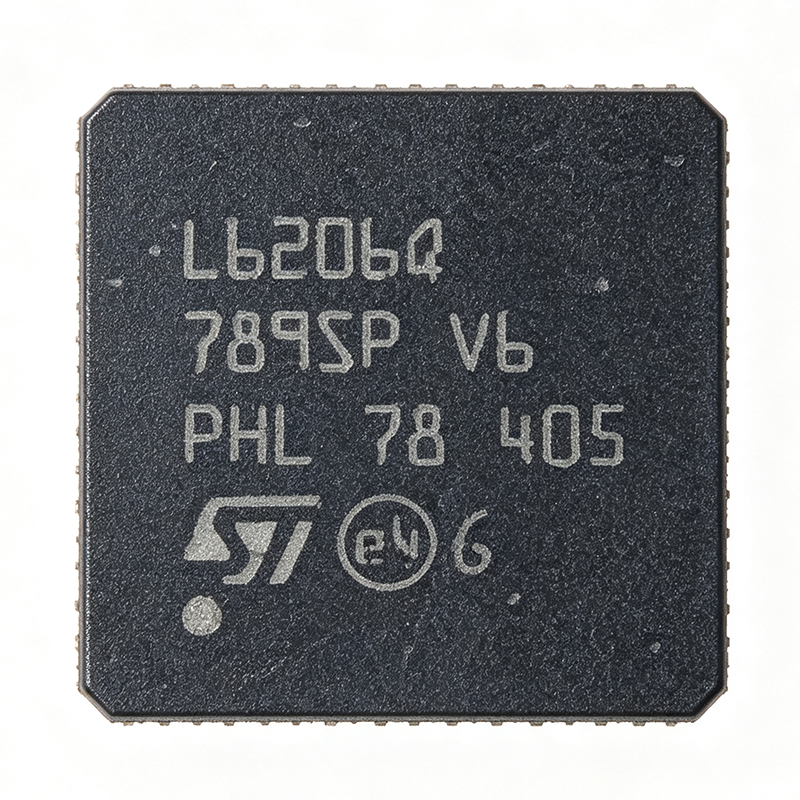
L6206Q - Dual DMOS Full-Bridge Driver 8A | STMicroelectronics
The STMicroelectronics L6206Q is a dual DMOS full-bridge motor driver capable of delivering up to 2.8A per channel (8A peak total) in a 48-pin QFN (QFN48) package. It operates from a supply voltage range of 8V to 52V, making it suitable for a wide variety of industrial and automotive motor control applications. The device integrates two independent H-bridges with a total output current of 5.6A continuous (2.8A per bridge), and includes thermal shutdown and undervoltage lockout protection. A DMOS full-bridge driver is a type of power integrated circuit that uses four N-channel DMOS transistors arranged in an H-bridge configuration to control the direction and speed of a DC motor or the phase currents of a stepper motor. It belongs to the broader category of motor drivers, which are power management ICs that translate low-power control signals into high-current, high-voltage outputs. The L6206Q sits in the hierarchy: DMOS full-bridge driver -> motor driver -> power management IC -> semiconductor. Key features include a low RDS(on) of 0.3 ohm per switch, which minimizes power dissipation and improves efficiency, and a fast switching frequency of up to 100 kHz, enabling precise PWM control. The device also features a non-dissipative overcurrent protection (OCP) that limits the output current to a safe level, and a diagnostic output that indicates fault conditions. The QFN48 package provides a compact footprint with an exposed thermal pad for enhanced heat dissipation. The L6206Q uses a mixed-signal BCD (Bipolar-CMOS-DMOS) process technology, integrating the DMOS power stage with CMOS control logic and bipolar protection circuits. This architecture allows for high current handling with low quiescent current and robust protection features. The device supports both parallel and bridge configurations, enabling flexible motor drive topologies. Typical applications include bipolar stepper motor drivers, DC motor drivers for robotics and automation, and brushless DC motor pre-drivers. The wide supply voltage range and high current capability make it ideal for industrial automation, CNC machines, and automotive actuators. In a stepper motor application, the L6206Q can drive two-phase motors with up to 2.8A per phase, providing smooth microstepping control. When designing with this device, ensure adequate PCB copper area for the thermal pad to dissipate heat, especially at high output currents. The VREF pin allows current sensing and regulation, which is essential for torque control in stepper applications. The EN pins provide independent enable control for each bridge, enabling power-saving modes. This page synthesizes distributor pricing, drop-in alternatives, and practical design notes not found in the ST datasheet, providing a comprehensive resource for engineers selecting a dual full-bridge driver.
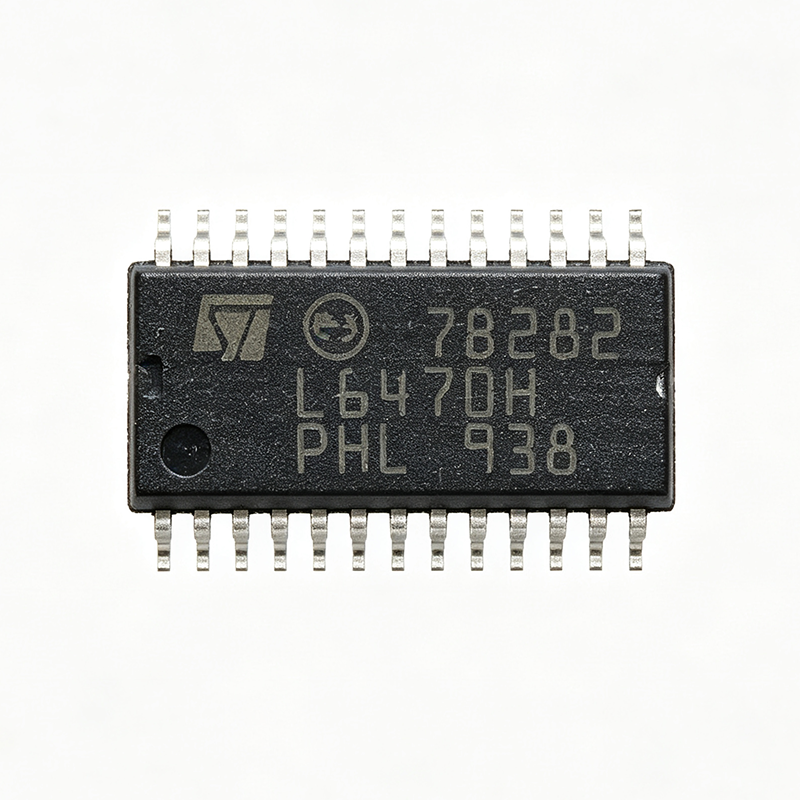
L6470H - dSPIN Stepper Motor Driver | STMicroelectronics | HTSSOP-28
The STMicroelectronics L6470H is a fully integrated microstepping motor driver with an embedded dSPIN™ motion engine, delivering up to 3 A peak output current per phase in a 28-pin HTSSOP (PowerSO-28) package. It operates from a supply voltage range of 8 V to 45 V and features programmable microstepping up to 1/128 step, making it suitable for high-resolution motion control applications. Data verified as of 2026-08-05. A stepper motor driver is a power management IC that translates digital step and direction commands into the precise current sequences needed to rotate a bipolar stepper motor. The L6470H belongs to the motor driver category, which sits within the broader power management IC hierarchy: motor driver -> power management IC -> semiconductor. Its integrated motion engine offloads complex acceleration and deceleration profiles from the host microcontroller, enabling smoother motion and reduced processor load. Key features include a programmable motor current from 0 mA to 3 A RMS, SPI interface for configuration and control, and a wide range of protection features such as overcurrent, overtemperature, and undervoltage lockout. The device also integrates a 1/128 microstepping capability, which significantly reduces motor noise and vibration compared to full-step operation. The HTSSOP-28 package with exposed pad provides excellent thermal performance, with a thermal resistance of 25 °C/W, enabling operation at high currents without external heatsinking in many applications. The L6470H uses a proprietary dSPIN™ architecture that combines a power stage, current sensing, and a motion profile generator on a single die. This integration reduces external component count and simplifies PCB layout. The SPI interface allows real-time adjustment of motor parameters, such as acceleration, deceleration, and target speed, enabling adaptive motion control in dynamic systems. The device also supports daisy-chaining of multiple drivers on a single SPI bus, simplifying multi-axis systems. Typical applications include 3D printers, CNC machines, robotics, and automated textile machinery. In a 3D printer, the L6470H's high microstepping resolution and quiet operation are critical for achieving precise layer deposition and reducing print artifacts. In robotics, the integrated motion engine allows smooth, controlled movement of joints and actuators, improving overall system performance. When designing with the L6470H, ensure adequate supply decoupling with a 100 nF ceramic capacitor close to the VSA and VSB pins, and a bulk capacitor (≥10 µF) on the supply rail. The exposed pad must be soldered to a large copper area for thermal management. The SPI lines should be kept short and shielded to avoid noise coupling into the motor current sense circuitry. This page synthesizes distributor pricing, drop-in alternatives, and practical design notes not found in the ST datasheet, providing engineers with a comprehensive resource for evaluating the L6470H in their motion control designs.

L6470HTR - dSPIN Stepper Motor Driver | STMicroelectronics
The L6470HTR is a fully integrated microstepping motor driver from STMicroelectronics, part of the dSPIN family. It combines a complete motor control system on a single chip, including a power stage with dual full-bridge drivers, a digital control core, and a serial interface. The device is designed to drive bipolar stepper motors with up to 3 A peak current per phase, operating from a supply voltage range of 8 V to 45 V. It is available in a compact HTSSOP28 package, making it suitable for space-constrained applications. A stepper motor driver is a power management IC that translates digital step and direction commands into the precise current sequences needed to rotate a stepper motor. The L6470HTR integrates the control logic, gate drivers, and power MOSFETs, eliminating the need for external components and simplifying PCB design. It belongs to the hierarchy: stepper motor driver -> motor driver -> power management IC -> semiconductor. This integration reduces system cost and board space while improving reliability. Key features of the L6470HTR include programmable microstepping up to 1/128 step, which provides smooth motion and high positioning accuracy. It offers a wide range of protection features, including overcurrent, overtemperature, and undervoltage lockout. The device also includes a SPI interface for configuration and control, allowing real-time adjustment of motor parameters. The integrated current sensing eliminates the need for external sense resistors, further reducing component count. The L6470HTR uses a proprietary control algorithm that automatically adjusts the current decay mode to optimize performance across different motor types and load conditions. This adaptive decay control minimizes audible noise and power dissipation. The device also features a programmable slew rate to reduce electromagnetic interference (EMI) in sensitive applications. The digital core operates at up to 16 MHz SPI clock, enabling fast communication with microcontrollers. Typical applications include 3D printers, CNC machines, robotics, office automation, and industrial automation. In 3D printers, the L6470HTR provides precise filament positioning with microstepping, resulting in high-quality prints. In CNC machines, it drives stepper motors for axis movement with high torque and accuracy. The device's wide voltage range and current capability make it versatile for various motor sizes. When designing with the L6470HTR, ensure proper thermal management by providing adequate copper area on the PCB for heat dissipation. The HTSSOP28 package has an exposed pad that must be soldered to a thermal relief. Additionally, place decoupling capacitors close to the power supply pins to minimize voltage transients. The SPI interface allows configuration of motor parameters, but careful attention to the register settings is required to avoid unintended behavior.
L6480H - 10A Dual Full-Bridge Stepper Motor Driver | STMicroelectronics
The STMicroelectronics L6480H is a fully integrated dual full-bridge stepper motor driver capable of delivering up to 10A peak output current per bridge, designed for high-performance motion control applications. It operates from a supply voltage range of 8V to 85V and integrates a complete digital control core with SPI interface, making it a versatile solution for industrial automation, robotics, and CNC machinery. The device is housed in a 28-pin HTSSOP (H) package with an exposed thermal pad, enabling efficient heat dissipation in compact designs. Data verified as of 2026-08-05. A stepper motor driver is a power management IC that translates digital step and direction commands into precise current-controlled pulses for driving bipolar stepper motors. It sits within the hierarchy: stepper motor driver -> motor driver -> power management IC -> semiconductor. The L6480H integrates both the power stage and the control logic, eliminating the need for external MOSFETs and simplifying PCB design. This integration reduces component count and improves reliability, making it a key building block in modern motion control systems. Key features of the L6480H include a programmable output current up to 10A peak, microstepping up to 1/128 step, and a wide supply voltage range of 8V to 85V. It also features overcurrent, overtemperature, and undervoltage protection, ensuring robust operation in harsh industrial environments. The SPI interface allows real-time configuration and monitoring, while the dedicated STEP and DIR pins enable simple interfacing with microcontrollers or motion controllers. The L6480H utilizes a proprietary advanced current control algorithm that minimizes motor noise and vibration, improving positioning accuracy. The device supports both full-step and microstepping modes, with the ability to adjust the decay mode for optimal performance across different motor types. The integrated sense resistors eliminate the need for external current sensing, further reducing BOM cost and board space. Typical applications include CNC machines, 3D printers, textile machinery, and automated assembly equipment. The L6480H's high current capability and wide voltage range make it suitable for driving large NEMA 34 and NEMA 42 stepper motors, which are common in industrial automation. Its SPI interface also enables advanced features like stall detection and position tracking, enhancing system intelligence. When designing with the L6480H, ensure adequate PCB copper area for thermal dissipation, as the device can dissipate significant power at high currents. The exposed pad must be soldered to a thermal via array connected to a ground plane. Additionally, place decoupling capacitors close to the VM and VCC pins to minimize voltage transients. This page synthesizes distributor pricing, drop-in alternatives, and practical design notes not found in the STMicroelectronics datasheet, providing engineers with a comprehensive resource for selecting and implementing the L6480H in their designs.
L9369 - Automotive H-Bridge Gate Driver | STMicroelectronics
The L9369 is a highly integrated automotive H-bridge gate driver IC from STMicroelectronics, designed for driving external N-channel MOSFETs in DC motor control and solenoid actuation applications. It operates from a supply voltage range of 5.5V to 40V and provides two half-bridge outputs capable of driving high-side and low-side MOSFETs with programmable gate drive currents. The device integrates a serial peripheral interface (SPI) for configuration and diagnostics, making it suitable for advanced automotive body control modules. An H-bridge gate driver is a power management IC that controls the gates of four external MOSFETs arranged in an H-bridge topology, enabling bidirectional current flow through a load such as a DC motor. It translates low-voltage logic signals into high-current gate drive pulses, providing the necessary voltage and current to switch the MOSFETs efficiently. In the system hierarchy, the L9369 sits between the microcontroller (MCU) and the power stage, acting as an interface that offloads high-current switching tasks from the MCU while adding protection and diagnostic features. Key features of the L9369 include a wide operating voltage range, programmable gate drive current for optimized switching performance, and comprehensive diagnostic functions via SPI. The device supports both high-side and low-side MOSFET drivers with adaptive dead-time control to prevent shoot-through currents. It also includes overcurrent, overtemperature, and undervoltage lockout protections, enhancing system reliability in harsh automotive environments. From a technical architecture perspective, the L9369 integrates charge pumps for high-side gate drive, level shifters for high-voltage domains, and a SPI-compatible interface for register-based control. The device is fabricated using STMicroelectronics' BCD (Bipolar-CMOS-DMOS) technology, which combines low-power logic with high-voltage power handling. This allows the L9369 to operate directly from automotive battery voltages while maintaining low quiescent current in standby mode. Typical applications include automotive DC motor control for window lifts, sunroofs, and seat adjustment, as well as solenoid actuation for transmission control and fuel injection systems. The L9369's robust protection features and SPI diagnostics make it ideal for safety-critical systems where fault detection and reporting are essential. When designing with the L9369, ensure proper PCB layout with adequate copper area for thermal dissipation, and place decoupling capacitors close to the supply pins. The SPI interface should be isolated from high-current traces to minimize noise coupling. Additionally, the gate drive current settings must be matched to the external MOSFETs' gate charge to achieve optimal switching performance and minimize EMI.

L9369-TR - Automotive H-Bridge Driver for Electric Parking Brake | STMicroelectronics
The L9369-TR is an automotive-grade H-bridge driver IC from STMicroelectronics, specifically designed for electric parking braking (EPB) systems. It integrates two H-bridge driver stages to drive 8 external FETs for rear wheel brake actuators, supporting both cable-puller and Motor Gear Unit (MGU) configurations. The device is housed in a 64-pin LQFP (10x10 mm) package and operates from a supply voltage range of 5.5 V to 28 V, with a peak output current of 8.5 A per H-bridge. An H-bridge driver is a power management IC that controls the direction and speed of a DC motor by selectively turning on four transistors in an H-shaped configuration. It is a type of motor driver, which falls under the broader category of power management ICs. The L9369-TR is specifically designed for automotive applications, meeting the stringent AEC-Q100 qualification standard for reliability in harsh environments. Key features of the L9369-TR include a low RDS(on) of 0.15 ohm per switch, which minimizes power dissipation and improves efficiency. It also features a built-in current sense amplifier for precise motor current monitoring, and a SPI interface for advanced diagnostics and control. The device includes comprehensive protection features such as overcurrent, overtemperature, and undervoltage lockout, ensuring robust operation in automotive systems. The L9369-TR utilizes a smart power technology that integrates the power stage with control logic and protection circuits on a single die. This integration reduces external component count and improves system reliability. The SPI interface allows for real-time monitoring of fault conditions and precise control of the motor, making it suitable for advanced driver assistance systems (ADAS) and body control modules. Typical applications include electric parking brakes, electric power steering (EPS), electronic stability control (ESC), and active suspension systems. The device is also used in HVAC blower motors, cooling fan control, and window lift modules. Its high current capability and robust protection make it ideal for driving brushed DC motors in automotive environments. When designing with the L9369-TR, it is essential to ensure proper PCB layout with adequate copper area for heat dissipation. The 64-LQFP package has a thermal resistance of 25 C/W, so a heatsink or large copper pour is recommended for continuous high-current operation. Additionally, the SPI interface should be configured correctly to enable fault reporting and diagnostic functions.
L9370 - Automotive Electric Parking Brake IC | STMicroelectronics
The L9370 from STMicroelectronics is a specialized automotive IC designed for electric parking braking (EPB) systems, supporting both cable-puller and Motor Gear Unit (MGU) configurations. It integrates two H-bridge driver stages to drive eight external FETs for rear wheel brake actuators, enabling precise and reliable parking brake control. The device is housed in a 64-pin TQFP (10x10 mm) package, suitable for surface-mount assembly in automotive electronic control units (ECUs). An electric parking brake (EPB) is an automated parking brake system that replaces the traditional mechanical handbrake with electronic controls. The L9370 is a motor driver IC that sits between the vehicle's microcontroller and the brake actuator motors, providing the high-current H-bridge switching needed to drive the motors in both directions. In the broader system hierarchy, the L9370 is a specialized motor driver within the automotive power management and actuation domain, working alongside microcontrollers, power supplies, and sensor interfaces to deliver safe and reliable parking brake operation. Key features of the L9370 include dual H-bridge driver stages capable of driving eight external FETs, enabling bidirectional motor control for brake apply and release. The device is designed for automotive environments, with support for VDA 3.0 compliance (as noted in ST community discussions), ensuring compatibility with industry-standard safety and communication protocols. The 64-pin TQFP package offers a compact footprint while providing adequate thermal performance for automotive under-hood or in-cabin mounting. Technically, the L9370 integrates gate driver circuitry for the external FETs, with the gate driver block being identical to that of the L9369, another ST automotive IC. This design reuse ensures proven performance and simplifies qualification. The device operates over an extended automotive temperature range, typically -40°C to +125°C, and is designed to meet stringent automotive reliability standards, including AEC-Q100 qualification (though this should be verified from the datasheet). Typical applications include electric parking brake systems in passenger cars and light commercial vehicles, where the L9370 drives the brake actuator motors in cable-puller or MGU configurations. It is also suitable for other automotive actuation applications requiring dual H-bridge motor control, such as electronic stability control (ESC) or adaptive cruise control (ACC) actuators. When designing with the L9370, ensure proper thermal management by providing adequate copper area on the PCB for heat dissipation, especially when driving high-current motors. Also, implement robust EMI filtering on the motor supply lines to prevent interference with other vehicle electronics. The device requires careful layout of the high-current paths to minimize parasitic inductance and ensure reliable switching.
L9390 - 12-Channel Valve Driver | STMicroelectronics | Automotive
The STMicroelectronics L9390 is a specialized 12-channel valve driver integrated circuit designed for automotive and industrial actuation systems. Housed in a 100-pin eTQFP (14x14 mm) package, this device integrates high-current low-side drivers with advanced diagnostic and protection features, making it suitable for driving solenoid valves, injectors, and other inductive loads in engine management and transmission control units. A valve driver is a power management IC that translates low-power logic signals from a microcontroller into high-current, high-voltage drive signals capable of actuating electromechanical valves. In the system hierarchy, the L9390 sits between the engine control unit (ECU) microcontroller and the physical valves, functioning as a power actuator interface. This category of components is essential in automotive electronics, where reliable, high-current switching with built-in diagnostics is critical for safety and performance. Key features of the L9390 include 12 independent output channels, each capable of driving inductive loads with integrated freewheeling protection. The device supports a wide operating voltage range suitable for 12V and 24V automotive systems, and includes overcurrent, overtemperature, and open-load detection for each channel. The 100-pin eTQFP package provides excellent thermal performance and allows for compact PCB layouts in space-constrained engine control modules. The L9390 utilizes a robust BCD (Bipolar-CMOS-DMOS) process technology, enabling high-voltage operation with low quiescent current. Each output channel features a DMOS power transistor with low on-resistance, minimizing power dissipation and heat generation. The device includes a serial peripheral interface (SPI) for configuration and diagnostic readback, allowing the ECU to monitor valve health in real time and implement predictive maintenance strategies. Typical applications include diesel and gasoline engine management systems, where the L9390 drives fuel injectors and EGR valves, and automatic transmission control units, where it actuates hydraulic solenoids for gear selection. The device is also used in industrial automation for controlling pneumatic and hydraulic valves, and in commercial vehicle systems for managing air suspension and braking actuators. When designing with the L9390, ensure adequate PCB copper area for thermal dissipation, especially when driving multiple channels at high current simultaneously. The SPI interface should be properly configured for the desired diagnostic thresholds, and external flyback diodes or the integrated freewheeling protection should be verified against the specific inductive load characteristics to prevent voltage spikes.

L9904 - Automotive 3-Phase Brushless DC Motor Driver | STMicroelectronics
The STMicroelectronics L9904 is a highly integrated 3-phase brushless DC (BLDC) motor driver designed for automotive applications. It integrates a triple half-bridge gate driver, charge pump, and protection features in a 48-pin LQFP package. The device operates from a supply voltage range of 5.5V to 40V, making it suitable for 12V and 24V automotive electrical systems. It provides up to 1A gate drive current per channel, enabling efficient driving of external N-channel MOSFETs. A brushless DC motor driver is a power management IC that controls the commutation of a BLDC motor by sequentially energizing the motor windings. It typically includes gate drivers for the power stage, current sensing, and protection features. In the system hierarchy, a BLDC motor driver sits between the microcontroller (MCU) and the power MOSFETs, translating low-voltage logic signals into high-current gate drive signals. This component is essential in automotive applications such as electric power steering, engine cooling fans, and oil pumps, where precise motor control and reliability are critical. Key features of the L9904 include a programmable gate drive current, a built-in charge pump for high-side gate drive, and comprehensive protection features such as overcurrent, overvoltage, and thermal shutdown. The device also includes a SPI interface for configuration and diagnostics, allowing the MCU to monitor and control the motor driver in real time. The LQFP-48 package provides a compact footprint while maintaining good thermal performance, with a thermal resistance of 40°C/W. The L9904 utilizes a smart power technology that integrates analog and digital circuitry on a single chip. The charge pump enables 100% duty cycle operation of the high-side MOSFETs, which is crucial for high-speed motor applications. The SPI interface supports daisy-chaining of multiple devices, simplifying PCB layout in multi-motor systems. The device is AEC-Q100 qualified, ensuring reliability in harsh automotive environments. Typical applications include electric power steering (EPS), engine cooling fans, fuel pumps, and other automotive BLDC motor control systems. The wide supply voltage range and robust protection features make it ideal for 12V and 24V automotive electrical systems. The SPI interface allows for advanced motor control algorithms, such as field-oriented control (FOC), to be implemented by the MCU. When designing with the L9904, ensure proper PCB layout to minimize parasitic inductance in the gate drive loops. Use appropriate gate resistors to control switching speed and reduce EMI. The device requires a bootstrap capacitor for the high-side gate drive, which should be placed close to the IC pins. Thermal management is critical; ensure adequate copper area on the PCB to dissipate heat from the LQFP-48 package.

L9904-TR - Motor Bridge Controller for Automotive | STMicroelectronics
The L9904-TR from STMicroelectronics is a motor bridge controller designed to drive four external N-channel power MOSFETs in an H-bridge configuration for DC motor control in automotive applications. It integrates a charge pump for high-side gate drive, an ISO 9141 bus interface for diagnostics, and a step-up converter to support operation down to 6V. The device is available in a 20-pin SO-20 package and is qualified for the automotive temperature range of -40°C to +150°C. A motor bridge controller is a specialized power management IC that generates the gate drive signals and protection features needed to control external power MOSFETs in an H-bridge topology. It sits between a microcontroller and the power stage, translating low-voltage logic commands into high-current, high-voltage gate signals. This component category is part of the broader power management IC family, which includes gate drivers, motor drivers, and full H-bridge drivers. The L9904-TR specifically targets brushed DC motors in automotive body and chassis systems. Key features of the L9904-TR include a programmable cross-conduction protection time, PWM operation up to 30 kHz, real-time diagnostic feedback, and a wide operating supply voltage range of 8V to 28V with an overvoltage tolerance up to 40V. The quiescent current in standby mode is less than 50 µA, making it suitable for always-on automotive modules. The charge pump enables efficient high-side N-channel MOSFET driving without external bootstrap components. The L9904-TR uses a dedicated control architecture that includes a charge pump, a step-up converter for low-voltage operation, and an ISO 9141 serial interface for diagnostics. This allows the device to report fault conditions such as overcurrent, overtemperature, and short-circuit events to the ECU. The programmable cross-conduction protection time prevents shoot-through current in the H-bridge, enhancing system reliability. Typical applications include automotive DC motor control for window lifts, sunroofs, seat adjusters, and cooling fans. The device is also suitable for industrial brushed DC motor control where a robust, automotive-grade controller is required. The ISO 9141 interface simplifies integration with existing vehicle diagnostic networks. When designing with the L9904-TR, ensure adequate PCB copper area for thermal dissipation, especially when driving high-current motors. The charge pump requires a flying capacitor placed close to the CP pins, and the ISO 9141 bus line should be protected with appropriate ESD and load-dump protection components.
L9904TR - Automotive 3-Phase Brushless DC Motor Driver | STMicroelectronics
The STMicroelectronics L9904TR is a highly integrated automotive-grade 3-phase brushless DC (BLDC) motor driver designed for 12V automotive systems. It integrates a 3-phase gate driver, a 5V/3.3V low-dropout regulator (LDO), a charge pump for high-side gate drive, and comprehensive protection features in a 48-pin LQFP (EP) package. The device is AEC-Q100 qualified, making it suitable for engine cooling fans, oil pumps, water pumps, and other automotive actuators. A brushless DC (BLDC) motor driver is a power management IC that controls the commutation of a BLDC motor by driving the gates of external power MOSFETs in a three-phase bridge configuration. It sits between the motor control MCU and the power stage, translating low-voltage logic signals into high-current gate drive signals. In the system hierarchy, the L9904TR is a motor driver IC within the broader category of power management ICs, specifically under motor drivers and gate drivers. It is a key component in automotive electronic control units (ECUs) that require precise, efficient, and reliable motor control. Key features of the L9904TR include a wide operating voltage range from 5.5V to 28V, a charge pump that provides gate drive voltage for high-side N-channel MOSFETs, and a built-in 5V/3.3V LDO for powering the MCU and logic circuits. The device offers SPI (Serial Peripheral Interface) for configuration and diagnostics, and includes protection features such as overcurrent, overvoltage, undervoltage, and thermal shutdown. The LDO output can deliver up to 100mA, and the gate drive current is 1A source/2A sink, enabling fast switching of external MOSFETs. The L9904TR uses a smart power technology that integrates analog, digital, and power functions on a single die. The charge pump architecture allows the use of N-channel MOSFETs for both high-side and low-side switches, reducing cost and improving efficiency compared to P-channel high-side solutions. The SPI interface enables real-time monitoring of fault conditions and flexible configuration of protection thresholds, making it a versatile solution for various motor control applications. Typical applications include engine cooling fans, electric oil pumps, water pumps, HVAC blowers, and other automotive BLDC motor actuators. The device's wide input voltage range and robust protection make it suitable for harsh automotive environments, where voltage transients and thermal stress are common. The integrated LDO simplifies the power supply design by providing a regulated rail for the MCU, reducing external component count. When designing with the L9904TR, it is essential to ensure proper PCB layout for the power stage, including adequate copper area for heat dissipation and low-inductance paths for the gate drive signals. The charge pump requires external flying capacitors, and the bootstrap capacitors for high-side gate drive must be placed close to the IC. The SPI interface should be isolated from high-current traces to avoid noise coupling. Proper decoupling of the VCC and LDO output pins is critical for stable operation.
L9906 - 3-Phase BLDC Motor Driver | STMicroelectronics | 64-TQFP
The STMicroelectronics L9906 is a high-performance 3-phase brushless DC (BLDC) motor driver IC designed for automotive and industrial applications. It integrates gate drivers for external N-channel MOSFETs, enabling precise motor control with low electromagnetic emissions. The device is housed in a 64-pin TQFP package, providing a compact solution for motor control units. A motor driver IC is a power management integrated circuit that translates low-power control signals from a microcontroller into high-current signals capable of driving motor windings. In a BLDC motor system, the driver controls the commutation sequence of the three phases, ensuring smooth rotation and efficient operation. The L9906 sits between the microcontroller and the power stage, providing the necessary gate drive, protection, and diagnostic functions. Key features of the L9906 include support for 3-phase BLDC motors, integrated gate drivers for external MOSFETs, and a wide operating voltage range suitable for 12V automotive systems. The device offers thermal shutdown protection, current sensing, and diagnostic feedback, enhancing system reliability. Its low electromagnetic emission design helps meet automotive EMC standards. The L9906 utilizes a sophisticated architecture that includes charge pumps for high-side gate drive, current sense amplifiers, and protection circuits. The device is designed to operate in harsh environments, with a junction temperature range of -40°C to +150°C. The 64-pin TQFP package offers good thermal performance and is suitable for surface-mount assembly. Typical applications include automotive engine cooling fans, electric power steering, and industrial motor control. The L9906 is also used in HVAC blowers and pumps, where reliable and efficient motor control is essential. Its robust design and comprehensive protection features make it a preferred choice for demanding applications. When designing with the L9906, ensure proper PCB layout to minimize parasitic inductance and optimize thermal dissipation. The device requires careful selection of external MOSFETs and bootstrap capacitors to achieve optimal performance. Refer to the STMicroelectronics application notes for detailed design guidelines.

L9906-TR - Automotive 3-Phase Brushless DC Motor Driver | STMicroelectronics
The L9906-TR is an automotive-grade, 3-phase brushless DC (BLDC) motor driver IC from STMicroelectronics, designed for high-reliability motor control applications. It integrates a triple half-bridge gate driver with a 5.5V to 18V supply range, capable of driving external N-channel MOSFETs for motor currents up to 10A (depending on external FETs). The device is housed in a 48-pin LQFP package (7x7 mm) with exposed pad, suitable for compact automotive electronic control units (ECUs). A brushless DC (BLDC) motor driver is a power management IC that controls the commutation of a BLDC motor by sequentially energizing its stator windings. It sits between the microcontroller (MCU) and the power stage, translating low-voltage logic signals into high-current gate drive signals for external power MOSFETs. In the system hierarchy, it belongs to: BLDC motor driver -> motor driver -> power management IC -> semiconductor. This device is essential in automotive applications where precise, efficient, and reliable motor control is required. Key features of the L9906-TR include a wide operating voltage range (5.5V to 18V), three high-side and three low-side gate driver outputs with 1A peak source/sink current, and integrated bootstrap diodes for high-side driving. It also provides a 5V/100mA voltage regulator for powering the MCU or logic circuits, a SPI interface for configuration and diagnostics, and comprehensive protection features such as overcurrent, overvoltage, undervoltage, and thermal shutdown. The device is AEC-Q100 qualified, ensuring automotive-grade reliability. Technically, the L9906-TR uses a smart power architecture with a charge pump for high-side gate drive, enabling 100% duty cycle operation. The SPI interface allows real-time monitoring of fault conditions and flexible configuration of dead-time and slew-rate settings. The device supports both sensorless and sensor-based commutation, making it versatile for various motor control algorithms. Its low quiescent current (typically 5mA) in standby mode helps reduce battery drain in automotive systems. Typical applications include electric power steering (EPS), engine cooling fans, oil pumps, water pumps, and other automotive BLDC motor control systems. The device's robust protection and diagnostic features make it ideal for safety-critical applications where motor failure could compromise vehicle operation. When designing with the L9906-TR, ensure proper PCB layout with adequate copper area for thermal dissipation, and place decoupling capacitors close to the supply pins. The SPI interface should be isolated from high-current traces to avoid noise coupling. Also, verify the bootstrap capacitor sizing for high-side gate drive at the desired PWM frequency.
L9935 - 1A Dual H-Bridge Stepper Motor Driver | STMicroelectronics
The STMicroelectronics L9935 is a two-phase stepper motor driver circuit designed to drive bipolar stepper motors, delivering up to 1A continuous output current per channel. It operates from a supply voltage range of 5V to 40V and is housed in a 20-pin PowerSO-20 package with an exposed pad for enhanced thermal performance. The device integrates two independent full-bridge drivers, a serial interface (SPI) for control, and advanced protection features including short-circuit protection, thermal shutdown, and error flag output. A stepper motor driver is an integrated circuit that translates low-power control signals from a microcontroller into the higher-current, higher-voltage signals needed to drive a stepper motor. It typically contains H-bridge topologies that allow bidirectional current flow through the motor windings, enabling precise position control in open-loop systems. Stepper motor drivers are a subset of motor drivers, which fall under power management ICs, specifically designed for motion control in automotive, industrial, and consumer applications. Key features of the L9935 include a wide supply voltage range (5V to 40V), continuous output current of 1A per channel, and integrated chopping current regulation to minimize power dissipation. The device also features controlled output voltage slopes to reduce electromagnetic radiation, short-circuit protection on all outputs, and an error flag for overload, open load, and overtemperature pre-alarm. The PowerSO-20 package offers a thermal resistance of 35°C/W, allowing operation at high ambient temperatures without external heatsinking in moderate load conditions. The L9935 utilizes a bipolar-CMOS-DMOS (BCD) process technology, integrating power MOSFETs with control logic on a single die. This architecture provides high efficiency and fast switching, with a typical rise/fall time of 100ns. The device includes a serial interface for controlling the H-bridges, reducing the number of GPIO pins required from the microcontroller. The built-in protection features ensure robust operation in harsh automotive environments, where voltage transients and thermal stress are common. Typical applications include automotive DC motor control for power windows, mirrors, and seat adjustment, as well as industrial automation for conveyor belts and robotic actuators. The wide supply voltage range and high current capability make it versatile for various motor types, including brushed DC motors and stepper motors in bipolar configurations. When designing with the L9935, ensure adequate PCB copper area for heat dissipation, especially when operating at high currents. The standby mode can be used to reduce power consumption when the motor is idle, but note that the serial interface must be re-initialized after waking from standby. Proper decoupling capacitors on the supply and logic pins are essential to maintain stable operation.
L9935-TR - Dual H-Bridge Motor Driver | STMicroelectronics
The L9935-TR is a dual H-bridge motor driver IC from STMicroelectronics, designed for driving two DC motors or one stepper motor in automotive and industrial applications. It operates from a supply voltage range of 5V to 40V and can deliver up to 1.2A continuous output current per channel. The device is available in a PowerSO-20 package, which provides excellent thermal performance for high-current applications. A motor driver is an integrated circuit that translates low-power control signals from a microcontroller into the higher voltage and current needed to drive motors. It typically contains H-bridge configurations that allow bidirectional control of DC motors or precise stepping of stepper motors. Motor drivers are essential components in the power management and actuation hierarchy, bridging the gap between digital logic and electromechanical loads. Key features of the L9935-TR include a wide operating voltage range, high output current capability, and built-in protection features such as thermal shutdown and overcurrent protection. The device also features a low quiescent current in standby mode, making it suitable for battery-powered applications. The PowerSO-20 package ensures efficient heat dissipation, allowing continuous operation at high currents without external heatsinks in many cases. The L9935-TR utilizes a bipolar technology with integrated power transistors, providing a compact and cost-effective solution for motor control. The device includes a parallel interface for controlling the H-bridges, with inputs for direction and enable signals. The internal protection circuitry ensures reliable operation under fault conditions, such as short circuits or overtemperature, enhancing system robustness. Typical applications include automotive seat adjustment, mirror control, window lift, and industrial automation systems. The wide supply voltage range and high current capability make it suitable for driving brushed DC motors in these environments. The device's ability to operate at high temperatures (up to 150°C junction) makes it ideal for under-hood automotive applications. When designing with the L9935-TR, ensure adequate PCB copper area for heat dissipation, especially when operating at high currents. The device requires external flyback diodes for inductive load protection, and proper decoupling capacitors on the supply pins are essential for stable operation. The standby mode can be used to reduce power consumption when the motor is not active.
L9942 - Integrated Stepper Motor Driver with Microstepping | STMicroelectronics
The STMicroelectronics L9942 is an integrated stepper motor driver for bipolar stepper motors, featuring microstepping and a programmable current profile look-up-table. It is designed to drive two full bridges with a maximum load of 1.3 A, with an RDSON of 500 mΩ per bridge. The device is housed in a PowerSSO-24 package, providing a compact solution for automotive and industrial stepper motor control applications. A stepper motor driver is a power management IC that translates digital step and direction commands into the precise current sequences required to rotate a bipolar stepper motor. It sits between a microcontroller and the motor windings, converting low-power logic signals into high-current, high-voltage drive signals. Stepper motor drivers are essential in applications requiring precise position control, such as automotive headlamp leveling, HVAC vent positioning, and industrial automation. The L9942 integrates the power stage, current sensing, and PWM control, reducing external component count and simplifying system design. Key features of the L9942 include two full bridges for up to 1.3 A load, programmable current waveform with a 9-entry look-up table at 5-bit resolution, and current regulation via an integrated PWM controller with internal current sensing. It supports programmable stepping modes: full, half, and mini stepping. The device operates from a supply voltage range of 4.5V to 40V, making it suitable for automotive battery systems. It also includes a serial peripheral interface (SPI) for advanced diagnostics and control, allowing the microcontroller to read fault status and configure output behavior. The L9942 utilizes a robust bipolar-CMOS-DMOS (BCD) process technology, integrating power MOSFETs with control and protection circuitry on a single die. This integration reduces external component count and improves reliability. The device includes overcurrent protection, thermal shutdown, and a diagnostic output for fault detection. The SPI interface operates at up to 5 MHz, enabling fast communication in real-time control loops. The device supports a wide operating temperature range of -40°C to +150°C, making it suitable for harsh automotive environments. Typical applications include automotive headlamp leveling, HVAC vent positioning, and industrial automation. In automotive headlamp leveling, the L9942 precisely controls the stepper motor that adjusts the headlamp beam angle, ensuring optimal visibility without dazzling oncoming traffic. Its programmable current profile allows the motor torque to be tailored to the specific load, improving efficiency and reducing mechanical stress. In HVAC vent positioning, the driver controls the stepper motor that adjusts air flow direction, providing passenger comfort. In industrial automation, it can drive stepper motors in positioning systems, such as conveyor belt diverters and robotic arms. When designing with the L9942, ensure adequate PCB copper area for heat dissipation, especially when driving high currents continuously. The PowerSSO-24 package has a thermal resistance of 35°C/W, so a heatsink or large copper pour is recommended for loads above 1A. Additionally, place a flyback diode across inductive loads to protect the output from voltage spikes during switching.
L9950 - Multifunctional Door Actuator Driver | STMicroelectronics
The L9950 is a microcontroller-driven multifunctional door actuator driver from STMicroelectronics, designed for automotive body control applications. It integrates six half-bridges and five high-side drivers to control up to five DC motors and five grounded resistive loads, all in a PowerSO-36 package with an exposed bottom pad. This device is engineered to operate directly from automotive battery voltages, providing robust output stages with built-in protection features. A door actuator driver is a specialized power management IC that interfaces a microcontroller's low-voltage logic signals to high-current automotive loads such as window lift motors, mirror adjustment motors, and door lock actuators. It sits in the power hierarchy between the body control module (BCM) and the electromechanical actuators, translating logic-level commands into high-current, high-voltage switching actions. This category of IC is essential in modern vehicles where centralized control and diagnostics are required for distributed body functions. Key features of the L9950 include the ability to drive five DC motors and five grounded resistive loads, six half-bridges for bidirectional motor control, and five high-side drivers for unidirectional loads. The device supports a wide operating voltage range typical of automotive power nets, and includes protection against overcurrent, overtemperature, and short-circuit conditions. Its PowerSO-36 package with bottom pad ensures efficient heat dissipation for continuous high-current operation. Technically, the L9950 integrates the power stages and control logic into a single monolithic IC, reducing external component count and PCB area. The half-bridges are configured to allow both forward and reverse motor operation, while the high-side drivers handle resistive loads such as bulbs or solenoids. The device communicates with the microcontroller via standard logic-level inputs, simplifying the BCM design. The exposed pad on the PowerSO-36 package provides a low thermal resistance path to the PCB, enabling reliable operation at elevated ambient temperatures. Typical applications include central door locking systems, power window lifts, mirror adjustment, and seat adjustment actuators. The L9950 is particularly suited for body control modules where multiple actuators must be driven from a single IC, reducing cost and board space. Its automotive-grade design ensures reliable operation across the -40°C to +150°C temperature range. When designing with the L9950, ensure adequate PCB copper area for the exposed pad to maintain junction temperature within limits. Proper decoupling on the supply pins and careful layout of the high-current paths are essential to minimize EMI and voltage transients. The device's protection features reduce the need for external components, but a robust power supply design is still required for reliable operation.
L9951 - Automotive Rear Door Actuator Driver | STMicroelectronics
The L9951 is a highly integrated automotive rear door actuator driver from STMicroelectronics, designed to control DC motors and resistive loads in body control modules. It features three half bridges and two high-side drivers, enabling control of up to two DC motors and two grounded resistive loads. The device operates from a supply voltage range of 4.5 V to 28 V and is housed in a PowerSO-36 package with an exposed bottom pad for enhanced thermal performance. An automotive door actuator driver is a power management IC that interfaces between a microcontroller and the door lock, mirror, or window motor. It integrates the H-bridge, protection features, and diagnostic feedback, reducing external component count and PCB area. In the system hierarchy, it sits between the body control module (BCM) microcontroller and the actuator motor, translating low-power logic signals into high-current drive signals. This category of components is essential for modern automotive body electronics, where reliability and safety are paramount. Key features include a half bridge capable of driving 7.4 A loads with an on-resistance of 150 mΩ, two half bridges for 5 A loads with 200 mΩ on-resistance, and two high-side drivers for 1.25 A loads with 800 mΩ on-resistance. The device also includes a programmable soft-start function to handle high inrush currents, such as those exceeding 5 A or 1.25 A. It provides overcurrent, overtemperature, and short-circuit protection, ensuring robust operation in harsh automotive conditions. The L9951 also features a serial peripheral interface (SPI) for advanced diagnostics and control, allowing the microcontroller to read fault status and configure the driver. The L9951 uses smart power technology that integrates the power stage with control logic and protection circuits on a single die. This architecture enables precise current control and fast fault response, improving system reliability. The SPI interface supports daisy-chaining of multiple drivers, simplifying wiring in multi-motor applications. The device is designed to meet AEC-Q100 automotive qualification standards, ensuring reliability across the -40°C to +150°C operating temperature range. Typical applications include central locking systems, mirror adjustment, and seat adjustment motors. The device's high current capability and diagnostic features make it ideal for driving DC motors in body control modules, where reliability and safety are paramount. The L9951 is also suitable for rear door actuator systems, where it can drive multiple loads with a single IC, reducing component count and system cost. When designing with the L9951, ensure adequate PCB copper area for heat dissipation, especially at high output currents. The exposed pad on the PowerSO-36 package should be soldered to a large ground plane to minimize thermal resistance. Proper decoupling capacitors on the supply pins are essential to handle inrush currents during motor start-up. Additionally, the SPI interface should be configured correctly to enable fault monitoring and diagnostic functions.
L9953SB - SPI Controlled 8-Channel Low-Side Driver | STMicroelectronics
The STMicroelectronics L9953SB is a versatile SPI-controlled 8-channel low-side driver designed for automotive and industrial actuator control. It integrates eight low-side power outputs with a 16-bit SPI interface, enabling precise control and diagnostic feedback for loads such as relays, solenoids, LEDs, and DC motors. The device operates from a supply voltage range of 4.5V to 5.5V for the logic section and 4.5V to 28V for the power stage, making it suitable for 12V and 24V automotive systems. It is housed in a PowerSO-36 package, offering excellent thermal performance for high-current applications. A low-side driver is a type of power switch that connects the load to ground when activated, allowing the microcontroller to control high-side loads indirectly. In automotive systems, low-side drivers are essential for driving inductive loads like relays and solenoids, where the driver must handle back-EMF and provide diagnostic feedback. The L9953SB belongs to the family of smart power switches, which integrate protection and diagnostic features to enhance system reliability. These devices are part of the broader power management IC category, bridging the gap between logic-level control signals and high-power loads. Key features of the L9953SB include eight low-side outputs with a maximum current rating of 1.2A per channel, a 16-bit SPI interface for control and diagnostics, and built-in protection against overcurrent, overtemperature, and short-circuit conditions. The device also provides open-load detection and a dedicated status output for fault reporting. The SPI interface operates at clock frequencies up to 5MHz, allowing fast and reliable communication with microcontrollers. The PowerSO-36 package ensures efficient heat dissipation, with a thermal resistance of 35°C/W, enabling continuous operation at high ambient temperatures. From a technical perspective, the L9953SB utilizes a robust BCD (Bipolar-CMOS-DMOS) process technology, which combines the advantages of bipolar, CMOS, and DMOS transistors. This process enables high-voltage operation, low quiescent current, and precise analog control. The device includes a 16-bit shift register for SPI communication, with daisy-chain capability for multiple devices on a single bus. The output stages are designed to handle inductive loads with integrated freewheeling diodes, reducing the need for external components. The device also features a low quiescent current of 10µA in standby mode, making it suitable for battery-powered applications. Typical applications include automotive body control modules, where the L9953SB drives relays for lights, wipers, and door locks. It is also used in industrial automation for controlling solenoids and valves, and in LED lighting systems for dimming and switching. The SPI interface allows for real-time diagnostics, enabling predictive maintenance and fault detection in critical systems. The device's wide operating temperature range of -40°C to +150°C ensures reliable operation in harsh environments. When designing with the L9953SB, it is essential to provide adequate decoupling on the power supply pins and to ensure proper thermal management by connecting the exposed pad to a large copper area on the PCB. The SPI lines should be kept short and shielded to minimize noise, and the device's diagnostic features should be utilized to monitor load conditions and detect faults early. By following these guidelines, designers can maximize the reliability and performance of their systems.
L9958 - Low RDSON SPI Controlled H-Bridge | STMicroelectronics
The L9958 is an SPI-controlled H-Bridge motor driver from STMicroelectronics, designed for the control of DC and stepper motors in safety-critical applications and under extreme environmental conditions. It is housed in a PowerSO-20 package with an exposed pad, providing excellent thermal performance for high-current motor driving. The device integrates a low RDSON output stage, enabling efficient power delivery with minimal heat dissipation. An H-Bridge is a fundamental electronic circuit that allows a voltage to be applied across a load in either direction, enabling bidirectional control of DC motors and precise stepping of stepper motors. The L9958 is a specific implementation of this topology, adding an SPI interface for digital control and diagnostics, making it suitable for automotive and industrial applications where reliable, fault-tolerant motor control is required. As a motor driver, it sits within the broader category of power management ICs, specifically within motor drivers and controllers. Key features of the L9958 include its SPI-controlled interface, which allows for flexible configuration and real-time monitoring of the motor state. The low RDSON of the output stage minimizes power losses, improving overall system efficiency. The device is designed to operate under extreme environmental conditions, making it suitable for automotive under-the-hood applications. It also includes protection features such as overcurrent and overtemperature shutdown, ensuring safe operation in fault conditions. The L9958 is built using a robust CMOS process, which provides high noise immunity and low quiescent current. The SPI interface supports daisy-chaining of multiple devices, simplifying system design in multi-motor applications. The device operates over a wide supply voltage range, accommodating various automotive and industrial power rails. The PowerSO-20 package with exposed pad ensures efficient heat transfer to the PCB, allowing the device to handle continuous currents without exceeding thermal limits. Typical applications for the L9958 include automotive DC motor control for window lifts, seat adjustment, and mirror positioning, as well as industrial automation for conveyor belts and robotic actuators. Its SPI interface and diagnostic capabilities make it ideal for safety-critical systems where monitoring and fault detection are essential. The device's ability to drive both DC and stepper motors adds versatility, reducing the need for multiple driver ICs in a design. When designing with the L9958, it is important to ensure proper PCB layout for thermal management, particularly when driving high currents. The exposed pad should be connected to a large copper area to dissipate heat effectively. Additionally, the SPI interface should be properly terminated and decoupled to ensure reliable communication in noisy environments.
L9959-TR - Single/Dual PMOS High-Side H-Bridge | STMicroelectronics
The L9959-TR from STMicroelectronics is a single and dual integrated H-bridge driver designed for resistive and inductive loads, featuring output current direction control and supervising functions. It is part of the L9959 family, which includes L9959S, L9959U, and L9959T variants, all offering high-side PMOS architecture for robust automotive and industrial motor control applications. The device is available in a PowerSO-36 package, providing a compact solution for driving brushed DC motors, solenoids, and relays. An H-bridge is a fundamental electronic circuit that enables a load to be driven in both directions by controlling the polarity of the voltage applied across it. In motor control, H-bridges are essential for bidirectional rotation, braking, and speed control. The L9959 integrates the high-side PMOS switches and low-side NMOS switches, along with protection and diagnostic features, into a single IC, simplifying PCB design and reducing component count compared to discrete implementations. This integration is critical in automotive body control modules, where space and reliability are paramount. Key features of the L9959-TR include dual H-bridge channels, each capable of driving loads up to 8.5A peak current, with a wide operating voltage range from 4.5V to 28V. The device supports both direct pin control (PWM and DIR) and SPI register control (SPWM and SDIR), offering flexibility in system design. It includes comprehensive protection features such as overcurrent, overtemperature, and short-circuit protection, along with diagnostic feedback via SPI, enabling robust fault management in safety-critical applications. The L9959-TR utilizes a PMOS high-side architecture, which eliminates the need for charge pumps and reduces quiescent current, making it suitable for battery-powered and always-on automotive systems. The device is AEC-Q100 qualified, ensuring reliability under harsh automotive conditions, and is compliant with RoHS and REACH regulations. Its PowerSO-36 package with exposed pad provides excellent thermal performance, allowing continuous operation at high currents with proper PCB layout. Typical applications include automotive body control modules, DC motor drivers for window lifts, seat adjusters, and mirror controls, as well as industrial actuators and solenoid drivers. The device's ability to handle inductive loads with built-in freewheeling diodes makes it ideal for driving relays and solenoids without external clamping components. When designing with the L9959-TR, ensure proper decoupling of the supply pins with a 100nF ceramic capacitor and a 10uF electrolytic capacitor. The SPI interface allows for advanced configuration and diagnostics, but for simple applications, the direct PWM/DIR control pins can be used. Thermal management is critical; the exposed pad must be soldered to a copper area for heat dissipation, and the maximum junction temperature of 150°C should not be exceeded.
L9960 - Dual H-Bridge Motor Driver | STMicroelectronics | Automotive
The STMicroelectronics L9960 is a dual H-bridge motor driver designed for automotive and industrial applications, capable of driving two DC motors or one stepper motor with currents up to 8 A per bridge. It operates from a supply voltage range of 4.5 V to 28 V, making it suitable for 12 V and 24 V systems. The device is housed in a 48-pin TQFP (EP) package with an exposed pad for enhanced thermal performance. A motor driver is an integrated circuit that translates low-power control signals from a microcontroller into high-current, high-voltage signals to drive motors. It typically includes H-bridge topologies for bidirectional control, protection features such as overcurrent and thermal shutdown, and diagnostic interfaces. Motor drivers are a subset of power management ICs, which manage and distribute power within electronic systems. Key features of the L9960 include a low RDS(on) of 0.15 ohm per switch, which minimizes power dissipation and improves efficiency. It integrates a 10-bit current sense ADC for precise motor current monitoring, and a SPI interface for configuration and diagnostics. The device also features PWM current regulation, overcurrent protection, and thermal shutdown, ensuring robust operation in harsh environments. The L9960 uses a smart power technology that combines high-voltage power MOSFETs with CMOS control logic on a single die. This integration reduces external component count and enhances reliability. The SPI interface allows real-time monitoring of bridge currents and fault conditions, enabling advanced motor control algorithms and predictive maintenance. Typical applications include automotive body control modules, electric power steering, HVAC actuators, and industrial automation. In automotive body control, the L9960 drives window lifters, seat adjusters, and mirror motors with precise current control. In industrial settings, it controls conveyor belts and robotic arms with high reliability. When designing with the L9960, ensure adequate PCB copper area for heat dissipation, especially at high currents. The exposed pad must be soldered to a thermal via array to maintain junction temperature within limits. Proper decoupling capacitors on the supply and logic pins are essential to minimize voltage transients.
L9960-TR - Dual H-Bridge Motor Driver | STMicroelectronics | Automotive
The L9960-TR is a dual H-bridge motor driver IC from STMicroelectronics, designed for automotive and industrial applications requiring bidirectional control of two DC motors or one stepper motor. It integrates two full H-bridges with low RDS(on) power MOSFETs, capable of delivering continuous output current up to 6 A per bridge (with proper thermal management). The device operates from a supply voltage range of 4.5 V to 28 V, making it suitable for 12 V and 24 V automotive systems. It is available in a PowerSSO-36 package, which provides excellent thermal performance for high-current applications. A motor driver is an integrated circuit that translates low-power control signals from a microcontroller into high-current, high-voltage signals to drive motors. It typically includes H-bridge configurations to allow bidirectional current flow, enabling forward and reverse motor rotation. Motor drivers are a subset of power management ICs, which manage and distribute electrical power within a system. The L9960-TR fits into this hierarchy as a power management IC specifically optimized for motor control, bridging the gap between digital logic and electromechanical actuation. Key features of the L9960-TR include a low RDS(on) of 0.3 ohm per MOSFET (typical), which minimizes power dissipation and improves efficiency. It incorporates a serial peripheral interface (SPI) for advanced diagnostics and control, allowing real-time monitoring of load current, supply voltage, and junction temperature. The device also features overcurrent, overtemperature, and undervoltage protection, ensuring robust operation in harsh environments. Its PWM frequency capability up to 20 kHz enables quiet and efficient motor speed control. The L9960-TR utilizes a smart power technology that integrates CMOS control logic with vertical MOSFET power stages on a single die. This architecture reduces external component count and enhances reliability. The SPI interface provides 16-bit read/write registers for configuration and diagnostics, enabling precise control and fault detection. The device is AEC-Q100 qualified, meeting stringent automotive quality standards, and is RoHS compliant. Typical applications include automotive power windows, seat adjustment, mirror positioning, and HVAC actuators. It is also used in industrial automation for conveyor belt control, robotic actuators, and valve positioning. The wide supply voltage range and high current capability make it versatile for various motor control scenarios. When designing with the L9960-TR, ensure adequate PCB copper area for heat dissipation, especially when driving high currents continuously. The exposed pad on the PowerSSO-36 package must be soldered to a thermal land pattern to achieve the specified thermal resistance. Additionally, place decoupling capacitors close to the supply pins to minimize voltage transients during switching.