Motors & Drivers
Products (2)
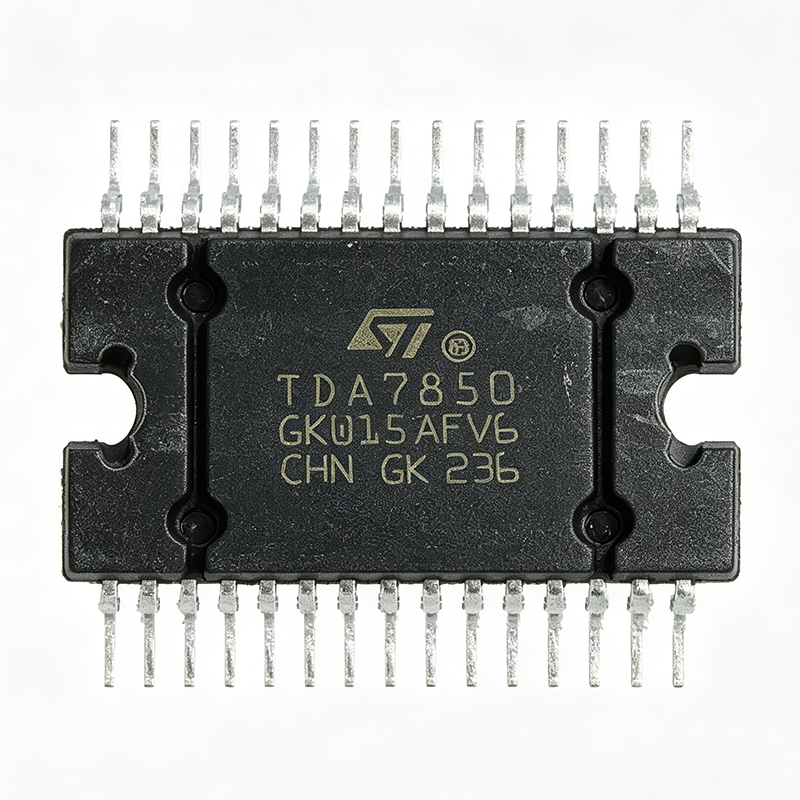
TDA7850 - 4x50W Quad Bridge Car Audio Amplifier | STMicroelectronics
The TDA7850 is a class AB quad bridge car radio amplifier from STMicroelectronics, delivering up to 4x50W into 4Ω loads with a 14.4V supply. It is housed in a Flexiwatt-25 package and designed for high-quality automotive audio systems. Data verified as of 2026-08-05. A class AB amplifier is a type of audio power amplifier that combines the efficiency of class B with the low distortion of class A, making it ideal for automotive head units where both power output and audio fidelity are critical. In the system hierarchy, the TDA7850 sits as the final power amplification stage, following the pre-amplifier and tone control stages, and drives the speakers directly. Key features include a high output power of 4x50W at 4Ω, a wide supply voltage range of 8V to 18V, and a low quiescent current of 120mA. The device also features standby and mute functions for power management, a full set of protections including short-circuit, over-temperature, and load-dump protection, and a very low output noise of 50µV. The Flexiwatt-25 package provides excellent thermal performance with a thermal resistance of 1°C/W, enabling reliable operation in confined automotive environments. The TDA7850 uses a complementary NPN/PNP output stage with a proprietary BiCMOS process, achieving a signal-to-noise ratio of 90dB and a total harmonic distortion of 0.006% at 1kHz. The high PSRR of 80dB minimizes alternator noise, ensuring clean audio output even with engine running. The device also includes a diagnostic pin for fault detection, simplifying system-level testing. Typical applications include car radio head units, aftermarket car audio amplifiers, and marine audio systems. The high output power and low distortion make it suitable for driving 4Ω or 2Ω speakers in multi-channel configurations. The standby and mute pins allow for easy integration with microcontroller-based control systems. When designing with this device, ensure adequate heatsinking to manage the thermal dissipation at high output power. The Flexiwatt-25 package requires a proper thermal interface to the chassis. Also, place the supply and output capacitors close to the IC to minimize EMI and ensure stable operation. This page synthesizes distributor pricing, drop-in alternatives, and practical design notes not found in the ST datasheet, providing a comprehensive resource for engineers selecting a quad bridge amplifier.
ZZCATCH-20260819 - Oil Catch Can | ZZPerformance | Engine Protection
The ZZCATCH-20260819 is an oil catch can manufactured by ZZPerformance, designed to intercept blow-by gases and oil vapor from the PCV (Positive Crankcase Ventilation) system before they enter the intake manifold. This device helps reduce carbon buildup on intake valves, improving engine performance and longevity. It is a mechanical component, not an electronic semiconductor, and is typically installed in the PCV line between the crankcase and the intake manifold. An oil catch can is a simple yet effective device used in internal combustion engines to separate oil mist and vapors from the crankcase ventilation gases. It works by allowing the blow-by gases to pass through a baffle or filter medium, where the oil droplets condense and collect in a reservoir, while the cleaned gases continue to the intake. This prevents oil from coating the intake valves, which is especially important in direct-injection engines where fuel is not sprayed on the valves to clean them. Key features of the ZZCATCH-20260819 include a durable aluminum or steel construction, a large capacity reservoir, and a simple installation process that requires no special tools. The device is designed to be maintenance-friendly, with a drain valve or removable bottom for easy emptying of collected oil. It is compatible with a wide range of vehicles, particularly those with turbocharged or supercharged engines that produce higher crankcase pressures. Technically, the catch can operates passively, relying on the pressure differential between the crankcase and the intake manifold to drive the blow-by gases through the device. The internal baffle design maximizes oil separation efficiency while minimizing flow restriction, ensuring that the PCV system continues to function correctly. The device does not require any electrical connections or electronic control, making it a purely mechanical addition to the engine. Typical applications include high-performance street cars, track vehicles, and daily drivers with modified engines. It is particularly beneficial for direct-injection engines, where carbon buildup on intake valves is a known issue. The ZZCATCH-20260819 is also suitable for use in both gasoline and diesel engines, provided the PCV system is compatible. When installing this catch can, it is important to ensure proper routing of the PCV hoses and to check the device periodically for accumulated oil. The reservoir should be emptied regularly to prevent overflow, which could lead to oil being drawn into the intake. The device is designed to be a low-maintenance addition to the engine, but regular inspection is recommended.