Power MOSFET Drivers
Products (63)
ADUM4221ARWZ - Isolated Half-Bridge Gate Driver | Analog Devices
The ADUM4221ARWZ is an isolated half-bridge gate driver from Analog Devices, designed to drive high-side and low-side N-channel MOSFETs and IGBTs in power conversion applications. It provides 4 A peak output current with a wide supply voltage range of 2.5 V to 6.5 V on the input side and 4.5 V to 35 V on the output side. The device features adjustable dead time, a disable pin, and a propagation delay of 60 ns, making it suitable for high-frequency switching power supplies, motor drives, and inverters. An isolated gate driver is a specialized IC that provides galvanic isolation between the control circuitry and the power stage, allowing safe and reliable switching of high-voltage power devices. It integrates isolation technology, typically using magnetic or capacitive coupling, to transmit control signals across an isolation barrier while preventing harmful voltage transients from reaching the low-voltage control side. This is essential in applications where the power stage operates at high voltages, such as in industrial motor drives, solar inverters, and electric vehicle chargers. Key features of the ADUM4221ARWZ include a 5 kVrms isolation rating, 100 kV/us common-mode transient immunity (CMTI), and adjustable dead time to prevent shoot-through current. The device also offers a disable pin for output shutdown and a UVLO (undervoltage lockout) function to ensure safe operation during power-up. The 16-lead SOIC package (SOIC-16) provides a compact solution for space-constrained designs. Technically, the ADUM4221ARWZ uses Analog Devices' iCoupler technology, which combines high-speed CMOS and monolithic transformer isolation. This architecture provides reliable signal transfer with low propagation delay and high noise immunity. The device supports both high-side and low-side drive with independent inputs, allowing flexible control of half-bridge topologies. The adjustable dead time, set via an external resistor, enables optimization of switching losses and prevents cross-conduction. Typical applications include isolated switch-mode power supplies (SMPS), motor drives, uninterruptible power supplies (UPS), and photovoltaic inverters. The device's high CMTI and fast propagation delay make it ideal for high-frequency switching circuits where signal integrity is critical. When designing with the ADUM4221ARWZ, ensure proper PCB layout to minimize parasitic inductance and maintain isolation spacing. The input supply should be decoupled with a 0.1 uF capacitor close to the VDD1 pin, and the output supplies should be decoupled with 10 uF electrolytic and 0.1 uF ceramic capacitors. The dead-time resistor should be placed near the DEADTIME pin to minimize noise pickup.
ADUM4221ARWZ-RL7 - Isolated Half-Bridge Gate Driver | Analog Devices
The ADUM4221ARWZ-RL7 is an isolated, half-bridge gate driver from Analog Devices, featuring 4 A peak output current and adjustable dead time. It employs iCoupler technology to provide independent and isolated high-side and low-side outputs, making it ideal for driving power MOSFETs and IGBTs in various power conversion applications. The device is available in a 16-lead SOIC package and operates over a wide supply voltage range. An isolated gate driver is a specialized integrated circuit that provides the necessary voltage and current to switch power transistors while maintaining galvanic isolation between the control side and the power stage. This isolation is critical for safety and noise immunity in applications such as motor drives, switch-mode power supplies, and inverters. The ADUM4221 integrates isolation and drive functions into a single package, eliminating the need for external isolation components like pulse transformers. Key features of the ADUM4221 include 4 A peak output current, adjustable dead time, and a wide supply voltage range. The device supports both high-side and low-side outputs with independent control, enabling flexible half-bridge configurations. Its propagation delay is typically 60 ns, and it offers a common-mode transient immunity of 100 kV/us, ensuring reliable operation in noisy environments. Technically, the ADUM4221 uses Analog Devices' iCoupler technology, which combines high-speed CMOS and monolithic transformer isolation. This architecture provides superior performance compared to traditional optocoupler-based solutions, including lower power consumption, higher data rates, and better timing accuracy. The device also features under-voltage lockout (UVLO) on both the input and output sides, protecting against insufficient supply voltages. Typical applications include isolated switch-mode power supplies, motor drives, solar inverters, and industrial automation. The ADUM4221 is particularly suited for half-bridge and full-bridge topologies where high-side and low-side drivers are required. Its adjustable dead time allows designers to optimize switching performance and prevent shoot-through currents. When designing with the ADUM4221, it is important to ensure proper PCB layout to minimize parasitic inductance and maintain signal integrity. The device's high common-mode transient immunity requires careful attention to grounding and isolation barriers. Additionally, the dead time should be set appropriately based on the switching characteristics of the power transistors to avoid cross-conduction.
ADUM4221BRWZ - Isolated Half-Bridge Gate Driver | Analog Devices
The ADUM4221BRWZ is an isolated, half-bridge gate driver from Analog Devices, designed to drive high-side and low-side N-channel MOSFETs or IGBTs in power conversion applications. It provides 4 A peak output current and features adjustable dead time, dual inputs, and a wide input supply range of 2.5 V to 6.5 V. The device is housed in a 16-lead SOIC package with a 5 kVrms isolation rating, making it suitable for industrial motor drives, solar inverters, and isolated DC-DC converters. An isolated gate driver is a specialized IC that transfers switching signals across an isolation barrier while providing the high current needed to charge and discharge the gate capacitance of power transistors. It combines galvanic isolation (often via magnetic coupling) with level-shifting and drive circuitry, enabling safe and efficient control of high-voltage power stages from low-voltage control logic. In the hierarchy of power management, it sits between the controller (MCU/DSP) and the power switches, ensuring signal integrity and protecting low-voltage circuitry from high-voltage transients. Key features of the ADUM4221BRWZ include 4 A peak output current, adjustable dead time via an external resistor, and a propagation delay of 60 ns (typical). The device supports a wide output supply range (VDDA/VDDB) from 4.5 V to 18 V, with UVLO thresholds of 7.5 V (typical) for both channels. It also features a disable pin for output shutdown and a CMOS input interface compatible with 2.5 V to 6.5 V logic. The isolation barrier is rated at 5 kVrms for 1 minute, with a working voltage of 560 Vrms, and the device is certified to UL 1577 and IEC 60747-5-5 (VDE 0884-10) standards. Technically, the ADUM4221 uses iCoupler technology, which employs chip-scale transformers to transmit signals across the isolation barrier. This provides reliable operation with high common-mode transient immunity (CMTI) of 100 kV/us, ensuring stable performance in noisy power environments. The adjustable dead time feature allows designers to optimize switching behavior to prevent shoot-through in half-bridge topologies, improving efficiency and reliability. Typical applications include isolated switch-mode power supplies, motor drives, solar inverters, and industrial automation. The device's high output current and fast switching speed make it ideal for driving large MOSFETs and IGBTs in high-power systems. Its wide input supply range and low propagation delay also suit high-frequency switching converters. When designing with the ADUM4221BRWZ, ensure proper PCB layout to minimize parasitic inductance in the gate drive loop, and place the dead-time resistor close to the DT pin. Also, provide adequate decoupling on the output supplies to handle peak currents.
ADUM4221BRWZ-RL7 - Isolated Half-Bridge Gate Driver | Analog Devices
The ADUM4221BRWZ-RL7 is an isolated, half-bridge gate driver from Analog Devices, featuring 4 A peak output current and adjustable dead time. It is based on the iCoupler technology, which combines high-speed CMOS and monolithic transformer isolation to provide robust galvanic isolation up to 3000 Vrms. The device operates from a wide supply voltage range of 2.5 V to 35 V on the high-side and low-side, making it suitable for a variety of power conversion applications. An isolated gate driver is a specialized integrated circuit that provides the necessary voltage and current to drive the gate of power transistors (MOSFETs or IGBTs) while maintaining galvanic isolation between the control side and the power side. This isolation is critical in applications where the power stage operates at high voltages or in noisy environments, as it protects the low-voltage control circuitry and prevents ground loops. The ADUM4221 belongs to the family of isolated gate drivers, which are essential components in switch-mode power supplies, motor drives, and inverters. Key features of the ADUM4221BRWZ-RL7 include a maximum propagation delay of 44 ns, high common-mode transient immunity of 150 kV/µs, and adjustable dead time to prevent shoot-through in half-bridge configurations. The device supports both dual-input and single-input modes (ADUM4221-1 variant) and offers a default low output state for safety. The output rise and fall times are 25 ns, enabling high-frequency switching operation. The ADUM4221 utilizes a proprietary iCoupler transformer-based isolation architecture, which provides superior performance compared to optocouplers or pulse transformers. The isolation barrier is rated for 3000 Vrms, and the device can operate at junction temperatures up to 125°C, making it suitable for demanding industrial environments. The high common-mode transient immunity ensures reliable operation in the presence of fast voltage transients, which is critical in motor drive and inverter applications. Typical applications include isolated switch-mode power supplies, motor drives, solar inverters, and industrial automation. The adjustable dead time feature allows designers to optimize switching efficiency and prevent cross-conduction. The device is available in a 16-lead SOIC package (BRWZ), which is compact and suitable for space-constrained designs. When designing with the ADUM4221, it is important to ensure proper PCB layout to minimize parasitic inductance and maintain signal integrity. The input and output supplies should be decoupled with low-ESR capacitors placed close to the pins. Additionally, the dead time should be set appropriately based on the switching characteristics of the power transistors to avoid shoot-through.
L9177ATR - Automotive Quad High-Side Driver | STMicroelectronics
The L9177ATR is an automotive-grade quad high-side driver from STMicroelectronics, designed to control resistive, inductive, and capacitive loads in 12V automotive systems. It integrates four independent high-side power switches with built-in protection features, making it suitable for driving relays, solenoids, lamps, and LEDs in body control modules, lighting systems, and motor control applications. The device operates from a supply voltage range of 5.5V to 18V, with a typical output current capability of 0.5A per channel, and is available in a PowerSO-20 package with exposed pad for enhanced thermal performance. A high-side driver is a type of power switch that connects the load to the positive supply rail, providing a simple and safe interface between a microcontroller and high-current loads. In automotive electronics, high-side drivers are essential for controlling actuators and lamps while offering diagnostic feedback and protection against short circuits, overcurrent, and overtemperature. The L9177ATR belongs to the family of smart power switches, which integrate power MOSFETs with control logic and protection circuitry on a single chip, reducing component count and improving system reliability. Key features of the L9177ATR include four independent high-side outputs with built-in overcurrent protection, short-circuit protection, and thermal shutdown. Each channel provides a typical on-resistance of 0.5 ohm, ensuring efficient power delivery with minimal voltage drop. The device also includes a serial peripheral interface (SPI) for advanced diagnostics and control, allowing the microcontroller to read fault status and control each channel individually. The operating temperature range of -40°C to +150°C makes it suitable for harsh automotive environments. The L9177ATR utilizes a robust BCD (Bipolar-CMOS-DMOS) process technology, which combines high-voltage capability with low power consumption and fast switching. The integrated protection features ensure safe operation under fault conditions, while the SPI interface enables real-time monitoring and control. The device is AEC-Q100 qualified, meeting the stringent quality and reliability standards required for automotive applications. Typical applications include automotive body control modules, interior and exterior lighting control, relay and solenoid drivers, and motor control in power windows and seats. The L9177ATR is also used in industrial automation and smart home systems where high-side switching with diagnostics is required. Its wide supply voltage range and robust protection make it a versatile choice for various load-driving applications. When designing with the L9177ATR, ensure proper PCB layout with adequate copper area for thermal dissipation, especially when driving multiple channels at high current. The exposed pad should be soldered to a thermal via array to improve heat transfer. Additionally, place a 100nF decoupling capacitor close to the VCC pin and a 10uF bulk capacitor on the supply rail to handle inrush currents.
L9300TU80T-TR - 80V Automotive Ignition IGBT Driver | STMicroelectronics
The STMicroelectronics L9300TU80T-TR is a high-voltage, automotive-grade ignition IGBT driver designed for direct injection and coil-on-plug ignition systems. It integrates a robust gate driver with an 80V rated output stage, capable of driving high-current IGBTs in harsh automotive environments. The device is housed in a compact surface-mount package, enabling dense engine control unit (ECU) layouts. An ignition IGBT driver is a specialized power management IC that provides the high-current, high-voltage gate drive required to switch ignition coils in internal combustion engines. It sits between the engine control unit's logic signals and the power IGBT, translating low-voltage control signals into the high-current pulses needed to charge and fire the ignition coil. This component is part of the broader power management IC hierarchy, specifically within the automotive power driver category, and is essential for reliable spark generation in modern vehicles. Key features include an 80V operating voltage, integrated protection features such as overcurrent and overtemperature shutdown, and a high-current gate drive capability. The device is AEC-Q100 qualified, ensuring reliability under extreme temperature and vibration conditions. Its low quiescent current and fast switching speeds contribute to efficient and precise ignition timing, reducing emissions and improving fuel economy. Technically, the L9300TU80T-TR employs a smart power architecture that combines logic, protection, and high-voltage output stages on a single die. This integration minimizes external component count and enhances system reliability. The driver supports both current and voltage sensing, enabling closed-loop control for optimal ignition energy delivery. Its robust ESD protection and short-circuit handling make it suitable for demanding automotive applications. Typical applications include direct injection engines, coil-on-plug ignition systems, and other high-voltage automotive actuators. The device's ability to drive large capacitive loads with minimal propagation delay ensures consistent spark timing across all engine operating conditions. Its wide operating temperature range (-40°C to +150°C) allows placement near the engine block without additional cooling. When designing with this driver, ensure adequate PCB copper area for heat dissipation, as high switching currents generate significant thermal energy. Proper gate resistor selection is critical to control switching speed and minimize EMI. The device's integrated protection features reduce the need for external clamping circuits, simplifying the overall design.

L9380 - Triple High-Side MOSFET Driver | STMicroelectronics | Automotive
The L9380 is a triple high-side MOSFET driver IC from STMicroelectronics, designed to control three external N-channel power MOSFETs in a high-side switch configuration. It is specifically intended for relay replacement in automotive electric control units (ECUs), offering robust protection features such as overvoltage charge pump shut-off for VS > 25V, reverse battery protection, programmable overload protection for channels 1 and 2, and open ground protection for channels 1 and 2. The device is available in a 20-pin SO package (SO-20) and operates over a wide temperature range, making it suitable for harsh automotive environments. A high-side MOSFET driver is a type of gate driver IC that controls the gate voltage of N-channel MOSFETs connected between the positive supply rail and the load. It is a critical component in power management systems, enabling efficient switching of high-current loads while providing protection against overcurrent, overvoltage, and reverse battery conditions. In the hierarchy of power management, a high-side driver falls under gate drivers, which are part of the broader category of power management ICs, ultimately contributing to the overall semiconductor ecosystem. Key features of the L9380 include its ability to drive three external N-channel MOSFETs, an overvoltage charge pump shut-off that protects the circuit when the supply voltage exceeds 25V, and reverse battery protection that prevents damage when the battery is connected with reversed polarity. The device also offers programmable overload protection for channels 1 and 2, allowing designers to set current limits according to their application requirements. Additionally, the open ground protection function ensures safe operation even when the ground connection is lost, which is crucial for automotive reliability. From a technical perspective, the L9380 integrates a charge pump to generate the necessary gate drive voltage for high-side N-channel MOSFETs, which typically require a gate voltage higher than the supply rail. The device is designed to operate with a supply voltage range that accommodates automotive battery voltages, including cranking and load-dump conditions. The SO-20 package provides a compact footprint while allowing adequate thermal dissipation for the driver's power dissipation. The driver's output stages are capable of sourcing and sinking sufficient current to switch the MOSFETs quickly, minimizing switching losses. Typical applications for the L9380 include automotive body control modules, lighting control, motor control, and other high-current loads that traditionally used electromechanical relays. By replacing relays with MOSFETs and the L9380 driver, designers can achieve faster switching, longer lifespan, and reduced electromagnetic interference (EMI). The device is also suitable for industrial applications where high-side switching with protection is required. When designing with the L9380, it is essential to ensure proper PCB layout to minimize parasitic inductance and provide adequate thermal management for the external MOSFETs. The charge pump requires external capacitors for proper operation, and the overload protection programming resistors must be selected carefully to match the desired current thresholds. Additionally, the reverse battery protection feature relies on the application circuit, so the external components must be chosen to ensure this protection is effective.
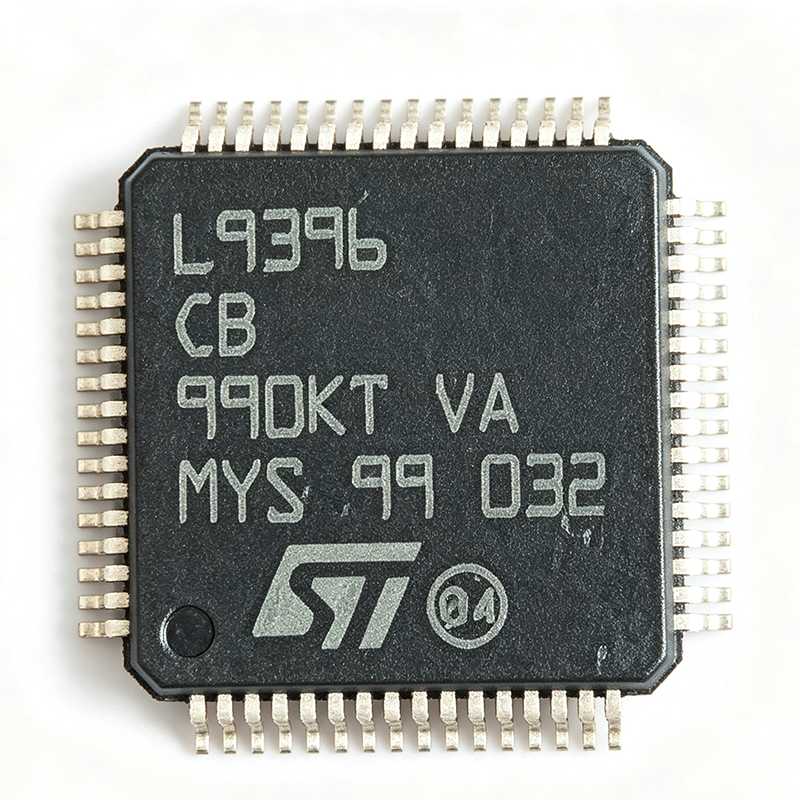
L9396B - High-Side Driver IC | STMicroelectronics | Automotive
The L9396B is a high-side driver IC manufactured by STMicroelectronics, designed for automotive and industrial applications requiring robust power switching. It integrates a high-side power MOSFET with protection features such as overcurrent, overtemperature, and short-circuit protection, making it suitable for driving resistive, inductive, and capacitive loads. The device operates over a wide input voltage range and is available in a PowerSO-20 package, offering excellent thermal performance for high-current applications. A high-side driver is a type of power switch that connects the load to the positive supply rail, providing a simple and safe way to control power to a load. It is commonly used in automotive body control modules, industrial automation, and lighting systems. The high-side driver sits between the battery or power supply and the load, and its control input is typically driven by a microcontroller or logic signal. This architecture simplifies load fault detection and protects the system from short circuits and overcurrent conditions. Key features of the L9396B include a low on-resistance (RDS(on)) of [DATA_NEEDED: RDS(on)] to minimize power dissipation, a wide operating voltage range of [DATA_NEEDED: operating voltage range], and built-in protection against overcurrent, overtemperature, and load dump. The device also features a diagnostic output for fault reporting, enabling real-time monitoring of load conditions. Its high current capability of [DATA_NEEDED: output current] makes it suitable for driving motors, solenoids, and lamps. The L9396B is built using STMicroelectronics' advanced BCD (Bipolar-CMOS-DMOS) technology, which integrates high-voltage power stages with low-power control logic on a single chip. This technology ensures high reliability and efficiency, with a typical quiescent current of [DATA_NEEDED: quiescent current]. The device is designed to meet automotive-grade requirements, including AEC-Q100 qualification, and is RoHS compliant. Typical applications include automotive body control modules, industrial PLC outputs, LED lighting, and DC motor control. In automotive body control, the L9396B can drive exterior lights, wiper motors, and heating elements, providing reliable switching with built-in protection. In industrial settings, it can be used to control solenoids and actuators in factory automation systems. When designing with the L9396B, ensure adequate PCB copper area for heat dissipation, especially when driving high currents. The PowerSO-20 package has a thermal resistance of [DATA_NEEDED: thermal resistance], so a proper thermal design is critical. Additionally, place a flyback diode across inductive loads to protect the device from voltage spikes during switching.
L9396L - Automotive Quad Low-Side Driver | STMicroelectronics
The L9396L is a quad low-side driver IC from STMicroelectronics, designed for automotive and industrial applications requiring robust, high-current switching of inductive or resistive loads. It integrates four independent low-side power outputs with built-in protection features, making it suitable for driving relays, solenoids, LEDs, and small motors. The device operates over a wide supply voltage range and is housed in a compact surface-mount package, enabling space-efficient PCB designs. A low-side driver is a type of power switch that connects the load to ground when activated, with the load connected between the positive supply and the driver output. This configuration is common in automotive body control modules, where multiple loads such as lamps, valves, and actuators must be switched reliably. Low-side drivers are preferred for their simplicity and ease of driving with standard logic-level signals, and they form a key building block in power management and load control systems. Key features of the L9396L include four high-current outputs, each capable of sourcing significant current to drive a variety of loads. The device incorporates overcurrent protection, thermal shutdown, and overvoltage clamping to safeguard both the IC and the connected loads. Its logic inputs are compatible with 3.3V and 5V microcontrollers, simplifying integration with modern automotive ECUs. The wide operating temperature range of -40°C to +150°C ensures reliable performance in harsh under-hood environments. Technically, the L9396L uses a robust bipolar/CMOS/DMOS (BCD) process technology, which combines low on-resistance power transistors with precise analog control circuitry. This architecture minimizes power dissipation and ensures fast switching times, reducing electromagnetic interference (EMI) in automotive networks. The device also features a serial peripheral interface (SPI) for advanced diagnostics and control, allowing the microcontroller to read fault status and configure output behavior, which is critical for safety-critical applications. Typical applications include automotive body control modules, where the L9396L drives exterior and interior lighting, relays for power windows and door locks, and solenoid valves in transmission or braking systems. It is also used in industrial automation for controlling actuators and in smart power distribution units. The device's ability to handle inductive loads with built-in freewheeling protection makes it ideal for relay and solenoid driving without external clamping diodes. When designing with the L9396L, ensure adequate PCB copper area for heat dissipation, especially when driving multiple outputs at high current simultaneously. The SPI interface requires proper pull-up resistors and careful layout to maintain signal integrity. Additionally, the supply voltage must be decoupled with a suitable capacitor close to the VCC pin to handle transient currents during switching.
L9698 - Automotive Quad Low-Side Driver | STMicroelectronics
The L9698 is a quad low-side driver from STMicroelectronics, designed for automotive and industrial applications requiring robust, high-current switching. It integrates four independent low-side outputs, each capable of driving loads up to 1.5A, with built-in protection features such as overcurrent, overtemperature, and short-circuit protection. The device operates from a supply voltage range of 4.5V to 40V, making it suitable for 12V and 24V automotive systems. It is available in a PowerSO-20 package, which provides excellent thermal performance for high-power applications. A low-side driver is a type of power switch that connects the load to ground when activated, commonly used to drive relays, solenoids, lamps, and resistive loads. In automotive systems, low-side drivers are essential for controlling actuators and indicators, where the load is connected between the battery positive and the driver output. The L9698 belongs to the family of smart power switches, which integrate protection and diagnostic functions to enhance system reliability and reduce external component count. Key features of the L9698 include four independent channels with a maximum output current of 1.5A per channel, a low ON-state resistance of 0.5 ohm, and a standby current of only 10 uA. The device also features a serial peripheral interface (SPI) for advanced diagnostics and control, allowing the microcontroller to read fault status and control each output independently. The SPI interface operates at up to 5 MHz, enabling fast communication in real-time control systems. From a technical perspective, the L9698 utilizes a smart power technology that integrates CMOS control logic with high-voltage power MOSFETs on a single chip. This architecture ensures efficient switching with minimal power loss, while the built-in protection circuits prevent damage from overload conditions. The device also includes a thermal shutdown feature that disables the outputs if the junction temperature exceeds 150°C, protecting the IC and the load from thermal stress. Typical applications for the L9698 include automotive body control modules, where it drives exterior lights, interior lighting, and small motors. It is also used in industrial automation for controlling solenoids and relays, and in smart power distribution systems. The wide supply voltage range and robust protection make it ideal for harsh environments. When designing with the L9698, it is important to consider the thermal dissipation, especially when driving multiple channels at high current. The PowerSO-20 package has a thermal resistance of 35°C/W, and adequate PCB copper area should be provided for heat sinking. Additionally, the SPI interface requires proper pull-up resistors on the data lines to ensure reliable communication.
L9698-TR - Automotive Ignition IGBT Driver | STMicroelectronics
The L9698-TR is a monolithic high-voltage ignition IGBT driver manufactured by STMicroelectronics, designed for automotive engine control units (ECUs). It integrates a Darlington power stage with a high-voltage clamp, providing a robust interface between the microcontroller and the ignition coil. The device is housed in a PowerSO-10 package, offering excellent thermal performance for under-hood applications. An ignition IGBT driver is a specialized power management IC that controls the current through an ignition coil to generate the high-voltage spark required for combustion in gasoline engines. It sits between the engine control unit (ECU) and the ignition coil, converting low-power logic signals into high-current pulses. In the system hierarchy, it belongs to the category of power management ICs, specifically within automotive power drivers and ignition control modules. Key features of the L9698-TR include a collector-emitter voltage rating of 400V, a collector current capability of 10A, and a low saturation voltage of 1.5V at 5A, ensuring efficient power transfer. The device integrates a Darlington configuration with a built-in collector-emitter clamp diode, protecting against inductive load transients. It also features an internal current sense output for diagnostic purposes, enabling real-time monitoring of ignition coil current. The L9698-TR utilizes a bipolar Darlington architecture, which provides high current gain and simplifies the drive circuitry. The integrated clamp diode absorbs the energy stored in the ignition coil during the off-state, preventing voltage spikes that could damage the driver. The device operates over a junction temperature range of -40°C to +150°C, making it suitable for harsh automotive environments. Its PowerSO-10 package with exposed pad ensures efficient heat dissipation, critical for high-current operation. Typical applications include direct ignition systems, distributorless ignition systems (DIS), and coil-on-plug (COP) configurations. The L9698-TR is also used in motorcycle and small engine ignition systems, as well as industrial ignition for gas turbines. Its high-voltage capability and robust protection make it ideal for demanding ignition applications. When designing with the L9698-TR, ensure adequate PCB copper area for thermal management, as the device can dissipate significant power during ignition pulses. The input control signal should be properly conditioned to avoid false triggering, and the current sense output should be filtered to prevent noise interference. Proper layout of the high-current path is essential to minimize parasitic inductance.
L9779WD-SPI-TR - Automotive SPI Driver IC | STMicroelectronics
The L9779WD-SPI-TR is an automotive-grade SPI-controlled driver IC from STMicroelectronics, designed for driving resistive, inductive, and capacitive loads in vehicle body control modules. It integrates multiple high-side and low-side drivers with diagnostic feedback via a standard SPI interface, enabling precise control and fault detection in 12V automotive systems. The device operates over a wide supply voltage range and is housed in a compact surface-mount package suitable for space-constrained ECU designs. What is an automotive SPI driver IC? An automotive SPI driver IC is a power management and actuation device that combines serial peripheral interface (SPI) communication with power output stages to control loads such as relays, LEDs, solenoids, and motors in vehicles. It sits between the microcontroller (MCU) and the load, translating low-voltage logic commands into high-current switching actions while providing diagnostic data on load status, open/short circuits, and thermal conditions. In the system hierarchy, it belongs to the class of smart power devices, which integrate protection, diagnostics, and control into a single package, reducing component count and improving reliability in harsh automotive environments. Key features of the L9779WD-SPI-TR include multiple output channels with configurable current limits, over-temperature and over-current protection, and a robust SPI interface for daisy-chaining multiple devices. The device supports a wide operating temperature range of -40°C to +150°C, making it suitable for under-hood and body control applications. Its low quiescent current in standby mode helps minimize battery drain in vehicles, and the integrated diagnostic features enable real-time fault monitoring without external components. Technically, the L9779WD-SPI-TR uses a smart power technology that combines CMOS logic with high-voltage power MOSFETs, allowing efficient switching of inductive loads with built-in freewheeling protection. The SPI interface operates at clock frequencies up to 5 MHz, supporting fast command updates and readback of diagnostic registers. The device also features a fail-safe mode that deactivates outputs in case of communication loss, enhancing system safety. Typical applications include automotive body control modules (BCM), lighting control (LED and incandescent), relay drivers for power windows and door locks, and solenoid drivers for transmission and braking systems. Its ability to handle both high-side and low-side configurations makes it versatile for various load types. When designing with this device, ensure proper PCB layout with adequate copper area for heat dissipation, and place decoupling capacitors close to the supply pins. The SPI lines should be routed with controlled impedance and kept away from high-current switching paths to minimize noise coupling.

L9779WDM-TR - Automotive Quad Low-Side Driver | STMicroelectronics
The STMicroelectronics L9779WDM-TR is a quad low-side driver designed for automotive and industrial applications, featuring four independent open-drain outputs capable of driving resistive, inductive, and capacitive loads. It operates from a supply voltage range of 4.5V to 40V, with a maximum output current of 1A per channel. The device is housed in a 20-pin SOIC (SO-20) package, providing a compact solution for high-side and low-side switching in harsh environments. A low-side driver is a type of power switch that connects the load to ground when activated, commonly used in automotive body control modules, relay drivers, and solenoid actuators. It is a fundamental building block in power management and load control systems, sitting between the microcontroller and the load, translating low-voltage logic signals into high-current switching actions. The L9779WDM-TR integrates protection features such as overcurrent, overtemperature, and short-circuit protection, ensuring robust operation in demanding conditions. Key features include a wide operating voltage range, low quiescent current, and built-in diagnostics via a serial peripheral interface (SPI) for fault reporting. The device supports PWM control up to 20 kHz, making it suitable for dimming and motor speed control. Its thermal shutdown and current limiting capabilities protect the IC and the load from damage, while the SPI interface allows for real-time monitoring and configuration. The L9779WDM-TR utilizes a robust BCD (Bipolar-CMOS-DMOS) process technology, enabling high-voltage operation with low on-resistance. The output stages are designed to handle inductive loads with built-in freewheeling diodes, reducing the need for external clamping components. The device also features a standby mode with very low current consumption, ideal for battery-powered automotive systems. Typical applications include automotive body control modules, relay and solenoid drivers, LED lighting control, and industrial PLC output stages. Its ability to drive multiple loads with individual control makes it a versatile choice for distributed control systems. The SPI interface simplifies integration with microcontrollers, reducing PCB complexity and component count. When designing with the L9779WDM-TR, ensure proper thermal management by providing adequate copper area on the PCB for heat dissipation. The device's thermal shutdown protection prevents damage, but sustained operation at high currents may require heatsinking. Additionally, place a decoupling capacitor close to the VCC pin to minimize voltage transients.
L9942-TR - Automotive Dual-Channel Low-Side Driver | STMicroelectronics
The L9942-TR is a dual-channel low-side driver IC from STMicroelectronics, designed for automotive and industrial applications requiring robust, high-current switching. It integrates two independent low-side power switches with a serial peripheral interface (SPI) for control and diagnostics, making it ideal for driving resistive, inductive, and capacitive loads such as relays, solenoids, and LEDs. The device operates over a wide supply voltage range of 4.5V to 40V and can deliver up to 1.5A per channel, with built-in protection features including overcurrent, overtemperature, and short-circuit protection. A low-side driver is a type of power switch that connects the load to ground when activated, allowing the microcontroller to control high-current loads with minimal logic-level drive. In the hierarchy of power management, a low-side driver falls under the category of power switches, which are essential components in automotive body control modules, industrial automation, and smart lighting systems. The L9942-TR specifically provides the interface between low-voltage logic and high-power loads, ensuring safe and efficient switching. Key features of the L9942-TR include its SPI interface for advanced diagnostics and configuration, a wide operating voltage range, and a low quiescent current of 50uA in standby mode. The device also features a 16-bit SPI protocol for reading fault status and controlling the output channels, making it suitable for complex automotive networks. Its thermal shutdown and overcurrent protection ensure reliable operation in harsh environments, while the exposed pad package enhances thermal dissipation. Technically, the L9942-TR is fabricated using STMicroelectronics' BCD (Bipolar-CMOS-DMOS) technology, which combines the benefits of bipolar, CMOS, and DMOS transistors to achieve high efficiency and robustness. The device includes a charge pump for gate driving, enabling low-side switching with minimal external components. The SPI interface operates at up to 5MHz, allowing fast communication with the host microcontroller, and the device supports daisy-chaining for multiple drivers on a single bus. Typical applications include automotive body control modules for controlling exterior lights, wipers, and relays, as well as industrial PLCs for driving solenoids and valves. The L9942-TR is also used in LED lighting systems for automotive and general lighting, where its current-sensing capability enables precise brightness control. Its wide input voltage range makes it suitable for both 12V and 24V systems. When designing with the L9942-TR, ensure proper PCB layout with adequate copper area for the exposed pad to manage thermal dissipation. The SPI lines should be kept short and shielded to avoid noise, and the supply voltage should be decoupled with a 100nF ceramic capacitor close to the VCC pin. The device's diagnostic features can be used to implement predictive maintenance in industrial applications.
L9950-TR - SPI Controlled 8-Channel Low-Side Driver | STMicroelectronics
The L9950-TR is a versatile 8-channel low-side driver from STMicroelectronics, designed for automotive and industrial applications requiring robust, high-current switching with advanced diagnostic capabilities. It integrates an SPI interface for control and diagnostics, making it ideal for driving resistive, inductive, and capacitive loads such as relays, solenoids, and LEDs. The device operates over a wide supply voltage range and provides comprehensive protection features including overcurrent, overtemperature, and open-load detection. A low-side driver is a type of power switch that connects the load to ground when activated, allowing the microcontroller to control high-side loads indirectly. In the hierarchy of power management, a low-side driver is a type of power switch, which falls under the broader category of power management ICs. These devices are essential in automotive body control modules, industrial PLCs, and other systems where multiple loads must be switched reliably. Key features of the L9950-TR include an SPI interface for serial control and diagnostics, eight low-side outputs with high current capability, and a wide operating voltage range. Each channel can handle continuous currents up to 1.2A, with peak currents up to 2A. The device supports 3.3V and 5V logic levels, making it compatible with modern microcontrollers. It also features a built-in 16-bit SPI protocol for reading fault status and controlling outputs. The L9950-TR is built using STMicroelectronics' advanced BCD (Bipolar-CMOS-DMOS) technology, which combines high-voltage capability with low on-resistance and fast switching. This technology enables the device to handle automotive load dump transients and provides excellent thermal performance. The device is available in a PowerSO-20 package, which offers a compact footprint with an exposed pad for enhanced thermal dissipation. Typical applications include automotive body control modules, industrial automation, and lighting control systems. In automotive applications, the L9950-TR can drive exterior lights, interior lighting, and small motors. In industrial settings, it can control solenoids, relays, and LED indicators. The SPI interface allows for real-time monitoring and control, reducing the need for additional discrete components. When designing with the L9950-TR, it is important to consider the thermal dissipation, especially when driving multiple channels at high currents. The exposed pad should be soldered to a large copper area on the PCB to ensure adequate heat sinking. Additionally, proper decoupling capacitors should be placed near the supply pins to minimize voltage transients.
L9951-TR - SPI Controlled 8-Channel Low-Side Driver | STMicroelectronics
The L9951-TR is a versatile 8-channel low-side driver from STMicroelectronics, designed for automotive and industrial applications requiring robust, high-current switching with diagnostic feedback. It integrates an SPI interface for control and diagnostics, making it ideal for driving resistive, inductive, and capacitive loads such as relays, solenoids, and LEDs. The device operates over a wide supply voltage range and provides comprehensive protection features including overcurrent, overtemperature, and open-load detection. A low-side driver is a type of power switch that connects the load to ground when activated, allowing the load to be powered from a positive supply. In automotive systems, low-side drivers are commonly used to control actuators, lamps, and motors, where the load is referenced to the battery positive terminal. The L9951-TR belongs to the family of smart power switches, which integrate protection and diagnostic functions into a single package, reducing external component count and improving system reliability. Key features of the L9951-TR include an 8-channel output stage with a maximum current capability of [DATA_NEEDED: maximum output current per channel] per channel, an SPI interface for serial control and readback of diagnostic information, and a wide operating voltage range of [DATA_NEEDED: operating voltage range]. The device also features a low quiescent current in standby mode, making it suitable for battery-powered applications. Its robust design includes protection against short circuits, overtemperature, and overvoltage, ensuring reliable operation in harsh environments. The L9951-TR is built using STMicroelectronics' advanced BCD (Bipolar-CMOS-DMOS) technology, which combines the benefits of bipolar, CMOS, and DMOS transistors to achieve high power handling with low power dissipation. The SPI interface allows for flexible control of each channel independently, enabling complex load management strategies. The device also includes a dedicated diagnostic pin for fault reporting, simplifying system-level monitoring. Typical applications for the L9951-TR include automotive body control modules, where it drives relays and lamps for lighting, wipers, and window lifts. It is also used in industrial automation for controlling solenoids and valves, and in smart home systems for driving LED lighting and small motors. The device's ability to handle inductive loads makes it suitable for driving relays and solenoids without additional freewheeling diodes, thanks to its integrated clamp circuitry. When designing with the L9951-TR, it is important to consider the thermal performance of the package, as high current loads can generate significant heat. Proper PCB layout with adequate copper area for heat dissipation is recommended. Additionally, the SPI interface should be configured with appropriate pull-up resistors and decoupling capacitors to ensure reliable communication. The device's diagnostic features can be used to implement predictive maintenance strategies, reducing downtime in industrial applications.
L9952-TR - SPI Controlled 8-Channel Low-Side Driver | STMicroelectronics
The L9952-TR is a monolithic integrated circuit from STMicroelectronics designed for automotive and industrial control applications. It provides eight low-side power outputs controlled via a standard SPI interface, with each channel capable of driving up to 1.2 A continuous current. The device operates from a supply voltage range of 4.5 V to 5.5 V for the logic section and 4.5 V to 28 V for the power stage, making it suitable for direct connection to automotive battery rails. The L9952-TR is available in a PowerSO-36 package, which offers excellent thermal performance for high-current switching applications. A low-side driver is a type of power switch that connects the load to ground when activated, commonly used to control relays, solenoids, LEDs, and other inductive or resistive loads in automotive body electronics. In the system hierarchy, the L9952-TR functions as a power management IC, specifically a smart power switch, integrating logic, protection, and diagnostic features into a single package. This integration reduces external component count and enhances system reliability compared to discrete MOSFET solutions. Key features of the L9952-TR include SPI-controlled outputs with daisy-chain capability, 16-bit data word for command and diagnosis, and built-in protection against overcurrent, overtemperature, and short-circuit conditions. Each output has a low-side driver with a typical on-resistance of 1.5 Ω, ensuring efficient power delivery. The device also features a 10-bit ADC for analog feedback of output currents, enabling precise load monitoring and fault detection. From a technical perspective, the L9952-TR utilizes a smart power technology that combines CMOS logic with vertical power MOSFETs, allowing for high integration and robust performance. The SPI interface operates at clock frequencies up to 5 MHz, enabling fast communication with microcontrollers. The device includes a fail-safe mode that turns off all outputs in case of a watchdog timeout or overtemperature event, enhancing system safety. Typical applications include automotive body control modules, relay drivers, LED lighting control, and industrial PLC output stages. The L9952-TR is particularly suited for driving inductive loads such as relays and solenoids, where its integrated freewheeling diodes and protection features simplify design. In automotive environments, the wide supply range and AEC-Q100 qualification ensure reliable operation under harsh conditions. When designing with the L9952-TR, it is essential to provide adequate decoupling on the supply pins and to ensure proper thermal management, as the PowerSO-36 package can dissipate significant power when driving multiple channels at high current. The SPI interface should be carefully configured to avoid bus contention, and the watchdog timer must be serviced regularly to prevent unintended shutdown.
L9953XP - SPI Controlled 8-Channel Low-Side Driver | STMicroelectronics
The STMicroelectronics L9953XP is a versatile SPI-controlled 8-channel low-side driver designed for automotive and industrial actuator control. It integrates eight low-side power outputs capable of driving resistive, inductive, and capacitive loads, with a maximum output current of 1.2 A per channel. The device operates from a supply voltage range of 4.5 V to 5.5 V for the logic section and 4.5 V to 28 V for the power stage, making it suitable for direct connection to automotive battery rails. Housed in a 36-pin PowerSO-36 package, the L9953XP provides excellent thermal performance and is qualified to AEC-Q100 Grade 1, ensuring reliable operation from -40°C to +150°C. A low-side driver is a type of power switch that connects the load to ground when activated, commonly used to control relays, solenoids, LEDs, and other actuators in automotive body control modules and industrial PLCs. In the system hierarchy, the L9953XP functions as a power management IC within the broader category of smart power switches, which integrate protection, diagnostics, and communication interfaces to simplify system design and enhance reliability. The SPI interface allows a microcontroller to configure each channel, read diagnostic status, and control output states with minimal GPIO usage. Key features of the L9953XP include an SPI interface for advanced control and diagnostics, eight low-side outputs with overcurrent and overtemperature protection, and a built-in 16-bit CRC for robust communication. Each channel can be independently PWM-controlled, enabling dimming or proportional control of loads. The device also features a sleep mode with a quiescent current of less than 10 µA, making it ideal for battery-powered applications where standby power is critical. The PowerSO-36 package includes an exposed pad for enhanced thermal dissipation, allowing the device to handle continuous currents up to 1.2 A per channel without external heatsinking in most applications. From a technical perspective, the L9953XP employs a smart power technology that integrates vertical power MOSFETs with CMOS logic and protection circuitry on a single die. This architecture enables precise current sensing and fast fault response, with a typical overcurrent threshold of 2.4 A per channel. The SPI interface operates at clock frequencies up to 5 MHz, supporting fast data transfer for real-time control. The device also includes a dedicated fail-safe input that can force all outputs off in the event of a microcontroller failure, enhancing system safety. Typical applications include automotive body control modules for controlling exterior and interior lighting, relay drivers for power distribution, and industrial PLC output stages for driving solenoids and valves. The L9953XP's ability to handle inductive loads with built-in freewheeling protection makes it particularly suitable for relay and solenoid applications where back-EMF management is essential. When designing with the L9953XP, ensure adequate decoupling on the power supply pins and place the exposed pad on a large copper area for thermal management. The SPI lines should be kept short and shielded to minimize noise, and the fail-safe input should be connected to a watchdog output for robust system monitoring.
L9954 - SPI Controlled Relay Driver | STMicroelectronics | Automotive
The L9954 is a versatile SPI-controlled relay driver IC from STMicroelectronics, designed for automotive and industrial applications requiring multiple high-side and low-side outputs. It integrates 10 high-side drivers and 4 low-side drivers, each capable of driving loads up to 500 mA, with a total output current capability of up to 5 A. The device operates from a supply voltage range of 4.5 V to 5.5 V for the logic section and 5.5 V to 28 V for the power section, making it suitable for direct connection to automotive battery voltages. A relay driver is a specialized power management IC that provides the necessary current and voltage to energize relay coils, enabling the control of high-power loads such as motors, lamps, and solenoids through low-power logic signals. In automotive systems, relay drivers are essential for managing body control modules, lighting systems, and power distribution, where they replace discrete transistor circuits with a more integrated, reliable, and diagnostic-capable solution. The L9954 belongs to the family of smart power switches, which combine power MOSFETs with protection, diagnostic, and communication features. Key features of the L9954 include SPI (Serial Peripheral Interface) for configuration and diagnostics, which allows a microcontroller to control and monitor each output channel individually. The device provides overcurrent, overtemperature, and open-load detection, enhancing system reliability. It also features a low quiescent current in standby mode, critical for automotive battery conservation. The outputs are protected against short circuits and can be configured for PWM (Pulse Width Modulation) control, enabling dimming or speed control of connected loads. Technically, the L9954 is built using STMicroelectronics' BCD (Bipolar-CMOS-DMOS) technology, which integrates high-voltage power stages with low-voltage logic and analog circuits on a single chip. This architecture allows for efficient power handling and precise control. The SPI interface supports daisy-chaining of multiple devices, simplifying wiring in complex systems. The device is available in a PowerSO-36 package, which provides excellent thermal performance for high-current applications. Typical applications include automotive body control modules, where the L9954 drives relays for lights, wipers, and door locks; industrial PLCs (Programmable Logic Controllers) for controlling actuators and valves; and smart power distribution units in vehicles. Its ability to handle high currents and provide comprehensive diagnostics makes it ideal for safety-critical systems. When designing with the L9954, ensure proper thermal management by connecting the exposed pad to a large copper area on the PCB. The SPI lines should be kept short and shielded to avoid noise, and the supply pins must be decoupled with ceramic capacitors close to the device. The device's standby mode should be utilized to minimize battery drain when the system is idle.
L9954-TR - SPI Controlled 8-Channel Low-Side Driver | STMicroelectronics
The L9954-TR is a versatile 8-channel low-side driver from STMicroelectronics, designed for automotive and industrial applications requiring robust, high-current switching with diagnostic feedback. It integrates an SPI interface for control and diagnostics, making it ideal for driving resistive, inductive, and capacitive loads such as relays, solenoids, and LEDs. The device operates over a wide supply voltage range and provides comprehensive protection features including overcurrent, overtemperature, and open-load detection. A low-side driver is a type of power switch that connects the load to ground when activated, allowing the microcontroller to control high-side loads with minimal complexity. In the hierarchy of power management, a low-side driver falls under the category of power switches, which are essential components in automotive body control modules, industrial PLCs, and general-purpose switching applications. The L9954-TR specifically integrates eight such channels in a single package, reducing board space and component count. Key features of the L9954-TR include an SPI interface with daisy-chain capability, 8-channel low-side outputs with a typical current rating of 1.5 A per channel, and a supply voltage range from 4.5 V to 5.5 V for the logic, with load supply up to 40 V. The device offers a low quiescent current in standby mode, making it suitable for battery-powered automotive systems. It also includes a 16-bit SPI protocol for control and diagnostics, with a maximum SPI clock frequency of 5 MHz. Technically, the L9954-TR is built on ST's BCD (Bipolar-CMOS-DMOS) technology, which combines the benefits of bipolar analog precision, CMOS digital logic, and DMOS power switching. This allows for high integration and robustness in harsh automotive environments. The device is available in a PowerSO-36 package, which provides excellent thermal performance and is designed for surface-mount assembly. The package includes an exposed pad for enhanced heat dissipation, and the device is qualified to AEC-Q100 standards for automotive applications. Typical applications include automotive body control modules, where the L9954-TR drives relays for lights, wipers, and door locks; industrial automation for controlling solenoids and valves; and general-purpose switching in test equipment. Its SPI interface simplifies microcontroller integration, and the diagnostic features enable real-time fault monitoring, improving system reliability. When designing with the L9954-TR, ensure proper thermal management by connecting the exposed pad to a sufficient copper area on the PCB. Additionally, place a 100 nF decoupling capacitor close to the VCC pin and a bulk capacitor on the load supply to handle inrush currents. The SPI lines should be kept short and shielded to minimize noise, especially in automotive environments with high electromagnetic interference.
L9955-TR - SPI Controlled 8-Channel Low-Side Driver | STMicroelectronics
The L9955-TR is a versatile 8-channel low-side driver from STMicroelectronics, designed for automotive and industrial applications requiring robust, high-current switching with advanced diagnostic capabilities. It integrates an SPI interface for control and diagnostics, making it ideal for driving resistive, inductive, and capacitive loads such as relays, solenoids, and LEDs. The device operates over a wide supply voltage range and features overcurrent, overtemperature, and open-load protection, ensuring reliable operation in harsh environments. A low-side driver is a type of power switch that connects the load to ground when activated, allowing the microcontroller to control high-current loads with minimal logic-level signals. In the hierarchy of power management, a low-side driver falls under the category of power switches, which are essential components in automotive body control modules, industrial automation, and smart actuator systems. The L9955-TR specifically provides eight independent channels, each capable of sinking significant current, with a serial peripheral interface (SPI) for configuration and real-time fault reporting. Key features of the L9955-TR include an operating voltage range of 4.5V to 5.5V for the logic supply, with the power stage capable of handling up to 40V. Each channel can sink up to 1.2A continuous current, with a maximum of 2A for short durations. The SPI interface operates at up to 5 MHz, enabling fast communication with microcontrollers. The device also includes a 16-bit diagnostic readback, allowing precise monitoring of each channel's status, including open-load, short-to-ground, and overtemperature conditions. From a technical architecture perspective, the L9955-TR utilizes a smart power technology that integrates CMOS logic with high-voltage power MOSFETs on a single die. This integration reduces external component count and enhances reliability. The device features a built-in charge pump for gate driving, ensuring efficient switching even at low battery voltages. Additionally, the SPI interface supports daisy-chaining of multiple devices, simplifying PCB layout in multi-channel systems. Typical applications include automotive body control modules, where the L9955-TR drives exterior lighting, wiper motors, and door locks. In industrial settings, it is used for controlling solenoids in pneumatic systems and actuators in robotic arms. The device's diagnostic capabilities make it particularly suitable for safety-critical applications where fault detection is essential. When designing with the L9955-TR, it is crucial to ensure proper thermal management, as the power dissipation across the low-side switches can be significant. A thermal pad on the package should be connected to a large copper area on the PCB to facilitate heat dissipation. Additionally, the SPI lines should be properly terminated to avoid signal integrity issues, and the supply pins should be decoupled with ceramic capacitors close to the device.
L9956 - SPI Controlled 8-Channel Low-Side Driver | STMicroelectronics
The STMicroelectronics L9956 is a versatile SPI-controlled 8-channel low-side driver designed for automotive and industrial applications. It integrates eight low-side power outputs capable of driving resistive, inductive, and capacitive loads, with a maximum output current of 1.5 A per channel. The device operates from a supply voltage range of 4.5 V to 5.5 V for the logic section and 4.5 V to 28 V for the power stage, making it suitable for direct connection to automotive battery voltages. The L9956 is housed in a 36-pin PowerSO-36 package, which provides excellent thermal performance for high-current switching applications. A low-side driver is a type of power switch that connects the load to ground when activated, commonly used in automotive body control modules, industrial automation, and lighting systems. In the broader system hierarchy, the L9956 functions as a power management IC, specifically a smart power switch, which integrates control logic, protection features, and power transistors into a single device. This integration reduces external component count, improves reliability, and simplifies PCB design compared to discrete implementations. Key features of the L9956 include SPI (Serial Peripheral Interface) control for advanced diagnostics and configuration, 8-bit PWM capability for dimming or proportional control, and comprehensive protection features such as overcurrent, overtemperature, and open-load detection. The device also features a low quiescent current in standby mode, making it ideal for battery-powered applications. The SPI interface allows real-time monitoring of output status and fault conditions, enabling robust system-level diagnostics. From a technical perspective, the L9956 utilizes a smart power technology that combines CMOS logic with vertical power MOSFETs, achieving low on-resistance (typically 0.5 ohm per channel) and fast switching speeds. The device includes a built-in charge pump to drive the high-side gate of the output transistors, ensuring efficient operation even at low battery voltages. The SPI interface operates at clock frequencies up to 5 MHz, supporting high-speed communication with microcontrollers. Typical applications include automotive body control modules (BCMs) for controlling exterior and interior lighting, relay replacement in industrial control systems, and driving solenoids or valves in automation equipment. The L9956's ability to handle inductive loads with built-in freewheeling diodes makes it particularly suitable for driving relays and solenoids without external clamping components. When designing with the L9956, it is essential to ensure proper thermal management by providing adequate copper area on the PCB for heat dissipation, especially when operating multiple channels at high current simultaneously. Additionally, the SPI lines should be properly terminated and protected against ESD to maintain reliable communication in harsh automotive environments.
L9956-TR - Automotive 8-Channel Low-Side Driver | STMicroelectronics
The L9956-TR is an automotive-grade 8-channel low-side driver from STMicroelectronics, designed for driving resistive, inductive, and capacitive loads in automotive body control applications. It integrates eight low-side power outputs with a serial peripheral interface (SPI) for control and diagnostics, and is housed in a PowerSO-36 package with exposed pad for enhanced thermal performance. A low-side driver is a type of power switch that connects the load to ground when activated, commonly used in automotive systems to control lamps, relays, solenoids, and LEDs. In the system hierarchy, the L9956-TR functions as a power management IC within the broader category of automotive power switches, which are essential for body control modules (BCMs), lighting control, and actuator driving. Its SPI interface enables microcontroller-based control and real-time diagnostics, making it a key component in smart power distribution. Key features include eight low-side outputs with a maximum current of 1.5 A per channel, an operating voltage range of 4.5 V to 5.5 V for the logic supply, and a load supply voltage up to 28 V. The device provides overcurrent, overtemperature, and open-load detection, with fault reporting via SPI. It also features a standby mode with low quiescent current, making it suitable for battery-powered automotive applications. Technically, the L9956-TR uses a smart power technology that integrates power MOSFETs with CMOS control logic on a single die. This architecture allows for precise current control, fast switching, and robust protection. The SPI interface supports daisy-chaining of multiple devices, enabling scalable designs for multi-channel control. The PowerSO-36 package offers a thermal resistance of 30 C/W, facilitating heat dissipation in high-current applications. Typical applications include automotive body control modules, interior and exterior lighting control, relay and solenoid drivers, and general-purpose low-side switching in 12V automotive systems. The device's diagnostic capabilities make it ideal for applications requiring fault detection and reporting, such as lamp failure detection in lighting systems. When designing with the L9956-TR, ensure proper thermal management by providing adequate copper area on the PCB for the exposed pad. Additionally, place a 100 nF decoupling capacitor close to the logic supply pin and a bulk capacitor on the load supply to handle inrush currents. The SPI lines should be kept short and shielded to minimize noise in the automotive environment.
L9957 - Automotive High-Side Driver | STMicroelectronics
The STMicroelectronics L9957 is a high-side driver designed for automotive applications, providing robust control of resistive, inductive, and capacitive loads. It integrates a power MOSFET with advanced protection features, making it suitable for driving relays, solenoids, and lamps in vehicle body control modules. The device operates over a wide supply voltage range and includes diagnostic feedback for system monitoring. A high-side driver is a power management IC that connects a load to the positive supply rail, enabling safe switching and protection. In automotive systems, high-side drivers are essential for controlling actuators and lighting while providing fault detection and thermal management. The L9957 belongs to the family of smart power switches, which combine power transistors with control and protection circuitry in a single package. Key features of the L9957 include a low on-resistance to minimize power dissipation, built-in overcurrent and overtemperature protection, and a diagnostic output that reports fault conditions. The device supports PWM control for dimming or proportional actuation, and its automotive-grade qualification ensures reliable operation in harsh environments. The package is designed for surface-mount assembly, facilitating compact PCB layouts. Technically, the L9957 uses a vertical power MOSFET architecture with integrated current sensing and protection logic. The output stage can handle continuous currents up to [DATA_NEEDED: maximum continuous current] and peak currents for inrush loads. The diagnostic pin provides a digital signal indicating open-load, short-circuit, or thermal shutdown events, enabling the microcontroller to respond appropriately. The device also features a standby mode to reduce quiescent current when the load is off. Typical applications include automotive body control modules for controlling exterior lighting, wiper motors, and fuel pumps. The L9957 is also used in industrial automation for driving solenoids and valves, and in marine or off-road vehicles where robust switching is required. Its wide operating voltage range and protection features make it a versatile choice for harsh environments. When designing with the L9957, ensure adequate PCB copper area for heat dissipation, especially when driving high currents. The diagnostic output should be connected to a microcontroller input with a pull-up resistor, and the input control signal should be properly filtered to avoid false triggering. Consider the inductive load clamping capability to protect the device from voltage spikes.