Temperature Sensors
Products (4)
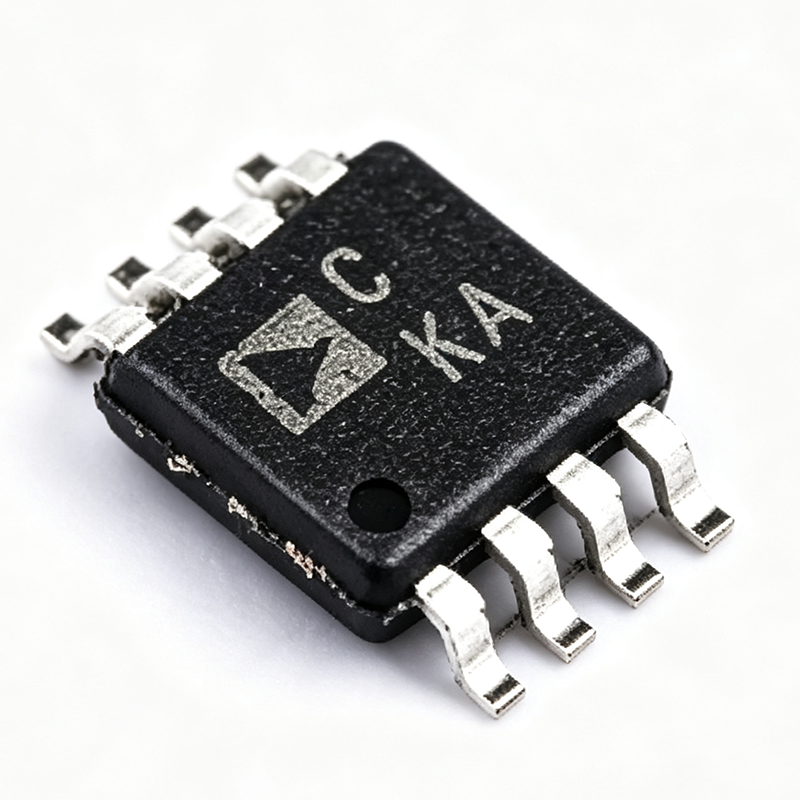
AD7314ARMZ - 10-Bit Digital Temp Sensor | Analog Devices
The AD7314ARMZ is a complete temperature monitoring system in an 8-lead MSOP package from Analog Devices. It integrates a bandgap temperature sensor and a 10-bit ADC to digitize temperature readings with a resolution of 0.25°C. The device operates over a temperature range of -35°C to +85°C and is designed for low-voltage applications, with a supply voltage range of 2.65V to 5.5V. The AD7314ARMZ features a flexible serial interface that is compatible with SPI and MICROWIRE protocols, enabling easy interfacing with most microcontrollers. The device also includes an ID pin (Pin 7) with a 1 kΩ internal pull-down resistor, which can be used to distinguish the device when used as a drop-in replacement in multi-sensor systems. A digital temperature sensor is an integrated circuit that converts ambient temperature into a digital output, typically using an internal bandgap reference and an analog-to-digital converter (ADC). These sensors are essential in thermal management systems, where they provide accurate temperature readings to microcontrollers for monitoring and control. The AD7314ARMZ falls under the category of temperature sensors, which are part of the broader sensor family used in industrial, consumer, and automotive applications. Key features of the AD7314ARMZ include its 10-bit resolution (0.25°C per LSB), low supply current, and wide operating temperature range. The device is available in a compact 8-lead MSOP package, making it suitable for space-constrained designs. The serial interface supports clock frequencies up to 5 MHz, allowing fast temperature readouts. The AD7314ARMZ also features a shutdown mode to reduce power consumption when not in use. Technically, the AD7314ARMZ uses a bandgap temperature sensor that produces a voltage proportional to absolute temperature, which is then digitized by a 10-bit successive approximation ADC. The device includes an on-chip oscillator and a serial interface that outputs the temperature data in a 16-bit word format. The ID pin provides a unique identifier for the device, which is useful in applications where multiple sensors are connected to the same bus. Typical applications for the AD7314ARMZ include thermal management in PCs, industrial process control, environmental monitoring, and battery management systems. Its low power consumption and small footprint make it ideal for portable and battery-powered devices. When designing with the AD7314ARMZ, ensure that the supply voltage is within the specified range and that the serial interface lines are properly terminated. The ID pin can be left floating or connected to a pull-up resistor if not used. Proper PCB layout, including decoupling capacitors near the supply pins, is recommended for accurate temperature readings.

AD7314ARMZ-REEL7 - 10-Bit Digital Temp Sensor | Analog Devices
The AD7314ARMZ-REEL7 from Analog Devices is a complete temperature monitoring system in an 8-lead MSOP package. It integrates a bandgap temperature sensor and a 10-bit ADC to digitize temperature readings with a resolution of 0.25°C. The device operates over a temperature range of -35°C to +85°C and supports a supply voltage from 2.65V to 5.5V. Its flexible serial interface is compatible with SPI, QSPI, and MICROWIRE protocols, enabling easy connection to most microcontrollers. A temperature sensor is a device that measures temperature and converts it into an electrical signal. The AD7314 is a digital temperature sensor, meaning it outputs a digital representation of the temperature, which can be read by a microcontroller or processor. Digital temperature sensors are part of the broader category of temperature sensors, which also includes analog output sensors and thermocouples. They are widely used in system monitoring, thermal management, and environmental sensing applications. Key features of the AD7314 include a 10-bit resolution providing 0.25°C temperature steps, a low supply current, and a shutdown mode for power saving. The device also includes an ID pin with an internal 1kΩ pull-down resistor, which can be used to distinguish the device when used as a drop-in replacement. The MSOP package is compact and suitable for space-constrained designs. The AD7314 uses a bandgap temperature sensor, which provides a stable and accurate temperature-dependent voltage. This voltage is converted to a digital value by the integrated 10-bit ADC. The serial interface allows the host controller to read the temperature data with minimal pin usage. The device is designed for low power consumption, making it suitable for battery-powered applications. Typical applications include system thermal monitoring in computers and servers, temperature compensation in precision analog circuits, and environmental monitoring in industrial equipment. The AD7314's small footprint and digital output simplify PCB design and reduce component count. When designing with the AD7314, ensure that the supply voltage is within the specified range and that the serial interface lines are properly terminated. The ID pin can be left floating or connected to ground, depending on the application. For accurate temperature readings, place the sensor close to the heat source and provide adequate thermal coupling.

LM235 - Precision Temperature Sensor | STMicroelectronics | Industrial
The LM235 is a precision integrated-circuit temperature sensor that produces an output voltage linearly proportional to the Celsius temperature. It operates over a temperature range of -40°C to +125°C and provides an output of 10 mV/°C with a typical accuracy of ±1°C at 25°C. The device is available in a TO-92 package, making it suitable for through-hole mounting in a wide range of applications. A temperature sensor is a device that converts thermal energy into an electrical signal, typically a voltage or current, that can be measured and processed. The LM235 belongs to the family of analog temperature sensors, which are widely used in environmental monitoring, industrial control, and consumer electronics. These sensors are essential in systems that require temperature compensation, thermal protection, or precise temperature measurement. Key features of the LM235 include a wide operating voltage range of 4V to 30V, low self-heating of 0.1°C in still air, and a linear output of 10 mV/°C. The device also features a typical accuracy of ±1°C at 25°C and ±2°C over the full temperature range. Its low output impedance and ability to drive capacitive loads make it easy to interface with analog-to-digital converters (ADCs) and microcontrollers. The LM235 uses a bandgap reference circuit to generate a voltage proportional to temperature, ensuring stable and repeatable performance. The output voltage is calibrated at the factory, eliminating the need for external trimming in most applications. The device operates from a single supply and can be used in both single-ended and differential configurations. Typical applications include temperature monitoring in industrial process control, thermal management in power supplies, battery temperature sensing in portable devices, and environmental monitoring in HVAC systems. The LM235 is also used in automotive applications for engine temperature sensing and cabin climate control. When designing with the LM235, ensure that the supply voltage is within the specified range and that the output is properly buffered if driving a low-impedance load. The device's low self-heating minimizes measurement errors, but for high-accuracy applications, consider using a heat sink or mounting the sensor away from heat sources.

STTS751 - 1.8V to 3.6V Digital Temperature Sensor | STMicroelectronics
The STTS751 is a low-voltage, digital temperature sensor from STMicroelectronics that provides high-accuracy temperature monitoring with an I2C/SMBus serial interface. It operates from a supply voltage range of 1.8V to 3.6V and is available in a compact 6-pin UDFN package (2x2 mm). The device measures temperature with a typical accuracy of ±1°C (from +75°C to +95°C) and offers a programmable resolution from 9 to 12 bits, allowing designers to trade off conversion time versus resolution. A digital temperature sensor is an integrated circuit that converts ambient temperature into a digital output, typically using an internal bandgap reference and an analog-to-digital converter (ADC). It belongs to the broader category of temperature sensors, which are essential in thermal management systems for monitoring and protecting electronic components. Digital temperature sensors like the STTS751 are preferred over analog sensors (e.g., thermistors) because they provide direct digital readout, eliminate the need for calibration, and can be easily interfaced with microcontrollers via standard communication protocols such as I2C or SMBus. Key features of the STTS751 include a programmable resolution (9 to 12 bits), an SMBus-compatible interface with up to 400 kHz clock frequency, and a standby current of only 3.5 µA (typical) to extend battery life in portable applications. The device also supports a one-shot mode for single temperature readings, which reduces power consumption further. The operating temperature range is -40°C to +125°C, making it suitable for a wide range of environments. The STTS751 uses a sigma-delta ADC architecture to achieve high accuracy and low noise. It includes an on-chip oscillator and a digital comparator that can generate an interrupt (ALERT) when the temperature exceeds programmable high or low limits. The device also features a shutdown mode that reduces current consumption to 0.5 µA (typical), ideal for power-sensitive designs. Typical applications include system thermal management in laptops, servers, and industrial controllers; battery temperature monitoring in smartphones and tablets; and environmental monitoring in IoT devices. The small UDFN package and low power consumption make it an excellent choice for space-constrained, battery-powered designs. When designing with the STTS751, ensure proper PCB layout to minimize thermal coupling from other heat sources. Place the sensor away from power components and provide adequate copper pour for heat dissipation. The I2C address is set by the ADD0 pin, allowing up to two devices on the same bus.