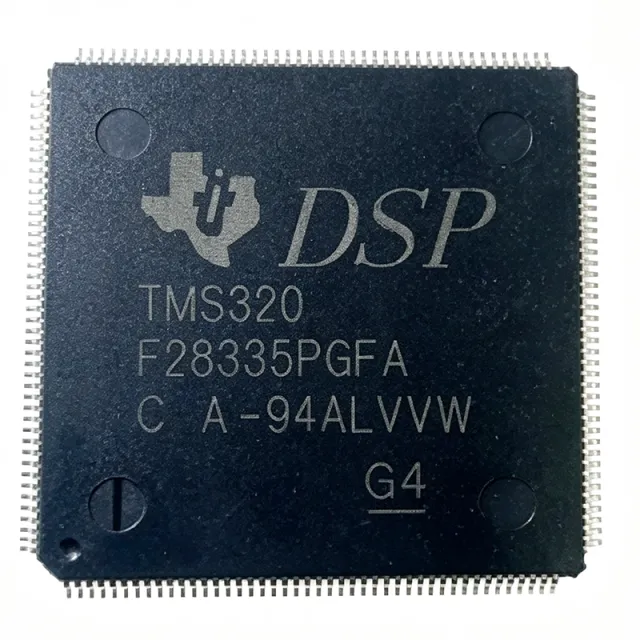
Quick Answers: What Is the TMS320F28335PGFA and Why Does It Matter?
The TMS320F28335PGFA is a high-performance 32-bit floating-point digital signal controller (DSC) from Texas Instruments' C2000 Delfino family. It operates at up to 150 MHz, delivering 150 MIPS, and integrates 512 KB (256K x 16) of flash memory and 68 KB of SRAM. Housed in a 176-pin LQFP (24x24 mm) package, it is currently in active lifecycle status with 99,999 units in stock at XAIPART, priced at $11.9318 per unit at 1,000+ quantities as of 2026-08-28. This device combines real-time control capabilities with DSP math power, making it ideal for motor control, power conversion, and industrial automation.
Technical Guide: How to Select, Design In, and Use the TMS320F28335PGFA
Selecting the TMS320F28335PGFA requires understanding its core architecture and peripherals. The C28x core with FPU accelerates complex control algorithms, while the 12-bit ADC with 16 channels and 18 PWM outputs enable precise real-time control. When designing in, pay attention to power supply decoupling: the core runs at 1.9V and I/O at 3.3V, so separate regulators and decoupling capacitors are essential. The JTAG interface is critical for debugging and programming via Code Composer Studio. For thermal management, the LQFP package dissipates heat through the PCB; ensure adequate copper area. The device supports an external memory interface (EMIF) for memory expansion, and communication interfaces include CAN, I2C, SPI, SCI, and UART. Always refer to the official datasheet for detailed pinout and electrical characteristics.
Alternatives & Comparison: Drop-In Replacements and Functional Equivalents
When considering alternatives, the TMS320F28335PTPQ is the best drop-in replacement, offering pin-to-pin compatibility in the same 176-pin LQFP package with an extended temperature range (-40°C to +125°C). The TMS320F28335ZJZA uses a BGA package and is not pin-compatible. For functional equivalents, the TMS320F28075 provides similar performance but requires PCB redesign. Below is a comparison based on verified data.
| Parameter | TMS320F28335PGFA | TMS320F28335PTPQ | TMS320F28335ZJZA |
|---|---|---|---|
| Core | C28x 32-bit DSP with FPU | C28x 32-bit DSP with FPU | C28x 32-bit DSP with FPU |
| Clock Speed | 150 MHz | 150 MHz | 150 MHz |
| Flash Memory | 512 KB | 512 KB | 512 KB |
| SRAM | 68 KB | 68 KB | 68 KB |
| ADC Resolution | 12-bit | 12-bit | 12-bit |
| ADC Channels | 16 | 16 | 16 |
| PWM Outputs | 18 | 18 | 18 |
| Operating Temp | -40°C to +85°C | -40°C to +125°C | [DATA_NEEDED: Operating Temperature Range] |
| Package | 176-LQFP (24x24 mm) | 176-LQFP (24x24 mm) | BGA |
| Pin Compatibility | Reference | Pin-to-pin compatible | Not pin-compatible |
Summary: For most applications, the PTPQ variant is the safest drop-in choice, especially for extended temperature environments. The ZJZA requires a PCB redesign due to package differences.
Industry Insight: Market Position, Lifecycle, and Supply Situation
The TMS320F28335PGFA holds a strong position in the industrial and automotive control markets, thanks to its balance of performance and integration. Its lifecycle status is 'active', indicating ongoing production and support. As of 2026-08-28, XAIPART reports 99,999 units in stock, with a base price of $11.9318 at 1,000+ quantities. The device is widely available from major distributors, and lead times are typically short for in-stock items. For long-term supply assurance, the active lifecycle and TI's commitment to the C2000 family provide confidence. [DATA_NEEDED: Market share data, competitor sales figures]
Trends & Outlook: What Buyers Should Watch
Buyers should monitor the trend toward higher integration and functional safety in motor control and power conversion. The TMS320F28335PGFA's FPU and high-resolution PWM position it well for advanced control algorithms. However, newer C2000 devices may offer enhanced features like more memory or integrated analog front-ends. Watch for potential price fluctuations due to supply chain dynamics, and consider the extended temperature variant (PTPQ) for automotive applications. The device's active lifecycle ensures continued availability, but design-in decisions should account for future migration paths within the C2000 family.
Comments
Be the first to comment.
🔐 Please sign in to post a comment.
Don't have an account? Sign up