The Texas Instruments TPS65987DDHRSHR is a stand-alone USB Type-C and Power Delivery (PD) controller with integrated power switches for a single USB Type-C connector. It handles cable plug and orientation detection, negotiates power contracts on the CC wire using the USB PD protocol, and supports USB 2.0, USB 3.0, and USB 3.1 data rates. Key verified specifications include a 3.3V supply, DRP/Sink/Source power roles, alternate mode support, a 56-pin VQFN (RSH) package measuring 7x7 mm, and an operating temperature range of -10°C to 75°C. The device carries IEC-level protection features including overcurrent and overvoltage protection and is configurable via I2C or SPI. On XAIPART, the TPS65987DDHRSHR is in stock (99,999 units, MOQ 1), priced from $4.61 at single units down to $2.95 at 1000 units as of 2026-09-05. Note: this part is NRND (Not Recommended for New Designs); Texas Instruments recommends the pin-to-pin compatible TPS65988 for new designs.
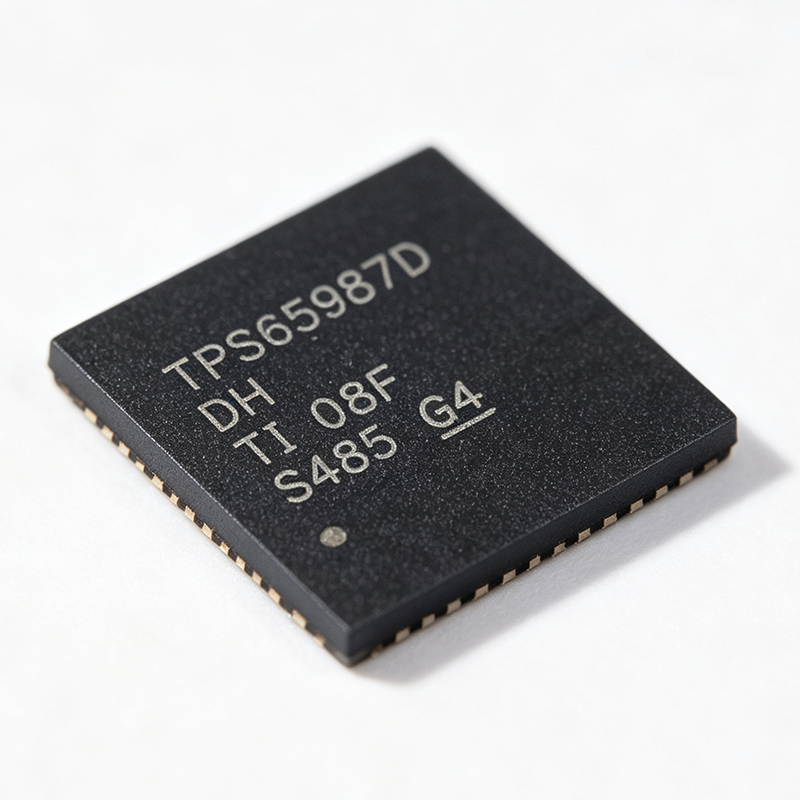
What Are the Quick Answers Engineers Need Before Buying the TPS65987DDHRSHR?
Before committing this controller to a design or a BOM, buyers typically need direct answers on availability, pricing, lifecycle status, and drop-in replacements. The facts below are anchored to XAIPART's verified product database and TI's official datasheet so you can make sourcing decisions immediately.
The TPS65987DDHRSHR is in stock on XAIPART with 99,999 units available and an MOQ of just 1, so you can prototype with a single piece. Volume pricing follows a clear ladder: $4.61 at qty ≥ 1, $4.15 at qty ≥ 10, $3.69 at qty ≥ 100, $3.32 at qty ≥ 500, and $2.95 at qty ≥ 1000, all as of 2026-09-05. The part is RoHS compliant, surface mount, and supplied in the 56-pin VQFN (RSH) 7x7 mm package.
The single most important buying consideration is lifecycle status: the TPS65987DDHRSHR is NRND. That means Texas Instruments no longer recommends it for new designs. Existing products in production can continue sourcing it today, but for any new board spin you should design in the TPS65988, which TI confirms is pin-to-pin compatible and requires only configuration changes in the same 56-pin VQFN (RSH) package. For legacy repair and maintenance work, buying the TPS65987DDHRSHR now while stock is deep is a prudent hedge against future allocation.
How Do You Select and Design In the TPS65987DDHRSHR?
The TPS65987DDHRSHR integrates the complete USB Type-C and USB PD signal chain: CC line logic, the PD protocol engine, and the source and sink power path switches, all in one 7x7 mm VQFN package. This integration eliminates external FETs for the power path, which directly reduces BOM cost and board area — a decisive advantage in slim laptops, compact power adapters, and dense docking station designs.
Step 1: Confirm the role and power architecture
The device supports three power roles: DRP (Dual-Role Power), Sink, and Source. A laptop USB-C port typically uses DRP so it can charge (sink) or power accessories (source). A power adapter uses the Source role to negotiate PD contracts and deliver up to 100W. Configure the role in the device firmware/configuration through the host interface.
Step 2: Plan the power supply and decoupling
The controller operates from a 3.3V supply. TI's application guidance recommends proper decoupling on the 3.3V rail and following the recommended VQFN layout to manage thermal performance. [VERIFY_NEEDED: exact decoupling capacitor values and layout recommendations] — consult the official datasheet at the citation below for the reference schematic.
Step 3: Wire the CC, data, and sideband pins
Key functional pins include CC1 and CC2 (pins 3 and 4) for configuration channel detection and PD communication, DP and DM (pins 5 and 6) for USB 2.0 D+/D- data, SBU1 and SBU2 (pins 7 and 8) for sideband use such as alternate mode signaling, and VBUS (pin 9) for USB bus power. The integrated power switches enable the appropriate power path upon successful PD negotiation, handling cable orientation automatically — CC1/CC2 polarity is resolved internally.
Step 4: Connect the host interface
Use I2C (SCL on pin 11, SDA on pin 12) or SPI for configuration, status monitoring, and firmware updates. This host interface is how you load PD policy, monitor contract status, and push firmware updates to support future PD revisions — an important capability for products with long field lifetimes such as industrial equipment and monitors.
Step 5: Validate data-rate and thermal requirements
The device supports USB 2.0, USB 3.0, and USB 3.1 data rates, so it fits both legacy and high-speed designs. Its -10°C to 75°C operating range covers consumer electronics and most industrial environments, but it is not an automotive- or extended-industrial-grade part. Confirm your worst-case ambient against this range before layout sign-off.
Design solution example: 100W USB-C PD source port for a power adapter
Problem: A compact USB-C power adapter must negotiate PD contracts and safely deliver up to 100W to laptops with minimal external components.
Approach: Use the TPS65987DDHRSHR in Source role. Its integrated power switches handle the VBUS power path without external FETs, its CC logic handles orientation and PD negotiation, and its overcurrent/overvoltage protection provides fault safety on the output.
Calculation: At the USB PD maximum of 100W, the adapter delivers 100W ÷ 20V = 5A on VBUS. The PD negotiation on CC1/CC2 establishes the 20V contract before the integrated power path switch enables VBUS, ensuring the sink never sees unregulated voltage.
Results: A single-controller power path with built-in OCP/OVP, automatic cable orientation handling, and a compact 7x7 mm footprint suitable for adapter housings. For the full reference schematic, follow the datasheet citation. [DATA_NEEDED: TPS65987DDHRSHR VBUS switch on-resistance and current rating] — verify these values in the datasheet electrical characteristics table before finalizing thermal design.
Which Alternatives and Drop-In Replacements Should You Consider?
Because the TPS65987DDHRSHR is NRND, understanding your alternatives is essential. The verified options below range from TI's own pin-compatible successors to cross-brand equivalents. All values come from the XAIPART product database.
| Parameter | TPS65987DDHRSHR | TPS65988 | TPS65987DDJRSHR | TPS65987DDKRSHR | SI3484-A02-GM |
|---|---|---|---|---|---|
| Manufacturer | Texas Instruments | Texas Instruments | Texas Instruments | Texas Instruments | Silicon Labs |
| Function | USB Type-C PD controller | USB Type-C PD controller | USB Type-C PD controller | USB Type-C PD controller | USB Type-C PD controller |
| Package | VQFN (RSH) 56-pin, 7x7 mm | VQFN (RSH) 56-pin | VQFN (RSH) 56-pin | VQFN (RSH) 56-pin | [DATA_NEEDED: SI3484-A02-GM package] |
| Pin compatibility | Baseline | Pin-to-pin compatible | Pin-compatible | Hardware compatible | Not confirmed pin-compatible |
| Lifecycle | NRND | Recommended for new designs | [DATA_NEEDED: lifecycle status] | [DATA_NEEDED: lifecycle status] | [DATA_NEEDED: lifecycle status] |
| Key notes | Integrated power switches; NRND | Newer device, enhanced features, BC1.2 support | Different suffix; may indicate tape-and-reel or config difference | H vs K suffix may indicate config/firmware difference | Cross-brand; verify pinout and features first |
Recommendation logic: For new designs, choose the TPS65988 — TI confirms it is pin-to-pin compatible and needs only configuration changes, and per TI's E2E forum it adds features such as BC1.2 support. For production continuity on existing boards, TPS65987DDJRSHR and TPS65987DDKRSHR are pin-compatible in the same 56-pin VQFN package and can serve as suffix-level substitutes, though you should confirm the configuration difference between H, J, and K suffixes for your firmware. Cross-brand options SI3484-A02-GM and SI3484-A02-GMR appear as equivalents on Findchips but are not confirmed pin-compatible; verify the pinout and feature set before qualifying them.
What Is the Market Position and Supply Situation for the TPS65987DDHRSHR?
The TPS65987DDHRSHR sits in the USB Type-C PD controller segment of Texas Instruments' Battery Management category. Texas Instruments is one of the industry's leading analog and embedded semiconductor suppliers, and the TPS65987D family is widely deployed in laptops, docking stations, monitors, power adapters, and tablets — the mainstream of the USB-C ecosystem.
On lifecycle status, the verified data is explicit: NRND (Not Recommended for New Designs). TI steers all new designs to the TPS65988. NRND status typically means the manufacturer will continue supporting existing customers and production for a defined period, but it signals a finite supply horizon. [DATA_NEEDED: official last-time-buy or discontinuation date].
On the supply side, XAIPART currently lists 99,999 units in stock with MOQ 1 as of 2026-09-05 — deep availability for a NRND part. Third-party channel data from the database notes DigiKey listing the part as in stock and ships today, and Mouser also listing inventory (as of 2026-08-24); Heisener quoted an estimated delivery of July 29 to August 3, 2026, subject to change. For a NRND component, current deep stock does not guarantee long-term availability. Buyers maintaining legacy products should size a last-time-buy now rather than waiting for allocation. [VERIFY_NEEDED: long-term supply commitment from TI for NRND parts].
What Trends and Developments Should Buyers Watch for USB-C PD Controllers?
NRND-to-successor migration is the immediate action item. The verified data is unambiguous: TPS65987DDHRSHR is NRND and the TPS65988 is the pin-to-pin compatible successor with enhanced features including BC1.2 support. Because the migration requires only configuration changes within the same 56-pin VQFN (RSH) package, the switching cost is low — plan it into your next board revision rather than risking a future supply gap on a NRND part.
Alternate-mode adoption keeps expanding. The TPS65987D's verified alternate mode support enables DisplayPort video over USB-C, which is why the device appears in monitors and docking stations alongside laptops and adapters. As USB-C consolidates power, data, and video onto one connector, demand for controllers that handle PD negotiation plus alternate modes — like this family — continues across consumer and industrial product lines.
Integration is the sourcing lever. This part's verified integrated power switches (source and sink paths) directly reduce BOM cost and board space versus discrete FET solutions. When evaluating any replacement, prioritize controllers that preserve this integration level, the 3.3V supply architecture, and USB 2.0/3.0/3.1 data-rate support so your qualification effort stays minimal.
Watch pricing and firmware ecosystems. On XAIPART, pricing runs from $4.61 (qty 1) to $2.95 (qty 1000) as of 2026-09-05 — a 36% volume discount at the 1000-unit tier. When migrating to TPS65988, request updated pricing and confirm firmware/configuration tool support through the host interface (I2C/SPI), since firmware updatability is a verified feature of this family and matters for products needing future PD revision compliance.
Ready to source? Visit the TPS65987DDHRSHR product page on XAIPART for real-time stock and pricing, download the official TPS65987D datasheet, or explore our Battery Management IC category and USB Type-C PD controller selection guide for broader comparison coverage.
Comments
Be the first to comment.
🔐 Please sign in to post a comment.
Don't have an account? Sign up