EEPROM
Products (18)

DS2430AP+ - 256-Bit 1-Wire EEPROM | Analog Devices
The DS2430AP+ is a 256-bit 1-Wire EEPROM from Analog Devices (formerly Maxim Integrated), designed to identify and store product-specific information with minimal interface requirements. It operates over a 1-Wire bus, requiring only a single data line plus ground, and communicates at a data rate of 15 µs per bit. The device is housed in a 6-pin TSOC package (also known as 6-LSOJ), measuring 3.76 mm in width, making it suitable for space-constrained applications. A 1-Wire EEPROM is a type of non-volatile memory that uses the proprietary 1-Wire protocol developed by Dallas Semiconductor (now part of Maxim Integrated). This protocol enables communication between a host microcontroller and one or more slave devices over a single data line, which also provides power to the slave in parasitic power mode. The DS2430AP+ belongs to the broader category of serial EEPROMs, which are used for storing calibration data, device identification, and small configuration parameters in embedded systems. Key features of the DS2430AP+ include a factory-lasered 64-bit registration number that contains a unique 48-bit serial number, an 8-bit CRC, and an 8-bit family code (14h). This ensures each device is uniquely identifiable on the 1-Wire bus. The memory is organized as 32 x 8-bit words, providing 256 bits of user-programmable EEPROM. The device supports both parasitic and external power supply modes, and it operates over a supply voltage range of 2.8V to 5.25V. The 1-Wire interface simplifies PCB design by reducing the number of required traces. Technically, the DS2430AP+ uses a 1-Wire communication protocol that is timing-sensitive, with a 15 µs time slot for each bit. The device includes an on-chip CRC generator for error detection, ensuring data integrity during read operations. The EEPROM cells are rated for a minimum of 100,000 write cycles and 10 years of data retention at 85°C, making it reliable for long-term storage of critical information. The device also features a 64-bit one-time-programmable (OTP) area for permanent data storage. Typical applications include PCB identification and tracking, consumable authentication (e.g., printer cartridges), medical device calibration data storage, and industrial sensor calibration. The DS2430AP+ is particularly well-suited for applications where a minimal interface is required, such as battery packs, accessory identification, and system configuration storage. When designing with the DS2430AP+, ensure proper pull-up resistor (typically 2.2 kΩ to 4.7 kΩ) on the 1-Wire bus and consider the timing requirements for reliable communication. For parasitic power mode, a strong pull-up during the write operation is necessary to ensure sufficient current for programming the EEPROM.

M24C01-RMN6TP - 1Kbit I2C EEPROM, SOIC-8 | STMicroelectronics
The M24C01-RMN6TP is a 1-Kbit (128 x 8-bit) serial I2C EEPROM from STMicroelectronics, housed in an 8-pin SOIC (MN) package. It operates with a supply voltage range of 2.5V to 5.5V, supports I2C bus speeds up to 400 kHz, and features a write cycle time of 5 ms. The device is organized as 128 bytes of non-volatile memory, with a byte-write and page-write capability (up to 16 bytes per page). It includes a write protect (WC) pin for hardware data protection and a device address (E0, E1, E2) input for up to 8 devices on the same bus. An EEPROM (Electrically Erasable Programmable Read-Only Memory) is a type of non-volatile memory that can be electrically erased and reprogrammed. It is a key component in the memory hierarchy, sitting between volatile RAM and permanent storage like flash. EEPROMs are used to store small amounts of configuration data, calibration constants, and device parameters that must persist across power cycles. In the broader system, EEPROMs are part of the memory IC category, which includes ROM, RAM, and flash, and are essential for applications requiring data retention without power. Key features of the M24C01-RMN6TP include a wide operating voltage range (2.5V to 5.5V), I2C interface with clock frequencies up to 400 kHz, and a low-power design with a standby current of 1 uA (typical). The device offers a write cycle time of 5 ms, ensuring fast programming, and supports both byte and page write modes. The SOIC-8 package is industry-standard, making it easy to integrate into existing PCB designs. The device is RoHS compliant and operates over a temperature range of -40C to +85C. Technically, the M24C01 uses a floating-gate transistor architecture for non-volatile storage, with a built-in charge pump for programming. The I2C interface allows for simple two-wire communication (SCL and SDA), with the device address set via three pins (E0, E1, E2), enabling up to 8 devices on a single bus. The write protect pin (WC) provides hardware protection against accidental writes, and the device supports both sequential and random read operations. Typical applications include storing calibration data in industrial sensors, configuration parameters in consumer electronics, and system settings in automotive modules. The wide voltage range and low power consumption make it suitable for battery-powered devices, while the I2C interface simplifies integration with microcontrollers. When designing with this device, ensure proper pull-up resistors on the SCL and SDA lines (typically 4.7 kOhm) and consider the write cycle time when updating data. The WC pin should be tied to ground for normal operation or to VCC for write protection. For high-reliability applications, consider the automotive-grade variant M24C01-RMN6TP/A.
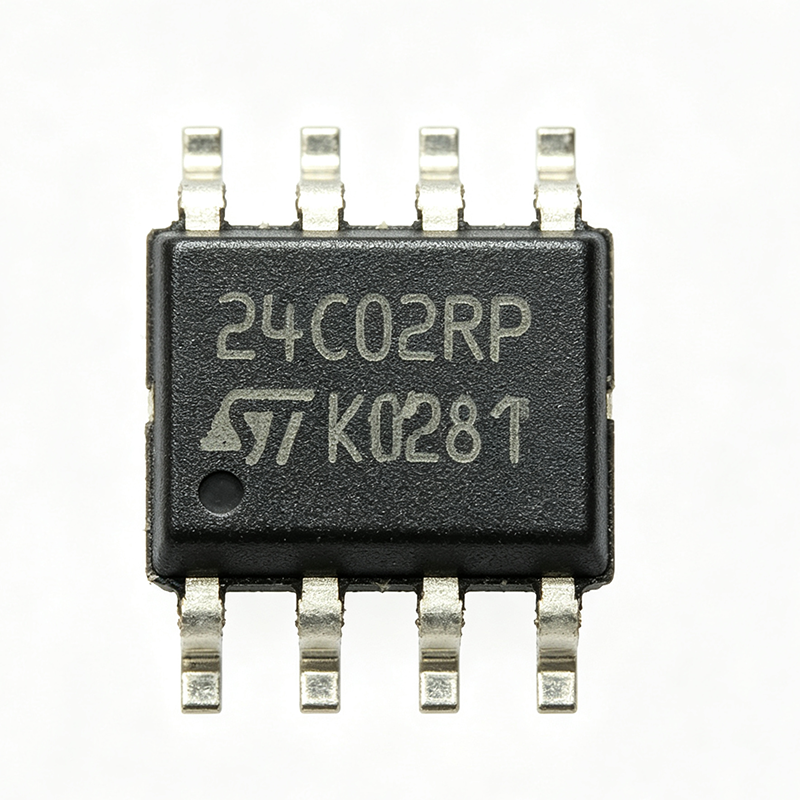
M24C02-RMN6TP - 2Kbit I2C EEPROM | STMicroelectronics
The M24C02-RMN6TP is a 2-Kbit (256 x 8-bit) serial I2C EEPROM from STMicroelectronics, housed in a compact SOIC-8 package. It operates over a supply voltage range of 1.8V to 5.5V, supports a clock frequency up to 400 kHz, and features a write cycle time of 5 ms. Data verified as of 2026-08-05. An EEPROM (Electrically Erasable Programmable Read-Only Memory) is a non-volatile memory type that retains data when power is removed, allowing byte-level erasure and reprogramming electrically. In the memory hierarchy, EEPROM sits between volatile RAM and read-only ROM, providing flexible storage for configuration parameters, calibration data, and small application logs. It is a fundamental building block in embedded systems, often interfaced via standard serial protocols like I2C or SPI. Key features include a wide operating voltage range (1.8V to 5.5V) that supports both 3.3V and 5V logic systems, a 400 kHz I2C interface for fast data transfer, and a 5 ms write cycle time for efficient programming. The device also offers a write protect pin to prevent accidental data corruption, and a page write capability of 16 bytes, enhancing programming efficiency. Its low-power consumption makes it suitable for battery-operated devices. The M24C02-RMN6TP uses a standard I2C protocol with a 7-bit device address, allowing up to eight devices on the same bus. It features a self-timed write cycle with auto-erase, simplifying the programming sequence. The device is manufactured using ST's advanced CMOS technology, ensuring high reliability and endurance of 1 million write cycles, with data retention of 40 years. Typical applications include storing calibration data in industrial sensors, configuration parameters in smart meters, and device settings in consumer electronics such as TVs and set-top boxes. Its small SOIC-8 footprint and wide voltage range make it ideal for space-constrained designs. When designing with this device, ensure proper pull-up resistors on the SDA and SCL lines (typically 4.7kΩ for 400 kHz operation) and connect the write protect pin to ground when writing is required. The device supports both byte and page write modes, with page size of 16 bytes, and acknowledges each byte during programming. This page synthesizes distributor pricing, drop-in alternatives, and practical design notes not found in the ST datasheet, providing a comprehensive resource for engineers evaluating the M24C02-RMN6TP.
M24C08-RMN6TP - 8Kbit I2C EEPROM, SOIC-8 | STMicroelectronics
The M24C08-RMN6TP is an 8-Kbit (1024 x 8) I2C-compatible serial EEPROM from STMicroelectronics, packaged in an 8-pin SOIC (N) package. It operates over a supply voltage range of 1.8V to 5.5V, making it suitable for a wide range of low-power and battery-operated applications. The device supports a clock frequency of up to 400 kHz (I2C fast mode) and features a write protect pin for hardware data protection. An EEPROM (Electrically Erasable Programmable Read-Only Memory) is a non-volatile memory that can be electrically erased and reprogrammed, retaining data without power. It is a type of memory IC that falls under the broader category of non-volatile memory, which also includes flash memory and MRAM. EEPROMs are used for storing configuration parameters, calibration data, device IDs, and small amounts of firmware that require in-system updates. The M24C08 is part of the M24Cxx family of serial EEPROMs, which are widely used in industrial, automotive, and consumer electronics. Key features of the M24C08-RMN6TP include a byte-write time of 5 ms, a write cycle endurance of 1 million write cycles, and a data retention of 40 years. The device supports both byte and page write modes (up to 16 bytes per page), and sequential read operations. It also includes a write protect (WC) pin that, when tied high, prevents write operations to the entire memory array. The device is available in a standard SOIC-8 package, which is pin-compatible with many other 8-pin EEPROMs, allowing easy drop-in replacement. The M24C08 uses a standard I2C interface with a 2-wire serial bus (SCL and SDA), and supports 7-bit device addressing with three address pins (A0, A1, A2) allowing up to eight devices on the same bus. The device is designed for low-power operation, with a standby current of 1 uA and a maximum active current of 2 mA at 400 kHz. It operates over a temperature range of -40C to +85C, making it suitable for industrial environments. Typical applications include storing calibration data in sensors, configuration settings in set-top boxes, device parameters in smart meters, and system logs in industrial controllers. The M24C08 is also used in automotive electronics for storing VIN numbers, tire pressure monitoring system (TPMS) data, and infotainment system settings. When designing with the M24C08, ensure that the SDA and SCL lines have appropriate pull-up resistors (typically 4.7 kOhm) and that the write protect pin is connected to a defined logic level. The device supports I2C fast mode (400 kHz) and is compatible with standard mode (100 kHz). For reliable operation, decouple the VCC pin with a 0.1 uF ceramic capacitor close to the device.
M24C128-RMN6TP - 128Kbit I2C EEPROM, SO-8 | STMicroelectronics
The M24C128-RMN6TP is a 128-Kbit (16K x 8) I2C-compatible EEPROM from STMicroelectronics, packaged in an 8-pin SO-8 (N) package. It operates over a supply voltage range of 1.8V to 5.5V, making it suitable for a wide variety of low-power and battery-operated applications. The device supports I2C clock frequencies up to 1 MHz (Fast-mode Plus) and features a write cycle time of 5 ms, with byte and page write modes (up to 64 bytes per page). An EEPROM (Electrically Erasable Programmable Read-Only Memory) is a non-volatile memory that retains data when power is removed, and can be electrically erased and reprogrammed. It is a type of non-volatile memory (NVM) that sits within the broader memory hierarchy, often used for storing configuration parameters, calibration data, device settings, and small amounts of firmware. EEPROMs are distinct from flash memory in that they allow byte-level erasure and programming, whereas flash typically operates on larger blocks. In a system, EEPROMs serve as a bridge between volatile RAM and permanent storage, providing a flexible and durable solution for data that must survive power cycles. Key features of the M24C128-RMN6TP include a wide operating voltage range (1.8V to 5.5V), low power consumption (standby current of 1 uA typical), and high reliability with 1 million write/erase cycles and 40-year data retention. The device also includes a write protect (WC) pin to prevent accidental writes, and supports both byte and page write operations. The I2C interface allows for easy integration with microcontrollers and other digital systems, with device addressing via three hardware pins (E0, E1, E2) to support up to 8 devices on the same bus. Technically, the M24C128-RMN6TP uses a floating-gate transistor technology for non-volatile storage, with an internal charge pump for programming. The I2C interface is compliant with the I2C bus specification, supporting standard (100 kHz), fast (400 kHz), and fast-mode plus (1 MHz) data rates. The device includes a self-timed write cycle with an internal timer, and an acknowledge polling feature to detect the completion of a write operation. The SO-8 package is a widely used surface-mount package, offering a compact footprint for space-constrained designs. Typical applications include parameter storage in industrial control systems, calibration data in medical devices, configuration settings in consumer electronics, and identification data in smart meters. The wide voltage range and low power consumption make it ideal for battery-powered IoT devices, where it can store sensor calibration and network credentials. In automotive applications, the AEC-Q100 qualified versions (M24C128-RMN6TP is not AEC-Q100 qualified, but the M24C128-RMN6TP-Q1 variant is) are used for odometer and configuration data. When designing with this device, ensure proper decoupling on the VCC pin with a 0.1 uF ceramic capacitor placed close to the device. The SDA and SCL lines should have pull-up resistors (typically 4.7 kOhm for standard mode, 2.2 kOhm for fast mode) to VCC. The write protect pin (WC) should be tied to ground for normal operation, or to VCC to protect the memory from accidental writes. For reliable operation, avoid exceeding the absolute maximum ratings, and consider the write cycle time when planning system operations.
M24C16-RMN6TP - 16Kbit I2C EEPROM, SOIC-8 | STMicroelectronics
The M24C16-RMN6TP is a 16-Kbit (2 Kbyte) serial I2C EEPROM from STMicroelectronics, organized as 2048 x 8 bits. It operates with a supply voltage range of 1.8V to 5.5V, making it suitable for a wide variety of low-power and battery-operated applications. The device is housed in an 8-pin SOIC (N) package, which is widely used in industrial and consumer electronics. An EEPROM (Electrically Erasable Programmable Read-Only Memory) is a non-volatile memory that retains data when power is removed, and can be electrically erased and reprogrammed. It is a type of non-volatile memory (NVM) that falls under the broader category of memory ICs, which also includes Flash, SRAM, and DRAM. EEPROMs are commonly used for storing configuration parameters, calibration data, device addresses, and small amounts of firmware that require in-system updates. Key features of the M24C16-RMN6TP include a 400 kHz I2C interface, a write cycle time of 5 ms, and a write protect (WC) pin for hardware data protection. It supports byte and page write modes (up to 16 bytes per page), and random and sequential read modes. The device has a typical standby current of 1 uA and an active read current of 0.5 mA, contributing to its low-power profile. It is available in a Pb-free, RoHS-compliant SOIC-8 package, with an operating temperature range of -40C to +85C. The M24C16 uses a standard I2C protocol with a 7-bit device address, where the three least significant bits (E2, E1, E0) are hardware-configurable, allowing up to eight devices on the same bus. The memory array is organized into 128 pages of 16 bytes each. The device includes a noise filter on the SCL and SDA lines to improve bus reliability in noisy environments. Typical applications include smart meters, industrial control systems, medical devices, and consumer electronics where non-volatile storage of small amounts of data is required. The wide voltage range and low power consumption make it ideal for battery-powered IoT sensors and portable devices. When designing with this device, ensure that the I2C bus pull-up resistors are properly sized for the bus capacitance and speed. The write protect pin should be tied to ground if not used, and decoupling capacitors should be placed close to the VCC pin to minimize noise.
M24C256-RMN6TP - 256Kbit I2C EEPROM, SOIC-8 | STMicroelectronics
The STMicroelectronics M24C256-RMN6TP is a 256-Kbit (32K x 8) I2C-compatible serial EEPROM with a wide operating voltage range of 1.8V to 5.5V, packaged in an 8-pin SOIC (MN) package. It features a 400 kHz clock frequency, a write cycle time of 5 ms, and a 32-byte page write capability, making it suitable for a wide range of data storage applications. An EEPROM (Electrically Erasable Programmable Read-Only Memory) is a non-volatile memory that retains data when power is removed, and can be electrically erased and reprogrammed. It is a type of non-volatile memory (NVM) that sits within the memory hierarchy between volatile RAM and permanent storage like flash. EEPROMs are used for storing configuration parameters, calibration data, device IDs, and small amounts of firmware that require in-system updates. The M24C256 is part of the M24Cxx family of I2C EEPROMs from STMicroelectronics, which are widely used in industrial, automotive, and consumer electronics. Key features include a 256-Kbit memory size, I2C interface with 400 kHz clock, 1.8V to 5.5V supply voltage, 5 ms write cycle time, 32-byte page write, and a write protect pin for hardware data protection. The device also supports sequential read and write operations, and has a 1,000,000 write/erase cycle endurance and 40-year data retention, ensuring reliable long-term data storage. The M24C256 uses a standard I2C two-wire interface (SCL and SDA) with a 7-bit device address, allowing up to 8 devices on the same bus. The device includes a write protect (WC) pin that, when tied high, prevents write operations to the entire memory array. The SOIC-8 package is industry-standard and pin-compatible with many other 256-Kbit I2C EEPROMs, enabling easy drop-in replacement in existing designs. Typical applications include storing configuration parameters in industrial sensors, calibration data in medical devices, device settings in consumer electronics, and firmware parameters in automotive ECUs. The wide voltage range and low power consumption make it suitable for battery-powered IoT devices. When designing with this device, ensure proper pull-up resistors on the SCL and SDA lines (typically 4.7kΩ for 400 kHz operation) and decouple the VCC pin with a 0.1µF ceramic capacitor. The write protect pin should be tied to ground if write protection is not needed, and the address pins (A0, A1, A2) should be tied to VCC or GND to set the device address.
M24C32-RMN6TP - 32Kbit I2C EEPROM | STMicroelectronics
The M24C32-RMN6TP is a 32-Kbit (4 Kbyte) serial EEPROM from STMicroelectronics, organized as 4096 words of 8 bits each. It operates over an I2C-compatible two-wire serial interface, supporting clock frequencies up to 400 kHz (Fast mode) and 1 MHz (Fast mode Plus) depending on the voltage range. The device is available in an 8-pin SOIC (MN) package, specifically the SO-8N (150 mil) body, and is supplied in tape and reel packaging (TP suffix). It is designed for low-power and low-voltage applications, with a wide operating voltage range of 1.8V to 5.5V, making it suitable for battery-powered and industrial systems. A serial EEPROM (Electrically Erasable Programmable Read-Only Memory) is a non-volatile memory that retains data when power is removed, and can be electrically erased and reprogrammed in-system. It is a type of EEPROM, which falls under the broader category of non-volatile memory (NVM) in the memory hierarchy. Serial EEPROMs use a serial interface (such as I2C, SPI, or Microwire) to communicate with a host controller, reducing pin count and PCB area compared to parallel EEPROMs. The M24C32 is part of the M24Cxx family of I2C EEPROMs from STMicroelectronics, which includes densities from 1 Kbit to 512 Kbit, all sharing a common command set and addressing scheme. Key features of the M24C32-RMN6TP include a write cycle time of 5 ms (typical), byte and page write modes (up to 32-byte page), and a write protect pin (WC) for hardware data protection. The device supports both sequential and random read modes, and includes an internal write protection scheme with a software write protect feature (via the WC pin). It also features a Schmitt trigger input for noise immunity and a noise filter on the SCL and SDA lines, ensuring reliable operation in electrically noisy environments. The operating temperature range is -40°C to +85°C, and the device is RoHS compliant and halogen-free. Technically, the M24C32 uses a floating-gate transistor technology for non-volatile storage, with a charge pump for programming and erasing. The I2C interface is compatible with standard, fast, and fast mode plus speeds, and the device supports 7-bit and 8-bit device addressing (with three address pins A0, A1, A2 for up to 8 devices on the same bus). The memory array is organized into 128 pages of 32 bytes each, and the device includes a self-timed write cycle with automatic erase-before-write. The write cycle time is 5 ms, and the device has an endurance of 1 million write cycles and a data retention of 40 years. Typical applications include parameter storage in industrial sensors, calibration data in medical devices, configuration storage in networking equipment, and firmware update storage in consumer electronics. The low power consumption (standby current of 1 uA) and wide voltage range make it ideal for battery-operated IoT devices and portable instruments. In an industrial sensor application, the M24C32 can store calibration coefficients and device configuration, which are read at power-up and updated periodically. When designing with this device, ensure that the I2C bus pull-up resistors are properly sized for the bus capacitance and speed. The WC pin should be tied to ground for normal write operations or to VCC for write protection. For reliable operation, decouple the VCC pin with a 0.1 uF ceramic capacitor close to the device. Also, consider the maximum write cycle time (5 ms) when planning write operations, and avoid exceeding the maximum clock frequency for the selected voltage range.
M24C512-RMN6TP - 512Kbit I2C EEPROM | STMicroelectronics
The M24C512-RMN6TP is a 512-Kbit (64K x 8) serial I2C EEPROM from STMicroelectronics, packaged in an 8-pin SOIC (SO-8) with a 200 ns write cycle time. It operates from a 1.8V to 5.5V supply voltage and supports clock frequencies up to 1 MHz, making it suitable for a wide range of data storage applications. An EEPROM (Electrically Erasable Programmable Read-Only Memory) is a non-volatile memory that retains data when power is removed, allowing for byte-level read and write operations. It is a type of non-volatile memory (NVM) within the broader memory IC category, which also includes flash memory and SRAM. EEPROMs are commonly used for storing configuration parameters, calibration data, and small amounts of firmware in embedded systems. Key features include a 512-Kbit memory size organized as 64K x 8 bits, a wide operating voltage range of 1.8V to 5.5V, and a maximum clock frequency of 1 MHz. The device supports both 100 kHz and 400 kHz I2C bus speeds, with a write cycle time of 5 ms (typical) and a write protect pin for hardware data protection. It also features a page write capability of up to 128 bytes, enhancing write efficiency. The M24C512-RMN6TP uses a standard I2C interface with a 2-wire serial bus (SCL and SDA), and includes a device address input (E0, E1, E2) allowing up to 8 devices on the same bus. The memory is organized into 512 pages of 128 bytes each, and supports sequential read and write operations. The device is manufactured using ST's advanced CMOS technology, ensuring low power consumption and high reliability. Typical applications include industrial control systems, smart meters, medical devices, and automotive electronics, where reliable non-volatile data storage is required. The wide voltage range and high clock speed make it suitable for both battery-powered and high-speed systems. When designing with this device, ensure proper decoupling capacitors on the power supply and pull-up resistors on the I2C lines. The write protect pin should be tied to ground for normal operation or to VCC to prevent accidental writes. The device is RoHS compliant and halogen-free, meeting environmental standards.
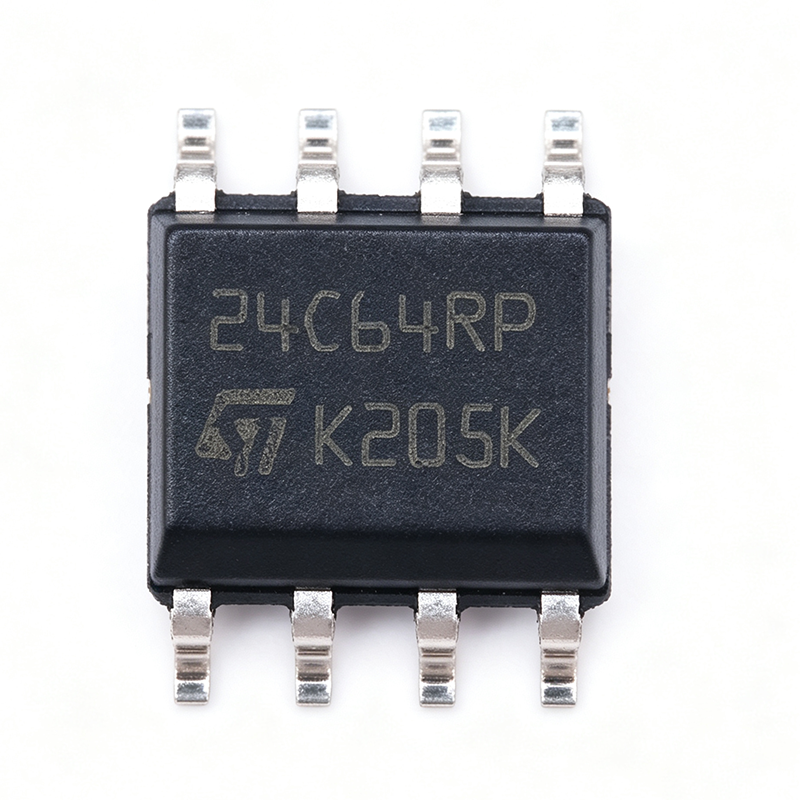
M24C64-RMN6TP - 64Kbit I2C EEPROM | STMicroelectronics
The M24C64-RMN6TP is a 64-Kbit (8K x 8) serial I2C EEPROM from STMicroelectronics, packaged in a compact SO-8 (N) package. It operates over a supply voltage range of 1.8V to 5.5V, with a maximum clock frequency of 1 MHz (for VCC >= 4.5V) and 400 kHz (for VCC >= 2.5V). The device features a byte-write time of 5 ms and a write cycle endurance of 1 million write cycles, with data retention of 40 years. Data verified as of 2026-08-05. An EEPROM (Electrically Erasable Programmable Read-Only Memory) is a non-volatile memory that can be electrically erased and reprogrammed. It is a type of memory IC that retains data when power is removed, making it essential for storing configuration parameters, calibration data, and small amounts of firmware in embedded systems. EEPROMs sit within the memory hierarchy as a non-volatile storage layer, distinct from volatile RAM and higher-capacity flash memory, and are commonly used for byte-level read/write operations in applications requiring frequent updates. Key features include a wide operating voltage range (1.8V to 5.5V), I2C interface with 7-bit device addressing, and a write protect pin for hardware data protection. The device supports sequential read and write operations, and includes a self-timed programming cycle with an internal write cycle time of 5 ms. The SO-8 package is industry-standard, enabling drop-in compatibility with many other 64-Kbit I2C EEPROMs. The M24C64-RMN6TP uses a floating-gate transistor architecture for non-volatile storage, with a charge pump for internal programming voltage generation. The I2C interface supports standard (100 kHz), fast (400 kHz), and fast-plus (1 MHz) modes, allowing flexible integration with microcontrollers. The device includes a write cycle time of 5 ms, which is typical for EEPROMs, and supports a write protect feature to prevent accidental writes. Typical applications include parameter storage in industrial sensors, calibration data in medical devices, configuration storage in networking equipment, and firmware updates in consumer electronics. The wide voltage range and low power consumption make it suitable for battery-powered IoT devices, while the high endurance (1 million cycles) supports frequent data logging. When designing with this device, ensure the I2C bus pull-up resistors are properly sized for the clock frequency and bus capacitance. The write protect pin should be tied to ground if not used, and the device address pins (A0, A1, A2) must be set to avoid conflicts with other I2C devices on the bus. This page synthesizes distributor pricing, drop-in alternatives, and practical design notes not found in the STMicroelectronics datasheet, providing a comprehensive resource for engineers selecting a 64-Kbit I2C EEPROM.
M95040-DRMN3TP/K - 4Kbit SPI EEPROM | STMicroelectronics
The M95040-DRMN3TP/K is a 4-Kbit (512 x 8) serial EEPROM from STMicroelectronics, featuring an SPI (Serial Peripheral Interface) bus interface. It operates with a supply voltage range of 1.8V to 5.5V, making it suitable for a wide range of low-power and battery-operated applications. The device is offered in the compact SO-8N package, which is ideal for space-constrained designs. An EEPROM (Electrically Erasable Programmable Read-Only Memory) is a non-volatile memory that can be electrically erased and reprogrammed. It retains data when power is removed, making it essential for storing configuration parameters, calibration data, and small amounts of firmware in embedded systems. EEPROMs are part of the memory IC hierarchy, which includes ROM, PROM, EPROM, and flash memory, with EEPROM offering byte-level erase and write capability. Key features of the M95040-DRMN3TP/K include a clock frequency of up to 10 MHz, a write cycle time of 5 ms, and a write protection mechanism using a hardware Write Protect (W) pin and a Status Register. The device supports both SPI modes 0 and 3, and features a page write capability of 16 bytes. It also provides a software write protection option via the Status Register's BP0 and BP1 bits. The M95040-DRMN3TP/K is built using STMicroelectronics' advanced CMOS technology, ensuring low power consumption with a maximum standby current of 2 µA and an active current of 2 mA at 5.5V. The device is qualified for industrial temperature range (-40°C to +85°C) and is RoHS compliant. It is also available in automotive grade (AEC-Q100) variants, such as the M95040-DRMN3TP/K, which is specifically designed for automotive applications. Typical applications include automotive body control modules, industrial sensors, smart meters, and consumer electronics where reliable non-volatile storage is required. The SPI interface allows easy integration with microcontrollers, and the small SO-8N package fits into compact PCB layouts. When designing with this device, ensure proper decoupling capacitors on the supply pins and consider the write cycle time when updating data. The Write Protect pin should be tied to a known state to prevent accidental writes during power-up.
M95080-DRMN3TP/K - 8Kbit SPI EEPROM | STMicroelectronics
The M95080-DRMN3TP/K is an 8-Kbit (1 Kbyte) serial EEPROM from STMicroelectronics, organized as 1024 x 8 bits and accessed via a standard SPI (Serial Peripheral Interface) bus. It operates from a 1.8V to 5.5V supply, making it suitable for a wide range of low-power and battery-operated applications. The device is offered in the compact SO-8N package, which is pin-compatible with industry-standard EEPROM footprints. An EEPROM (Electrically Erasable Programmable Read-Only Memory) is a non-volatile memory that retains data when power is removed, and can be electrically erased and reprogrammed in-system. It sits within the memory hierarchy between volatile RAM and permanent storage like flash, offering byte-level write granularity and high endurance. In embedded systems, EEPROMs are used to store configuration parameters, calibration data, device IDs, and small logs that must survive power cycles. Key features of the M95080-DRMN3TP/K include a 10 MHz SPI clock frequency, write protection using a hardware Write Protect (W) pin and a Status Register's Block Protection bits, and a Write Enable Latch (WEL) that prevents accidental writes. The device supports both byte and page write modes (up to 16 bytes per page), and has a self-timed write cycle with a typical write time of 5 ms. It also features a Software Write Protection mechanism via the Status Register, and a hardware Write Protect pin for additional security. The M95080 uses a standard SPI interface with four signals: Serial Clock (C), Serial Data In (D), Serial Data Out (Q), and Chip Select (S). The device supports SPI modes 0 and 3, and includes a Status Register that provides information on the Write In Progress (WIP) bit and Block Protection (BP1, BP0) bits. The memory array is organized into 16 pages of 64 bytes each, and the page write operation allows up to 16 bytes to be programmed in a single cycle, reducing programming time for multi-byte updates. Typical applications include smart meters, industrial sensors, medical devices, automotive electronics (e.g., odometer and configuration storage), and consumer electronics such as set-top boxes and printers. The wide voltage range and low power consumption make it ideal for battery-powered IoT nodes and portable instruments. The SO-8N package is widely used and easy to solder, and the device is RoHS compliant and halogen-free. When designing with this device, ensure that the Chip Select (S) pin is held high during power-up and power-down to avoid spurious writes. The Write Protect (W) pin should be tied to VCC if not used, and the Hold (HOLD) pin (if present) must be handled correctly to avoid unintended operations. For applications requiring high data integrity, consider using the Block Protection bits to lock critical memory regions.
M95256-DRMF3TG/K - 256Kbit SPI EEPROM | STMicroelectronics
The M95256-DRMF3TG/K is a 256-Kbit (32 Kbyte) serial EEPROM from STMicroelectronics, organized as 32,768 x 8 bits and accessed via a standard SPI bus. It operates from a 1.8V to 5.5V supply, supports clock frequencies up to 20 MHz, and is offered in the compact 8-pin MLP (DFN) package (2x3 mm). This device is designed for low-power, high-reliability data storage in a wide range of industrial, automotive, and consumer applications. A serial EEPROM is a non-volatile memory that retains data when power is removed, using a serial interface (SPI, I2C, or Microwire) to communicate with a host microcontroller. In the memory hierarchy, it sits between volatile RAM and mass storage, providing byte-level programmability and endurance of up to 4 million write cycles. The SPI interface offers a balance of speed and simplicity, making it ideal for applications requiring frequent updates of configuration parameters, calibration data, or small logs. Key features of the M95256-DRMF3TG/K include a wide voltage range (1.8V to 5.5V), a 20 MHz SPI clock, write protection via a hardware pin (WC), and a status register with WIP (Write In Progress) and WEL (Write Enable Latch) bits. It also supports page write mode (up to 64 bytes per page) and a self-timed write cycle of 5 ms typical. The device is RoHS compliant and halogen-free, meeting modern environmental standards. Technically, the M95256-DRMF3TG/K uses a floating-gate CMOS process, providing endurance of 4 million write cycles and data retention of 100 years. The SPI interface supports modes 0 and 3, and the device includes a write-protect pin (WC) that, when held high, prevents write operations to the entire memory array. The MLP package offers a small footprint (2x3 mm) with a thermal resistance of approximately 100 C/W, suitable for space-constrained designs. Typical applications include industrial automation (parameter storage), automotive electronics (calibration data), smart meters (data logging), and IoT devices (device configuration). The wide voltage range and low power consumption (1 uA standby current) make it suitable for battery-powered equipment. When designing with this device, ensure the SPI lines are properly terminated and the WC pin is tied to a known logic level (e.g., via a pull-up resistor) to avoid unintended writes. Also, consider the write cycle time (5 ms) when planning system timing, and use the WIP bit to poll for write completion.
M95256-DWDW4TP/K - 256Kbit SPI EEPROM | STMicroelectronics
The M95256-DWDW4TP/K is a 256-Kbit (32K x 8-bit) serial EEPROM from STMicroelectronics, featuring an SPI bus interface and operating from a 1.8V to 5.5V supply. It is housed in a compact 8-pin TSSOP package, making it suitable for space-constrained designs. The device supports SPI clock frequencies up to 20 MHz, enabling fast data transfer for configuration storage, parameter logging, and firmware updates. An EEPROM (Electrically Erasable Programmable Read-Only Memory) is a non-volatile memory that retains data when power is removed, and can be electrically erased and reprogrammed. It is a type of non-volatile memory (NVM) that sits within the broader memory hierarchy, bridging the gap between volatile RAM and permanent storage like flash. EEPROMs are used for storing small amounts of configuration data, calibration constants, and device parameters that require occasional updates. Key features include a wide voltage range (1.8V to 5.5V), 20 MHz SPI clock, byte and page write modes (up to 64-byte page), write protection via hardware pins, and a status register for write-in-progress and write-enable latch. The device also offers a high endurance of 4 million write cycles and data retention of 200 years, ensuring reliable long-term operation. The TSSOP-8 package provides a small footprint with a thermal resistance of approximately 150 C/W, suitable for moderate temperature environments. The M95256-DWDW4TP/K uses a standard SPI interface with four signals: Serial Clock (SCLK), Serial Data In (SDI), Serial Data Out (SDO), and Chip Select (CS). It supports both read and write operations with a simple command set, including READ, WRITE, WREN, WRDI, RDSR, and WRSR. The device includes a write-protect (W) pin and a hold (HOLD) pin for additional control, allowing the host to pause communication without losing data. Typical applications include industrial automation for parameter storage, smart meters for calibration data, automotive electronics for configuration settings, and IoT devices for device identity and network credentials. The wide voltage range and high endurance make it ideal for applications requiring frequent updates and long service life. When designing with this device, ensure proper decoupling with a 100nF capacitor near the VCC pin and connect all ground pins to a solid ground plane. The HOLD pin should be tied high if not used, and the W pin should be controlled to prevent accidental writes. For high-reliability systems, consider using the write-disable command to protect critical data.
M95640-DRMN3TP/K - 64Kbit SPI EEPROM | STMicroelectronics
The M95640-DRMN3TP/K is a 64-Kbit (8 Kbyte) serial EEPROM from STMicroelectronics, organized as 8192 x 8 bits and accessed via a standard SPI bus. It operates from a 1.8V to 5.5V supply, supports clock frequencies up to 20 MHz, and is offered in the compact SO-8N package. This device is designed for low-power, high-reliability data storage in a wide range of industrial, automotive, and consumer applications. An EEPROM (Electrically Erasable Programmable Read-Only Memory) is a non-volatile memory that retains data when power is removed, and can be electrically erased and reprogrammed in-system. It sits within the memory hierarchy between volatile RAM and permanent storage like flash, offering byte-level write granularity and high endurance. In embedded systems, EEPROMs are used to store calibration data, configuration parameters, device IDs, and small logs that must survive power cycles. Key features of the M95640-DRMN3TP/K include a wide operating voltage range (1.8V to 5.5V), a 20 MHz SPI clock, a 32-byte page write buffer, and a write protection scheme using a hardware pin (W) and status register bits. It also features a software write protection (BP0, BP1) and a hardware write protect pin, ensuring data integrity. The device supports both sequential and random read operations, and its low standby current (typically 2 uA) makes it ideal for battery-powered applications. The M95640-DRMN3TP/K is fabricated using ST's advanced CMOS technology, providing high endurance (4 million write cycles) and 200-year data retention. The SPI interface simplifies integration with microcontrollers, requiring only four signals: Serial Clock (C), Serial Data In (D), Serial Data Out (Q), and Chip Select (S). The device is available in the SO-8N package, which is widely used and easy to solder, and is RoHS compliant. Typical applications include smart meters, industrial sensors, automotive electronics (e.g., odometer, battery management), medical devices, and IoT nodes where reliable non-volatile storage is required. The wide voltage range and low power consumption make it suitable for both 3.3V and 5V systems. When designing with this device, ensure proper decoupling on the supply pin and respect the write cycle time (typically 5 ms) after each write operation. The hardware write protect pin should be tied to a known state to prevent accidental writes during power-up.
M95M01-DFMN6TP - 1Mbit SPI EEPROM, 10MHz | STMicroelectronics
The M95M01-DFMN6TP is a 1-Mbit (128 Kbyte) serial EEPROM from STMicroelectronics, organized as 131,072 x 8 bits and accessed via a high-speed SPI bus. It operates from a single 1.8V to 5.5V power supply, making it suitable for a wide range of low-power and industrial applications. The device is offered in an 8-pin SO-8 (MN) package with a -40°C to +85°C operating temperature range, and is available in tape and reel packaging. An EEPROM (Electrically Erasable Programmable Read-Only Memory) is a non-volatile memory that retains data when power is removed, and can be electrically erased and reprogrammed. It is a type of non-volatile memory (NVM) that sits within the broader memory hierarchy, bridging the gap between volatile RAM and permanent storage like flash. EEPROMs are used for storing configuration parameters, calibration data, device IDs, and small amounts of firmware that require in-system updates. Key features of the M95M01-DFMN6TP include a 10 MHz SPI clock frequency, byte and page write modes (up to 256 bytes per page), write protection via a hardware pin, and a status register for programming control. The device supports both sequential and random read operations, and features a write cycle time of 5 ms typical. It also includes a software write protection mechanism and a hardware write control pin (W) for additional security. The M95M01-DFMN6TP is built on ST's advanced EEPROM technology, offering high endurance of 4 million write cycles and data retention of 200 years at 55°C. The SPI interface allows for simple integration with microcontrollers and SoCs, requiring only four signal lines (C, D, Q, and S). The device is fully RoHS compliant and halogen-free, meeting modern environmental standards. Typical applications include industrial automation for parameter storage, smart meters for calibration data, automotive electronics for configuration storage, and IoT devices for device identity and network credentials. The wide voltage range and high speed make it versatile across battery-powered and line-powered systems. When designing with this device, ensure proper decoupling on the power supply and keep the SPI traces short to minimize signal integrity issues at 10 MHz. The write protect pin should be tied to a known state if not used, and the hold pin (not present on this package) is not available, so ensure the SPI master does not require hold functionality.
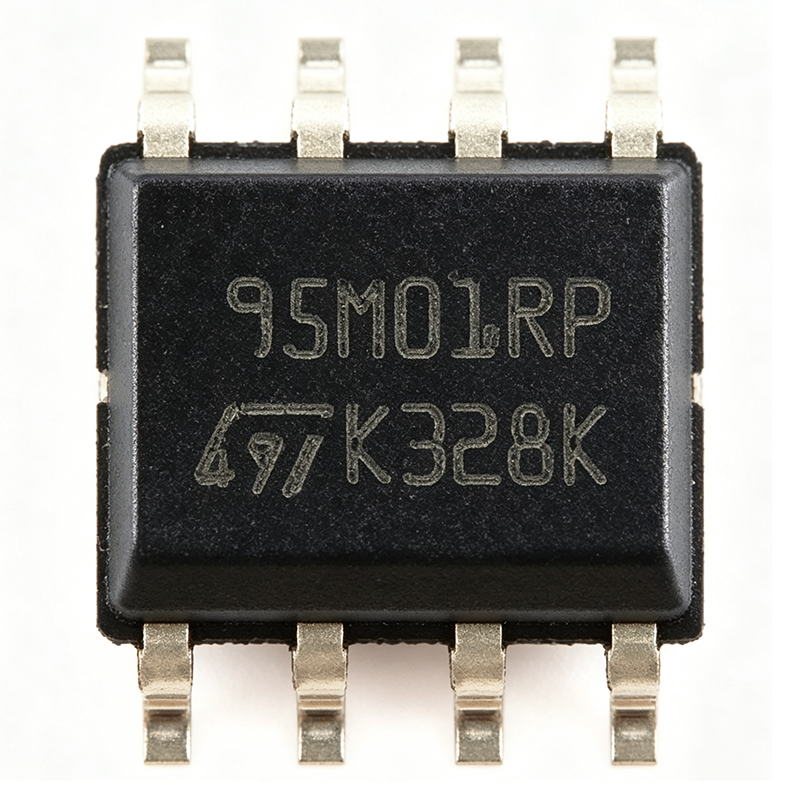
M95M01-RMN6TP - 1Mbit SPI EEPROM | STMicroelectronics
The M95M01-RMN6TP is a 1-Mbit (128 Kbyte) serial EEPROM from STMicroelectronics, organized as 131,072 x 8 bits and accessed via a high-speed SPI bus. It operates from a single 2.5V to 5.5V power supply, supports clock frequencies up to 16 MHz, and is housed in a standard 8-pin SOIC (SO-8N) package. Data verified as of 2026-08-05. An EEPROM (Electrically Erasable Programmable Read-Only Memory) is a non-volatile memory that retains data when power is removed and can be electrically erased and reprogrammed in-system. It sits within the memory hierarchy as a type of non-volatile memory, below flash memory in density but offering byte-level erase/write granularity and higher endurance for frequent small updates. In the product taxonomy, EEPROM is a subclass of memory ICs, which fall under integrated circuits, ultimately part of the broader semiconductor category. Key features include a 16 MHz SPI interface (SPI-compatible modes 0 and 0), a write time of 5 ms typical, and a write endurance of 4 million write cycles per byte. The device also offers a 200-year data retention at 55°C, a page size of 256 bytes, and a self-timed programming cycle with automatic address increment. The SO-8N package is widely used and footprint-compatible with many industry-standard EEPROMs, enabling drop-in replacement in existing designs. The M95M01 uses a standard SPI protocol with Chip Select (S), Serial Clock (C), Serial Data Input (D), and Serial Data Output (Q) pins. It includes a Write Protect (W) pin and a Hold (HOLD) pin for suspending communication without resetting the device. The memory array is organized into pages, and the device supports sequential read and write operations across page boundaries, simplifying firmware design. Typical applications include industrial automation parameter storage, smart metering data logging, medical device calibration data, and automotive electronics (non-safety-critical) where reliable non-volatile storage is required. The wide voltage range and high endurance make it suitable for frequent data updates in embedded systems. When designing with this device, ensure the SPI bus is properly terminated and that the Write Protect pin is controlled to prevent accidental writes. The HOLD pin should be pulled high if unused. For high-reliability applications, consider the device's 4 million write cycle endurance and 200-year data retention specifications. This page synthesizes distributor pricing, drop-in alternatives, and practical design notes not found in the STMicroelectronics datasheet, providing engineers with a comprehensive resource for selecting and using the M95M01-RMN6TP.
M95M02-DRMN6TP - 2Mbit SPI EEPROM | STMicroelectronics
The M95M02-DRMN6TP is a 2-Mbit (256 Kbyte) serial EEPROM from STMicroelectronics, organized as 262,144 x 8 bits and accessed via a high-speed SPI bus. It operates from a 1.8V to 5.5V supply, supports clock frequencies up to 20 MHz, and is housed in a compact SO-8N package. This device is designed for applications requiring reliable, non-volatile data storage with low power consumption and high endurance. An EEPROM (Electrically Erasable Programmable Read-Only Memory) is a type of non-volatile memory that can be electrically erased and reprogrammed. It retains data without power, making it essential for storing configuration parameters, calibration data, and small amounts of firmware in embedded systems. EEPROMs are part of the broader memory IC hierarchy: EEPROM -> serial EEPROM -> SPI EEPROM -> non-volatile memory -> semiconductor memory. The SPI interface provides a simple, high-speed serial connection using just four wires (SCK, MOSI, MISO, CS), reducing pin count and PCB area compared to parallel EEPROMs. Key features of the M95M02-DRMN6TP include a 20 MHz maximum clock frequency, byte and page write modes (up to 256 bytes per page), and a write time of 5 ms per page. It offers a write endurance of 4 million write cycles and data retention of 100 years, ensuring long-term reliability. The device also includes a hardware write-protect pin (WC) and a status register with a Write-In-Progress (WIP) bit for software polling. The SO-8N package is industry-standard, enabling drop-in compatibility with many other 2-Mbit SPI EEPROMs. Technically, the M95M02-DRMN6TP uses a floating-gate transistor architecture, which is standard for EEPROM technology. The SPI interface supports modes 0 and 3, and the device is compatible with both 3-wire and 4-wire SPI configurations. The memory array is organized into 1024 pages of 256 bytes each, allowing efficient block writes. The device also features a deep power-down mode that reduces current consumption to 1 uA, ideal for battery-powered applications. Typical applications include industrial automation for storing calibration and configuration data, smart meters for logging consumption data, and automotive electronics for storing VIN and diagnostic information. The wide voltage range and high endurance make it suitable for harsh environments. In IoT devices, it stores device credentials and sensor calibration data. When designing with this device, ensure the SPI bus is properly terminated and the CS pin is held high when the device is not selected. Use a 0.1 uF decoupling capacitor close to the VCC pin. For write operations, poll the WIP bit or wait 5 ms before initiating the next command to avoid data corruption.