Microprocessors
Products (2)

STM32MP153DAC1 - Dual Cortex-A7 + M4 MPU | STMicroelectronics
The STMicroelectronics STM32MP153DAC1 is a high-performance heterogeneous microprocessor (MPU) that combines a dual-core Arm Cortex-A7 application processor running up to 650 MHz with a Cortex-M4 coprocessor at 209 MHz. This device is designed for industrial and IoT applications requiring both rich operating system support (Linux/Android) and real-time deterministic control. The STM32MP153DAC1 is part of the STM32MP1 series, which integrates advanced security features, rich connectivity, and a comprehensive power management architecture. What is a heterogeneous microprocessor? A heterogeneous MPU integrates different types of processor cores on a single chip, typically a high-performance application core (like Cortex-A7) for running complex operating systems and a real-time core (like Cortex-M4) for time-critical tasks. This architecture allows a single chip to handle both user interface, networking, and control loops, reducing system cost and complexity. In the system hierarchy, the STM32MP153DAC1 sits above traditional microcontrollers (MCUs) by offering application-class performance while retaining MCU-like peripheral control and real-time capabilities. Key features of the STM32MP153DAC1 include a dual-core Cortex-A7 at 650 MHz, a Cortex-M4 at 209 MHz, a 3D GPU (Graphics Processing Unit) for enhanced user interfaces, and a comprehensive set of connectivity options including Gigabit Ethernet, USB 2.0, CAN FD, and multiple UART/SPI/I2C interfaces. The device supports up to 1 GB of DDR3/DDR3L memory and features a rich set of security functions such as secure boot, cryptographic acceleration, and a true random number generator (TRNG). The STM32MP153DAC1 is manufactured using a 28nm FD-SOI process, which provides low power consumption and high performance. The device includes a flexible power management unit with multiple voltage domains, allowing designers to optimize power for their specific application. The dual-core architecture enables asymmetric multiprocessing (AMP) or symmetric multiprocessing (SMP) configurations, providing flexibility in software design. Typical applications include industrial HMI (Human-Machine Interface) panels, smart factory controllers, IoT gateways, medical monitoring devices, and edge computing nodes. The combination of application processing and real-time control makes it ideal for systems that need to run Linux for connectivity and user interface while maintaining deterministic response for machine control. When designing with the STM32MP153DAC1, careful attention must be paid to power sequencing and decoupling. The device requires multiple supply rails (VDD, VDD_CPU, VDD_IO) that must be powered in a specific order. A dedicated PMIC (Power Management IC) such as the STPMIC1 is recommended to simplify power design and ensure proper sequencing.
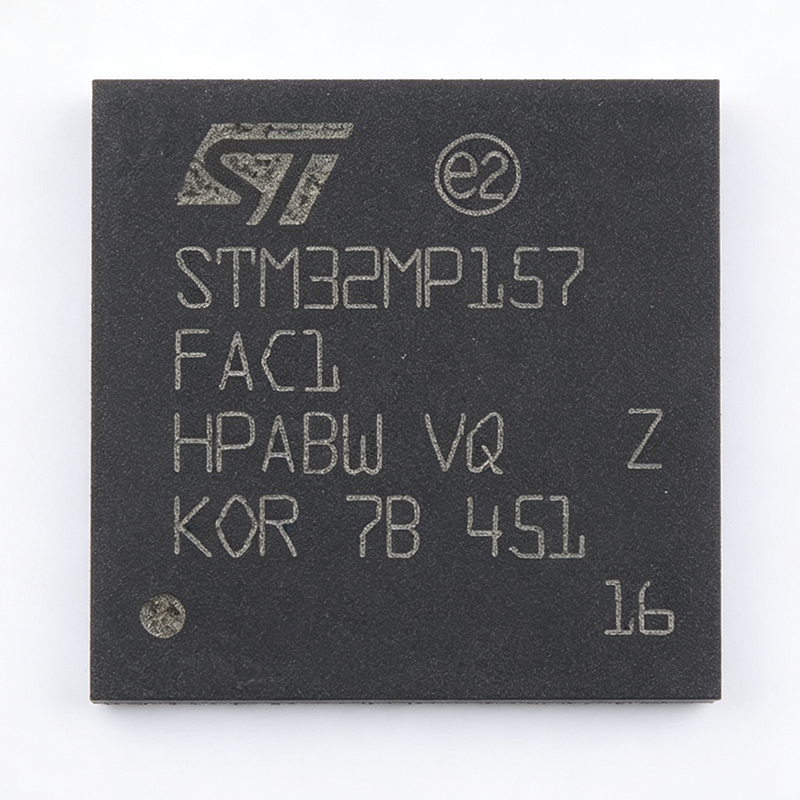
STM32MP157FAC1 - Dual Cortex-A7 + M4 MPU | STMicroelectronics
The STMicroelectronics STM32MP157FAC1 is a high-performance heterogeneous microprocessor (MPU) that combines a dual-core Arm Cortex-A7 application processor running up to 800 MHz with a Cortex-M4 real-time core running up to 209 MHz. This device is designed for advanced embedded applications requiring both rich operating system support (Linux, Android) and deterministic real-time control. It is housed in a 361-ball TFBGA package (12x12 mm, 0.5 mm pitch) and operates over a temperature range of -20°C to +105°C. A microprocessor (MPU) is a complete processing unit that integrates one or more CPU cores, memory controllers, and peripheral interfaces on a single chip, designed to run complex operating systems. In the system hierarchy, an MPU sits above a microcontroller (MCU) in processing power and memory capability, enabling applications such as human-machine interfaces (HMI), industrial gateways, and edge computing. The STM32MP157FAC1 belongs to the STM32MP1 series, which bridges the gap between high-performance application processors and the extensive STM32 ecosystem. Key features include a rich set of connectivity options: 2x Ethernet (10/100/1000 Mbps), 2x USB 2.0 OTG, 8x UART, 5x I2C, 5x SPI, and 2x CAN FD. It also integrates a 3D GPU (OpenGL ES 2.0), a 2D graphics accelerator, and a MIPI-DSI display interface, making it ideal for graphical user interfaces. The device supports up to 1 GB of external DDR3/DDR3L/LPDDR2/LPDDR3 memory and includes a comprehensive security suite with cryptographic acceleration and secure boot. From a technical architecture perspective, the STM32MP157FAC1 uses a heterogeneous multicore design where the Cortex-A7 cores handle high-level operating systems and the Cortex-M4 core manages real-time tasks. The two domains communicate through a hardware mailbox and shared memory, enabling efficient collaboration. The device also features a dedicated power management unit with multiple low-power modes, including standby and shutdown, to optimize energy consumption in battery-powered applications. Typical applications include industrial HMI panels, smart home gateways, medical monitoring devices, and edge AI inference nodes. The combination of high-performance processing, rich graphics, and real-time control makes it a versatile choice for products that require both user interaction and deterministic response. When designing with this device, careful attention must be paid to power sequencing and decoupling. The multiple power rails (VDD, VDD_IO, VDD_3V3, etc.) require proper sequencing to avoid latch-up. A dedicated PMIC (such as the STPMIC1) is recommended to manage the complex power requirements. Additionally, the DDR memory interface requires impedance-controlled routing and proper termination for signal integrity at high speeds.