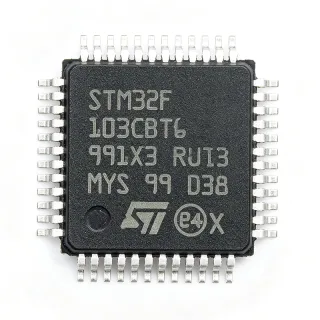
STM32MP153DAC1 - Dual Cortex-A7 + M4 MPU | STMicroelectronics
MPN: STM32MP153DAC1 ✓ Active| Qty | Unit Price | Extended |
|---|---|---|
| 1 | $12.5 | $12.50 |
| 10 | $11.25 | $112.50 |
| 100 | $10 | $1,000.00 |
| 500 | $8.75 | $4,375.00 |
| 1,000 | $7.47 | $7,470.00 |
Drop-in alternatives for STM32MP153DAC1 — same package, pin-to-pin compatible. Different-package parts requiring PCB rework are excluded.
Quick Comparison Tool — Select alternative parts for side-by-side comparison:
STM32MP153DAA1
✅ Drop-In ⚠️ 参数待验证📋 Reference alternative (not in catalog)
STM32MP153CAC3
✅ Drop-In✓ In Stock
$12 / Unit
View Datasheet →STM32MP153CAA3
✅ Drop-In📋 Reference alternative (not in catalog)
STM32MP157CAC3
✅ Drop-In✓ In Stock
$7 / Unit
View Datasheet →STM32MP157DAC1
✅ Drop-In ⚠️ 参数待验证📋 Reference alternative (not in catalog)
STM32MP153DAC1 Maximum Ratings & Electrical Characteristics
| Core Processor | ARM Cortex-A7 + Cortex-M4 |
| Number of Cores | 2 Core, 32-Bit |
| Core Speed | 209MHz, 800MHz |
| Package | 361-TFBGA (12x12) |
| Mounting Type | Surface Mount |
| Connectivity | Gigabit Ethernet, USB 2.0, CAN FD, UART, SPI, I2C |
| Graphics | 3D GPU |
| Security Features | Secure boot, cryptographic acceleration, TRNG |
| Process Technology | 28nm FD-SOI |
| RoHS Status | Compliant |
| Series | STM32MP1 |
STM32MP153DAC1 Pin Configuration
| Pin A1 | VDD — Power supply |
| Pin A2 | VSS — Ground |
| Pin B1 | VDD_CPU — CPU power supply |
| Pin B2 | VDD_IO — I/O power supply |
| Pin C1 | ETH_RX — Ethernet receive |
| Pin C2 | ETH_TX — Ethernet transmit |
| Pin D1 | USB_DP — USB data plus |
| Pin D2 | USB_DM — USB data minus |
| Pin E1 | CAN_TX — CAN transmit |
| Pin E2 | CAN_RX — CAN receive |
| Pin F1 | UART_TX — UART transmit |
| Pin F2 | UART_RX — UART receive |
Safe Operating Area (SOA) & Thermal Characteristics
No official SOA curve available for this component. Always operate within absolute maximum ratings specified in the datasheet. Ensure adequate cooling and derate as needed.
Typical Applications
STM32MP153DAC1 is suitable for 6 applications: Industrial HMI Panels, IoT Gateways, Smart Factory Controllers, Medical Monitoring Devices, Edge Computing Nodes, Smart Home Hubs.
Industrial HMI Panels
The STM32MP153DAC1 is ideal for industrial HMI panels due to its dual-core Cortex-A7 at 650 MHz, which can run Linux for rich user interfaces, and the Cortex-M4 at 209 MHz for real-time control. The integrated 3D GPU enhances graphical displays, while the rich connectivity options (Gigabit Ethernet, USB, CAN FD) support industrial communication protocols. In a typical HMI application, the MPU is connected to a TFT display via the parallel interface, with the Cortex-A7 handling the GUI and the Cortex-M4 managing touch input and machine control. The device's low power consumption on 28nm FD-SOI makes it suitable for fanless designs. Compared to using separate MCU and application processor, this heterogeneous architecture reduces BOM cost and board space.
Recommended
IoT Gateways
The STM32MP153DAC1 is well-suited for IoT gateways that require both application processing for cloud connectivity and real-time control for local sensor management. The dual-core Cortex-A7 can run Linux for MQTT/HTTP communication, while the Cortex-M4 handles time-critical sensor data acquisition and actuation. The device's Gigabit Ethernet and USB 2.0 interfaces enable high-speed data transfer to the cloud, and the security features (secure boot, cryptographic acceleration) ensure secure communication. In a typical IoT gateway, the MPU is connected to sensors via I2C/SPI, and to the internet via Ethernet. The low power consumption is critical for always-on devices. The heterogeneous architecture allows efficient handling of both protocol stacks and real-time tasks without external MCUs.
Recommended
Smart Factory Controllers
The STM32MP153DAC1 is ideal for smart factory controllers that need to run complex algorithms for machine vision or predictive maintenance while maintaining deterministic control over actuators. The Cortex-A7 cores can handle high-level processing and communication, while the Cortex-M4 provides real-time control with low latency. The device's CAN FD interface supports industrial automation protocols, and the 29 timers allow precise PWM generation for motor control. In a typical factory controller, the MPU is connected to sensors and actuators via CAN and GPIO, and to a central server via Ethernet. The 28nm FD-SOI process ensures reliable operation in harsh industrial environments. The heterogeneous architecture enables a single-chip solution, reducing system complexity and cost.
Recommended
Medical Monitoring Devices
The STM32MP153DAC1 is suitable for medical monitoring devices that require both advanced user interfaces and real-time signal processing. The Cortex-A7 cores can run Linux for display and data logging, while the Cortex-M4 handles real-time acquisition of vital signs (ECG, SpO2) with precise timing. The device's security features ensure patient data protection, and the low power consumption is critical for portable devices. In a typical medical monitor, the MPU is connected to analog front-end via SPI, and to a display via parallel interface. The 3D GPU can render waveforms smoothly. The heterogeneous architecture allows the system to meet strict real-time requirements while providing a rich user experience.
Recommended
Edge Computing Nodes
The STM32MP153DAC1 is well-suited for edge computing nodes that need to process data locally with low latency. The dual-core Cortex-A7 at 650 MHz can run lightweight AI inference or data analytics, while the Cortex-M4 handles sensor data collection and control. The device's Gigabit Ethernet and USB 2.0 interfaces enable high-speed data transfer to the cloud or local servers. In a typical edge node, the MPU is connected to sensors via I2C/SPI, and to the network via Ethernet. The security features ensure secure data processing. The heterogeneous architecture allows efficient handling of both compute-intensive tasks and real-time I/O, making it ideal for industrial IoT and smart city applications.
Recommended
Smart Home Hubs
The STM32MP153DAC1 is ideal for smart home hubs that need to manage multiple protocols (Zigbee, Z-Wave, Wi-Fi) and provide a user interface. The Cortex-A7 cores can run Linux for protocol stacks and cloud connectivity, while the Cortex-M4 handles real-time control of home automation devices. The device's USB 2.0 and UART interfaces support various wireless modules. In a typical smart home hub, the MPU is connected to a Wi-Fi module via SDIO, and to a display via parallel interface. The low power consumption is essential for always-on devices. The heterogeneous architecture allows the hub to handle both complex networking and real-time device control efficiently.
Recommended
Recommended Products Summary
Engineering reference data for STM32MP153DAC1 — comparison, design guidance, and compliance information.
Selection Guide
Comparison with Alternatives
| Parameter | This Product | STM32MP153DAA1 | STM32MP153CAC3 | STM32MP153CAA3 | STM32MP157CAC3 | STM32MP157DAC1 |
|---|---|---|---|---|---|---|
| Package | 361-TFBGA (12x12) | 361-TFBGA (12x12) | 361-TFBGA (12x12) | 361-TFBGA (12x12) | 361-TFBGA (12x12) | 361-TFBGA (12x12) |
| Brand | STMicroelectronics | STMicroelectronics | STMicroelectronics | STMicroelectronics | STMicroelectronics | STMicroelectronics |
| Core Processor | ARM Cortex-A7 + Cortex-M4 | ARM Cortex-A7 + Cortex-M4 | ARM Cortex-A7 + Cortex-M4 | ARM Cortex-A7 + Cortex-M4 | ARM Cortex-A7 + Cortex-M4 | ARM Cortex-A7 + Cortex-M4 |
| Core Speed | 209MHz, 800MHz | 209MHz, 800MHz | 209MHz, 800MHz | 209MHz, 800MHz | 209MHz, 800MHz | 209MHz, 800MHz |
| 3D GPU | Yes | Yes | Yes | Yes | Yes | Yes |
| Connectivity | Gigabit Ethernet, USB 2.0, CAN FD, UART, SPI, I2C | Gigabit Ethernet, USB 2.0, CAN FD, UART, SPI, I2C | Gigabit Ethernet, USB 2.0, CAN FD, UART, SPI, I2C | Gigabit Ethernet, USB 2.0, CAN FD, UART, SPI, I2C | Gigabit Ethernet, USB 2.0, CAN FD, UART, SPI, I2C | Gigabit Ethernet, USB 2.0, CAN FD, UART, SPI, I2C |
| Security Features | Secure boot, cryptographic acceleration, TRNG | Secure boot, cryptographic acceleration, TRNG | Secure boot, cryptographic acceleration, TRNG | Secure boot, cryptographic acceleration, TRNG | Secure boot, cryptographic acceleration, TRNG | Secure boot, cryptographic acceleration, TRNG |
| Process Technology | 28nm FD-SOI | 28nm FD-SOI | 28nm FD-SOI | 28nm FD-SOI | 28nm FD-SOI | 28nm FD-SOI |
Key Differentiators
- Heterogeneous dual-core architecture (vs NXP i.MX 6ULL)
- Integrated 3D GPU (vs NXP i.MX 6ULL)
- 28nm FD-SOI process (vs NXP i.MX 6ULL)
Design Notes
The STM32MP153DAC1 requires multiple power rails (VDD, VDD_CPU, VDD_IO) that must be powered in a specific sequence. Use a dedicated PMIC like the STPMIC1 to ensure proper power-up and power-down sequencing. Refer to the STM32MP153A/D datasheet for the exact power sequencing requirements. Incorrect sequencing can cause latch-up or damage to the device.
For the 361-TFBGA (12x12) package, ensure adequate decoupling capacitors are placed close to each power pin. Use a 100nF capacitor for each VDD pin and a 10uF bulk capacitor for each power domain. Follow the layout guidelines in the STM32MP153A/D application note for BGA packages to minimize inductance and ensure signal integrity.
The STM32MP153DAC1 can dissipate significant power when both Cortex-A7 cores are running at full speed. Ensure proper thermal management by providing a thermal pad on the PCB and using vias to conduct heat to the ground plane. The 28nm FD-SOI process helps reduce power consumption, but for high-performance applications, a heatsink or active cooling may be required. Refer to the thermal characteristics in the datasheet.
Compliance Information
RoHS compliance is indicated by STMicroelectronics. Other compliance details are not specified in the provided data.