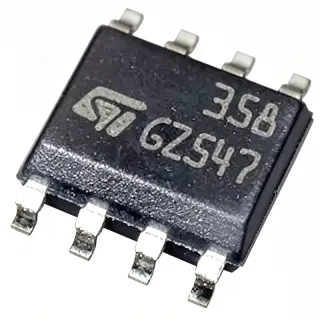
LM358QDRQ1 - Automotive Dual 1MHz Op-Amp SOIC-8 | Texas Instruments
MPN: LM358QDRQ1 ✓ Active| Qty | Unit Price | Extended |
|---|---|---|
| 1 | $0.45 | $0.45 |
| 10 | $0.38 | $3.80 |
| 100 | $0.28 | $28.00 |
| 500 | $0.22 | $110.00 |
| 1,000 | $0.18 | $180.00 |
Drop-in alternatives for LM358QDRQ1 — same package, pin-to-pin compatible. Different-package parts requiring PCB rework are excluded.
Quick Comparison Tool — Select alternative parts for side-by-side comparison:
LM358ADR
✅ Drop-In📋 Reference alternative (not in catalog)
LM2904QDRQ1Q1
✅ Drop-In📋 Reference alternative (not in catalog)
LMV358AQDRQ1
✅ Drop-In📋 Reference alternative (not in catalog)
MC33202DR2
✅ Drop-In📋 Reference alternative (not in catalog)
LM2904YDT
✅ Drop-In📋 Reference alternative (not in catalog)
LM358QDRQ1 Maximum Ratings & Electrical Characteristics
| Amplifier Type | General Purpose |
| Number of Circuits | 2 |
| Gain Bandwidth Product | 1 MHz |
| Slew Rate | [DATA_NEEDED: slew rate] |
| Input Offset Voltage | [DATA_NEEDED: input offset voltage] |
| Supply Voltage Range | [DATA_NEEDED: supply voltage range] |
| Output Type | [DATA_NEEDED: rail-to-rail or standard output] |
| Automotive Qualification | Qualified for automotive applications (AEC-Q100 family) |
| Package / Case | 8-SOIC (0.154 in, 3.90 mm width) |
| Mounting Type | Surface Mount |
| Packaging | Tape & Reel (TR) |
| Operating Temperature | [DATA_NEEDED: operating temperature range] |
| Quiescent Current | [DATA_NEEDED: quiescent current] |
| Input Bias Current | [DATA_NEEDED: input bias current] |
| RoHS Status | Compliant |
| Related Family | LMV321-Q1 (single), LMV358-Q1 (dual), LMV324-Q1 (quad) rail-to-rail output op-amps |
LM358QDRQ1 Pin Configuration
| Pin 1 | OUT A — Output of amplifier A |
| Pin 2 | IN A- — Inverting input of amplifier A |
| Pin 3 | IN A+ — Non-inverting input of amplifier A |
| Pin 4 | V- / GND — Negative supply or ground (single supply) |
| Pin 5 | IN B+ — Non-inverting input of amplifier B |
| Pin 6 | IN B- — Inverting input of amplifier B |
| Pin 7 | OUT B — Output of amplifier B |
| Pin 8 | V+ — Positive supply |
Safe Operating Area (SOA) & Thermal Characteristics
No official SOA curve available for this component. Always operate within absolute maximum ratings specified in the datasheet. Ensure adequate cooling and derate as needed.
Typical Applications
LM358QDRQ1 is suitable for 6 applications: Automotive Sensor Signal Conditioning, Current Sense Amplification Front-End, Active Filter Stages, Comparator and Level-Shifter Functions, Battery Management Monitoring, Industrial Control and Automation Analog Front-Ends.
Automotive Sensor Signal Conditioning
The LM358QDRQ1's Q1 automotive qualification and 1 MHz gain bandwidth make it well suited to conditioning low-frequency sensor signals such as pressure, position, and temperature in ECU front-ends. Used as a non-inverting amplifier or buffer between a resistive sensor bridge and an ADC, it adds gain with the offset floor appropriate for 12V single-supply rails. Its two channels allow amplification plus an active filter stage in one SOIC-8 footprint, reducing board area and BOM count in high-volume automotive builds.
Recommended
Current Sense Amplification Front-End
Paired with a shunt resistor, the LM358QDRQ1 amplifies small differential voltages for battery-management and load-monitoring circuits in vehicles and industrial equipment. Its general-purpose input stage and wide single-supply operation let one channel amplify the shunt signal while the second channel sets a reference or drives a fault comparator. For dedicated high-accuracy current sensing, TI INA-series amplifiers integrate the precision stage; the LM358-Q1 remains the economical choice where moderate accuracy and 1 MHz bandwidth are sufficient.
Recommended
Active Filter Stages
With a 1 MHz gain bandwidth product, the LM358QDRQ1 implements Sallen-Key and multiple-feedback active filters with corner frequencies up to tens of kilohertz while preserving adequate loop gain for accurate Q and cutoff settings. This fits anti-aliasing filters ahead of ADCs in automotive sensor modules and industrial controllers. Keeping closed-loop gains at or below 10x preserves bandwidth and phase margin; designers should account for the classic LM358 output stage swing limits when setting filter output headroom on single supplies.
Recommended
Comparator and Level-Shifter Functions
One LM358QDRQ1 channel can operate as a low-speed comparator for over-voltage, under-voltage, or window detection in 12V and 24V automotive rails, while the second channel buffers a threshold derived from a voltage reference. At 1 MHz-class speed it suits DC and slow transient supervision rather than fast edge detection. This dual-role usage - supervision plus reference buffering in one SOIC-8 package - is a common pattern in ECU power-monitoring and industrial power-supply health circuits where cost and board space dominate.
Recommended
Battery Management Monitoring
In battery-management systems, the LM358QDRQ1 buffers cell-voltage dividers and temperature-monitoring outputs before they reach a battery-monitor IC or microcontroller ADC. The Q1 automotive grade supports under-hood and traction-adjacent environments, and the dual channels let one package handle both a voltage buffer and a temperature-signal gain stage. Designers should bias inputs to keep the amplifier in its linear region across the full cell-voltage span, given the standard (non-rail-to-rail) output swing of the classic LM358 architecture.
Recommended
Industrial Control and Automation Analog Front-Ends
Beyond vehicles, the LM358QDRQ1 serves PLC I/O cards, motor-control supervisory circuits, and instrumentation front-ends that condition 0-10V or 4-20mA-derived signals. Its general-purpose bipolar design tolerates the noisy electrical environment of factory floors, and the SOIC-8 surface-mount footprint integrates into standard SMT assembly. The 1 MHz bandwidth covers control-loop feedback signals comfortably; for precision instrumentation where sub-millivolt offsets matter, TI's OPA series is the upgrade path at higher cost.
Recommended
Recommended Products Summary
Engineering reference data for LM358QDRQ1 — comparison, design guidance, and compliance information.
Selection Guide
Comparison with Alternatives
| Parameter | This Product | LM358ADR | LM2904QDRQ1Q1 | LMV358AQDRQ1 | MC33202DR2 | LM2904YDT |
|---|---|---|---|---|---|---|
| Package | SOIC-8 (D) | SOIC-8 (D) - same | SOIC-8 (D) - same | SOIC-8 (D) - same | SOIC-8 - same | SOIC-8 - same |
| Brand | Texas Instruments | Texas Instruments | Texas Instruments | Texas Instruments | onsemi | STMicroelectronics |
| Number of Circuits | 2 | 2 | 2 | 2 | 2 | 2 |
| Gain Bandwidth Product | 1 MHz | 1 MHz | 1 MHz | 1 MHz | 2.2 MHz | 1 MHz |
| Output Type | [DATA_NEEDED: output type] | Standard | Standard | Rail-to-Rail Output | Rail-to-Rail Output | Standard |
| Automotive Qualification | Q1 automotive flow | No (industrial) | Yes (Q1) | Yes (Q1) | No (industrial) | Automotive grade |
| Slew Rate | [DATA_NEEDED: slew rate] | [DATA_NEEDED] | [DATA_NEEDED] | 1 V/us | [DATA_NEEDED] | [DATA_NEEDED] |
| Approximate Unit Price (qty 1) | $0.45 | [DATA_NEEDED] | [DATA_NEEDED] | $0.1588 (LCSC) | [DATA_NEEDED] | [DATA_NEEDED] |
Key Differentiators
- Automotive Q1 qualification at commodity price (vs LM358ADR)
- Wide-supply classic architecture vs low-voltage variant (vs LMV358AQDRQ1)
- Cost and second-source coverage vs precision amplifiers (vs MC33202DR2)
Design Notes
The classic LM358 architecture does not swing rail-to-rail on the output: the output approaches the negative rail closely but stops roughly 1.5V below the positive supply under load. Do not design output ranges that require the positive rail; budget headroom or choose the rail-to-rail LMV358-Q1 variant instead. Also note the input common-mode range includes the negative rail but not the positive rail.
Place a 100 nF ceramic decoupling capacitor directly at pin 8 (V+) to pin 4 (V-/GND), plus a 1 uF bulk capacitor per supply rail. In automotive environments with load-dump transients, protect the supply pin with a series resistor or TVS clamp if the rail can exceed the device maximum rating.
With 1 MHz gain bandwidth, closed-loop gains above 10x erode bandwidth and phase margin; a gain-of-10 amplifier has only about 100 kHz of usable bandwidth. For filters, verify that the corner frequency is at least a decade below GBW divided by the noise gain to keep Q accurate. Keep feedback resistors in the 1k-100k range to balance bias-current error and stability.
Compliance Information
Q1 suffix denotes TI automotive flow with AEC-Q100-family qualification. RoHS/lead-free per standard TI automotive flow; verify REACH and halogen-free status on TI product page.