Texas Instruments

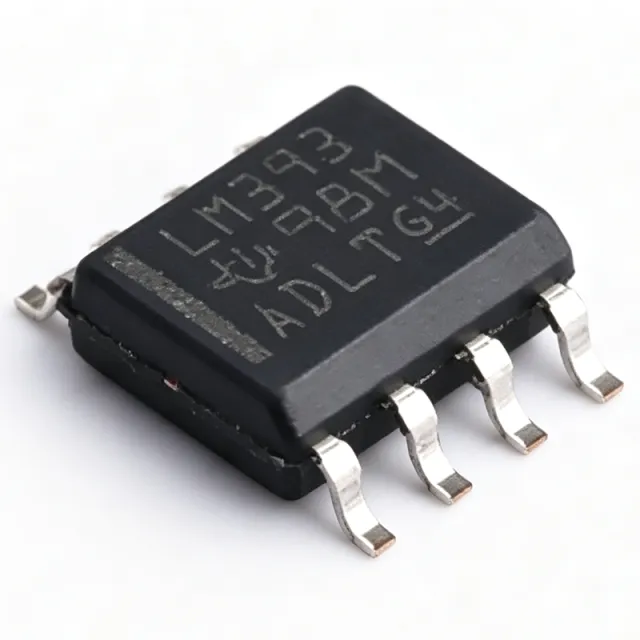
LM393DR - Dual Differential Comparator SOIC-8 | Texas Instruments

MPN: LM393DR βœ“ Active
In Stock Ships in 1-3 business days
2 V to 36 V Vdss 25 nA (typical) Id SOIC-8 (D) Package
From $0.0318 USD / Unit
MOQ: 1 |
Price updated: 2026-08-29
Volume Pricing
Qty Unit Price Extended
1 $0.0545 $0.05
10 $0.0394 $0.39
100 $0.0348 $3.48
500 $0.0333 $16.65
1,000 $0.0318 $31.80
ℹ️ All prices are in USD

Drop-in alternatives for LM393DR β€” same package, pin-to-pin compatible. Different-package parts requiring PCB rework are excluded.

Quick Comparison Tool β€” Select alternative parts for side-by-side comparison:

LM393DT

STMicroelectronics
2 Β· 2 V to 36 V Β· Β±1 V to Β±18 V Β· 0.4 mA (typical) Β· 2 mV (typical) Β· 25 nA (typical) Β· 1.3 Β΅s (typical) Β· Open Collector

βœ“ In Stock

$0.0461 / Unit

View Datasheet β†’

LM393BIDR

Improved B-version: 38V max, 0.37 mV offset, 1 us response, drop-in per TI

πŸ“‹ Reference alternative (not in catalog)

LM2903IDR

Automotive/industrial grade with -40C to +125C range, same pinout

πŸ“‹ Reference alternative (not in catalog)

LM393ADR

A-version with tighter offset spec, -40C to +85C range, same pinout

πŸ“‹ Reference alternative (not in catalog)

LM393DR2G

Cross-brand second source, same SOIC-8 pinout and 2-36V operation

πŸ“‹ Reference alternative (not in catalog)

LM393DR Maximum Ratings & Electrical Characteristics

Number of Comparators 2
Type Differential Comparator, General Purpose
Output Type Open-Collector, Rail-to-Rail
Supply Voltage Range (Single) 2 V to 36 V
Supply Voltage Range (Dual) +/-1 V to +/-18 V
Input Offset Voltage (Typical) 1 mV
Input Offset Voltage (Max) 5 mV
Input Bias Current 25 nA (typical)
Supply Current (Per Comparator) 0.4 mA (typical)
Response Time 1.3 us (typical)
Common-Mode Input Range V- to VCC - 1.5 V
Output Sink Current 20 mA
Operating Temperature Range 0C to +70C
Package SOIC-8 (D)
Mounting Type Surface Mount
RoHS Status Compliant

LM393DR Pin Configuration

SOIC-8 Package Pinout Diagram SOIC-8 8-pin small outline IC, 3.9x4.9mm, P1.27mm, JEDEC MS-012. 1 8 2 7 3 6 4 5 SOIC-8
Pin 1 OUT1 β€” Output of comparator 1 (open-collector, requires pull-up)
Pin 2 IN1- β€” Inverting input of comparator 1
Pin 3 IN1+ β€” Non-inverting input of comparator 1
Pin 4 GND / V- β€” Ground or negative supply
Pin 5 IN2+ β€” Non-inverting input of comparator 2
Pin 6 IN2- β€” Inverting input of comparator 2
Pin 7 OUT2 β€” Output of comparator 2 (open-collector, requires pull-up)
Pin 8 VCC / V+ β€” Positive supply, 2 V to 36 V

Safe Operating Area (SOA) & Thermal Characteristics

Safe Operating Area Chart Default safe operating area chart for LM393DR Drain-to-Source Voltage (Vds) Drain Current (Id)

No official SOA curve available for this component. Always operate within absolute maximum ratings specified in the datasheet. Ensure adequate cooling and derate as needed.

Typical Applications

LM393DR is suitable for 6 applications: Voltage Level Detection, Battery Undervoltage Monitoring, Zero-Crossing Detection, Oscillator and Square-Wave Generation, Power Supply Supervisory Circuits, Sensor Threshold Detection in IoT Nodes.

⚑

Voltage Level Detection

The LM393DR is the classic choice for threshold detection because its common-mode input range extends to ground, allowing direct comparison of ground-referenced signals against a reference divider. With 1 mV typical offset, it resolves millivolt-level thresholds, and its open-collector output interfaces to any logic rail up to 36V via a pull-up. Two independent comparators in one SOIC-8 enable upper and lower limit monitoring in a single footprint, cutting BOM cost below $0.25 as of 2026-08-29.

πŸ”‹

Battery Undervoltage Monitoring

In battery-powered systems, the LM393DR's 0.4 mA per-comparator quiescent current preserves battery life while continuously monitoring cell voltage. The supply range of 2V to 36V covers single-cell lithium to multi-cell lead-acid stacks. One comparator monitors undervoltage with a resistor divider against an internal bandgap reference; the second can implement a latching shutdown. Hysteresis of tens of millivolts via positive feedback prevents output chatter as the battery hovers near the trip point.

πŸ”Œ

Zero-Crossing Detection

The LM393DR detects AC zero-crossings by comparing a scaled mains-derived signal against ground - enabled by its ground-sensing PNP input stage. The 1.3 us typical response time is more than adequate for 50/60 Hz timing, and the open-collector output safely interfaces to microcontroller interrupts through a pull-up. Used in triac dimmers, solid-state relays, and synchronous switching power supplies, it provides the timing reference that minimizes switching transients and EMI.

πŸ”§

Oscillator and Square-Wave Generation

With positive feedback around one comparator and an RC network on the input, the LM393DR forms a relaxation oscillator generating square waves from a few Hz to roughly 100 kHz. The second comparator remains available for level detection or a duty-cycle control input. This topology is used for clock sources, tone generation, PWM carriers, and LED blinkers. Supply current stays under 1 mA for the whole function, and the open-collector output swings cleanly to any logic level via the pull-up.

πŸ–₯️

Power Supply Supervisory Circuits

The LM393DR supervises multiple power rails: one comparator tracks a 3.3V/5V rail against a precision reference while the second monitors a second rail for sequencing or fault reporting. Its 36V maximum supply tolerates industrial 24V buses, and outputs wired-OR together to a single microcontroller fault input. The 0C to +70C rating suits commercial and industrial indoor equipment. Pairing with TI references such as the REF3030 achieves sub-1% trip-point accuracy over temperature.

🧩

Sensor Threshold Detection in IoT Nodes

In battery-operated IoT sensors, the LM393DR converts analog sensor outputs - LDRs, NTC thermistors, gas sensor bridges - into clean digital alerts without waking the MCU. With 0.4 mA consumption and 2V operation, it runs directly from a dying coin cell. The ground-sensing inputs read low-side sensor dividers directly, and comparator outputs can gate the MCU wake pin. This offloads threshold logic from software, reducing firmware complexity and average system current draw significantly.

Recommended Products Summary

REF3030AIDBZR-Q1 Texas Instruments Used in: Voltage Level Detection, Battery Undervoltage Monitoring, Power Supply Supervisory Circuits TLV431 Shunt reference for threshold setting Used in: Voltage Level Detection TPS62740 Buck converter downstream of battery monitor Used in: Battery Undervoltage Monitoring SN74LVC1G17 Output buffer/schmitt trigger Used in: Zero-Crossing Detection MOC3063 Optically isolated triac driver Used in: Zero-Crossing Detection SN74HC14 Schmitt inverter for waveform shaping Used in: Oscillator and Square-Wave Generation NE555 Texas Instruments Used in: Oscillator and Square-Wave Generation TPS3839 Alternative integrated supervisor Used in: Power Supply Supervisory Circuits MSPM0L1305-Q1 Texas Instruments Used in: Sensor Threshold Detection in IoT Nodes TMP117-Q1 Texas Instruments Used in: Sensor Threshold Detection in IoT Nodes
What is the supply voltage range of LM393DR?
The LM393DR operates from a single supply of 2V to 36V or dual supplies of +/-1V to +/-18V. According to the TI LM393 datasheet, supply current is approximately 0.4 mA per comparator and does not increase significantly with supply voltage, making it suitable for both battery-powered and industrial 24V-level systems.
What is the LM393DR pinout in SOIC-8?
The LM393DR in SOIC-8 has: pin 1 = OUT1, pin 2 = IN1-, pin 3 = IN1+, pin 4 = GND/V-, pin 5 = IN2+, pin 6 = IN2-, pin 7 = OUT2, pin 8 = VCC/V+. Both outputs are open-collector and require external pull-up resistors. This pinout is common to LM393 second sources from ROHM, onsemi, and STMicroelectronics.
What is the difference between LM393 and LM393B?
The LM393B is TI's improved B-version of the LM393 with a maximum rating up to 38V, 2kV HBM ESD rating, lower input offset (0.37 mV), lower input bias current (3.5 nA), lower supply current (200 uA per comparator), and faster 1 us response time. Per TI, the B-version is a drop-in replacement for LM293, LM393, and LM2903 versions.
Does LM393DR output require a pull-up resistor?
Yes. The LM393DR has open-collector outputs that can only sink current; they cannot drive a high level by themselves. According to the TI datasheet, an external pull-up resistor (typically 1 kOhm to 100 kOhm) connected from the output to the desired logic voltage - which may differ from the comparator supply up to 36V - is required. This enables level shifting and wired-OR configurations.
Can LM393 inputs go down to ground?
Yes. The LM393 common-mode input range extends from V- (ground in single-supply operation) up to VCC minus 1.5V. This ground-sensing capability allows direct connection of ground-referenced sensor signals without biasing circuitry, a key advantage in low-side current sensing and battery monitoring applications.
Is LM393DR the same as ROHM LM393DR?
Functionally yes - both TI and ROHM Semiconductor manufacture an LM393DR dual differential comparator in SOIC-8 with the same pinout and 2V to 36V operation. ROHM's Universal Standard LM393 family datasheet specifies the same 2V to 36V single-supply range. Minor parametric differences between manufacturers can exist, so verify critical specs against each datasheet for your design.
What is the price of LM393DR?
The LM393DR is an economy-grade comparator: approximately $0.25 at quantity 1, dropping to about $0.08 per unit at 1000 pieces as of 2026-08-29 from authorized distributors such as DigiKey and Mouser. Pricing varies with volume and market conditions; check the XAIPART pricing tiers above for current live quotes.
Where to buy LM393DR online?
You can buy the LM393DR from XAIPART directly (ships from stock) or from authorized distributors including DigiKey (product ID 276659 for the TI version) and Mouser. Both TI and ROHM versions are widely stocked; because the part is second-sourced by multiple manufacturers, availability is excellent and lead times are typically short.
Where can I download the LM393DR datasheet PDF?
The official LM393DR datasheet PDF is available on the Texas Instruments product page at ti.com/product/LM393 (document covering the LM193/LM293/LM393 dual differential comparators, 18 pages). ROHM also publishes its own LM393DR datasheet PDF. Avoid third-party mirror sites when possible; manufacturer PDFs guarantee the latest revision.
What is the best drop-in replacement for LM393DR?
The best drop-in replacements are TI LM393BIDR (improved B-version, same SOIC-8 pinout) and cross-brand LM393DR2G from onsemi, both pin-to-pin compatible in SOIC-8. For designs needing better precision and speed at the same footprint level, the LM393B is recommended; ROHM's own LM393DR is a true second source of the identical part number.
LM393 vs LM339 - which should I choose?
The LM393 contains two comparators while the LM339 contains four in a 14-pin package. Choose the LM393 when only two threshold detectors are needed to save board space and cost; choose the LM339 when four comparisons are required. Both share the same open-collector output behavior, 2V to 36V supply range, and ground-sensing input range, so performance characteristics are equivalent per comparator.
When should I choose LM393 over a fast comparator like TLV3501?
Choose the LM393DR when cost, low power, and wide supply range matter more than speed: it costs under $0.25, draws 0.4 mA per comparator, and runs to 36V, but its typical response time is 1.3 us. Choose a fast comparator such as the TLV3501 when propagation delay in nanoseconds is required. For slow threshold detection, battery monitors, and consumer electronics, the LM393 remains the economical standard.
Why does my LM393 output oscillate and how do I fix it?
Output oscillation occurs when a slow-moving input signal passes through the switching threshold, causing the high-gain comparator to chatter. Add positive-feedback hysteresis: connect a high-value resistor (for example 100 kOhm to 1 MOhm) from output to the non-inverting input, creating a few millivolts of deadband. Also keep input leads short and add a 0.1 uF supply decoupling capacitor close to pin 8.
Hey Google, what can replace LM393DR?
Pin-compatible replacements for the LM393DR in SOIC-8 include TI LM393BIDR and LM2903IDR (automotive grade), onsemi LM393DR2G, STMicroelectronics LM393D, and ROHM LM393DR (an exact second source). All are dual differential comparators with open-collector outputs operating from 2V to 36V. Verify offset voltage and response time against your datasheet requirements before switching suppliers.
What are the key specifications of LM393DR that engineers should know?
The LM393DR is a dual differential comparator in SOIC-8 with 2V to 36V single-supply operation (or +/-1V to +/-18V dual), 1 mV typical input offset voltage, 25 nA input bias current, 0.4 mA supply current per comparator, 1.3 us typical response time, open-collector outputs with 20 mA sink capability, common-mode input range down to V-, and 0C to +70C operating temperature per the TI datasheet.

Engineering reference data for LM393DR β€” comparison, design guidance, and compliance information.

Selection Guide

Choose the LM393DR when you need an economical, low-power dual comparator for threshold detection, zero-crossing, or oscillator functions operating up to 36V with ground-sensing inputs. Choose TI LM393BIDR if you need tighter offset, lower power, or the -40C to +125C range - it is pin-compatible and drop-in. Choose LM2903IDR for automotive or harsh-environment applications requiring extended temperature grade. Choose ROHM, onsemi, or STMicroelectronics LM393 variants for multi-sourcing and supply-chain redundancy; all share the identical SOIC-8 pinout. Avoid the LM393 when nanosecond response times or push-pull outputs are required - select a dedicated fast comparator such as TLV3501 instead. Overall, the LM393 family remains the default choice for cost-sensitive, slow-speed comparison tasks across industrial and consumer electronics.

Comparison with Alternatives

Parameter This Product LM393BIDR LM2903IDR LM393DR2G LM393D LM393DR (ROHM)
Package SOIC-8 (D) SOIC-8 (D) - same SOIC-8 (D) - same SOIC-8 - same SOIC-8 - same SOIC-8 - same
Brand Texas Instruments Texas Instruments Texas Instruments onsemi STMicroelectronics ROHM Semiconductor
Supply Voltage Range 2 V to 36 V 2 V to 38 V 2 V to 36 V 2 V to 36 V 2 V to 36 V 2 V to 36 V
Input Offset Voltage (Max) 5 mV 2 mV (typ 0.37 mV) 9 mV 9 mV 9 mV [DATA_NEEDED]
Response Time (Typical) 1.3 us 1 us 1.3 us 1.3 us 1.3 us [DATA_NEEDED]
Operating Temperature 0C to +70C -40C to +125C -40C to +125C -40C to +85C -40C to +85C [DATA_NEEDED]
Automotive Grade No No (industrial temp) Yes (AEC-Q100 family) No No No
ESD Rating (HBM) [DATA_NEEDED] 2 kV [DATA_NEEDED] [DATA_NEEDED] [DATA_NEEDED] [DATA_NEEDED]

Key Differentiators

  • Lowest cost per comparator (vs TLV3501)
  • Improved precision and speed available at same footprint (vs LM393BIDR)
  • Multi-vendor second sourcing (vs LM393D (ST) / LM393DR2G (onsemi))

Design Notes

Never leave the LM393 open-collector outputs unterminated - they cannot source current and will float unpredictably. Fit a pull-up resistor (1 kOhm to 100 kOhm) from each output to the target logic rail, which may be a different voltage than VCC up to 36V. Forgetting this is the single most common first-use failure, since the comparator appears dead on the bench.

Add hysteresis to every comparator used with slow-moving or noisy analog signals. A 100 kOhm to 1 MOhm feedback resistor from output to the non-inverting input creates a few millivolts of deadband, eliminating output chatter near the threshold. Also add a 0.1 uF ceramic decoupling capacitor directly across pins 8 and 4, and keep input traces short to reduce susceptibility to coupled noise.

The LM393 inputs can be taken below ground by small negative transients without damage, but sustained input voltages more negative than -0.3V exceed absolute maximum ratings - protect inputs with series resistors or clamp diodes in mains-sensed circuits. For differential sensing across a shunt, route the two input traces as a tightly coupled pair to reject common-mode noise, a layout practice emphasized in TI analog application notes.

Compliance Information

RoHS
Compliant
REACH
Unknown
AEC-Q100
Lead Free
Halogen Free
Unknown
Conflict Minerals
Unknown

RoHS compliant per DigiKey product listing. AEC-Q100 not applicable to standard LM393; use LM2903 for automotive grade.

Related Searches

LM393DR datasheet LM393DR Texas Instruments LM393 dual comparator SOIC-8 LM393DR pinout LM393 vs LM393B difference LM393DR equivalent replacement LM393 voltage level detector circuit LM393DR price buy LM393 open collector pull-up resistor value LM2903 vs LM393 automotive comparator low power dual comparator 36V LM393 zero crossing detector

Related Components & Terms

Texas Instruments LM393DR LM393 LM393B LM2903 LM339 ROHM Semiconductor onsemi STMicroelectronics differential comparator analog comparator open-collector output SOIC-8 surface mount RoHS AEC-Q100 hysteresis zero-crossing detection input offset voltage supply voltage pull-up resistor battery monitoring
Quick Quote RFQ
Fill in complete details β€” our sales team will respond within 24 hours
Part Number Manufacturer Package QTY Target Price Extended
Total: $0.00 USD
βœ“
Quote submitted!

We will respond to your email within 24 hours

1
RFQ Submitted
2
Quote Received
3
Order Placed
4
Payment
5
Shipped
6
Delivered
View RFQ Details