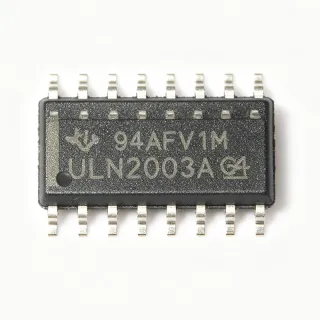
MPQ2222 - Quad NPN 40V 500mA Transistor Array | Central Semiconductor
MPN: MPQ2222 ✓ Active| Qty | Unit Price | Extended |
|---|---|---|
| 1 | $0.72 | $0.72 |
| 10 | $0.65 | $6.50 |
| 100 | $0.54 | $54.00 |
| 500 | $0.46 | $230.00 |
| 1,000 | $0.39 | $390.00 |
MPQ2222 Overview
A transistor array such as the MPQ2222 integrates multiple discrete BJTs into one package, sitting within the component hierarchy: NPN transistor -> bipolar junction transistor (BJT) -> transistor array -> discrete semiconductor. Arrays reduce board area, guarantee matched device characteristics from the same silicon lot, and simplify sourcing compared with four separate transistors, making them a staple of general-purpose amplifier and switching designs.
The defining feature of the MPQ2222 family is true independence: all four transistors share no internal connections, so designers can freely parallel them for higher current, configure Darlington pairs, or use each device in a separate circuit section. The 200 MHz transition frequency supports RF-to-VHF small-signal amplification, while the 500 mA per-device current rating covers relay drivers, LED drivers, and medium-power switching nodes. The through-hole DIP-14 (TO-116) footprint is ideal for prototyping, breadboarding, repair, and legacy industrial equipment.
Architecturally, the MPQ2222 uses diffused-junction NPN silicon planar construction identical to the industry-standard 2N2222 discrete device, so individual transistors behave exactly as a 2N2222 designer expects. The MPQ2222A suffix denotes the tighter 2N2222A-grade beta and leakage specifications.
Typical applications include general-purpose amplifiers, low-side switch banks, relay and solenoid drivers, LED column drivers, oscillator and multivibrator circuits, and analog front-end gain stages in industrial and instrumentation equipment.
Design consideration: total package dissipation of 650 mW is shared across all four devices; when paralleling transistors or running multiple hot devices, derate per the thermal resistance in the datasheet and verify junction temperature against the operating limit.
This page adds value beyond the manufacturer datasheet by synthesizing distributor pricing, drop-in alternatives, pinout data, and practical design notes in one place.
Drop-in alternatives for MPQ2222 — same package, pin-to-pin compatible. Different-package parts requiring PCB rework are excluded.
Variants in this series
Same-series models that are drop-in compatible with MPQ2222 (same form factor and footprint) — differing in Package, Emitter-Base Voltage (VEBO), Transistor Type, Collector-Base Voltage (VCBO), Application.
Quick Comparison Tool — Select alternative parts for side-by-side comparison:
MPQ2222A
✅ Drop-In✓ In Stock
$0.41 / Unit
View Datasheet →MPQ2222AR
✅ Drop-In📋 Reference alternative (not in catalog)
MPQ2222R
✅ Drop-In📋 Reference alternative (not in catalog)
MPQ2221A
✅ Drop-In📋 Reference alternative (not in catalog)
MPQ2222
✅ Drop-In✓ In Stock
$0.39 / Unit
View Datasheet →MPQ2222 Maximum Ratings & Electrical Characteristics
| Configuration | Quad NPN Transistor Array (4 independent devices) |
| Transistor Polarity | NPN Silicon |
| Collector-Emitter Voltage Rating | 40 V |
| Continuous Collector Current (per device) | 500 mA |
| Transition Frequency (fT) | 200 MHz |
| Power Dissipation (total package) | 650 mW |
| Package | 14-pin DIP (TO-116), Through Hole |
| Mounting Type | Through Hole |
| Marking | Full part number |
| RoHS Status | Lead-free (PB Free suffix version available) |
MPQ2222 Pin Configuration
| Pin 1 | E1 — Transistor 1 emitter |
| Pin 2 | B1 — Transistor 1 base |
| Pin 3 | C1 — Transistor 1 collector |
| Pin 4 | E2 — Transistor 2 emitter |
| Pin 5 | B2 — Transistor 2 base |
| Pin 6 | C2 — Transistor 2 collector |
| Pin 7 | NC — Not connected (per datasheet) |
| Pin 8 | C4 — Transistor 4 collector |
| Pin 9 | B4 — Transistor 4 base |
| Pin 10 | E4 — Transistor 4 emitter |
| Pin 11 | C3 — Transistor 3 collector |
| Pin 12 | B3 — Transistor 3 base |
| Pin 13 | E3 — Transistor 3 emitter |
| Pin 14 | NC — Not connected (per datasheet) |
Typical Applications
MPQ2222 is suitable for 6 applications: General-Purpose Amplifier Stages, Relay and Solenoid Driver Banks, LED Column and Indicator Drivers, Oscillators and Multivibrators, Legacy Industrial Equipment Repair and Maintenance, Switching Logic and Level Shifting in Prototype Systems.
General-Purpose Amplifier Stages
The MPQ2222 fits multi-stage general-purpose amplification because it provides four matched, independent NPN transistors with a 200 MHz transition frequency in one 14-pin DIP package, guaranteeing same-lot beta tracking that discrete transistors cannot. In a typical two- or three-stage common-emitter amplifier, the array supplies input, interstage, and output devices from a single part, reducing board area and BOM line count. With 40 V ratings, stages can run from 24 V industrial rails with headroom, and 500 mA per-device capability allows a lightly loaded output buffer. The through-hole DIP-14 footprint also simplifies hand rework during prototype gain-stage tuning.
Recommended
Relay and Solenoid Driver Banks
The MPQ2222 is a natural fit for driving multiple relays or small solenoids because each internal NPN sinks up to 500 mA, covering typical 5-24 V PCB relay coils that draw 30-100 mA. A single 14-pin DIP replaces four discrete driver transistors plus their base resistors, consolidating a four-channel driver onto one footprint. Designers should drive each base through a resistor sized for a forced beta of about 10 (for example, roughly 10 mA base drive for a 100 mA coil) to ensure hard saturation and low VCE(sat) dissipation. External flyback diodes across each coil are mandatory, as the array contains no integrated clamp diodes, and the 650 mW package limit governs simultaneous channel loading.
Recommended
LED Column and Indicator Drivers
For LED indicator columns, seven-segment digits, and lamp matrix rows, the MPQ2222 provides four independent low-side NPN switches in a single 14-pin DIP. Each channel comfortably handles multiple parallel indicator LEDs, since 500 mA per device far exceeds typical 20 mA-per-LED drive requirements, and the 200 MHz fT is more than sufficient for PWM dimming at tens of kilohertz. The same-lot transistor matching keeps brightness consistent across channels when driven with identical base currents. The through-hole package suits panel-mounted indicator boards and repair of legacy industrial annunciator panels where DIP-14 sockets are already present.
Recommended
Oscillators and Multivibrators
The MPQ2222 suits astable multivibrators, square-wave oscillators, and RC timing circuits because a single package supplies both (or all four) transistors with matched characteristics, which improves oscillator symmetry and duty-cycle accuracy compared with two unrelated discrete devices. With a 200 MHz transition frequency, RC-limited designs well into the hundreds of kilohertz operate without transistor speed constraints. The 40 V rating allows operation from 24 V industrial supplies, and the DIP-14 through-hole format is convenient for breadboarding timing circuits during development. For crystal oscillators, one array transistor serves as the oscillator and a second as the output buffer, keeping the total part count to one.
Recommended
Legacy Industrial Equipment Repair and Maintenance
The MPQ2222 is a key maintenance part for legacy industrial controllers, test instruments, and audio equipment originally designed around Motorola MPQ2222/MPQ2222A quad arrays in DIP-14 sockets. Central Semiconductor actively manufactures the type, and DigiKey stocks the PBFREE version for same-day shipment as of 2026-09-14, making it a reliable continuity source where the original Motorola parts are long discontinued. Because the Central part replicates the original TO-116 footprint and electrical behavior, boards can be repaired without PCB modification. The full part number marking also simplifies visual verification during servicing of production equipment where traceability matters.
Recommended
Switching Logic and Level Shifting in Prototype Systems
In prototyping and mixed-voltage bench systems, the MPQ2222 serves as a bank of general-purpose switches for level shifting, open-collector outputs, and microcontroller fan-out. Each transistor switches loads up to 500 mA at 40 V, so a single array can interface a 3.3 V or 5 V microcontroller to 12 V or 24 V loads with a base series resistor. The 200 MHz fT supports fast edge switching for pulse circuits, while matched same-package devices keep threshold behavior consistent across channels. The through-hole DIP-14 package is ideal for solderless breadboard prototypes and educational lab work where hand placement and socketing are routine.
Recommended
Recommended Products Summary
Engineering reference data for MPQ2222 — comparison, design guidance, and compliance information.
Selection Guide
Comparison with Alternatives
| Parameter | This Product | MPQ2222A | MPQ2222AR | MPQ2221A |
|---|---|---|---|---|
| Package | 14-pin DIP (TO-116) | 14-pin DIP (TO-116) - same | 14-pin DIP (TO-116) - same | 14-pin DIP (TO-116) - same |
| Brand | Central Semiconductor | Central Semiconductor | Central Semiconductor | Central Semiconductor |
| Transistor Configuration | 4x independent NPN | 4x independent NPN | 4x independent NPN | 4x independent NPN |
| Collector Current (per device) | 500 mA | 500 mA | 500 mA | 200 mA class (2N3904-type) |
| Voltage Rating Class | 40 V | 40 V | 40 V | 40 V class |
| Transition Frequency (fT) | 200 MHz | 200 MHz | 200 MHz | 300 MHz class |
| Total Package Power Dissipation | 650 mW | 650 mW | 650 mW | 625 mW class |
| hFE Grade | 2N2222 standard grade | 2N2222A tight grade | 2N2222A tight grade | 2N3904A grade |
Key Differentiators
- Higher current per device than the MPQ2221 family (vs MPQ2221A)
- Tighter beta grade available as pin-compatible drop-in (vs MPQ2222A)
- Active manufacture of a legacy Motorola type (vs Motorola-origin MPQ2222 (discontinued source))
Design Notes
Do not assume quad-array pinouts are interchangeable between families. The MPQ2222/MPQ2221 series use different emitter-base-collector pin assignments than other manufacturers' quad arrays, and R-suffix variants may use modified pin ordering. Always lay out or repair against the Central Semiconductor datasheet pin diagram (page 1 of the MPQ2222.PDF). Sockets in legacy boards may have been modified by previous servicing - verify continuity before dropping in a replacement array.
Estimated design check: the 650 mW total-package limit is shared by all four transistors. For a four-channel relay driver with each channel sinking 100 mA at VCE(sat) of roughly 0.3 V, per-channel dissipation is about 30 mW, totaling 120 mW - safe. However, four channels at 500 mA with 2 V VCE would dissipate 4 W, far beyond the limit. Derate using the datasheet total-package thermal resistance and your maximum ambient temperature before finalizing current budgets.
Place base resistors close to the DIP-14 base pins to minimize loop area and improve switching edge quality. For switching applications, provide a low-impedance ground return for all emitter pins; in this array the emitters are not commoned, so route each emitter to the appropriate circuit node, not to a shared ground unless the design intends common-emitter operation. The through-hole package suits prototypes; for new production consider verifying whether a surface-mount quad array better fits your assembly process.
Compliance Information
DigiKey lists the part as MPQ2222 PBFREE, indicating the lead-free/RoHS offering. REACH and halogen-free status not stated in provided data.