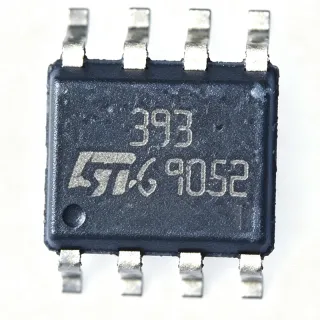
OPA211 - 1.1nV/√Hz Low-Noise Precision Op Amp | TI
MPN: OPA211 ✓ Active| Qty | Unit Price | Extended |
|---|---|---|
| 1 | $8.88 | $8.88 |
| 10 | $8.1 | $81.00 |
| 100 | $7.2 | $720.00 |
| 500 | $6.5 | $3,250.00 |
| 1,000 | $5.9 | $5,900.00 |
Drop-in alternatives for OPA211 — same package, pin-to-pin compatible. Different-package parts requiring PCB rework are excluded.
Quick Comparison Tool — Select alternative parts for side-by-side comparison:
OPA1611
✅ Drop-In📋 Reference alternative (not in catalog)
OPA827
✅ Drop-In✓ In Stock
$2.88 / Unit
View Datasheet →OPA627
✅ Drop-In✓ In Stock
$7.9 / Unit
View Datasheet →AD8675ARZ
✅ Drop-In✓ In Stock
$2.2 / Unit
View Datasheet →AD8676ARZ
✅ Drop-In✓ In Stock
$2.25 / Unit
View Datasheet →LT1128
✅ Drop-In📋 Reference alternative (not in catalog)
OPA211 Maximum Ratings & Electrical Characteristics
| Number of Channels | 1 |
| Total Supply Voltage (Min) | 4.5 V |
| Total Supply Voltage (Max) | 36 V |
| Input Offset Voltage | 50 µV (typical) |
| Input Bias Current | 60 nA |
| Voltage Noise Density | 1.1 nV/√Hz |
| Current Noise Density | 1.7 pA/√Hz |
| Gain Bandwidth Product | 80 MHz |
| Slew Rate | 20 V/µs |
| Quiescent Current | 3.6 mA |
| Output Type | Rail-to-Rail |
| Operating Temperature Range | -40°C to +125°C |
| Package Type | SOIC-8, VSSOP-8, SON-8 |
| Mounting Type | Surface Mount |
| RoHS Status | Compliant |
OPA211 Pin Configuration
| Pin 1 | OUT — Output |
| Pin 2 | -IN — Inverting input |
| Pin 3 | +IN — Non-inverting input |
| Pin 4 | V- — Negative supply |
| Pin 5 | NC — No connect |
| Pin 6 | V+ — Positive supply |
| Pin 7 | NC — No connect |
| Pin 8 | NC — No connect |
Safe Operating Area (SOA) & Thermal Characteristics
No official SOA curve available for this component. Always operate within absolute maximum ratings specified in the datasheet. Ensure adequate cooling and derate as needed.
Typical Applications
OPA211 is suitable for 6 applications: Low-Noise Audio Preamplifier, Precision Instrumentation Amplifier, Active Filter, Data Acquisition System, Medical Imaging Equipment, Test and Measurement Equipment.
Low-Noise Audio Preamplifier
The OPA211's 1.1 nV/√Hz noise density and low distortion make it ideal for high-end audio preamplifiers. In a phono preamp, the OPA211 amplifies the tiny signal from a cartridge while adding minimal noise, preserving the dynamic range. Its rail-to-rail output allows maximum headroom, and its 80 MHz bandwidth ensures accurate reproduction of high-frequency audio. The low quiescent current of 3.6 mA is beneficial for battery-powered portable audio devices. When used with a low-noise power supply and proper decoupling, the OPA211 delivers exceptional audio fidelity.
Recommended
Precision Instrumentation Amplifier
In precision instrumentation, the OPA211's low offset voltage (50 µV) and low noise are critical for accurate measurement. It can be used in a three-op-amp instrumentation amplifier configuration to amplify small sensor signals, such as from strain gauges or thermocouples. The high gain-bandwidth product (80 MHz) ensures stable amplification at high gains, while the rail-to-rail output maximizes the dynamic range of the ADC. The OPA211's low input bias current (60 nA) minimizes errors in high-impedance sensor interfaces. Its wide supply range (4.5 V to 36 V) accommodates various industrial power rails.
Recommended
Active Filter
The OPA211 is well-suited for active filters, such as low-pass or high-pass filters, due to its high bandwidth and low noise. In a fourth-order Butterworth low-pass filter, the OPA211 provides accurate frequency response with minimal phase error. Its 80 MHz gain-bandwidth product allows the filter to operate at high frequencies without degradation. The low noise ensures that the filter does not introduce additional noise into the signal path. The rail-to-rail output is beneficial for single-supply filter designs. The OPA211's stability at unity gain simplifies filter design, as it can be used in voltage-follower configurations.
Recommended
Data Acquisition System
In data acquisition systems, the OPA211 is used to condition signals before ADC conversion. Its low noise and high bandwidth ensure that the signal is accurately amplified without adding distortion. The OPA211 can drive high-resolution ADCs, such as 24-bit delta-sigma converters, with its rail-to-rail output and low output impedance. The low offset voltage minimizes DC errors, and the low input bias current reduces loading on high-impedance sources. The OPA211's wide supply range allows it to operate from various power rails in the system. Its small package options (SOIC-8, VSSOP-8, SON-8) make it easy to integrate into compact designs.
Recommended
Medical Imaging Equipment
The OPA211 is used in medical imaging equipment, such as ultrasound and MRI systems, where low noise and high precision are essential. In an ultrasound receiver, the OPA211 amplifies the weak echo signals from the body with minimal noise, improving image quality. Its high bandwidth (80 MHz) supports the high-frequency ultrasound signals. The low offset voltage ensures accurate signal processing, and the rail-to-rail output maximizes the dynamic range of the ADC. The OPA211's wide temperature range (-40°C to +125°C) ensures reliable operation in medical environments. Its low power consumption is beneficial for portable medical devices.
Recommended
Test and Measurement Equipment
In test and measurement equipment, such as oscilloscopes and spectrum analyzers, the OPA211 provides accurate signal amplification with low noise and high bandwidth. It can be used in the input stage of an oscilloscope to buffer and amplify the signal without distortion. The OPA211's 80 MHz gain-bandwidth product supports high-frequency signals, and its low noise ensures accurate measurements. The rail-to-rail output allows full-scale signal swing, and the low offset voltage minimizes DC errors. The OPA211's wide supply range and small package options make it versatile for various test equipment designs.
Recommended
Recommended Products Summary
Engineering reference data for OPA211 — comparison, design guidance, and compliance information.
Selection Guide
Comparison with Alternatives
| Parameter | This Product | OPA1611 | OPA827 | AD8675 |
|---|---|---|---|---|
| Package | SOIC-8, VSSOP-8, SON-8 | SOIC-8 | SOIC-8 | SOIC-8 |
| Brand | Texas Instruments | Texas Instruments | Texas Instruments | Analog Devices |
| Voltage Noise Density | 1.1 nV/√Hz | 1.0 nV/√Hz | 4 nV/√Hz | 2.8 nV/√Hz |
| Gain Bandwidth Product | 80 MHz | 80 MHz | 22 MHz | 10 MHz |
| Slew Rate | 20 V/µs | 27 V/µs | 28 V/µs | 5 V/µs |
| Quiescent Current | 3.6 mA | 3.6 mA | 4.8 mA | 2.8 mA |
| Input Offset Voltage | 50 µV | 100 µV | 75 µV | 10 µV |
| Supply Voltage Range | 4.5 V to 36 V | 4.5 V to 36 V | 8 V to 36 V | 5 V to 36 V |
Key Differentiators
- Ultra-low noise density of 1.1 nV/√Hz (vs OPA827)
- Higher bandwidth of 80 MHz (vs AD8675)
- Wider supply voltage range (vs OPA827)
Design Notes
Provide adequate power supply decoupling. According to the TI datasheet, place 0.1-µF capacitors close to the device pins to filter high-frequency noise. For best performance, use a 10-µF tantalum capacitor in parallel for low-frequency decoupling. Ensure the supply voltage does not exceed the absolute maximum rating of 36 V.
For optimal noise performance, use a ground plane and keep the input traces short and shielded. Avoid routing high-frequency digital signals near the input pins. Use surface-mount components to minimize parasitic inductance. The SON-8 package has an exposed pad that should be soldered to the PCB for improved thermal performance.
Respect the input common-mode voltage range to avoid output phase reversal. The OPA211 is not a rail-to-rail input, so ensure the input signals stay within the specified range. Also, avoid driving capacitive loads directly without a series resistor, as this can cause instability. Use a feedback capacitor if necessary.
Compliance Information
RoHS compliant per TI product page. Not AEC-Q100 qualified.