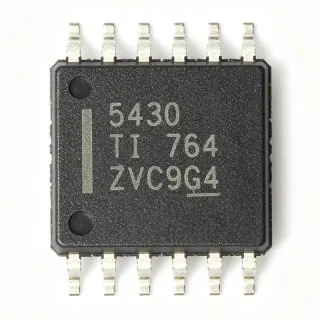
SN74HCS86QPWRQ1 - Quad 2-Input XOR Gate, AEC-Q100 | TI
MPN: SN74HCS86QPWRQ1 ✓ Active| Qty | Unit Price | Extended |
|---|---|---|
| 1 | $0.42 | $0.42 |
| 10 | $0.38 | $3.80 |
| 100 | $0.29 | $29.00 |
| 500 | $0.24 | $120.00 |
| 1,000 | $0.2 | $200.00 |
| 3,000 | $0.17 | $510.00 |
Drop-in alternatives for SN74HCS86QPWRQ1 — same package, pin-to-pin compatible. Different-package parts requiring PCB rework are excluded.
Quick Comparison Tool — Select alternative parts for side-by-side comparison:
SN74HCS86PWR
✅ Drop-In✓ In Stock
$0.1258 / Unit
View Datasheet →SN74HC86PWR
✅ Drop-In📋 Reference alternative (not in catalog)
CD74HC86M96
✅ Drop-In📋 Reference alternative (not in catalog)
74HC86D653
✅ Drop-In📋 Reference alternative (not in catalog)
74HC86D.118
✅ Drop-In📋 Reference alternative (not in catalog)
SN74HCS86QPWRQ1 Maximum Ratings & Electrical Characteristics
| Logic Function | XOR (Exclusive OR), 4 independent gates |
| Inputs per Gate | 2 |
| Input Type | Schmitt-Trigger |
| Supply Voltage Range | 2 V to 6 V |
| Operating Temperature | -40C to +125C (TA) |
| AEC-Q100 Qualification | Qualified, temperature grade 1 |
| HBM ESD Classification | Level 2 |
| CDM ESD Classification | Level C6 |
| Package | 14-TSSOP (PW) |
| Mounting Type | Surface Mount |
| Part Marking | HCS86Q |
| Family | HCS (HC with Schmitt-trigger) |
| Propagation Delay | [DATA_NEEDED: propagation delay] |
| Output Drive Current | [DATA_NEEDED: output drive current] |
| Quiescent Current | [DATA_NEEDED: quiescent current] |
| Moisture Sensitivity Level | [DATA_NEEDED: MSL level] |
| RoHS Status | [DATA_NEEDED: RoHS status] |
SN74HCS86QPWRQ1 Pin Configuration
| Pin 1 | 1A — Gate 1 input A |
| Pin 2 | 1B — Gate 1 input B |
| Pin 3 | 1Y — Gate 1 XOR output |
| Pin 4 | 2A — Gate 2 input A |
| Pin 5 | 2B — Gate 2 input B |
| Pin 6 | 2Y — Gate 2 XOR output |
| Pin 7 | GND — Ground |
| Pin 8 | 3Y — Gate 3 XOR output |
| Pin 9 | 3A — Gate 3 input A |
| Pin 10 | 3B — Gate 3 input B |
| Pin 11 | 4Y — Gate 4 XOR output |
| Pin 12 | 4A — Gate 4 input A |
| Pin 13 | 4B — Gate 4 input B |
| Pin 14 | VCC — Supply, 2 V to 6 V |
Safe Operating Area (SOA) & Thermal Characteristics
No official SOA curve available for this digital IC. Always operate within absolute maximum ratings specified in the datasheet. Ensure adequate cooling and derate as needed.
Typical Applications
SN74HCS86QPWRQ1 is suitable for 6 applications: Automotive Body Electronics, Parity Generation and Checking, Gate Drive Interlock Logic, Frequency Doublers and Phase Comparison, Pseudo-Random Sequence and CRC Generation, Signal Comparison and Address Decoding.
Automotive Body Electronics
The SN74HCS86QPWRQ1 is AEC-Q100 grade-1 qualified for -40C to +125C, making it well suited to body-control modules, lighting logic, and door-zone ECUs. Its Schmitt-trigger inputs reject noise on switch matrix and harness-routed signals, where long wiring picks up transients. Used for command XOR-ing and safety interlock checks, its 2 V to 6 V range tolerates battery-system supply sag, reducing risk of logic errors during crank conditions.
Recommended
Parity Generation and Checking
XOR gates are the canonical element for parity trees: cascading four XOR gates checks or generates even parity over serial and parallel buses. The SN74HCS86QPWRQ1 provides four independent gates per package, allowing a 4-to-16-input parity tree with a few ICs. Schmitt-trigger inputs keep the tree stable when data lines arrive with slow or ringing edges, a common condition in industrial cable runs, improving error-detection reliability over plain HC86 alternatives.
Recommended
Gate Drive Interlock Logic
In motor drives and power converters, XOR gates combine PWM and enable signals to implement shoot-through interlocks and dead-time validation. The SN74HCS86QPWRQ1 grades-1 temperature rating suits underhood environments, and Schmitt inputs prevent oscillation from the ringing edges common on gate-drive PCBs. At 2 V to 6 V it interfaces directly with 3.3 V or 5 V MCU ports, feeding isolated gate-driver inputs with deterministic, glitch-free logic states.
Recommended
Frequency Doublers and Phase Comparison
XOR of a clock with its delayed copy produces a frequency-doubled output; the propagation path is typically an RC or gate delay. The SN74HCS86QPWRQ1 fits this role because Schmitt inputs provide a clean, deterministic threshold, minimizing jitter contribution from slow clock edges. Its low-power CMOS process limits added supply noise, and its -40C to +125C range keeps delay variations within automotive expectations across temperature excursions.
Recommended
Pseudo-Random Sequence and CRC Generation
Linear feedback shift registers use XOR taps to generate pseudo-random sequences and CRC checksums in automotive and industrial communication links. The SN74HCS86QPWRQ1 supplies the tap XORs; four gates per package let a compact LFSR fit in one or two devices. Wide 2 V to 6 V operation matches 3.3 V and 5 V logic families, and Schmitt inputs stabilize feedback signals on longer PCB traces, supporting reliable code generation at system level.
Recommended
Signal Comparison and Address Decoding
XOR-based comparators detect inequality between two bit vectors: any XOR output HIGH indicates a mismatch, useful in address decoding, jumper-based configuration, and tamper detection. The SN74HCS86QPWRQ1 grade-1 automotive qualification suits ECUs that validate configuration straps. Schmitt-trigger inputs tolerate slow strap voltage settling during power-up from RC networks, ensuring glitch-free comparison results where standard CMOS inputs could oscillate through the threshold region.
Recommended
Recommended Products Summary
Engineering reference data for SN74HCS86QPWRQ1 — comparison, design guidance, and compliance information.
Selection Guide
Comparison with Alternatives
| Parameter | This Product | SN74HCS86PWR | SN74HC86PWR | 74HC86D653 |
|---|---|---|---|---|
| Package | 14-TSSOP (PW) | 14-TSSOP (PW) - same | 14-TSSOP (PW) - same | 14-TSSOP (SSOP14) - same |
| Brand | Texas Instruments | Texas Instruments | Texas Instruments | NXP Semiconductors |
| Logic Function | Quad 2-input XOR | Quad 2-input XOR | Quad 2-input XOR | Quad 2-input XOR |
| Schmitt-Trigger Inputs | Yes | Yes | No | No |
| Supply Voltage Range | 2 V to 6 V | 2 V to 6 V | 2 V to 6 V | 2 V to 6 V |
| AEC-Q100 Qualified | Yes (grade 1, -40C to +125C) | No | No | No |
| ESD Rating | HBM Level 2, CDM Level C6 | [DATA_NEEDED] | [DATA_NEEDED] | [DATA_NEEDED] |
| Propagation Delay | [DATA_NEEDED] | [DATA_NEEDED] | [DATA_NEEDED] | [DATA_NEEDED] |
Key Differentiators
- Schmitt-trigger inputs tolerate slow or noisy signals (vs SN74HC86PWR)
- AEC-Q100 grade-1 automotive qualification (vs SN74HCS86PWR)
- Robust automotive ESD performance (vs 74HC86D653)
Design Notes
Tie all unused inputs to VCC or GND; for unused XOR gates, ground both inputs to hold the output LOW. Floating CMOS Schmitt inputs can still pick up noise and inject switching current into the supply. Never leave any input pin open, even momentarily during bench testing, and avoid routing inputs across switching power traces.
Place a 100 nF ceramic decoupling capacitor within 5 mm of the VCC pin, plus bulk capacitance per board guidance. Keep XOR outputs away from Schmitt inputs to prevent ground-bounce coupling; use a solid ground plane. The TSSOP-14 (PW) thermal pad requirements are minimal since CMOS logic dissipates little static power, but switching at high frequency with heavy loads increases dynamic dissipation.
The Schmitt-trigger inputs tolerate slow edges, but do not intentionally rely on hysteresis for signals with sub-nanosecond ringing near thresholds. For 5 V systems interfacing TTL sources, verify VIH/VOH margins in the datasheet at the applicable VCC; at 3.3 V operation, switching speed derates - confirm timing budget at the design corner temperatures of -40C and +125C.
Compliance Information
AEC-Q100 qualified at temperature grade 1 (-40C to +125C) per TI datasheet Rev. C. RoHS/REACH status not stated in provided data.