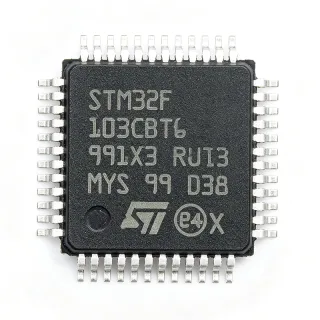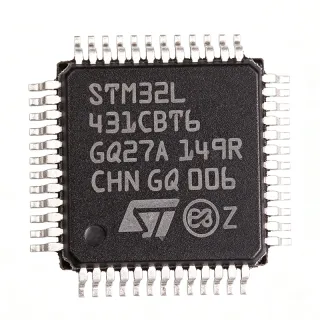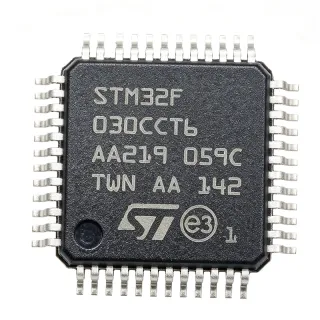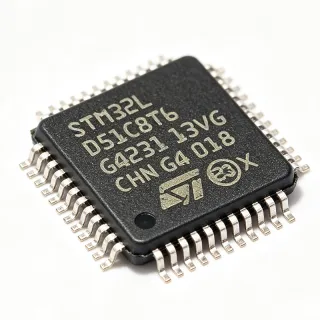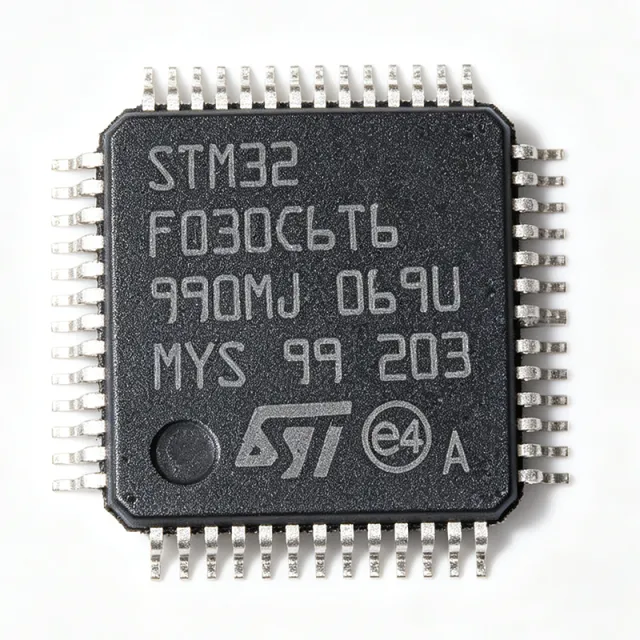
STM32F030C6T6 - 32-bit ARM Cortex-M0 MCU, 32KB Flash | STMicroelectronics
MPN: STM32F030C6T6 ✓ Active| Qty | Unit Price | Extended |
|---|---|---|
| 1 | $1.1727 | $1.17 |
| 10 | $0.847 | $8.47 |
| 100 | $0.7492 | $74.92 |
| 500 | $0.7167 | $358.35 |
| 1,000 | $0.6841 | $684.10 |
Drop-in alternatives for STM32F030C6T6 — same package, pin-to-pin compatible. Different-package parts requiring PCB rework are excluded.
Quick Comparison Tool — Select alternative parts for side-by-side comparison:
STM32F030C8T6
📋 Reference alternative (not in catalog)
STM32F031C6T6
📋 Reference alternative (not in catalog)
STM32F042C6T6
📋 Reference alternative (not in catalog)
STM32F030C6T6 Maximum Ratings & Electrical Characteristics
| Core | ARM Cortex-M0 |
| Core Frequency | 48 MHz |
| Flash Memory | 32 KB |
| SRAM | 4 KB |
| Supply Voltage | 2.4 V to 3.6 V |
| Operating Temperature | -40C to +85C |
| Package | LQFP-48 (7x7 mm) |
| GPIO Pins | 39 |
| ADC | 12-bit, 10 channels |
| Timers | 5x 16-bit, 1x 32-bit |
| Communication Interfaces | I2C, SPI, USART |
| DMA Channels | 5 |
| Low-Power Modes | Sleep, Stop, Standby |
| RoHS Status | Compliant |
| Mounting Type | Surface Mount |
STM32F030C6T6 Pin Configuration
| Pin 1 | VBAT — Battery backup supply |
| Pin 2 | PC13 — GPIO / RTC output |
| Pin 3 | PC14 — GPIO / OSC32_IN |
| Pin 4 | PC15 — GPIO / OSC32_OUT |
| Pin 5 | PF0 — GPIO / OSC_IN |
| Pin 6 | PF1 — GPIO / OSC_OUT |
| Pin 7 | NRST — Reset (active low) |
| Pin 8 | VDD — Digital power supply |
| Pin 9 | VSS — Ground |
| Pin 10 | PA0 — GPIO / ADC_IN0 |
| Pin 11 | PA1 — GPIO / ADC_IN1 |
| Pin 12 | PA2 — GPIO / USART2_TX |
| Pin 13 | PA3 — GPIO / USART2_RX |
| Pin 14 | PA4 — GPIO / SPI1_NSS |
| Pin 15 | PA5 — GPIO / SPI1_SCK |
| Pin 16 | PA6 — GPIO / SPI1_MISO |
| Pin 17 | PA7 — GPIO / SPI1_MOSI |
| Pin 18 | PB0 — GPIO / ADC_IN8 |
| Pin 19 | PB1 — GPIO / ADC_IN9 |
| Pin 20 | PB2 — GPIO / BOOT1 |
| Pin 21 | PB10 — GPIO / I2C2_SCL |
| Pin 22 | PB11 — GPIO / I2C2_SDA |
| Pin 23 | PB12 — GPIO / SPI2_NSS |
| Pin 24 | PB13 — GPIO / SPI2_SCK |
| Pin 25 | PB14 — GPIO / SPI2_MISO |
| Pin 26 | PB15 — GPIO / SPI2_MOSI |
| Pin 27 | PA8 — GPIO / MCO |
| Pin 28 | PA9 — GPIO / USART1_TX |
| Pin 29 | PA10 — GPIO / USART1_RX |
| Pin 30 | PA11 — GPIO / USART1_CTS |
| Pin 31 | PA12 — GPIO / USART1_RTS |
| Pin 32 | PA13 — GPIO / SWDIO |
| Pin 33 | PA14 — GPIO / SWCLK |
| Pin 34 | PA15 — GPIO / JTDI |
| Pin 35 | PB3 — GPIO / JTDO |
| Pin 36 | PB4 — GPIO / NJTRST |
| Pin 37 | PB5 — GPIO / I2C1_SMBA |
| Pin 38 | PB6 — GPIO / I2C1_SCL |
| Pin 39 | PB7 — GPIO / I2C1_SDA |
| Pin 40 | BOOT0 — Boot mode selection |
| Pin 41 | PB8 — GPIO / I2C1_SCL |
| Pin 42 | PB9 — GPIO / I2C1_SDA |
| Pin 43 | VDD — Digital power supply |
| Pin 44 | VSS — Ground |
| Pin 45 | PC14 — GPIO / OSC32_IN |
| Pin 46 | PC15 — GPIO / OSC32_OUT |
| Pin 47 | PC13 — GPIO / RTC output |
| Pin 48 | VBAT — Battery backup supply |
Safe Operating Area (SOA) & Thermal Characteristics
No official SOA curve available for this digital IC. Always operate within absolute maximum ratings specified in the datasheet. Ensure adequate cooling and derate as needed.
Typical Applications
STM32F030C6T6 is suitable for 6 applications: Industrial Control, Consumer Electronics, Home Automation, Motor Control, Sensor Interfacing, IoT Edge Devices.
Industrial Control
The STM32F030C6T6 is well-suited for industrial control systems such as PLCs, motor drives, and factory automation. Its 48 MHz Cortex-M0 core provides deterministic real-time performance for control loops, while the multiple 16-bit timers with PWM generation enable precise motor speed and position control. The 12-bit ADC with up to 10 channels allows for accurate current and voltage sensing, essential for closed-loop control. The device's wide operating temperature range (-40°C to +85°C) and robust I/O structure ensure reliable operation in harsh industrial environments. Communication interfaces like USART, SPI, and I2C facilitate integration with industrial networks (e.g., Modbus) and sensor arrays. The low-power modes help reduce energy consumption in always-on monitoring applications. Overall, the STM32F030C6T6 offers a cost-effective solution for industrial control without compromising on performance or reliability.
Recommended
Consumer Electronics
In consumer electronics, the STM32F030C6T6 is ideal for smart home devices, remote controls, and small appliances. Its low power consumption and multiple low-power modes extend battery life in portable devices. The rich peripheral set, including I2C, SPI, and USART, allows easy interfacing with sensors, displays, and wireless modules (e.g., Bluetooth LE). The 32 KB Flash is sufficient for firmware implementing user interfaces, communication protocols, and sensor processing. The compact LQFP-48 package fits into space-constrained designs, and the wide supply voltage range (2.4V to 3.6V) accommodates various battery chemistries. The device's cost-effectiveness makes it a popular choice for high-volume consumer products where price is a key factor. Additionally, the STM32 ecosystem provides extensive software libraries and examples, accelerating development cycles.
Recommended
Home Automation
The STM32F030C6T6 is a strong candidate for home automation hubs, smart thermostats, and lighting control systems. Its multiple communication interfaces (USART, SPI, I2C) enable seamless connectivity with various sensors and actuators, such as temperature sensors, motion detectors, and relay modules. The device's low-power modes are crucial for battery-powered wireless nodes, allowing years of operation on a single coin cell. The 12-bit ADC can read analog sensors like light-dependent resistors (LDRs) and thermistors. The 32 KB Flash provides ample space for implementing protocols like Zigbee, Z-Wave, or proprietary RF stacks when paired with an external transceiver. The STM32F030C6T6's robust I/O and ESD protection ensure reliable operation in residential environments. Its affordability makes it suitable for mass deployment in smart home ecosystems.
Recommended
Motor Control
The STM32F030C6T6 excels in motor control applications, including brushless DC (BLDC), permanent magnet synchronous (PMSM), and stepper motors. Its 48 MHz core can execute field-oriented control (FOC) algorithms with sufficient bandwidth for many applications. The device features multiple 16-bit timers with complementary PWM outputs and dead-time insertion, essential for driving three-phase inverters. The 12-bit ADC with up to 10 channels can sample motor phase currents and DC bus voltage simultaneously, enabling precise current regulation. The STM32F030C6T6 also includes a comparator and operational amplifier options (in some variants) for overcurrent protection. The low-power modes help reduce standby consumption in battery-powered tools. With the STM32 motor control SDK, developers can quickly implement sensorless FOC, reducing development time. The device's cost-effectiveness makes it a popular choice for high-volume motor control applications like fans, pumps, and power tools.
Recommended
Sensor Interfacing
The STM32F030C6T6 is well-suited for sensor interfacing in IoT and data acquisition systems. Its I2C and SPI interfaces allow direct connection to a wide range of digital sensors, including temperature, humidity, pressure, and gas sensors. The 12-bit ADC can read analog sensors such as photodiodes, thermocouples (with external amplification), and strain gauges. The device's DMA controller (5 channels) enables efficient data transfer from peripherals to memory without CPU intervention, reducing power consumption and freeing the core for other tasks. The 32 KB Flash can store calibration data and sensor fusion algorithms. The low-power modes are critical for battery-powered sensor nodes, allowing periodic wake-up and measurement. The STM32F030C6T6's small package and low cost make it ideal for distributed sensor networks. Additionally, the STM32CubeMX tool simplifies pin assignment and code generation for various sensor configurations.
Recommended
IoT Edge Devices
The STM32F030C6T6 serves as an efficient MCU for IoT edge devices, handling local processing, sensor data aggregation, and communication with cloud services via external connectivity modules. Its low power consumption and multiple low-power modes enable battery-powered operation for years. The device's communication interfaces (USART, SPI, I2C) allow seamless integration with Wi-Fi, Bluetooth, or LoRa modules. The 32 KB Flash is sufficient for lightweight IoT protocols like MQTT and CoAP, as well as for storing device credentials. The 12-bit ADC can read analog sensors for environmental monitoring. The STM32F030C6T6's robust security features, including a unique device ID, support secure boot and firmware authentication. Its cost-effectiveness makes it suitable for mass deployment in smart agriculture, smart city, and industrial IoT applications. The STM32 ecosystem provides cloud connectivity examples, accelerating development.
Recommended
Recommended Products Summary
Engineering reference data for STM32F030C6T6 — comparison, design guidance, and compliance information.
Selection Guide
Comparison with Alternatives
| Parameter | This Product | STM32F030C8T6 | STM32F031C6T6 | STM32F042C6T6 |
|---|---|---|---|---|
| Package | LQFP-48 | LQFP-48 | LQFP-48 | LQFP-48 |
| Flash Memory | 32 KB | 64 KB | 32 KB | 32 KB |
| SRAM | 4 KB | 8 KB | 4 KB | 6 KB |
| Core Frequency | 48 MHz | 48 MHz | 48 MHz | 48 MHz |
| DMA Channels | 5 | 5 | 0 | 5 |
| USB | No | No | No | Yes (Device) |
| CAN | No | No | No | Yes |
| Price (1k) | $1.45 | $1.70 | $1.40 | $1.90 |
Key Differentiators
- Cost-effective 32-bit performance (vs STM32F031C6T6)
- Memory scalability (vs STM32F030C8T6)
- Pin-to-pin compatibility with higher-featured variants (vs STM32F042C6T6)
Design Notes
Decouple the power supply with a 100nF ceramic capacitor on each VDD pin and a 4.7uF capacitor on the main supply. Place capacitors as close to the pins as possible to minimize inductance. The STM32F030C6T6 operates from 2.4V to 3.6V, so ensure the supply is stable within this range, especially during transient loads.
For the LQFP-48 package, use a 4-layer PCB with a solid ground plane to reduce noise and improve EMC. Route the crystal oscillator (if used) with short traces and a ground guard ring. Keep the SWD lines (PA13, PA14) short and avoid routing them near high-speed signals to prevent programming issues.
Ensure the BOOT0 pin is properly configured to boot from Flash (tied low). If BOOT0 is high, the device will boot from the system memory, which may prevent your firmware from running. Also, configure the RCC to enable the PLL for 48 MHz operation; the default HSI is 8 MHz, which may be insufficient for time-critical applications.
Compliance Information
RoHS compliant per STMicroelectronics. Not AEC-Q100 qualified; for automotive, consider STM32F0 series with AEC-Q100 option.