Microcontrollers
Products (319)
SPC560B40L3 - 32-bit MCU, 512KB Flash, 64MHz | STMicroelectronics
The SPC560B40L3 is a 32-bit microcontroller from STMicroelectronics, part of the SPC560B family based on the Power Architecture® e200z0h core. It operates at a maximum frequency of 64 MHz and features 512 KB of flash memory and 48 KB of RAM, making it suitable for automotive body and gateway applications. The device is housed in a 100-pin LQFP package (LQFP-100) and supports a supply voltage range of 3.3V to 5V. A microcontroller (MCU) is a compact integrated circuit designed to govern a specific operation in an embedded system. It contains a processor core, memory, and programmable input/output peripherals. The SPC560B40L3 belongs to the family of 32-bit automotive microcontrollers, which are a subset of embedded controllers used in vehicle electronics. These MCUs are optimized for real-time control, low power consumption, and high reliability in harsh environments. Key features of the SPC560B40L3 include a 64 MHz e200z0h core, 512 KB flash memory, 48 KB RAM, and a rich set of peripherals such as multiple CAN interfaces, LIN, SPI, and ADC. It also includes a flexible timer module (FTM) and a crossbar switch for efficient data routing. The device is designed to meet AEC-Q100 automotive qualification standards, ensuring reliable operation in automotive temperature ranges from -40°C to +125°C. The SPC560B40L3 utilizes a single-issue, 32-bit Power Architecture core with variable-length encoding (VLE) for code density. It integrates a memory protection unit (MPU) and a cyclic redundancy check (CRC) unit for enhanced safety. The MCU supports low-power modes, including halt and stop modes, to reduce power consumption in battery-powered applications. Typical applications include automotive body control modules, gateway modules, and sensor fusion units. The multiple CAN interfaces make it ideal for in-vehicle networking, while the ADC and timer modules support motor control and signal conditioning. The device's robust design and automotive qualification make it a reliable choice for safety-critical systems. When designing with the SPC560B40L3, ensure proper decoupling of the power supply pins and consider the thermal performance of the LQFP-100 package. The device requires a stable clock source, typically a 4-40 MHz crystal, and supports an internal RC oscillator for cost-sensitive designs.
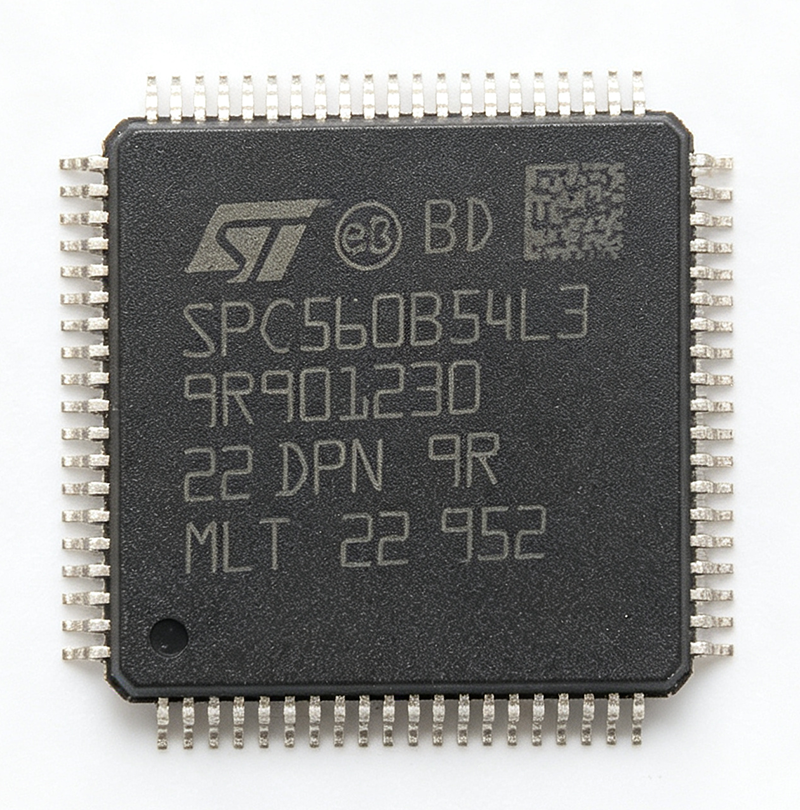
SPC560B54L3 - 32-bit MCU, 1.5MB Flash, 64MHz | STMicroelectronics
The SPC560B54L3 is a 32-bit microcontroller from STMicroelectronics, based on the Power Architecture e200z0h core, operating at up to 64 MHz. It features 1.5 MB of embedded flash memory and 96 KB of RAM, making it suitable for automotive body electronics and industrial control applications. The device is housed in a 100-pin LQFP package (LQFP-100) and operates over a temperature range of -40°C to +125°C. A microcontroller (MCU) is a compact integrated circuit designed to govern a specific operation in an embedded system. It contains a processor core, memory, and programmable input/output peripherals. The SPC560B54L3 belongs to the SPC56 family of automotive microcontrollers, which are part of the broader Power Architecture portfolio. These MCUs are optimized for real-time control, with features like a 10-bit ADC, multiple CAN and LIN interfaces, and a flexible timer module (eTPU). Key features of the SPC560B54L3 include a 64 MHz e200z0h core with single-precision floating-point unit (FPU), 1.5 MB flash with ECC, 96 KB SRAM, and a rich set of communication interfaces: 3x FlexCAN, 3x LIN, and 2x SPI. It also integrates a 10-bit ADC with up to 16 channels, a 16-bit timer, and a watchdog timer. The device supports low-power modes and has a supply voltage range of 3.3V to 5V, making it flexible for various automotive and industrial power rails. The SPC560B54L3 is built on ST's advanced 90nm embedded flash process, providing high reliability and low power consumption. The e200z0h core is a cost-optimized version of the Power Architecture, delivering efficient code execution for control applications. The device includes a memory protection unit (MPU) and a cyclic redundancy check (CRC) unit for enhanced safety and data integrity, aligning with automotive safety standards. Typical applications include automotive body control modules (BCM), gateway modules, HVAC control, and industrial automation controllers. The multiple CAN and LIN interfaces make it ideal for in-vehicle networking, while the robust temperature range and AEC-Q100 qualification support harsh environments. When designing with the SPC560B54L3, ensure proper decoupling of the power supply pins and consider the thermal performance of the LQFP-100 package. The device requires a stable 3.3V or 5V supply and a crystal or oscillator for the system clock. Use the on-chip flash programming interface for firmware updates, and follow ST's application notes for optimal EMC performance.
SPC560D30L1 - 32-bit MCU, 1MB Flash, 64MHz | STMicroelectronics
The SPC560D30L1 is a 32-bit microcontroller from STMicroelectronics, part of the SPC560D family based on the Power Architecture e200z0h core. It operates at a maximum frequency of 64 MHz and features 1 MB of flash memory and 96 KB of RAM, making it suitable for automotive body and gateway applications. The device is available in a 100-pin LQFP package and supports a supply voltage range of 3.3V to 5V. A microcontroller (MCU) is a compact integrated circuit designed to govern a specific operation in an embedded system. It contains a processor core, memory, and programmable input/output peripherals. The SPC560D30L1 belongs to the family of 32-bit automotive microcontrollers, which are part of the broader category of embedded processors used in vehicle control units. These MCUs are optimized for real-time performance, reliability, and low power consumption, often meeting AEC-Q100 automotive qualification standards. Key features of the SPC560D30L1 include a 64 MHz e200z0h Power Architecture core, 1 MB flash memory, 96 KB RAM, and a rich set of communication interfaces such as CAN, LIN, and SPI. It also integrates a 10-bit ADC, multiple timers, and a flexible PWM module. The device supports a wide operating temperature range of -40°C to +125°C, making it suitable for harsh automotive environments. The SPC560D30L1 is built on a highly reliable flash technology with ECC (Error Correction Code) support, ensuring data integrity in safety-critical applications. The MCU includes a Memory Protection Unit (MPU) and a Cyclic Redundancy Check (CRC) unit for enhanced security and data validation. Its low-power modes, including stop and standby, help reduce energy consumption in battery-powered systems. Typical applications include automotive body control modules, gateway modules, and sensor fusion units. The device's robust CAN and LIN interfaces enable seamless communication in vehicle networks, while its high-speed ADC and PWM capabilities support motor control and lighting applications. When designing with the SPC560D30L1, ensure proper decoupling of the power supply pins and a stable clock source. The device requires a 4-40 MHz crystal or external clock for operation. Careful PCB layout is essential to minimize electromagnetic interference, especially in automotive environments.
SPC560D30L3 - 32-bit MCU, 1MB Flash, 64MHz | STMicroelectronics
The SPC560D30L3 is a 32-bit microcontroller from STMicroelectronics, part of the SPC560D family based on the Power Architecture® e200z0h core. It operates at a maximum frequency of 64 MHz and provides 1 MB of flash memory and 96 KB of RAM, making it suitable for automotive body and gateway applications. The device is available in a LQFP-100 package, offering a compact footprint for space-constrained designs. A microcontroller (MCU) is a compact integrated circuit designed to govern a specific operation in an embedded system. It contains a processor core, memory (flash and RAM), and programmable input/output peripherals. The SPC560D30L3 belongs to the class of 32-bit automotive microcontrollers, which are optimized for real-time control, robust communication interfaces, and high reliability under harsh environmental conditions. Within the hierarchy, it is a microcontroller -> automotive MCU -> Power Architecture MCU -> SPC560 family. Key features of the SPC560D30L3 include a 64 MHz e200z0h core with single-precision floating-point unit (FPU), 1 MB flash with ECC, 96 KB SRAM, and a rich set of communication interfaces: 3× FlexCAN, 3× LINFlex, 3× DSPI, and 1× I2C. It also integrates a 10-bit ADC with up to 16 channels, multiple timers (eMIOS, PIT, STM), and a CRC unit. The device supports a supply voltage range of 3.3V to 5V, with an operating temperature range of -40°C to +125°C, meeting AEC-Q100 Grade 1 requirements. Technically, the SPC560D30L3 is built on a 90nm process technology, offering a balance between performance and power consumption. The e200z0h core is a single-issue, 32-bit Power Architecture core with variable-length encoding (VLE) for code density, reducing flash usage by up to 30% compared to traditional PowerPC instructions. The device includes a memory protection unit (MPU) and a memory management unit (MMU) for enhanced safety, and it supports a Nexus class 1 debug interface for real-time trace. Typical applications include automotive body control modules (BCM), gateway modules, smart junction boxes, and industrial control systems. The SPC560D30L3's robust CAN and LIN interfaces make it ideal for in-vehicle networking, while its high-temperature rating and AEC-Q100 qualification ensure reliable operation in under-hood environments. When designing with this device, ensure proper decoupling of the power supply pins with 100nF capacitors placed close to each VDD pin, and a 4.7µF bulk capacitor on the main supply. The device requires a stable clock source; an external 8-40 MHz crystal can be used with the on-chip oscillator, or an external clock can be applied. For safety-critical applications, use the built-in self-test (BIST) and cyclic redundancy check (CRC) modules to enhance diagnostic coverage.
SPC560D40L1 - 32-bit MCU, 1.5MB Flash, 64MHz | STMicroelectronics
The SPC560D40L1 is a 32-bit microcontroller from STMicroelectronics, part of the SPC560D family based on the Power Architecture e200z0h core. It operates at a maximum core frequency of 64 MHz and provides 1.5 MB of embedded flash memory and 96 KB of RAM, making it suitable for automotive body electronics and industrial control applications. The device is offered in a 100-pin LQFP package (LQFP-100) with a 14x14 mm body, supporting surface-mount assembly. A microcontroller (MCU) is a compact integrated circuit designed to govern a specific operation in an embedded system. It contains a processor core, memory (flash and RAM), and programmable input/output peripherals on a single chip. MCUs are the building blocks of modern automotive electronics, industrial automation, and consumer devices, providing the intelligence to control sensors, actuators, and communication interfaces. The SPC560D40L1 sits within the broader hierarchy of embedded processors, specifically as a 32-bit automotive-grade MCU, which offers higher performance and memory than 8-bit or 16-bit counterparts while maintaining real-time responsiveness. Key features of the SPC560D40L1 include a 64 MHz e200z0h core with single-precision floating-point unit (FPU), 1.5 MB flash with error correction code (ECC), 96 KB SRAM, and a rich set of peripherals: two FlexCAN modules for CAN 2.0B communication, multiple eSCI (UART) and DSPI (SPI) interfaces, a 16-channel 12-bit ADC, and a flexible timer module (eMIOS). The device also integrates a crossbar switch (XBAR) for efficient bus arbitration and a memory protection unit (MPU) for enhanced safety. These features enable complex real-time control and communication in automotive body control modules, gateway nodes, and industrial motor control. The SPC560D40L1 is designed for harsh environments, with an operating temperature range of -40°C to +125°C (ambient) and AEC-Q100 qualification, ensuring reliability in automotive applications. It supports low-power modes (HALT, STOP, STANDBY) to reduce energy consumption in battery-powered systems. The MCU is programmed via JTAG or LINFlex (UART) bootloader, and development is supported by ST's SPC5 Studio IDE and third-party tools like IAR and GCC. Typical applications include automotive body control modules (BCM), door and seat control units, HVAC control, industrial PLCs, and motor control for pumps and fans. The combination of CAN, LIN, and rich analog peripherals makes it a versatile choice for distributed automotive networks. When designing with the SPC560D40L1, ensure proper decoupling of the VDD and VDDA pins with 100 nF ceramic capacitors placed close to the pins, and provide a stable 5V or 3.3V supply. The device requires an external crystal or oscillator on the EXTAL/XTAL pins for the main clock; a 8-40 MHz crystal is recommended. For EMI-sensitive designs, use the internal PLL with spread-spectrum modulation if available.
SPC560D40L3 - 32-bit MCU, 1.5MB Flash, 64MHz | STMicroelectronics
The SPC560D40L3 is a 32-bit microcontroller from STMicroelectronics, based on the Power Architecture e200z0h core. It operates at a maximum frequency of 64 MHz and features 1.5 MB of flash memory and 96 KB of RAM. The device is housed in a 100-pin LQFP package, making it suitable for a wide range of automotive and industrial applications. A microcontroller (MCU) is a compact integrated circuit designed to govern a specific operation in an embedded system. It contains a processor core, memory, and programmable input/output peripherals. The SPC560D40L3 belongs to the SPC56 family of automotive microcontrollers, which are part of the broader Power Architecture portfolio. These MCUs are optimized for real-time control, safety-critical applications, and harsh environments, offering a balance of performance, power efficiency, and reliability. Key features of the SPC560D40L3 include a 64 MHz e200z0h core, 1.5 MB flash memory, 96 KB RAM, and a rich set of peripherals such as multiple CAN, LIN, SPI, and I2C interfaces. It also includes advanced timers, ADCs, and a flexible memory protection unit. The device supports a wide operating voltage range of 3.3V to 5V and is designed for extended temperature ranges from -40°C to +125°C, making it ideal for under-the-hood automotive applications. Technically, the SPC560D40L3 is built on a 90nm process technology, offering a good balance of performance and power consumption. The e200z0h core is a single-issue, 32-bit Power Architecture core with a five-stage pipeline, providing efficient execution of control algorithms. The MCU includes a memory protection unit (MPU) and a cyclic redundancy check (CRC) unit for enhanced safety and data integrity. It also features a fail-safe clock monitor and a watchdog timer to ensure reliable operation in safety-critical systems. Typical applications include engine control units (ECUs), transmission control, body control modules, and industrial automation. The SPC560D40L3 is particularly well-suited for automotive body electronics, where its robust communication interfaces and low-power modes are essential. In industrial settings, it can be used for motor control, PLCs, and process control systems. When designing with the SPC560D40L3, it is important to consider proper decoupling of the power supply pins and careful layout of the crystal oscillator circuit. The device supports multiple low-power modes, which can be leveraged to reduce overall system power consumption. Additionally, the flash memory can be programmed in-circuit, simplifying firmware updates in the field.
SPC560P40L3 - 32-bit MCU, 512KB Flash, 64MHz | STMicroelectronics
The SPC560P40L3 is a 32-bit microcontroller from STMicroelectronics' SPC560P family, based on the Power Architecture e200z0h core. It operates at a maximum frequency of 64 MHz and features 512 KB of flash memory and 48 KB of RAM. The device is housed in a 100-pin LQFP package (LQFP-100) and is designed for automotive and industrial applications requiring robust performance and safety features. A microcontroller (MCU) is a compact integrated circuit designed to govern a specific operation in an embedded system. It contains a processor core, memory (flash and RAM), and programmable input/output peripherals. The SPC560P40L3 belongs to the category of 32-bit automotive microcontrollers, which are optimized for real-time control, safety-critical functions, and harsh environments. These MCUs are part of the broader power management and control hierarchy, often used in engine control units (ECUs), body control modules, and industrial automation systems. Key features of the SPC560P40L3 include a 64 MHz e200z0h core with single-precision floating-point unit (FPU), 512 KB flash with ECC, 48 KB SRAM, and a rich set of peripherals: 2x eSCI (UART), 2x DSPI (SPI), 1x FlexCAN, 1x eMIOS (timer), 1x ADC with 16 channels, and up to 64 GPIO pins. It supports a supply voltage range of 3.3V to 5V, with an operating temperature range of -40°C to +125°C, making it suitable for automotive under-hood applications. The device is AEC-Q100 qualified and RoHS compliant. Technically, the SPC560P40L3 is built on a 90nm flash process, offering a balance of performance and power efficiency. The e200z0h core is a Power Architecture v1.1 compliant core with variable-length encoding (VLE) for code density, reducing memory footprint. The MCU includes a memory protection unit (MPU), a cyclic redundancy check (CRC) unit, and a fail-safe protection module, enhancing reliability for safety-critical systems. The FlexCAN module supports CAN 2.0B with up to 32 message buffers, enabling robust communication in automotive networks. Typical applications include automotive body control modules (BCMs), engine management systems, transmission control units, and industrial motor control. The SPC560P40L3's combination of high-speed processing, extensive peripherals, and automotive-grade reliability makes it ideal for real-time control loops and communication-intensive tasks. For example, in a BCM, it manages lighting, door locks, and window lifts, while communicating over CAN bus. When designing with this device, ensure proper decoupling of the power supply pins with 100nF capacitors close to each VDD pin, and a 10uF bulk capacitor. The device requires a stable clock source; an external 8-40 MHz crystal can be used with the on-chip oscillator. For safety-critical applications, use the built-in self-test (BIST) and CRC modules to meet ISO 26262 requirements. Also, consider the thermal dissipation: the LQFP-100 package has a thermal resistance of 45°C/W, so adequate PCB copper area is needed for high ambient temperatures.
SPC560P50L3 - 32-bit MCU, 512KB Flash, 64MHz | STMicroelectronics
The SPC560P50L3 is a 32-bit microcontroller from STMicroelectronics, part of the SPC560P family based on the Power Architecture e200z0h core. It operates at a maximum frequency of 64 MHz and features 512 KB of flash memory and 48 KB of RAM, making it suitable for automotive body and gateway applications. The device is available in a LQFP-100 package and supports a supply voltage range of 3.3V to 5V. A microcontroller (MCU) is a compact integrated circuit designed to govern a specific operation in an embedded system. It contains a processor core, memory, and programmable input/output peripherals on a single chip. MCUs are the backbone of automotive electronics, industrial control, and IoT devices, providing the intelligence to process sensor data, control actuators, and communicate over networks. The SPC560P50L3 belongs to the family of 32-bit automotive microcontrollers, which offer higher performance and memory capacity compared to 8-bit or 16-bit counterparts, enabling complex control algorithms and connectivity. Key features of the SPC560P50L3 include a 64 MHz e200z0h core, 512 KB flash with ECC, 48 KB SRAM, and a rich set of peripherals such as multiple CAN, LIN, SPI, and I2C interfaces. It also integrates a 10-bit ADC with up to 16 channels, PWM timers, and a flexible timer module (FTM) for motor control. The device is AEC-Q100 qualified, ensuring reliability for automotive environments, and supports a wide operating temperature range from -40°C to +125°C. The SPC560P50L3 is built on ST's advanced 90nm process technology, offering a balance of performance and power efficiency. The e200z0h core is a single-issue, 32-bit Power Architecture core with variable-length encoding (VLE) for code density, reducing memory footprint. The MCU includes a memory protection unit (MPU) and a cyclic redundancy check (CRC) unit for enhanced safety and data integrity, aligning with ISO 26262 functional safety requirements. Typical applications include automotive body control modules, gateway modules, and industrial automation. In body control, the SPC560P50L3 manages lighting, wipers, and power windows, while in gateways it routes messages between CAN and LIN networks. Its robust communication interfaces and high-temperature operation make it ideal for under-hood and in-cabin electronics. When designing with this MCU, ensure proper decoupling of the power supply pins and a stable clock source. The device supports both external crystal and internal RC oscillator, with a phase-locked loop (PLL) for frequency multiplication. For safety-critical applications, utilize the built-in self-test (BIST) and watchdog timer to meet ISO 26262 requirements.

SPC560P50L5CEFBY - 32-bit MCU, 512KB Flash, 64MHz | STMicroelectronics
The SPC560P50L5CEFBY is a 32-bit microcontroller from STMicroelectronics, part of the SPC560P family based on the Power Architecture e200z0h core. It operates at a maximum frequency of 64 MHz and provides 512 KB of flash memory and 48 KB of RAM, making it suitable for automotive body and gateway applications. The device is housed in an LQFP-64 package with a 10x10 mm body and 0.5 mm pitch, offering a compact footprint for space-constrained designs. A microcontroller (MCU) is a compact integrated circuit designed to govern a specific operation in an embedded system. It contains a processor core, memory (flash and RAM), and programmable input/output peripherals on a single chip. MCUs are the backbone of automotive electronics, industrial control, and IoT devices, providing the intelligence to process sensor data, control actuators, and communicate over networks. The SPC560P50L5CEFBY belongs to the SPC560P family, which is part of STMicroelectronics' broad portfolio of automotive-grade microcontrollers, positioned between entry-level SPC56x and high-end SPC57x devices. Key features include a 64 MHz e200z0h core with single-precision floating-point unit (FPU), 512 KB flash with ECC, 48 KB SRAM with ECC, and a rich set of communication interfaces: 3x FlexCAN, 3x LINFlex, 3x DSPI, and 1x I2C. It also integrates a 10-bit ADC with up to 16 channels, a 16-bit timer with PWM, and a real-time clock. The device supports a supply voltage range of 3.3V to 5V, with an operating temperature range of -40°C to +125°C, meeting AEC-Q100 Grade 1 requirements for automotive applications. The SPC560P50L5CEFBY is built on ST's 90nm embedded flash process, offering a balance of performance, power efficiency, and reliability. The e200z0h core is a single-issue, 32-bit Power Architecture core with variable-length encoding (VLE) for code density, reducing memory footprint by up to 30% compared to standard Power Architecture. The device includes a memory protection unit (MPU) and a cyclic redundancy check (CRC) unit for enhanced safety, supporting ASIL-B functional safety requirements. Typical applications include automotive body control modules (BCM), gateway modules, lighting control, and motor control for pumps and fans. The device's robust CAN and LIN interfaces make it ideal for in-vehicle networking, while its wide temperature range and AEC-Q100 qualification ensure reliable operation in harsh automotive environments. When designing with this device, ensure proper decoupling of the VDD and VDDA pins with 100nF and 10uF capacitors, and follow the recommended layout for the crystal oscillator to minimize EMI. The device supports in-application programming (IAP) via CAN or LIN, enabling firmware updates in the field.
SPC563M60L7 - 32-bit MCU, 1MB Flash, 80MHz | NXP Semiconductors
The NXP SPC563M60L7 is a 32-bit microcontroller based on the Power Architecture e200z3 core, operating at up to 80 MHz. It features 1 MB of flash memory and 96 KB of RAM, making it suitable for automotive and industrial control applications. The device is housed in a 144-pin LQFP package and supports a supply voltage range of 3.0V to 5.5V. A microcontroller (MCU) is a compact integrated circuit designed to govern a specific operation in an embedded system. It contains a processor core, memory, and programmable input/output peripherals. The SPC563M60L7 belongs to the MPC56xx family, which is part of NXP's broader Power Architecture portfolio, known for its high performance and reliability in safety-critical environments. Key features include a 32-bit e200z3 core with variable-length encoding (VLE) for code density, a 10-bit ADC with up to 32 channels, multiple CAN interfaces for automotive networking, and a flexible timer module (eTPU) for complex timing tasks. The device also includes a memory protection unit (MPU) and a cyclic redundancy check (CRC) unit for enhanced data integrity. The SPC563M60L7 is built on NXP's proven Power Architecture technology, offering a balance of performance and power efficiency. The e200z3 core supports single-precision floating-point operations, enabling complex mathematical computations in real-time control loops. The device's flash memory is organized into multiple blocks, allowing for simultaneous read and write operations, which is critical for over-the-air updates and data logging. Typical applications include engine control units (ECUs), transmission control, body control modules, and industrial automation systems. The multiple CAN interfaces make it ideal for automotive networks, while the eTPU provides precise timing for fuel injection and ignition control. When designing with this device, ensure proper decoupling of the power supply pins and consider the thermal characteristics of the LQFP-144 package. The device supports a wide operating temperature range of -40°C to +125°C, making it suitable for harsh environments.
SPC563M64L5COAR - 32-bit MCU, 1.5MB Flash, 80MHz | NXP
The NXP SPC563M64L5COAR is a 32-bit microcontroller based on the Power Architecture e200z3 core, operating at up to 80 MHz. It features 1.5 MB of flash memory and 94 KB of RAM, making it suitable for automotive and industrial control applications. The device is housed in a 144-pin LQFP package and supports a supply voltage range of 3.0V to 5.5V. A microcontroller (MCU) is a compact integrated circuit designed to govern a specific operation in an embedded system. It contains a processor core, memory, and programmable input/output peripherals. The SPC563M64L5COAR belongs to the SPC56 family of automotive microcontrollers, which are part of the broader Power Architecture portfolio. These MCUs are optimized for real-time control, safety-critical applications, and harsh environments. Key features include a 32-bit e200z3 core with variable-length encoding (VLE) for code density, 1.5 MB of flash with error correction code (ECC), and 94 KB of SRAM. The device integrates multiple communication interfaces such as CAN, LIN, and SPI, along with a 10-bit ADC and a flexible timer module (eTPU). It operates over a temperature range of -40°C to +125°C, making it suitable for under-hood automotive applications. The SPC563M64L5COAR uses a 90nm process technology, balancing performance and power consumption. The e200z3 core supports single-precision floating-point operations, enabling complex control algorithms. The device includes a memory protection unit (MPU) and a cyclic redundancy check (CRC) unit for enhanced safety and data integrity. Typical applications include engine control units (ECUs), transmission control, body control modules, and industrial automation. The rich peripheral set and robust communication interfaces make it ideal for distributed control systems in vehicles and factory floors. When designing with this MCU, ensure proper decoupling of the power supply pins and follow the layout guidelines in the reference manual to minimize noise. The device requires a stable clock source; an external crystal or oscillator can be used, and the internal PLL provides flexible clock multiplication.
SPC564A80L7 - 32-bit MCU, 4MB Flash, 150MHz | STMicroelectronics
The STMicroelectronics SPC564A80L7 is a high-performance 32-bit microcontroller built on the Power Architecture e200z4 core, operating at up to 150 MHz. It features 4 MB of embedded flash memory and 256 KB of RAM, making it suitable for complex automotive and industrial control applications. The device is housed in a 176-pin LQFP package, providing extensive I/O and peripheral integration. A microcontroller (MCU) is a compact integrated circuit designed to govern a specific operation in an embedded system. It contains a processor core, memory, and programmable input/output peripherals. The SPC564A80L7 belongs to the family of 32-bit MCUs, which offer higher performance and memory capacity compared to 8-bit or 16-bit counterparts, enabling sophisticated control algorithms and real-time processing. Within the hierarchy, it is a microcontroller -> embedded processor -> semiconductor device, used in automotive engine control, industrial automation, and robotics. Key features include a 150 MHz e200z4 core with single-precision floating-point unit (FPU), 4 MB flash with error correction code (ECC), 256 KB SRAM, and a rich set of communication interfaces such as FlexCAN, LIN, SPI, and eSCI. The device also integrates advanced timers (eMIOS, eTPU2), a 12-bit ADC with up to 64 channels, and a DMA controller. These features enable high-speed data acquisition and precise control in real-time systems. The SPC564A80L7 is built on STMicroelectronics' proven Power Architecture technology, offering robust real-time performance and safety features. It includes a memory protection unit (MPU), a cyclic redundancy check (CRC) unit, and a fault-tolerant design, making it suitable for safety-critical applications. The device supports a wide operating temperature range of -40°C to +125°C, ensuring reliability in harsh environments. Typical applications include automotive engine management, transmission control, electric power steering, and industrial motor control. Its high flash memory and processing power allow for complex control algorithms and over-the-air updates. The extensive peripheral set reduces the need for external components, lowering system cost and board space. When designing with this MCU, ensure proper decoupling of power supply pins and a stable clock source. The device requires a 3.3V supply and supports various low-power modes. For safety-critical applications, utilize the built-in self-test (BIST) and error correction features to meet ISO 26262 requirements.
SPC564B64L7 - 32-bit MCU, 1.5MB Flash, 150MHz | STMicroelectronics
The SPC564B64L7 is a 32-bit automotive-grade microcontroller from STMicroelectronics, based on the Power Architecture e200z4 core. It operates at a maximum core frequency of 150 MHz and integrates 1.5 MB of flash memory and 128 KB of RAM, making it suitable for complex automotive body and powertrain control applications. The device is housed in a 176-pin LQFP package (LQFP176) with a 24x24 mm body, providing ample I/O for system integration. A microcontroller (MCU) is a compact integrated circuit designed to govern a specific operation in an embedded system. It contains a processor core, memory (flash and RAM), and programmable input/output peripherals. In the automotive domain, MCUs like the SPC564B64L7 are the central processing units for electronic control units (ECUs), managing functions such as engine control, transmission, and body electronics. They are part of the broader hierarchy: microcontroller -> automotive MCU -> engine control unit -> vehicle electronic system. Key features of the SPC564B64L7 include a 150 MHz e200z4 core with single-precision floating-point unit (FPU), 1.5 MB flash with ECC, 128 KB RAM, and a rich set of communication interfaces: 3x FlexCAN, 3x LIN, 2x SPI, 2x I2C, and 1x FlexRay. It also integrates a 12-bit ADC with up to 32 channels, multiple timers (eTPU, eMIOS), and a DMA controller. The device supports a supply voltage of 3.3V to 5V for I/O, with a core voltage of 1.2V, and operates over the automotive temperature range of -40°C to +125°C. Architecturally, the SPC564B64L7 is built on ST's 90nm embedded flash process, offering a balance of performance and power efficiency. The e200z4 core is a Power Architecture v2.06 compliant core with variable-length encoding (VLE) for code density, and the FPU accelerates control algorithms. The device includes a memory protection unit (MPU) and a crossbar switch (XBAR) for concurrent access to memory and peripherals, reducing latency in real-time control loops. Typical applications include engine management systems, transmission control units, body control modules, and advanced driver assistance systems (ADAS) that require deterministic real-time performance and robust communication. The FlexRay interface supports high-speed, fault-tolerant networking for x-by-wire applications, while the FlexCAN interfaces enable standard CAN bus connectivity. When designing with the SPC564B64L7, ensure proper decoupling of the core and I/O supply pins, and follow the recommended power-up sequencing. The device requires an external crystal or oscillator for the main clock, and the internal PLL can multiply the reference frequency up to 150 MHz. For safety-critical applications, the built-in self-test (BIST) and error correction code (ECC) on flash and RAM should be utilized to meet ISO 26262 requirements.
SPC564B74L7 - 32-bit MCU, 4MB Flash, 150MHz | STMicroelectronics
The SPC564B74L7 is a 32-bit automotive-grade microcontroller from STMicroelectronics, based on the Power Architecture e200z4 core. It operates at up to 150 MHz and features 4 MB of embedded flash memory and 256 KB of RAM, making it suitable for complex real-time control applications in automotive and industrial domains. The device is housed in a 176-pin LQFP package (LQFP176) with a 24x24 mm body, providing ample I/O for peripheral integration. A microcontroller (MCU) is a compact integrated circuit designed to govern a specific operation in an embedded system. It contains a processor core, memory (flash and RAM), and programmable input/output peripherals on a single chip. MCUs are the brain of countless electronic products, from automotive engine control units (ECUs) to industrial automation controllers. The SPC564B74L7 belongs to the family of 32-bit MCUs, which offer higher performance and memory capacity compared to 8-bit or 16-bit counterparts, enabling more sophisticated software algorithms and real-time processing. Key features of the SPC564B74L7 include a dual-core lockstep architecture for safety-critical applications, a rich set of communication interfaces (FlexCAN, LIN, SPI, I2C, UART), and advanced timer modules (eTPU, eMIOS) for precise motor control and timing. The MCU also integrates a 12-bit ADC with multiple channels, supporting high-resolution analog sensing. Its operating temperature range of -40°C to +125°C and AEC-Q100 qualification make it robust for harsh automotive environments. Technically, the SPC564B74L7 leverages the Power Architecture e200z4 core, which is optimized for deterministic real-time execution. The lockstep dual-core configuration detects and corrects transient faults, enhancing system reliability for ISO 26262 ASIL-D compliance. The device includes a memory protection unit (MPU), error correction code (ECC) on flash and RAM, and a cyclic redundancy check (CRC) unit for data integrity. These features are critical for safety-critical applications where failure is not an option. Typical applications include engine management systems, transmission control, electric power steering, battery management systems (BMS), and industrial motor drives. The MCU's high-speed processing and extensive peripheral set allow it to handle complex control algorithms, such as field-oriented control (FOC) for motors and real-time diagnostics. When designing with the SPC564B74L7, ensure proper power supply decoupling with 100 nF capacitors close to each VDD pin and a bulk capacitor on the main supply. The device requires a stable 3.3V or 5V supply, and the internal regulator can be configured accordingly. For safety-critical applications, implement the lockstep mode and use the built-in self-test (BIST) features during startup to meet ISO 26262 requirements.

SPC5668E - 32-bit Dual-Core MCU for Automotive | NXP
The NXP SPC5668E is a 32-bit automotive-grade microcontroller from the MPC56xx Qorivva family, based on the Power Architecture e200 core. It features a dual-core design with an e200z650 main core and an e200z0 secondary core, running at up to 116 MHz. The device integrates 2 MB of flash memory and 192 KB of RAM, providing ample resources for complex automotive control algorithms. It is housed in a 208-pin BGA (17x17 mm) package, offering extensive I/O and connectivity options for vehicle systems. A microcontroller (MCU) is a compact integrated circuit designed to govern a specific operation in an embedded system. It contains a processor core, memory, and programmable input/output peripherals on a single chip. In the automotive domain, MCUs like the SPC5668E are the central processing units for electronic control units (ECUs), managing functions such as engine management, transmission control, and body control. The SPC5668E sits within the broader hierarchy of automotive microcontrollers, which are specialized for harsh environments, requiring extended temperature ranges (-40°C to +125°C) and compliance with AEC-Q100 standards. Key features of the SPC5668E include its dual-core architecture for redundancy and safety, a rich set of communication interfaces (CAN, LIN, FlexRay, SPI, I2C), and advanced timer modules for precise motor control. It also features a 10-bit ADC with up to 32 channels, enabling accurate sensor readings. The device supports a supply voltage range of 3.0V to 5.5V, making it compatible with automotive battery systems. Its low-power modes and wake-up capabilities are optimized for battery-powered applications. From a technical depth perspective, the SPC5668E leverages the Power Architecture instruction set, which is widely used in automotive and industrial applications for its robustness and deterministic behavior. The dual-core design allows for lockstep operation, where both cores execute the same code and compare results, enhancing fault detection for safety-critical systems. The flash memory is organized with error correction code (ECC) to ensure data integrity, and the device includes a memory protection unit (MPU) to prevent unauthorized access. Typical applications include engine control units (ECUs), transmission control modules, electric power steering, and hybrid vehicle control systems. The SPC5668E's high-speed processing and extensive peripheral set make it ideal for real-time control loops that require precise timing and reliability. For example, in an engine management system, the MCU processes sensor data (crankshaft position, oxygen sensor) and adjusts fuel injection and ignition timing within microseconds. When designing with the SPC5668E, engineers must consider the power supply decoupling, clock source selection (external crystal or internal oscillator), and proper grounding for the ADC. The device requires a stable 3.3V or 5V supply with adequate bypass capacitors. Additionally, the JTAG interface is essential for debugging and programming, and the device supports in-circuit programming for firmware updates.
SPC56AP54L3BEFBR - 32-bit MCU, 1.5MB Flash, 128KB RAM | STMicroelectronics
The SPC56AP54L3BEFBR is a 32-bit automotive-grade microcontroller from STMicroelectronics, based on the Power Architecture e200z0h core. It operates at a maximum frequency of 64 MHz and is designed for body electronics, gateway, and industrial control applications. The device is housed in a 100-pin LQFP package (14x14 mm) and supports a supply voltage range of 3.3V to 5V. A microcontroller (MCU) is a compact integrated circuit designed to govern a specific operation in an embedded system. It contains a processor core, memory (Flash and RAM), and programmable input/output peripherals. In the system hierarchy, the SPC56AP54L3BEFBR is a 32-bit MCU, which falls under the broader category of embedded processors, which in turn are part of the semiconductor industry. This MCU is specifically optimized for real-time control and automotive safety applications, offering a balance of performance, power efficiency, and robustness. Key features include 1.5 MB of Flash memory, 128 KB of RAM, and a rich set of communication interfaces such as CAN, LIN, SPI, and I2C. It also integrates multiple timers, a 12-bit ADC with up to 16 channels, and a flexible PWM module. The device is AEC-Q100 qualified, ensuring reliability for automotive environments, and is RoHS compliant. Technically, the SPC56AP54L3BEFBR uses a single-issue, in-order pipeline with a variable-length encoding (VLE) instruction set, which improves code density. The e200z0h core includes a Memory Protection Unit (MPU) and supports up to 32 external interrupts. The MCU operates over a temperature range of -40°C to +125°C, making it suitable for harsh environments. The LQFP-100 package offers a compact footprint with a 0.5 mm pitch, facilitating PCB layout and thermal management. Typical applications include automotive body control modules, gateway modules, and industrial automation controllers. Its robust communication peripherals and high Flash capacity make it ideal for applications requiring complex control algorithms and data logging. The device also supports low-power modes, which is critical for battery-powered or energy-efficient systems. When designing with this MCU, ensure proper decoupling of the power supply pins and a clean ground plane to minimize noise. The ADC reference voltage should be filtered to achieve accurate conversions. Additionally, the Flash memory endurance is rated for 100,000 write/erase cycles, so plan wear-leveling strategies for data logging applications.
SPC56AP60L3BEAAY - 32-bit MCU, 1MB Flash, 64MHz | STMicroelectronics
The SPC56AP60L3BEAAY is a 32-bit microcontroller from STMicroelectronics, part of the SPC56 family designed for automotive and industrial applications. It features a Power Architecture e200z0 core running at up to 64 MHz, with 1 MB of flash memory and 96 KB of RAM. The device is housed in a 100-pin LQFP package, offering a compact solution for embedded control systems. A microcontroller (MCU) is a compact integrated circuit designed to govern a specific operation in an embedded system. It contains a processor core, memory, and programmable input/output peripherals. The SPC56AP60L3BEAAY belongs to the SPC56 family, which is part of the broader Power Architecture portfolio, known for its high reliability and real-time performance. This MCU sits in the hierarchy: microcontroller -> 32-bit MCU -> Power Architecture MCU -> SPC56 family. Key features include a 64 MHz e200z0 core, 1 MB flash memory, 96 KB RAM, and a rich set of peripherals such as CAN, LIN, SPI, and ADC. The device operates over a supply voltage range of 3.3V to 5V, making it suitable for automotive environments. It also includes advanced safety features like a memory protection unit (MPU) and a cyclic redundancy check (CRC) unit, enhancing system reliability. The SPC56AP60L3BEAAY is built on a 90nm process technology, balancing performance and power consumption. The e200z0 core is a single-issue, 32-bit Power Architecture core with variable-length encoding (VLE) support, enabling code density improvements. The flash memory is organized with error correction code (ECC) for data integrity, and the device supports a wide operating temperature range from -40°C to +125°C, making it ideal for harsh environments. Typical applications include automotive body control modules, engine management systems, industrial automation, and motor control. The MCU's robust communication interfaces (CAN, LIN) and high-temperature tolerance make it a preferred choice for automotive networking and control. Its 1 MB flash allows for complex application code, while the 96 KB RAM supports real-time data processing. When designing with this MCU, consider the power supply decoupling and layout for the LQFP-100 package. Ensure proper grounding and use of the exposed pad for thermal dissipation. The device supports in-circuit programming and debugging via JTAG, facilitating development and field updates.
SPC56AP60L5CEFBR - 32-bit Power Architecture MCU 64MHz 1MB Flash | STMicroelectronics
The SPC56AP60L5CEFBR is a 32-bit automotive microcontroller from STMicroelectronics, built on the Power Architecture e200z0h core. It operates at a maximum frequency of 64MHz and integrates 1MB (1M x 8) of Flash memory, along with 96KB of RAM. The device is housed in a 144-pin LQFP (20x20mm) package, making it suitable for space-constrained automotive electronic control units (ECUs). A microcontroller (MCU) is a compact integrated circuit designed to govern a specific operation in an embedded system. It contains a processor core, memory, and programmable input/output peripherals. The SPC56AP60L5CEFBR belongs to the SPC56 family of automotive microcontrollers, which are part of STMicroelectronics' broader Power Architecture portfolio. These MCUs are optimized for real-time control applications, particularly in automotive chassis and safety systems, where reliability and deterministic behavior are critical. Key features of the SPC56AP60L5CEFBR include its 32-bit e200z0h core, which provides efficient instruction execution for control algorithms. The 1MB Flash memory supports complex application code, while the 64MHz clock speed enables fast processing of sensor data and actuator commands. The device also includes a range of communication interfaces, such as CAN, LIN, and SPI, facilitating integration into vehicle networks. Additionally, it is designed to operate over an extended temperature range, making it suitable for harsh automotive environments. From a technical perspective, the SPC56AP60L5CEFBR leverages the Power Architecture instruction set, which is widely used in automotive and industrial applications for its robustness and real-time capabilities. The e200z0h core is a single-issue, 32-bit processor with a five-stage pipeline, delivering predictable performance for safety-critical tasks. The MCU includes a memory protection unit (MPU) and a cyclic redundancy check (CRC) unit, enhancing system reliability. Its low-power modes and flexible clocking options allow designers to optimize energy consumption in battery-powered or energy-efficient systems. Typical applications for the SPC56AP60L5CEFBR include automotive chassis control, such as anti-lock braking systems (ABS) and electronic stability control (ESC), as well as safety systems like airbag control modules. Its robust communication interfaces and real-time processing capabilities make it ideal for these safety-critical functions. The MCU is also used in industrial automation and motor control applications where high reliability and deterministic performance are required. When designing with the SPC56AP60L5CEFBR, engineers should consider the power supply decoupling and PCB layout to minimize electromagnetic interference (EMI). Proper grounding and the use of bypass capacitors near the power pins are essential for stable operation. Additionally, the device's flash programming interface should be planned during the design phase to facilitate in-circuit programming and updates.
SPC56EC70L7C800Y - 32-bit MCU, 4MB Flash, 180MHz | STMicroelectronics
The SPC56EC70L7C800Y is a 32-bit automotive-grade microcontroller from STMicroelectronics, based on the Power Architecture e200z4d core. It operates at a maximum core frequency of 180 MHz and integrates 4 MB of flash memory and 256 KB of RAM, making it suitable for complex automotive body and chassis control applications. The device is housed in a 176-pin LQFP package (LQFP176) with a 24x24 mm body size and 0.5 mm pitch, providing a compact yet high-density solution for space-constrained electronic control units (ECUs). A microcontroller (MCU) is a compact integrated circuit designed to govern a specific operation in an embedded system. It contains a processor core, memory (flash and RAM), and programmable input/output peripherals on a single chip. MCUs are the backbone of modern automotive electronics, managing functions such as engine control, body electronics, and advanced driver-assistance systems (ADAS). The SPC56EC70L7C800Y belongs to the SPC56 family of automotive MCUs, which are designed to meet the stringent reliability and safety requirements of the automotive industry, including AEC-Q100 qualification and support for ISO 26262 functional safety. Key features of the SPC56EC70L7C800Y include a 180 MHz e200z4d core with single-precision floating-point unit (FPU), 4 MB of flash with error correction code (ECC), 256 KB of RAM with ECC, and a comprehensive set of communication interfaces including FlexCAN, LIN, SPI, and I2C. The device also integrates a 10-bit ADC with up to 32 channels, multiple timers (eTPU, eMIOS), and a DMA controller. These features enable real-time control and data acquisition in demanding automotive environments. The SPC56EC70L7C800Y is built on STMicroelectronics' advanced 90nm embedded flash process technology, which balances performance, power consumption, and cost. The e200z4d core is based on the Power Architecture Book E specification, providing high code density and efficient execution. The device supports a wide operating voltage range of 3.3V to 5V (VDD) and an operating temperature range of -40°C to +125°C, ensuring reliable operation in harsh automotive conditions. Typical applications include automotive body control modules (BCM), gateway modules, engine management systems, and transmission control units. The device's high flash memory capacity and rich peripheral set make it ideal for applications requiring complex control algorithms and extensive data logging. Additionally, its support for FlexCAN and LIN protocols enables seamless integration into vehicle networks. When designing with the SPC56EC70L7C800Y, ensure proper power supply decoupling with 100nF capacitors close to each VDD pin and a bulk capacitor (e.g., 10uF) at the main supply. The device requires a stable clock source; an external crystal or oscillator can be connected to the dedicated pins. For functional safety applications, utilize the built-in safety features such as ECC on flash and RAM, and the memory protection unit (MPU) to isolate critical software tasks.
SPC56EC70L7C9E0X - 32-bit MCU, 4MB Flash, 120MHz | STMicroelectronics
The SPC56EC70L7C9E0X is a 32-bit automotive-grade microcontroller from STMicroelectronics, based on the Power Architecture e200z4 core. It operates at a maximum frequency of 120 MHz and features 4 MB of flash memory and 256 KB of RAM, making it suitable for complex automotive body and gateway applications. The device is housed in a 176-pin LQFP package (LQFP176) with a 24x24 mm body size and 0.5 mm pitch, providing a compact yet high-density solution for space-constrained electronic control units (ECUs). A microcontroller (MCU) is a compact integrated circuit designed to govern a specific operation in an embedded system. It contains a processor core, memory (flash and RAM), and programmable input/output peripherals on a single chip. In the automotive domain, MCUs like the SPC56EC70L7C9E0X are the central processing units for body control modules, gateway modules, and instrument clusters, managing functions such as lighting, window control, and network communication. The Power Architecture e200z4 core is a high-performance, low-power design that supports real-time control and complex algorithm execution, positioning this MCU within the broader hierarchy of embedded processors, from simple 8-bit controllers to advanced multi-core SoCs. Key features of the SPC56EC70L7C9E0X include a 120 MHz e200z4 core with single-precision floating-point unit (FPU), 4 MB of flash with error correction code (ECC), and 256 KB of SRAM with ECC. It integrates multiple communication interfaces: 3 FlexCAN modules (with CAN FD support), 4 LIN/UART, 3 DSPI (SPI), 1 I2C, and 1 FlexRay controller. The device also includes a 10-bit ADC with up to 32 channels, a 16-bit timer system (eTimer), and a 6-channel PWM module. These peripherals enable robust real-time control and communication in automotive networks. From a technical architecture perspective, the SPC56EC70L7C9E0X is built on ST's 90nm embedded flash process, balancing performance and power efficiency. The e200z4 core implements the Power Architecture Book E specification, supporting variable-length encoding (VLE) for code density and a memory management unit (MMU) for advanced operating systems. The flash memory features a prefetch buffer and a memory protection unit (MPU) to enhance execution speed and safety. The device is designed to meet ISO 26262 ASIL-B safety requirements, with built-in self-test (BIST) and a cyclic redundancy check (CRC) unit for data integrity. Typical applications include automotive body control modules (BCM), gateway modules, instrument clusters, and heating, ventilation, and air conditioning (HVAC) control units. The SPC56EC70L7C9E0X is also used in industrial automation and motor control systems where high reliability and real-time performance are critical. Its wide operating temperature range (-40°C to +125°C) and AEC-Q100 qualification make it suitable for under-hood and passenger-compartment environments. When designing with this MCU, ensure proper power supply decoupling with 100 nF capacitors close to each VDD pin and a bulk capacitor (e.g., 10 µF) on the main supply. The device requires a 3.3V core and I/O supply, with an internal voltage regulator for the core. For safety-critical applications, implement the built-in self-test (BIST) routines at startup and use the CRC unit for memory integrity checks. The FlexRay and CAN FD interfaces require external transceivers, so plan the PCB layout to minimize signal integrity issues on high-speed communication lines.
SPC56EL70L3CBFSR - 32-bit MCU, 1.5MB Flash, 128KB RAM | STMicroelectronics
The SPC56EL70L3CBFSR is a 32-bit automotive-grade microcontroller from STMicroelectronics, based on the Power Architecture e200z4d core. It operates at a maximum core frequency of 120 MHz and features 1.5 MB of embedded flash memory and 128 KB of RAM. The device is housed in a 144-pin LQFP package (LQFP-144) and is designed for demanding automotive and industrial applications requiring high performance, functional safety, and real-time control. A microcontroller (MCU) is a compact integrated circuit designed to govern a specific operation in an embedded system. It integrates a processor core, memory (flash and RAM), and programmable input/output peripherals on a single chip. MCUs are the backbone of modern automotive electronics, industrial automation, and IoT devices, providing the intelligence to control sensors, actuators, and communication interfaces. The SPC56EL70L3CBFSR belongs to the SPC56 family of 32-bit MCUs, which are part of STMicroelectronics' broader automotive microcontroller portfolio, positioned between entry-level 8-bit MCUs and high-end application processors. Key features of the SPC56EL70L3CBFSR include a 120 MHz e200z4d core with single-precision floating-point unit (FPU), 1.5 MB flash with ECC, 128 KB RAM with ECC, and a rich set of peripherals including multiple CAN, LIN, SPI, and FlexRay interfaces. The device supports a wide operating voltage range of 3.3V to 5V and is qualified to AEC-Q100 Grade 1 (-40°C to +125°C), making it suitable for under-hood automotive applications. It also includes advanced safety features such as a memory protection unit (MPU), cyclic redundancy check (CRC) unit, and a fault collection and control unit (FCCU) for ISO 26262 functional safety compliance. From a technical architecture perspective, the SPC56EL70L3CBFSR uses a dual-core lockstep configuration (e200z4d and e200z0h) to achieve high diagnostic coverage for safety-critical applications. The device integrates a 10-bit ADC with up to 32 channels, multiple timers (eTPU, eMIOS), and a crossbar switch for efficient data flow. The flash memory is organized into multiple banks, allowing read-while-write operations for firmware updates without halting the system. The MCU also supports low-power modes, including stop and standby, to reduce power consumption in battery-powered applications. Typical applications include engine control units (ECUs), transmission control, body control modules, battery management systems (BMS), and industrial automation controllers. The combination of high-speed processing, extensive communication interfaces, and functional safety features makes it ideal for real-time control loops and safety-critical systems. When designing with this device, ensure proper decoupling of the power supply pins and follow the layout guidelines in the datasheet to minimize noise and electromagnetic interference. The device requires a stable clock source, typically a 8-40 MHz crystal, and supports an internal RC oscillator for startup. For functional safety applications, implement the recommended self-test routines and use the FCCU to manage fault handling.
SPC574K72E7 - 32-bit Power Architecture MCU, 2.5MB Flash | STMicroelectronics
The STMicroelectronics SPC574K72E7 is a high-performance 32-bit microcontroller based on the Power Architecture® e200z4 core, designed for automotive and industrial applications requiring advanced real-time control and functional safety. It operates at a core frequency of up to 160 MHz and integrates 2.5 MB of flash memory and 256 KB of RAM, providing ample resources for complex control algorithms and data logging. The device is housed in a 144-pin LQFP package (LQFP-144) with a 20x20 mm body, offering a compact footprint for space-constrained electronic control units (ECUs). A microcontroller (MCU) is a compact integrated circuit designed to govern a specific operation in an embedded system. It contains a processor core, memory, and programmable input/output peripherals on a single chip. The SPC574K72E7 belongs to the Power Architecture family, which is a RISC-based instruction set architecture widely used in automotive and industrial control. This MCU sits within the broader hierarchy of embedded processors, serving as the central processing unit in systems such as engine control modules, transmission controllers, and industrial automation controllers. Key features of the SPC574K72E7 include a dual-core e200z4 configuration (one core with lockstep capability for safety), a 10/100 Ethernet controller, multiple CAN (Controller Area Network) interfaces (up to 4 FlexCAN modules), and a 12-bit ADC with up to 64 channels. It also supports a wide operating voltage range of 3.3V to 5.0V, making it suitable for automotive battery environments. The device is AEC-Q100 qualified, ensuring reliability under extreme temperatures (-40°C to +125°C) and vibration. From a technical architecture perspective, the SPC574K72E7 integrates a memory protection unit (MPU), a crossbar switch for efficient bus arbitration, and a DMA controller to offload data transfers from the CPU. The lockstep core provides error detection for safety-critical applications, aligning with ISO 26262 ASIL-B requirements. The MCU also includes a hardware security module (HSM) for secure boot and cryptographic operations, enhancing cybersecurity in connected vehicles. Typical applications include automotive engine management, transmission control, body control modules, and industrial motor control. In engine management, the SPC574K72E7's high-speed ADC and PWM timers enable precise fuel injection and ignition timing. For industrial motor control, its dual-core architecture and Ethernet connectivity support real-time monitoring and remote diagnostics. When designing with this MCU, ensure proper decoupling of the power supply pins with 100nF ceramic capacitors placed close to each VDD pin. The device requires a stable 3.3V or 5V supply, and the internal regulator can be configured for different voltage domains. Pay attention to the crystal oscillator layout to minimize noise, and use the recommended 40 MHz crystal for the PLL to achieve the maximum core frequency.
SPC574S60E7 - 32-bit Automotive MCU, 3MB Flash | NXP Semiconductors
The NXP SPC574S60E7 is a high-performance 32-bit automotive microcontroller based on the Power Architecture e200z4 core, operating at up to 160 MHz. It features 3 MB of flash memory and 256 KB of RAM, designed for demanding automotive body, gateway, and safety applications. The device is housed in a 144-pin LQFP package (EPAD) and operates over a -40°C to +125°C temperature range, meeting AEC-Q100 Grade 1 requirements. A microcontroller (MCU) is a compact integrated circuit designed to govern a specific operation in an embedded system. It contains a processor core, memory, and programmable input/output peripherals. In the automotive domain, MCUs are the central control units for engine management, body control, advanced driver-assistance systems (ADAS), and infotainment. The SPC574S60E7 belongs to the SPC57 family of automotive MCUs, which are built on the Power Architecture and are widely used in safety-critical applications. Key features of the SPC574S60E7 include a dual-core lockstep configuration for safety (eC200z4), a 3 MB flash with ECC, a 256 KB RAM, and a rich set of communication interfaces: 3 FlexCAN, 3 LIN, 2 SPI, 1 I2C, and 1 Ethernet (10/100 Mbps). It also integrates a 12-bit ADC with up to 32 channels, a 16-bit timer (eTPU2), and a 32-channel DMA controller. The device supports a supply voltage of 3.3V to 5V for I/O, with a core voltage of 1.2V. The SPC574S60E7 is designed for functional safety up to ASIL-B, with built-in self-test (BIST) and error-correcting code (ECC) on memory. It includes a Memory Protection Unit (MPU) and a Cyclic Redundancy Check (CRC) unit for data integrity. The MCU is manufactured using a 55nm automotive-grade process, ensuring high reliability and low power consumption. Typical applications include automotive body control modules (BCM), gateway modules, smart junction boxes, and battery management systems (BMS). Its robust communication interfaces and safety features make it ideal for connecting various vehicle networks and ensuring reliable data exchange. When designing with the SPC574S60E7, ensure proper decoupling of the core and I/O power supplies, and follow the recommended PCB layout for the LQFP-144 package to minimize noise and thermal issues. The device requires an external crystal or oscillator for the main clock, and a separate low-power oscillator for the RTC.
SPC5777CK3 - 32-bit Tri-Core MCU, 264MHz, 8MB Flash | NXP
The NXP SPC5777CK3 is a high-performance 32-bit microcontroller designed for automotive and industrial applications, featuring a dual-core Power Architecture® e200z7 core running at up to 200 MHz. It integrates 6 MB of flash memory and 512 KB of RAM, providing ample resources for complex control algorithms and data logging. The device is housed in a 176-pin LQFP package (LQFP-176) with a 24x24 mm body, offering a compact footprint for space-constrained electronic control units (ECUs). A microcontroller (MCU) is a compact integrated circuit designed to govern a specific operation in an embedded system. It contains a processor core, memory, and programmable input/output peripherals on a single chip. MCUs are the backbone of modern automotive electronics, managing everything from engine control to advanced driver-assistance systems (ADAS). The SPC5777CK3 belongs to the Power Architecture family, a RISC-based instruction set architecture widely used in automotive and networking applications, known for its robustness and real-time performance. Key features of the SPC5777CK3 include a dual-core e200z7 processor with 200 MHz operation, 6 MB of on-chip flash memory, and 512 KB of SRAM. It supports a wide operating voltage range of 3.3V to 5V and operates over a temperature range of -40°C to +125°C, making it suitable for harsh automotive environments. The device includes advanced safety features such as a Memory Protection Unit (MPU), Error Correction Code (ECC) on flash and RAM, and a Cyclic Redundancy Check (CRC) unit, aligning with ISO 26262 functional safety requirements. Technically, the SPC5777CK3 leverages a dual-core architecture with lockstep capability for redundancy, enhancing reliability in safety-critical applications. It integrates a rich set of peripherals including multiple CAN, LIN, and FlexRay interfaces for in-vehicle networking, as well as ADCs, timers, and PWM modules for motor control and sensor interfacing. The device also features a hardware security module (HSM) for secure boot and cryptographic operations, addressing cybersecurity needs in connected vehicles. Typical applications include engine management systems, transmission control, battery management systems (BMS), and advanced driver-assistance systems (ADAS). Its high-performance processing and extensive peripheral set make it ideal for real-time control loops and complex sensor fusion algorithms. The SPC5777CK3 is also used in industrial automation and robotics where high reliability and deterministic behavior are critical. When designing with the SPC5777CK3, ensure proper power supply decoupling with 100nF capacitors close to each power pin and a bulk capacitor on the main supply. Pay attention to the thermal design, as the LQFP-176 package has a thermal resistance of approximately 23°C/W; adequate PCB copper area and airflow are necessary for high-power applications. The device supports multiple power modes, including low-power stop modes, which can be leveraged to reduce overall system power consumption.