ADC/DAC
Products (181)
AD7621BCPZ - 16-Bit 3 MSPS PulSAR ADC | Analog Devices
The AD7621BCPZ is a 16-bit, 3 MSPS, charge redistribution successive approximation register (SAR) analog-to-digital converter (ADC) from Analog Devices. It operates from a single 2.5 V power supply and features a fully differential input, an internal conversion clock, and an internal 2.048 V reference with a typical drift of ±7 ppm/°C. The device is available in a 48-lead LFCSP-VQ (7x7 mm) package, offering a compact solution for high-speed data acquisition systems. A SAR ADC is a type of analog-to-digital converter that uses a binary search algorithm to convert an analog input into a digital output. It is known for its high speed, low power consumption, and excellent accuracy, making it ideal for applications such as medical imaging, industrial process control, and instrumentation. The AD7621 belongs to the PulSAR family of ADCs, which are recognized for their superior linearity and low noise performance. Key features of the AD7621 include a 16-bit resolution with no missing codes, a maximum throughput of 3 MSPS, and a typical power dissipation of 65 mW. The device supports both parallel and serial output interfaces, providing flexibility in system design. The internal reference eliminates the need for an external reference, simplifying the design and reducing component count. The fully differential input allows for high common-mode rejection, improving noise immunity in noisy environments. The AD7621 is fabricated using Analog Devices' iCMOS high-voltage process, which enables high performance and reliability. The device includes an internal conversion clock, reducing the need for external timing components. The ADC operates over a temperature range of -40°C to +85°C, making it suitable for industrial applications. The LFCSP package provides excellent thermal performance and is RoHS compliant. Typical applications for the AD7621 include high-speed data acquisition systems, medical imaging equipment, industrial process control, and instrumentation. Its high throughput and accuracy make it ideal for applications requiring precise and fast analog-to-digital conversion. The device is also suitable for portable and battery-powered applications due to its low power consumption. When designing with the AD7621, it is important to provide a clean, low-noise power supply and proper decoupling to achieve optimal performance. The reference input should be bypassed with a capacitor to reduce noise. The digital interface should be designed to minimize crosstalk and ensure reliable data transfer.
AD7621BCPZ-RL7 - 16-Bit 3MSPS PulSAR ADC | Analog Devices
The AD7621BCPZ-RL7 is a 16-bit, 3 MSPS, charge redistribution successive approximation register (SAR) analog-to-digital converter (ADC) from Analog Devices. It operates from a single 2.5 V supply and typically dissipates only 65 mW, making it ideal for high-speed, low-power data acquisition systems. The device features a 2.048 V internal reference with a typical drift of ±7 ppm/°C, ensuring stable performance over temperature. It is available in a 48-lead LFCSP package (7x7 mm) and is specified over the industrial temperature range of -40°C to +85°C. A SAR ADC is a type of analog-to-digital converter that uses a binary search algorithm to convert an analog input into a digital output. It is known for its high speed, low power consumption, and excellent accuracy, making it suitable for applications such as medical imaging, industrial process control, and high-speed data acquisition. The AD7621 belongs to the PulSAR family of ADCs, which are renowned for their superior linearity and no missing codes. Key features of the AD7621 include a maximum throughput of 3 MSPS, no missing 16-bit codes, and an internal reference with low drift. The device also offers a flexible serial interface that is compatible with SPI, QSPI, MICROWIRE, and DSPs, simplifying integration into digital systems. The ADC operates from a single 2.5 V supply, reducing power supply complexity, and features a power-down mode for energy savings in battery-powered applications. The AD7621 uses a charge redistribution architecture with a capacitive DAC, providing excellent linearity and low noise. The internal reference buffer ensures accurate conversion results, while the device's high input bandwidth allows it to digitize high-frequency signals without significant aliasing. The ADC also includes a track-and-hold circuit that maintains signal integrity during conversion. Typical applications for the AD7621 include high-speed data acquisition, medical imaging (such as ultrasound and MRI), industrial process control, and instrumentation. Its combination of speed, accuracy, and low power makes it suitable for portable and battery-operated devices where power efficiency is critical. When designing with the AD7621, it is important to provide a clean, low-noise power supply and proper decoupling to achieve optimal performance. The reference voltage should be bypassed with a capacitor to minimize noise, and the analog input should be driven with a low-impedance source to avoid settling time issues.
AD7682BCPZ - 16-Bit 4-Ch 250kSPS SAR ADC | Analog Devices
The AD7682BCPZ is a 16-bit, 4-channel, 250 kSPS successive approximation register (SAR) analog-to-digital converter (ADC) from Analog Devices. It operates from a single power supply, VDD, and features a charge redistribution architecture with no missing codes. The device includes a 4-channel low crosstalk multiplexer that can be configured for unipolar single-ended, differential (GND sense), or pseudobipolar inputs, making it highly versatile for multichannel data acquisition systems. The AD7682BCPZ is housed in a 20-lead LFCSP (4x4 mm) package, offering a compact solution for space-constrained designs. A SAR ADC is a type of analog-to-digital converter that uses a binary search algorithm to convert an analog input into a digital output. It is known for its high speed, low power consumption, and excellent accuracy, making it ideal for applications such as industrial process control, medical instrumentation, and portable battery-powered devices. The AD7682BCPZ is part of the PulSAR family, which is recognized for its high performance and ease of use. Key features of the AD7682BCPZ include 16-bit resolution with no missing codes, a maximum sampling rate of 250 kSPS, and an internal low drift reference that can be selected at 2.5 V or 4.096 V. The device also offers a wide input voltage range, low power dissipation, and a flexible serial interface that is compatible with SPI, QSPI, MICROWIRE, and DSPs. The internal multiplexer allows the user to configure the inputs as single-ended, differential, or bipolar, providing design flexibility. The AD7682BCPZ uses a charge redistribution SAR architecture, which ensures high linearity and low noise. The device includes an internal reference buffer and a track-and-hold circuit, simplifying the external component count. The ADC operates from a 2.3 V to 5.5 V supply, and the digital interface can operate from 1.8 V to 5.5 V, allowing easy interfacing with low-voltage digital logic. The power dissipation is typically 12 mW at 250 kSPS, making it suitable for power-sensitive applications. Typical applications for the AD7682BCPZ include multichannel data acquisition systems, industrial process control, medical instrumentation, and battery-powered portable devices. Its high resolution and low power consumption make it ideal for precision measurement and monitoring systems. The device is also suitable for use in automotive and aerospace applications where reliability and accuracy are critical. When designing with the AD7682BCPZ, it is important to provide a clean, low-noise power supply and to place decoupling capacitors close to the VDD and REF pins. The reference input should be bypassed with a 10 uF capacitor to ensure stable operation. The serial interface should be configured for the appropriate clock speed and data format, and the conversion result can be read via the SDO pin. Proper PCB layout, including a solid ground plane and short traces, is essential to achieve the specified performance.
AD7683BCPZ - 16-Bit 250kSPS PulSAR ADC | Analog Devices
The AD7683BCPZ is a 16-bit, charge redistribution, successive approximation, PulSAR analog-to-digital converter (ADC) from Analog Devices. It operates from a single power supply, VDD, between 2.7 V and 5.5 V, and features a low power, high speed, 16-bit sampling ADC with no missing codes (B grade), an internal conversion clock, and a serial, SPI-compatible interface port. The part also contains a low noise, wide bandwidth, short aperture delay, track-and-hold circuit. The AD7683BCPZ is available in an 8-lead LFCSP (CP-8-2) package, offering a compact solution for precision data acquisition systems. An analog-to-digital converter (ADC) is a device that converts continuous analog signals into discrete digital numbers. The AD7683 is a successive approximation register (SAR) ADC, which uses a binary search algorithm to determine the digital output. SAR ADCs are known for their high speed, low power, and excellent accuracy, making them ideal for applications such as industrial process control, medical instrumentation, and portable battery-powered devices. The AD7683 belongs to the PulSAR family of ADCs, which are renowned for their high performance and ease of use. Key features of the AD7683BCPZ include 16-bit resolution with no missing codes, a maximum sampling rate of 250 kSPS, and a typical power dissipation of only 12.5 mW at 5 V. The device offers a pseudo-differential analog input, an SPI-compatible serial interface, and a reference input that can be driven by an external reference. The AD7683 also includes a busy indicator and a power-down mode to conserve energy during idle periods. The AD7683 uses a charge redistribution architecture with an internal conversion clock, eliminating the need for an external clock. The track-and-hold circuit has a short aperture delay, ensuring accurate sampling of high-frequency signals. The device operates over the industrial temperature range of -40°C to +85°C and is available in a lead-free, RoHS-compliant package. Typical applications for the AD7683BCPZ include battery-powered instruments, data acquisition systems, industrial process control, medical devices, and portable electronics. Its low power consumption and small package make it suitable for space-constrained designs. The SPI-compatible interface simplifies connection to microcontrollers and DSPs. When designing with the AD7683, ensure that the reference voltage is stable and noise-free, as it directly affects conversion accuracy. Use a low-pass filter on the analog input to remove high-frequency noise, and place decoupling capacitors close to the VDD and REF pins. The device's power-down mode can be used to reduce power consumption between conversions.
AD7684BCPZ - 16-Bit 100kSPS PulSAR ADC | Analog Devices
The AD7684BCPZ is a 16-bit, charge redistribution, successive approximation, PulSAR analog-to-digital converter (ADC) from Analog Devices. It operates from a single power supply, VDD, between 2.7 V and 5.5 V, and features a low power, high speed, 16-bit sampling ADC with no missing codes, an internal conversion clock, and a serial SPI-compatible interface. The device is available in a 20-lead LFCSP (4x4 mm) package, offering a compact solution for precision data acquisition systems. What is a successive approximation register (SAR) ADC? A SAR ADC is a type of analog-to-digital converter that uses a binary search algorithm to convert an analog input into a digital output. It typically consists of a comparator, a digital-to-analog converter (DAC), and a successive approximation register. SAR ADCs are known for their high speed, low power consumption, and excellent accuracy, making them ideal for applications such as industrial process control, medical instrumentation, and portable battery-powered devices. They are a subset of the broader ADC family, which also includes delta-sigma and pipeline converters, and are widely used in data acquisition systems. Key features of the AD7684BCPZ include a 16-bit resolution with no missing codes, a throughput of 100 kSPS, and a differential input. The device also features a low noise performance, with a typical SNR of 92 dB and a typical THD of -110 dB. It includes an internal conversion clock and a serial interface that is SPI-compatible, simplifying integration with microcontrollers and DSPs. The power consumption is typically 4.5 mW at 5 V and 2.5 mW at 2.7 V, making it suitable for power-sensitive applications. The AD7684BCPZ uses a charge redistribution architecture, which provides inherent sample-and-hold functionality and excellent linearity. The device includes a low noise, wide bandwidth track-and-hold amplifier that can handle input frequencies up to 45 kHz. The reference input is buffered, allowing the use of low-cost external references. The device also features a power-down mode that reduces current consumption to 1 uA, ideal for battery-powered systems. Typical applications for the AD7684BCPZ include battery-powered instrumentation, portable medical devices, data acquisition systems, and industrial process control. Its high accuracy and low power make it an excellent choice for applications where precision and energy efficiency are critical. When designing with the AD7684BCPZ, ensure that the reference voltage is stable and well-decoupled, as it directly affects the conversion accuracy. The analog input should be driven by a low-impedance source, and proper layout techniques should be used to minimize noise and parasitic capacitance.
AD7685BCPZ - 16-Bit 250kSPS PulSAR ADC | Analog Devices
The AD7685BCPZ is a 16-bit, charge redistribution successive approximation register (SAR) analog-to-digital converter (ADC) from Analog Devices, operating from a single 2.3 V to 5.5 V power supply. It achieves a throughput of 250 kSPS with no missing codes, making it ideal for high-precision data acquisition systems. The device is available in a compact 10-lead LFCSP-WD (3x3 mm) package, suitable for space-constrained designs. A SAR ADC is a type of analog-to-digital converter that uses a binary search algorithm to convert an analog input into a digital output. It employs a charge redistribution capacitor array to perform the conversion, offering a balance of speed, resolution, and power consumption. SAR ADCs are widely used in applications requiring high accuracy and moderate sampling rates, such as industrial process control, medical instrumentation, and portable battery-powered devices. Key features of the AD7685BCPZ include 16-bit resolution with no missing codes, a 250 kSPS sampling rate, and a low power consumption of typically 3.5 mW at 5 V supply. The device also features a pseudo-differential input, an SPI-compatible serial interface, and a power-down mode for energy savings. The LFCSP package provides excellent thermal performance and a small footprint, enabling high-density PCB layouts. The AD7685 uses a charge redistribution architecture with an internal track-and-hold circuit, ensuring accurate sampling of the input signal. The device includes a precision reference input that can be driven by an external reference, allowing flexibility in system design. The SPI interface supports daisy-chaining of multiple ADCs, simplifying multi-channel data acquisition systems. Typical applications include battery-powered instrumentation, data acquisition systems, industrial process control, and medical devices. The AD7685's low power and high accuracy make it suitable for portable and remote sensing applications where power efficiency is critical. When designing with the AD7685BCPZ, ensure a clean analog supply and a stable reference voltage to achieve optimal performance. Proper PCB layout with adequate decoupling and grounding is essential to minimize noise and maximize SNR.
AD7686BCPZ - 16-Bit 500kSPS PulSAR ADC | Analog Devices
The AD7686BCPZ is a 16-bit, 500 kSPS successive approximation (SAR) analog-to-digital converter (ADC) from Analog Devices, featuring a PulSAR architecture. It operates from a single 2.3V to 5.5V power supply and is available in a 10-lead LFCSP-WD (3x3 mm) package. The device offers a high-speed serial interface (SPI) and a pseudo-differential analog input, making it suitable for a wide range of precision data acquisition applications. An ADC (analog-to-digital converter) is an electronic component that converts continuous analog signals into discrete digital values. The AD7686 is a SAR ADC, which uses a binary search algorithm to determine the digital output, offering a good balance of speed, resolution, and power consumption. SAR ADCs are widely used in industrial, medical, and instrumentation systems where high accuracy and moderate sampling rates are required. Key features of the AD7686BCPZ include a maximum sampling rate of 500 kSPS, 16-bit resolution with no missing codes, and a typical signal-to-noise ratio (SNR) of 92 dB. The device also features a low power dissipation of 12.5 mW at 500 kSPS, which scales with throughput, making it ideal for battery-powered applications. The pseudo-differential input allows for flexible signal conditioning, and the SPI-compatible serial interface simplifies connection to microcontrollers and DSPs. The AD7686 uses a charge redistribution (capacitive DAC) architecture with an internal reference buffer, achieving excellent linearity and low noise. The device includes a 1-pole low-pass filter on the analog input, which helps to reduce external noise. The LFCSP package provides a compact footprint and good thermal performance, enabling dense PCB layouts. Typical applications include portable instrumentation, medical devices, data acquisition systems, and industrial process control. The high SNR and low power make it suitable for battery-operated equipment where power efficiency is critical. The device is also used in vibration analysis, motor control, and other precision measurement systems. When designing with the AD7686BCPZ, ensure that the reference voltage is stable and well-decoupled. The analog input should be driven by a low-impedance source to maintain accuracy. The serial interface timing must be respected to avoid data corruption. Proper PCB layout, including a solid ground plane and short traces, is essential for achieving the specified performance.
AD7687BCPZ - 16-Bit 250kSPS PulSAR ADC | Analog Devices
The AD7687BCPZ is a 16-bit, 250 kSPS successive approximation (SAR) analog-to-digital converter (ADC) from Analog Devices, part of the PulSAR family. It features a differential input and operates from a single 2.3 V to 5.5 V supply, with a separate VIO pin for digital interface compatibility with 1.8 V, 2.5 V, 3 V, or 5 V logic. The device is housed in a compact 10-lead LFCSP-WD (3x3 mm) package, making it suitable for space-constrained applications. An ADC (analog-to-digital converter) is an electronic component that converts continuous analog signals into discrete digital numbers. The AD7687 is a SAR ADC, which uses a successive approximation register algorithm to perform conversions with high speed and accuracy. SAR ADCs are widely used in data acquisition systems, industrial process control, and medical instrumentation due to their excellent balance of speed, resolution, and power consumption. The AD7687 belongs to the PulSAR family, known for its low power and high precision. Key features of the AD7687BCPZ include 16-bit resolution with 1.5 LSB INL (integral nonlinearity), a maximum sampling rate of 250 kSPS, and a differential input range of ±VREF. The device offers a serial SPI-compatible interface with daisy-chain capability and an optional BUSY indicator via the SDI pin. Power consumption scales linearly with throughput, enabling low-power operation in battery-powered systems. The ADC also features a pseudo-differential input option and a dedicated VIO pin for flexible logic-level interfacing. Technically, the AD7687 uses a charge-redistribution capacitive DAC architecture, which provides inherent sample-and-hold functionality and excellent linearity. The device includes an internal reference buffer, but an external reference voltage (VREF) is required, typically ranging from 0.5 V to VDD. The ADC achieves a signal-to-noise ratio (SNR) of 92 dB and a total harmonic distortion (THD) of -108 dB, making it suitable for high-precision measurement applications. The LFCSP package offers a small footprint with an exposed pad for improved thermal performance. Typical applications include portable instrumentation, battery-powered data loggers, medical devices such as patient monitors, and industrial process control. The AD7687's low power consumption (typically 4.5 mW at 250 kSPS) and small package make it ideal for these applications. The SPI interface simplifies connection to microcontrollers and DSPs, and the daisy-chain feature allows multiple ADCs to share a single bus. When designing with the AD7687, ensure that the reference voltage is stable and well-decoupled, as it directly affects conversion accuracy. The VIO pin must be connected to the appropriate logic supply to match the host interface voltage. Proper PCB layout with separate analog and digital ground planes is recommended to minimize noise and achieve optimal performance.
AD7688BCPZ - 16-Bit 500kSPS PulSAR ADC | Analog Devices
The AD7688BCPZ is a 16-bit, 500 kSPS successive approximation (SAR) analog-to-digital converter (ADC) from Analog Devices, featuring a true differential input and a tiny 10-lead LFCSP-WD (3x3 mm) package. It operates from a single 2.3 V to 5.5 V supply and provides excellent DC and AC performance, including ±0.4 LSB typical INL, 96.5 dB dynamic range, and 95.5 dB SNR at 20 kHz. The device uses the PulSAR architecture, which combines a capacitive DAC with a high-speed comparator to achieve fast, accurate conversions with low power consumption. A SAR ADC is a type of analog-to-digital converter that uses a binary search algorithm to determine the digital output. It compares the input signal against a reference voltage using a successive approximation register, converging to the final value in N steps for an N-bit converter. SAR ADCs are widely used in data acquisition systems, industrial process control, medical instrumentation, and portable devices due to their high resolution, low latency, and low power consumption. The AD7688 belongs to the PulSAR family, known for its high precision and ease of use. Key features of the AD7688BCPZ include 16-bit resolution with no missing codes, a throughput of 500 kSPS, and a true differential analog input range that can be configured for unipolar or bipolar operation. The device offers a serial interface (SPI) that operates at clock speeds up to 50 MHz, allowing for high-speed data transfer. It also includes a busy indicator and a conversion result readback feature, simplifying system integration. The LFCSP package is lead-free and RoHS compliant, making it suitable for environmentally conscious designs. Technically, the AD7688 uses a charge redistribution architecture with an internal reference buffer, eliminating the need for an external reference driver in many applications. The device provides excellent linearity with a maximum INL of ±1.5 LSB (±23 ppm of FSR) and a THD of -118 dB at 20 kHz, ensuring high-fidelity signal acquisition. The input range is fully differential, allowing the ADC to reject common-mode noise and improve dynamic performance. The device operates over the industrial temperature range of -40°C to +85°C, making it suitable for harsh environments. Typical applications include high-speed data acquisition systems, medical imaging equipment, industrial process control, and portable instrumentation. The AD7688's combination of high speed, high resolution, and low power makes it ideal for battery-powered devices where performance and efficiency are critical. Its small package footprint also enables compact PCB designs. When designing with the AD7688BCPZ, ensure that the reference voltage is stable and well-decoupled, as it directly affects conversion accuracy. Use a low-noise reference such as the ADR4550 and place decoupling capacitors close to the VDD and VIO pins. The differential input should be driven with a low-impedance source to maintain linearity.
AD7690BCPZRL7 - 18-Bit 400kSPS PulSAR ADC | Analog Devices
The AD7690BCPZRL7 is an 18-bit, successive approximation register (SAR) analog-to-digital converter (ADC) from Analog Devices, offering a 400 kSPS throughput in a compact 10-lead LFCSP-WD (3x3 mm) package. It operates from a single 5V supply (VDD) and features a differential input, an internal conversion clock, and a versatile SPI-compatible serial interface. The device guarantees no missing codes over the full operating temperature range, making it suitable for precision measurement applications. An ADC (analog-to-digital converter) is an electronic component that converts a continuous analog voltage into a discrete digital representation. SAR ADCs use a binary search algorithm to approximate the input voltage, balancing speed and resolution. The AD7690 belongs to the PulSAR family, known for low power consumption and high accuracy, and is part of the broader class of data converters used in signal processing chains. Key features include 18-bit resolution with no missing codes, integral nonlinearity (INL) of ±0.75 LSB typical and ±1.5 LSB maximum (±6 ppm of FSR), and a dynamic range that scales with throughput. The device supports daisy-chaining via the SDI input, allowing multiple ADCs on a single 3-wire bus, and includes an optional busy indicator. It is compatible with 1.8V, 2.5V, 3V, or 5V logic through a separate VIO supply. The AD7690 uses a low-power, high-speed 18-bit sampling ADC architecture with an internal conversion clock, eliminating the need for external clocking. The power consumption scales linearly with throughput, enabling efficient operation in battery-powered systems. The differential input provides excellent common-mode rejection, and the device is specified from 4.75V to 5.25V. Typical applications include precision data acquisition systems, medical instrumentation, industrial process control, and vibration analysis. The high resolution and low noise make it ideal for sensor interfaces where accuracy is critical. The small LFCSP package saves board space, and the SPI interface simplifies connection to microcontrollers and DSPs. When designing with the AD7690, ensure a clean, low-noise analog supply and proper decoupling. The reference input should be driven by a low-impedance source, and the layout should minimize parasitic capacitance on the analog inputs to maintain specified performance.
AD7690BRMZ - 18-Bit 400kSPS PulSAR ADC | Analog Devices
The AD7690BRMZ is an 18-bit, successive approximation register (SAR) analog-to-digital converter (ADC) from Analog Devices, offering a 400 kSPS throughput in a compact 10-lead MSOP package. It operates from a single 5V supply (VDD) and features a differential input with a maximum integral nonlinearity (INL) of 1.5 LSB, ensuring high accuracy for precision measurement applications. The device includes an internal conversion clock and a versatile SPI-compatible serial interface that supports daisy-chaining multiple ADCs on a single 3-wire bus, with an optional busy indicator. It is compatible with 1.8V, 2.5V, 3V, or 5V logic via a separate VIO supply, making it flexible for various digital host interfaces. An ADC (analog-to-digital converter) is a device that converts continuous analog signals into discrete digital numbers, enabling digital processing of real-world signals. SAR ADCs use a binary search algorithm to approximate the input voltage, offering a good balance of speed, resolution, and power consumption. The AD7690 belongs to the PulSAR family, known for low power and high precision, and is widely used in data acquisition systems, industrial process control, and medical instrumentation. Key features of the AD7690BRMZ include 18-bit resolution with no missing codes, a 400 kSPS sampling rate, and a power dissipation that scales linearly with throughput. The differential input range is ±VREF, with VREF ranging from 2.3V to 5.25V, allowing flexible reference configurations. The device also offers a pseudo-differential mode for single-ended applications. The SPI interface supports daisy-chaining, reducing the number of digital lines required in multi-channel systems. Technically, the AD7690 uses a charge redistribution architecture with a capacitive DAC, achieving excellent linearity and low noise. The internal conversion clock eliminates the need for an external clock, simplifying design. The device operates over a temperature range of -40°C to +125°C, making it suitable for industrial environments. The MSOP-10 package is small, saving board space, and is available in tape and reel for automated assembly. Typical applications include high-speed data acquisition, industrial process control, medical imaging, and battery-powered instrumentation. The high resolution and speed make it ideal for precision measurement systems where accuracy is critical. The low power consumption, which scales with throughput, is beneficial for portable devices. When designing with the AD7690BRMZ, ensure a clean, low-impedance reference voltage and adequate decoupling on VDD and VIO. The differential input should be driven with a low-impedance source to maintain accuracy. For best performance, use a precision reference and careful PCB layout to minimize noise.
AD7690BRMZ-RL7 - 18-Bit 400kSPS PulSAR ADC | Analog Devices
The AD7690BRMZ-RL7 is an 18-bit, successive approximation (SAR) analog-to-digital converter (ADC) from Analog Devices, operating from a single power supply, VDD. It delivers a throughput of 400 kSPS with no missing codes, ensuring excellent linearity and accuracy for precision measurement applications. The device features a differential input, an internal conversion clock, and a versatile SPI-compatible serial interface that supports daisy-chaining and an optional busy indicator. Housed in a compact 10-lead MSOP package, the AD7690BRMZ-RL7 is ideal for space-constrained designs requiring high-resolution data acquisition. An ADC (analog-to-digital converter) is an electronic component that converts continuous analog signals into discrete digital values, enabling digital systems to process real-world signals. The AD7690 belongs to the PulSAR family of SAR ADCs, which are known for their high speed, low power, and excellent DC accuracy. SAR ADCs use a binary search algorithm to approximate the input voltage, offering a good balance between resolution, speed, and power consumption. They are widely used in industrial process control, medical instrumentation, and data acquisition systems where precision and reliability are paramount. Key features of the AD7690BRMZ-RL7 include 18-bit resolution with no missing codes, a maximum integral nonlinearity (INL) of ±1.5 LSB (±6 ppm of FSR), and a typical dynamic range of 102 dB at 400 kSPS. The device operates from a single 2.3V to 5.5V supply, with power scaling linearly with throughput, making it energy-efficient for battery-powered applications. The reference voltage is applied externally and can be set up to the supply voltage, providing flexibility in system design. The SPI-compatible interface supports daisy-chaining multiple ADCs on a single 3-wire bus, simplifying multi-channel data acquisition. Technically, the AD7690 uses a charge redistribution SAR architecture with an internal conversion clock, eliminating the need for an external clock source. The differential input reduces common-mode noise and improves signal integrity, making it suitable for bridge sensors and other low-level signal applications. The device also features a busy indicator, which can be used to synchronize data reads with conversion completion. The MSOP package offers a small footprint while maintaining excellent thermal performance, and the device is specified for operation over the industrial temperature range of -40°C to +125°C. Typical applications include precision data acquisition systems, industrial process control, medical instrumentation, and battery-powered portable devices. The AD7690BRMZ-RL7 is particularly well-suited for applications requiring high resolution and low power, such as portable medical monitors and field instruments. Its differential input and high dynamic range make it ideal for vibration analysis, weigh scales, and other sensor interfaces. When designing with the AD7690BRMZ-RL7, ensure that the reference voltage is stable and well-decoupled, as it directly affects conversion accuracy. Use a low-noise reference and place decoupling capacitors close to the VDD and REF pins. The SPI interface should be kept short and properly terminated to avoid signal integrity issues at high throughput rates.
AD7691BCPZ - 18-Bit 250kSPS Differential ADC | Analog Devices
The AD7691BCPZ is an 18-bit, 250 kSPS successive approximation register (SAR) analog-to-digital converter (ADC) from Analog Devices, housed in a 10-lead LFCSP-WD (3x3 mm) package. It features a fully differential input with a maximum integral nonlinearity (INL) of 1.5 LSB, ensuring high accuracy for precision measurement applications. The device operates from a single 2.3 V to 5.5 V supply and supports a separate VIO supply for logic interface compatibility with 1.8 V, 2.5 V, 3 V, or 5 V systems. An ADC (analog-to-digital converter) is an electronic component that converts continuous analog signals into discrete digital codes for processing by digital systems. The AD7691 is a SAR ADC, which uses a binary search algorithm to approximate the input voltage with high speed and low power. SAR ADCs are widely used in data acquisition systems, industrial process control, and medical instrumentation due to their excellent balance of speed, resolution, and power consumption. Key features of the AD7691BCPZ include a 250 kSPS throughput, 18-bit resolution, and a pseudo-differential input that can be configured for true differential operation. The SPI-compatible serial interface supports daisy-chaining multiple ADCs on a single 3-wire bus using the SDI input, and provides an optional busy indicator. The device also features a track-and-hold amplifier with a 1 MHz full-power bandwidth, making it suitable for high-frequency signal acquisition. The AD7691 uses a charge redistribution SAR architecture with an internal reference buffer, achieving a signal-to-noise ratio (SNR) of 101 dB and a total harmonic distortion (THD) of -118 dB at 1 kHz. The device operates over the industrial temperature range of -40°C to +85°C and is available in both MSOP and LFCSP packages. The LFCSP package (CPZ suffix) offers a compact footprint for space-constrained designs. Typical applications include battery-powered instruments, data acquisition systems, industrial process control, medical instrumentation, and seismic data acquisition. The high resolution and low noise make it ideal for precision sensor interfaces and vibration analysis. When designing with the AD7691, ensure proper decoupling of the AVDD and DVDD supplies with 10 µF and 0.1 µF capacitors placed close to the pins. The reference input should be driven by a low-impedance source, and the VIO supply must be matched to the host logic level to avoid interface damage.
AD7693BCPZ - 16-Bit 500kSPS PulSAR ADC | Analog Devices
The AD7693BCPZ is a 16-bit, 500 kSPS successive approximation (SAR) analog-to-digital converter (ADC) from Analog Devices, part of the PulSAR family. It features a differential input, an SPI-compatible serial interface, and operates from a single 5V supply. The device is housed in a compact 10-lead LFCSP-WD (3x3 mm) package, making it suitable for space-constrained industrial and instrumentation applications. An ADC (analog-to-digital converter) is an electronic component that converts continuous analog signals into discrete digital values. The AD7693 is a SAR ADC, which uses a capacitive digital-to-analog converter and a comparator to perform binary search conversion. SAR ADCs are known for their high speed, low power, and excellent accuracy, making them ideal for data acquisition systems, medical instrumentation, and industrial process control. The AD7693 sits within the hierarchy: SAR ADC -> ADC -> data converter -> mixed-signal IC -> semiconductor. Key features of the AD7693BCPZ include 16-bit resolution with no missing codes, a throughput of 500 kSPS, and excellent linearity with INL/DNL of ±0.25 LSB typical and ±0.5 LSB maximum (±8 ppm of FSR). It achieves a dynamic range of 96.5 dB and a SINAD of 96.5 dB at 1 kHz input, ensuring high-fidelity signal acquisition. The device supports an input voltage range of 4.5V to 5V and operates over the industrial temperature range of -40°C to +85°C. Technically, the AD7693 uses a charge redistribution architecture with a precision reference input. It features a separate VIO supply for logic interface, allowing compatibility with 1.8V, 2.5V, 3V, or 5V logic. The SPI interface supports daisy-chaining multiple ADCs on a single 3-wire bus and provides an optional busy indicator. The device also includes a power-down mode for reduced power consumption between conversions. Typical applications include high-speed data acquisition systems, medical imaging, industrial process control, and battery-powered instrumentation. Its combination of high resolution, speed, and low power makes it ideal for portable and embedded systems where accuracy and efficiency are critical. When designing with the AD7693, ensure a clean, low-impedance reference voltage and adequate decoupling on the power supply pins. The differential input should be driven with a low-impedance source to maintain specified performance. Proper PCB layout, including a solid ground plane and short trace lengths, is essential for achieving the best SNR and linearity.
AD7694BCPZ - 16-Bit 250kSPS PulSAR ADC | Analog Devices
The AD7694BCPZ is a 16-bit, 250 kSPS, charge redistribution successive-approximation analog-to-digital converter (ADC) from Analog Devices, part of the PulSAR family. It operates from a single power supply, VDD, between 2.7 V and 5.25 V, and features a low power, high speed, 16-bit sampling ADC with no missing codes (B grade), an internal conversion clock, and a serial SPI-compatible interface port. The device is available in a 10-lead LFCSP (CP-10-2) package, offering a compact solution for precision data acquisition systems. An ADC (analog-to-digital converter) is an electronic component that converts continuous analog signals into discrete digital numbers, enabling digital processing of real-world signals. The AD7694 is a successive approximation register (SAR) ADC, which uses a binary search algorithm to determine the digital output. SAR ADCs are known for their high speed, low power, and excellent accuracy, making them ideal for applications such as industrial process control, medical instrumentation, and portable battery-powered devices. The AD7694 sits within the hierarchy: ADC -> SAR ADC -> PulSAR ADC -> precision ADC -> data acquisition system. Key features of the AD7694BCPZ include 16-bit resolution with no missing codes (B grade), a maximum sampling rate of 250 kSPS, and a typical power dissipation of only 4.5 mW at 5 V supply. The device offers a true differential analog input with a peak-to-peak voltage range of ±VREF, and an SPI-compatible serial interface that operates at clock speeds up to 50 MHz. The internal conversion clock eliminates the need for an external clock, simplifying system design. The device also includes a busy indicator and a power-down mode to reduce power consumption between conversions. Technically, the AD7694 uses a charge redistribution architecture with a capacitive DAC, achieving excellent linearity and low noise. The B grade ensures no missing codes, guaranteeing monotonicity over the full temperature range. The device operates over a temperature range of -40°C to +85°C, making it suitable for industrial environments. The LFCSP package provides a small footprint (3 mm x 3 mm) with an exposed pad for improved thermal performance. Typical applications include battery-powered instrumentation, portable medical devices, data acquisition systems, and industrial process control. The low power consumption and small package make it ideal for space-constrained designs. The SPI interface allows easy connection to microcontrollers and DSPs. When designing with the AD7694, ensure that the reference voltage (VREF) is stable and well-decoupled, as it directly affects conversion accuracy. The analog input should be driven by a low-impedance source to avoid sampling errors. The device requires a 10 µF decoupling capacitor on VDD and a 1 µF capacitor on VREF for optimal performance.
AD7699BCPZ - 16-Bit 8-Ch 500kSPS SAR ADC | Analog Devices
The AD7699BCPZ is a 16-bit, 8-channel, 500 kSPS successive approximation register (SAR) analog-to-digital converter (ADC) from Analog Devices. It operates from a single 5V supply and features a charge redistribution architecture with no missing codes. The device is available in a 20-lead LFCSP (4x4 mm) package, making it suitable for space-constrained industrial and instrumentation designs. An ADC (analog-to-digital converter) is an electronic component that converts continuous analog signals into discrete digital values for processing by digital systems. The AD7699 is a SAR ADC, which uses a binary search algorithm to approximate the input voltage with high speed and accuracy. SAR ADCs are widely used in data acquisition systems, motor control, and medical instrumentation due to their excellent balance of speed, resolution, and power consumption. Key features of the AD7699BCPZ include 16-bit resolution with no missing codes, an 8-channel multiplexer with unipolar single-ended, differential (GND sense), and pseudobipolar input modes, and a throughput of 500 kSPS. It offers an INL of ±0.5 LSB typical and ±1.5 LSB maximum (±23 ppm of FSR), ensuring high linearity for precision measurements. The device also features a dynamic range of [DATA_NEEDED: dynamic range] and operates over a temperature range of -40°C to +125°C. The AD7699 uses a charge redistribution SAR architecture with an internal track-and-hold circuit, providing accurate sampling without external sample-and-hold components. It includes a flexible serial interface that is compatible with SPI, QSPI, MICROWIRE, and DSPs, simplifying integration with microcontrollers and FPGAs. The device also offers a busy indicator and a conversion result readback feature, enhancing system design flexibility. Typical applications include multichannel data acquisition systems, industrial process control, medical instrumentation, and battery-powered portable devices. The AD7699's low power consumption and small package make it ideal for these applications, where board space and power efficiency are critical. When designing with the AD7699BCPZ, ensure proper decoupling of the VDD and VIO pins with 0.1 µF and 10 µF capacitors, and provide a clean reference voltage to achieve specified performance. The analog input range should be set according to the selected input mode, and the reference voltage should be stable and low-noise for optimal SNR.

AD7766-2BRUZ - 24-Bit 32kSPS ADC | Analog Devices
The AD7766-2BRUZ is a high-performance, 24-bit, oversampled successive approximation (SAR) analog-to-digital converter (ADC) from Analog Devices. It delivers a dynamic range of 115.5 dB at a 32 kSPS output data rate while consuming only 8.5 mW of power, making it ideal for high-resolution, low-power data acquisition systems. The device is housed in a compact 16-lead TSSOP package, enabling space-constrained designs. An oversampled SAR ADC combines the benefits of a traditional SAR architecture with oversampling techniques to achieve high dynamic range and input bandwidth. Unlike delta-sigma ADCs, which use noise shaping and require digital filters, the AD7766-2 uses a successive approximation register with an oversampling ratio to reduce quantization noise and improve signal-to-noise ratio. This architecture provides a balance between resolution, speed, and power consumption, making it suitable for applications where both accuracy and efficiency are critical. Key features of the AD7766-2BRUZ include a 24-bit resolution, 32 kSPS output data rate, 115.5 dB dynamic range, and a low power consumption of 8.5 mW. The device operates from a single 2.5 V supply (2.375 V to 2.625 V) and features a serial interface with MSB-first, twos complement output format. It also includes an internal oscillator option and a power-down mode for further power savings. The AD7766-2BRUZ uses an oversampled SAR architecture that achieves high performance without the latency of delta-sigma converters. The device includes a precision reference and a track-and-hold amplifier, ensuring accurate conversion of input signals. The serial interface is SPI-compatible, allowing easy integration with microcontrollers and DSPs. The device also features a SYNC pin for synchronization in multi-channel systems. Typical applications include vibration monitoring, industrial process control, medical instrumentation, and high-precision data acquisition systems. The high dynamic range and low power make it particularly suitable for battery-powered portable instruments and sensor interfaces. When designing with the AD7766-2BRUZ, ensure a clean, low-noise power supply and proper decoupling to achieve the specified dynamic range. The reference input should be bypassed with a low-ESR capacitor, and the analog input should be driven with a low-impedance source to maintain accuracy.
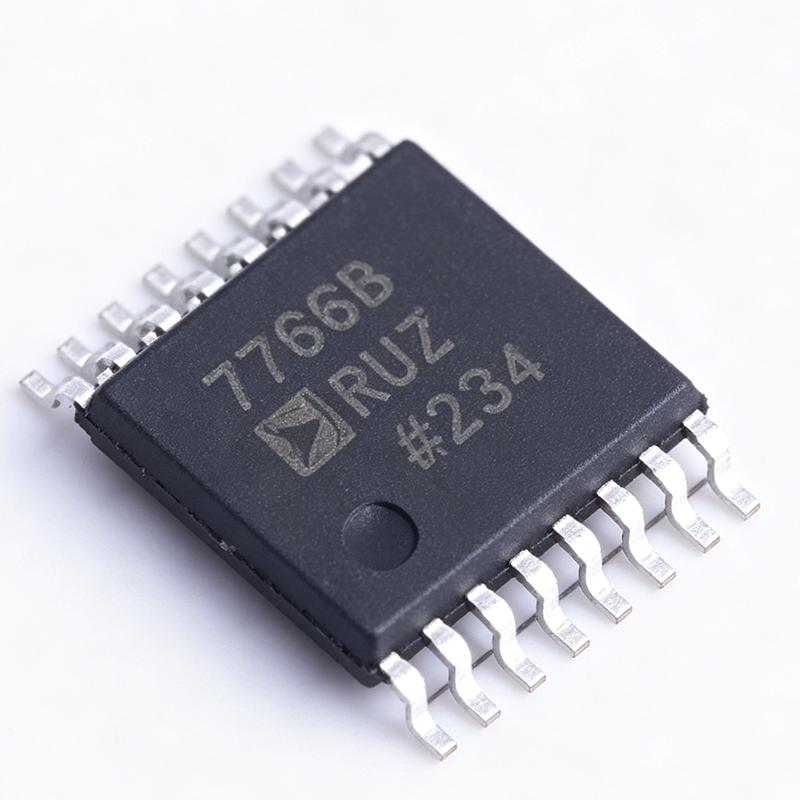
AD7766BRUZ - 24-Bit Oversampled SAR ADC | Analog Devices
The AD7766BRUZ is a high-performance, 24-bit, oversampled successive approximation (SAR) analog-to-digital converter (ADC) from Analog Devices. It is part of the AD7766 family, which includes the AD7766, AD7766-1, and AD7766-2 variants, each offering different sample rates and power consumption levels. The AD7766BRUZ specifically operates at 128 kSPS with a dynamic range of 109.5 dB and consumes only 8.5 mW, making it ideal for low-power, high-resolution data acquisition systems. The device is housed in a 16-lead TSSOP package and operates from a 2.5 V supply with a 5 V reference. An oversampled SAR ADC is a type of analog-to-digital converter that combines the benefits of a successive approximation register (SAR) architecture with oversampling techniques to achieve high resolution and excellent noise performance. Unlike traditional SAR ADCs, which sample at the Nyquist rate, oversampled SAR ADCs sample at a much higher rate and use digital filtering to improve the signal-to-noise ratio (SNR) and dynamic range. This makes them particularly suitable for applications requiring high accuracy and low noise, such as precision instrumentation, medical devices, and industrial control systems. The AD7766BRUZ falls under the broader category of data converters, which are essential components in any mixed-signal system. Key features of the AD7766BRUZ include a 24-bit resolution, a dynamic range of 109.5 dB, and a total harmonic distortion (THD) of -112 dB. The device also features an oversampled SAR architecture that provides high performance with low power consumption. The AD7766BRUZ includes an SDI pin that allows for daisy-chaining multiple devices, enabling easy expansion in multi-channel systems. The device operates from a 2.5 V supply and uses a 5 V reference, which simplifies power supply design. The AD7766BRUZ is designed for applications that require high-resolution, low-noise analog-to-digital conversion with minimal power consumption. Its oversampled SAR architecture provides excellent AC and DC accuracy, making it suitable for precision measurement and control systems. The device's low power consumption of 8.5 mW makes it ideal for battery-powered and portable applications. Typical applications for the AD7766BRUZ include precision data acquisition systems, medical instrumentation, industrial process control, and vibration analysis. The device's high dynamic range and low noise make it well-suited for applications where signal integrity is critical. Additionally, the daisy-chain capability allows for easy integration into multi-channel systems. When designing with the AD7766BRUZ, it is important to ensure proper decoupling of the power supply and reference pins. A clean, low-noise reference voltage is essential for achieving the specified dynamic range. Additionally, the input signal should be properly conditioned to avoid aliasing and to ensure optimal performance.

AD7768-4BSTZ - 24-Bit 4-Ch Simultaneous ADC | Analog Devices
The AD7768-4BSTZ is a 24-bit, 4-channel, simultaneous sampling analog-to-digital converter (ADC) from Analog Devices, featuring a maximum output data rate of 256 kSPS and a wideband input bandwidth of 110.8 kHz. Housed in a 64-lead LQFP (10x10 mm) package, this sigma-delta ADC is designed for high-performance measurement applications requiring low power and high accuracy. An ADC (analog-to-digital converter) is a device that converts continuous analog signals into discrete digital numbers. The AD7768-4 is a sigma-delta ADC, which uses oversampling and noise shaping to achieve high resolution and excellent noise performance. It belongs to the family of precision data converters, specifically simultaneous sampling ADCs, which capture multiple channels at the exact same instant, essential for applications like power monitoring and vibration analysis. Key features of the AD7768-4BSTZ include three power modes (fast, median, and low power) that allow the user to trade off input bandwidth, output data rate, and power dissipation. It offers a wideband low-pass filter with ±0.005 dB pass-band ripple and 105 dB stop-band attenuation at the Nyquist frequency. The device operates from a 2.5 V analog supply and a 2.5 V to 3.3 V digital interface supply, with a typical power dissipation of 27.5 mW in low power mode. The AD7768-4 uses a sigma-delta modulator with a digital decimation filter, providing a flexible digital interface (SPI) for configuration and data readout. It includes an internal reference buffer and supports both differential and single-ended inputs. The device is specified over the industrial temperature range of -40°C to +105°C. Typical applications include power line monitoring, vibration analysis, motor control, and multi-phase energy metering. Its simultaneous sampling capability and high accuracy make it ideal for systems requiring precise phase alignment between channels. When designing with the AD7768-4, ensure proper decoupling of the analog and digital supplies, and use a low-jitter master clock to achieve the specified SNR. The power mode selection should be optimized based on the required bandwidth and power budget.
AD7768-4BSTZ-RL - 24-Bit 4-Ch ADC, 256kSPS | Analog Devices
The AD7768-4BSTZ-RL from Analog Devices is a 24-bit, 4-channel, simultaneous sampling sigma-delta (Σ-Δ) analog-to-digital converter (ADC) in a 64-lead LQFP (10x10 mm) package. It achieves 108 dB dynamic range at a maximum input bandwidth of 110.8 kHz, with a maximum output data rate of 256 kSPS per channel. The device integrates a Σ-Δ modulator and digital filter per channel, enabling synchronized sampling of ac and dc signals. A sigma-delta ADC is a type of analog-to-digital converter that uses oversampling and noise shaping to achieve high resolution. It is part of the ADC family, which converts analog signals to digital for processing in microcontrollers, DSPs, and FPGAs. Sigma-delta ADCs are preferred for precision measurement applications due to their excellent linearity and noise performance. Key features include three power modes (fast, median, low power) that allow trade-offs between input bandwidth, output data rate, and power dissipation. The AD7768-4 supports a wide input voltage range and provides a flexible digital interface with both SPI and parallel output options. It also features a low-pass digital filter with programmable decimation, enabling users to optimize for noise and bandwidth. The AD7768-4 uses a high-performance analog front-end with a precision reference and internal oscillator, reducing external component count. Its simultaneous sampling capability ensures accurate phase matching across channels, critical for multi-phase power monitoring and vibration analysis. The device operates from a 2.5 V analog supply and a 1.8 V digital supply, with power dissipation scaling with mode. Typical applications include power quality monitoring, vibration analysis, motor control, and data acquisition systems. The AD7768-4 is ideal for industrial automation, energy metering, and test and measurement equipment where high accuracy and synchronized multi-channel sampling are required. When designing with this ADC, ensure proper decoupling of the analog and digital supplies and use a low-noise reference to achieve the specified dynamic range. The digital filter settings should be configured to match the desired bandwidth and output data rate.

AD7780BRUZ - 24-Bit Sigma-Delta ADC, 330µA | Analog Devices
The AD7780BRUZ is a complete low power front-end solution for bridge sensor products, including weigh scales, strain gages, and pressure sensors. It integrates a precision, low power, 24-bit sigma-delta (Σ-Δ) ADC, an on-chip low noise programmable gain amplifier (PGA), and an on-chip oscillator. Consuming only 330 μA, the AD7780 is particularly suitable for portable or battery-operated products. The device operates from a single 2.7V to 5.25V supply and is available in a 16-lead TSSOP package. A sigma-delta ADC is an analog-to-digital converter that uses oversampling and noise shaping to achieve high resolution. It is ideal for low-frequency, high-precision measurement applications such as bridge sensors, where the signal bandwidth is narrow but accuracy is paramount. The AD7780 belongs to the family of sigma-delta ADCs, which are a subset of precision analog-to-digital converters used in industrial and instrumentation systems. Key features include a 24-bit resolution, a maximum output data rate of 16.7 SPS, and a programmable gain of 1, 2, 4, 8, 16, 32, 64, or 128. The device also features a low noise PGA, an on-chip oscillator, and a 3-wire serial interface. The AD7780 operates from a 2.7V to 5.25V supply and consumes only 330 μA, making it ideal for battery-powered applications. The AD7780 uses a sigma-delta architecture with a digital filter that provides 50 Hz and 60 Hz rejection. The device includes a temperature sensor and a bridge power-down switch, which can be used to conserve power. The AD7780 is specified over the -40°C to +105°C temperature range and is available in a 16-lead TSSOP package. Typical applications include weigh scales, strain gage transducers, pressure sensors, and portable instrumentation. The low power consumption and high resolution make it suitable for battery-operated devices where power efficiency is critical. When designing with the AD7780, ensure that the analog and digital supplies are properly decoupled and that the reference input is stable. The device requires an external reference voltage, which should be low-noise to achieve the specified performance.
AD7781BRUZ - 20-Bit Low Power Sigma-Delta ADC | Analog Devices
The AD7781BRUZ from Analog Devices is a complete low power front-end solution for bridge sensor products, including weigh scales, strain gages, and pressure sensors. It integrates a precision low power 20-bit sigma-delta (Σ-Δ) ADC, an on-chip low noise programmable gain amplifier (PGA) with gain of 128, and an on-chip oscillator. The device operates from a single 2.7V to 5.25V supply and consumes only 330 μA, making it ideal for portable and battery-operated applications. It is available in a 16-lead TSSOP package (BRUZ suffix indicates tube packaging). An analog-to-digital converter (ADC) is an electronic component that converts continuous analog signals into discrete digital numbers. The AD7781 is a sigma-delta ADC, which uses oversampling and noise shaping to achieve high resolution (20 bits) at low bandwidths. It belongs to the family of precision data converters used in measurement and instrumentation systems, where accurate conversion of sensor signals is critical. The on-chip PGA allows direct connection of low-level bridge sensors without external amplification, simplifying the signal chain. Key features of the AD7781BRUZ include 20-bit resolution, a pin-programmable gain of 1, 8, 16, 32, 64, or 128, and a maximum output data rate of 16.7 SPS. It has a differential input, external reference, and a serial SPI-compatible interface. The device includes a power-down mode that reduces current consumption to 1 μA, extending battery life in portable designs. The on-chip oscillator eliminates the need for an external clock, reducing component count and board space. The AD7781 uses a sigma-delta modulator followed by a digital filter, achieving excellent noise performance for low-frequency measurements. The programmable gain amplifier (PGA) amplifies small sensor signals before conversion, improving effective resolution. The device operates over the industrial temperature range of -40°C to +105°C, ensuring reliable performance in harsh environments. The 16-lead TSSOP package is compact and suitable for space-constrained designs. Typical applications include weigh scales, strain gage transducers, pressure sensors, and other bridge-type sensors. The low power consumption and high resolution make it suitable for portable medical devices, industrial process control, and battery-powered instrumentation. The AD7781BRUZ is a drop-in replacement for the AD7781BRZ (SOIC package) with the same electrical specifications, but in a smaller TSSOP footprint. When designing with the AD7781BRUZ, ensure that the reference voltage is stable and low-noise, as it directly affects conversion accuracy. Use a precision reference such as the ADR4520 for best performance. The differential inputs should be driven by a low-impedance source to minimize settling time errors. Proper PCB layout with a solid ground plane and decoupling capacitors near the supply pins is essential for achieving the specified noise performance.
AD7792BRUZ - 16-Bit Sigma-Delta ADC with PGA & Reference | Analog Devices
The AD7792BRUZ is a low power, low noise, 16-bit sigma-delta analog-to-digital converter (ADC) from Analog Devices, featuring three differential analog inputs, an on-chip low-noise programmable gain amplifier (PGA), and an embedded precision reference. It operates from a single 2.7V to 5.25V supply and achieves a maximum output data rate of 470 SPS. The device is housed in a 16-lead TSSOP package, making it suitable for space-constrained precision measurement applications. A sigma-delta ADC is a type of analog-to-digital converter that uses oversampling and noise shaping to achieve high resolution. It is widely used in precision measurement systems where low noise and high accuracy are required. The AD7792BRUZ belongs to the family of sigma-delta ADCs, which are part of the broader category of data converters, essential in bridging analog signals to digital processing. Key features include a 16-bit resolution, three differential inputs, a PGA with gains of 1, 2, 4, 8, 16, 32, 64, and 128, and an internal reference with low drift. The device also provides programmable excitation current sources, burnout currents, and a bias voltage generator, enhancing its versatility in sensor applications. The low power consumption of 500 µA typical makes it ideal for battery-powered systems. The AD7792BRUZ uses a sigma-delta modulator followed by a digital filter, providing excellent noise performance and inherent anti-aliasing. The on-chip PGA allows direct connection to low-level sensors such as thermocouples and strain gauges, eliminating the need for external amplification. The device communicates via a serial peripheral interface (SPI), simplifying integration with microcontrollers. Typical applications include temperature measurement with thermocouples and RTDs, pressure and strain gauge measurement, and industrial process control. The low noise and high resolution make it suitable for precision instrumentation and weigh scales. When designing with the AD7792BRUZ, ensure proper decoupling of the AVDD and DVDD supplies and place the reference decoupling capacitor close to the REFIN pins. The SPI interface should be isolated from noisy digital lines to maintain signal integrity.
AD7793BRUZ - 24-Bit Sigma-Delta ADC, 3-Channel | Analog Devices
The AD7793BRUZ is a low power, low noise, 24-bit sigma-delta analog-to-digital converter (ADC) from Analog Devices, featuring three differential input channels and an on-chip low noise instrumentation amplifier and reference. It operates from a 2.7V to 5.25V supply and is available in a 16-lead TSSOP package. The device achieves up to 23 bits effective resolution with RMS noise as low as 1.5 uV at 16.7 Hz output data rate, making it ideal for precision measurement applications. A sigma-delta ADC is a type of analog-to-digital converter that uses oversampling and noise shaping to achieve high resolution. It is part of the ADC family, which converts analog signals to digital for processing in microcontrollers and DSPs. Sigma-delta ADCs are known for their high resolution and excellent noise performance, making them suitable for precision instrumentation and sensor interfaces. Key features include a programmable gain amplifier (PGA) with gains from 1 to 128, a precision low noise, low drift internal band gap reference, and the ability to accept an external differential reference. The device also includes programmable excitation current sources, burnout currents, and a bias voltage generator. It communicates via a SPI-compatible serial interface and operates over a temperature range of -40°C to +105°C. The AD7793BRUZ uses a sigma-delta modulator with a digital filter, providing flexible output data rates from 4.17 Hz to 470 Hz. The on-chip PGA allows direct connection to low-level sensors such as thermocouples and strain gauges, while the internal reference ensures accuracy without external components. The device's low power consumption of 400 uA typical makes it suitable for battery-powered applications. Typical applications include temperature measurement with RTDs and thermocouples, pressure and strain gauge interfaces, and industrial process control. The device's low noise and high resolution enable precise measurements in harsh environments. Its SPI interface simplifies connection to microcontrollers, and the small TSSOP package saves board space. When designing with the AD7793BRUZ, ensure proper decoupling of the AVDD and DVDD supplies with 0.1 uF and 10 uF capacitors. The reference input should be bypassed with a 0.1 uF capacitor. For optimal noise performance, use a low-noise analog supply and keep digital traces away from analog inputs.