Memory ICs
Subcategories
Products (183)
NT5CB256M16CP-DIH - 4Gb DDR3L SDRAM 256Mx16 | Nanya
The Nanya NT5CB256M16CP-DIH is a 4Gb DDR3L SDRAM organized as 256M x 16, operating at 1.35V (VDD/VDDQ) with a data rate of 1600Mbps (DDR3L-1600). It is housed in a 96-ball TFBGA package and supports commercial, industrial, and automotive temperature grades. This memory device is designed for high-bandwidth, low-power applications, offering a 16-bit data bus and 8 internal memory banks (BA0-BA2). DDR3L SDRAM is a type of dynamic random-access memory that operates at a lower voltage (1.35V) compared to standard DDR3 (1.5V), reducing power consumption by up to 20% while maintaining similar performance. It is part of the DDR3 memory family, which uses double data rate architecture to transfer data on both edges of the clock, and is widely used in computing, networking, and embedded systems. Key features include differential clock inputs (CK, CK#), programmable CAS Latency (CL) and WRITE Latency (CWL) of 5,6,7,8, and 9, and POSTED CAS additive latency. The device supports on-die termination (ODT) and dynamic ODT for improved signal integrity. It also features auto-refresh and self-refresh modes for low-power standby. The NT5CB256M16CP-DIH uses a 70nm process technology, enabling high density and low power. The 96-ball TFBGA package provides excellent thermal and electrical performance, with a ball pitch of 0.8mm. The device is RoHS compliant and supports industrial temperature range (-40°C to +95°C) for the -DIH variant. Typical applications include embedded computing, networking equipment, industrial automation, and automotive infotainment systems. Its low voltage and high speed make it ideal for power-sensitive designs. When designing with this memory, ensure proper decoupling capacitors near the VDD and VDDQ pins, and follow the PCB layout guidelines in the datasheet to minimize signal integrity issues. The device requires a 1.35V supply and SSTL_15 interface.
NT5CB256M16CP-DII - 4Gb DDR3L SDRAM 256Mx16 | Nanya
The Nanya NT5CB256M16CP-DII is a 4Gb DDR3L SDRAM organized as 256M x 16, operating at 1.35V with a data rate of DDR3L-1600 (CL11). It is part of Nanya's C-die family, designed for commercial, industrial, and automotive temperature grades. The device is housed in a 96-ball FBGA package, offering a compact footprint for space-constrained applications. DDR3L SDRAM (Double Data Rate 3 Low Voltage) is a type of synchronous dynamic random-access memory that operates at a lower voltage (1.35V) compared to standard DDR3 (1.5V), reducing power consumption by up to 20% while maintaining similar performance. It is widely used in computing, networking, and embedded systems where energy efficiency is critical. DDR3L is part of the DDR SDRAM family, which includes DDR, DDR2, DDR3, and DDR4, each offering increased bandwidth and lower power. Key features include a 16-bit data bus, 8 internal banks, burst lengths of 8 and 4 (with burst chop), on-die termination (ODT), and programmable CAS latency. The device supports auto-refresh and self-refresh modes, with a refresh interval of 7.8us at 85C and 3.9us at 95C. It also features a temperature-compensated self-refresh (TCSR) for improved reliability in high-temperature environments. The NT5CB256M16CP-DII utilizes Nanya's advanced C-die process technology, enabling high density and low power. The memory operates from a 1.35V core supply and a 1.5V I/O supply (for DDR3L, VDDQ is 1.35V). It supports data transfer rates up to 1600 Mbps per pin, providing a peak bandwidth of 3.2 GB/s per device. The device includes a programmable mode register for configuring CAS latency, burst length, and other operating parameters. Typical applications include embedded computing, networking equipment (routers, switches), industrial automation, and automotive infotainment systems. Its low voltage and high density make it ideal for power-sensitive designs, while the industrial temperature range (-40C to +95C) ensures reliable operation in harsh environments. When designing with this device, ensure proper decoupling capacitors near the power pins and follow the PCB layout guidelines in the datasheet to minimize signal integrity issues. The device requires a stable 1.35V supply and a separate VDDQ supply; both must be within specified tolerances.
NT5CB256M16CP-EK - 4Gb DDR3L SDRAM 256Mx16 | Nanya
The Nanya NT5CB256M16CP-EK is a 4Gb DDR3L SDRAM organized as 256M x 16, operating at 1.35V (DDR3L) with a 96-ball TFBGA package. It supports data rates up to DDR3-2133 (CL14) and is designed for commercial, industrial, and automotive temperature grades. The device features 8 internal memory banks, differential clock inputs (CK, CK#), and programmable CAS Latency (CL), WRITE Latency (CWL), and Posted CAS Additive Latency. With a 16-bit data bus, it is ideal for applications requiring high-density, low-power memory in compact form factors. DDR3L SDRAM (Double Data Rate 3 Low Voltage) is a type of synchronous dynamic random-access memory that operates at 1.35V, reducing power consumption by about 20% compared to standard 1.5V DDR3. It is part of the DDR3 family, which uses double data rate signaling to transfer data on both edges of the clock, achieving high bandwidth. DDR3L is commonly used in mobile, embedded, and industrial systems where power efficiency is critical, and it is backward compatible with DDR3 through its support for both 1.35V and 1.5V operation. Key features include a 4Gb density, 256M x 16 organization, 96-ball TFBGA package, and support for data rates up to 2133 Mbps. The device operates from a 1.35V supply (1.425V to 1.575V range) and features programmable CAS Latency (CL) of 9, 10, 11, 12, 13, and 14, and WRITE Latency (CWL) of 5, 6, 7, 8, and 9. It also supports on-die termination (ODT), dynamic ODT, and programmable output driver impedance. The industrial and automotive temperature grades ensure reliable operation from -40°C to +95°C (case temperature). Technically, the NT5CB256M16CP uses a 30nm-class DRAM process, enabling high density with low power. The device includes 8 internal banks (BA0-BA2) for efficient interleaving and reduced row activation overhead. Differential clock inputs (CK, CK#) improve signal integrity, and the programmable additive latency (AL) supports posted CAS operations for improved bus efficiency. The device also features auto refresh and self refresh modes, with a typical refresh period of 7.8us at 85°C and 3.9us at 95°C. Typical applications include embedded computing, networking equipment, industrial automation, automotive infotainment and ADAS, and high-performance consumer electronics. The 256M x 16 organization is well-suited for systems requiring a 16-bit memory bus, such as SoCs and FPGAs with wide memory interfaces. The low-voltage operation makes it ideal for battery-powered and thermally constrained designs. When designing with this device, ensure proper decoupling with 0.1uF and 1uF capacitors near the power pins, and follow the PCB layout guidelines for DDR3 routing, including matched trace lengths and impedance control (typically 40-50 ohms). The VREFCA and VREFDQ should be decoupled with 0.1uF capacitors to ground.
NT5CC256M16CN-FLB - 4Gb DDR3L SDRAM | Nanya Technology
The Nanya Technology NT5CC256M16CN-FLB is a 4Gb (256M x 16) DDR3L SDRAM designed for commercial, industrial, and automotive applications. It operates at a supply voltage of 1.35V (DDR3L) and supports data rates up to 1866 Mbps (PC3-14900). The device is housed in a 96-ball FBGA package, offering a compact footprint for space-constrained designs. DDR3L SDRAM is a type of double data rate synchronous dynamic random-access memory that operates at a lower voltage (1.35V) compared to standard DDR3 (1.5V), reducing power consumption by up to 20% while maintaining high bandwidth. It is part of the DDR3 memory family, which uses an 8n prefetch architecture and on-die termination (ODT) to improve signal integrity at high speeds. DDR3L is widely used in mobile devices, embedded systems, and industrial computing where power efficiency is critical. Key features include a 16-bit I/O interface, 8 internal banks, burst lengths of 8 and 4 (with burst chop), programmable CAS latency (CL) of 9, 10, 11, and 13, and a self-refresh mode for low-power standby. The device supports auto precharge, write leveling, and ZQ calibration for improved signal integrity. It also includes a temperature sensor for thermal management, enabling dynamic refresh rate adjustment. The NT5CC256M16CN-FLB uses a 30nm-class process technology, achieving high density with low power consumption. The FBGA package provides excellent thermal and electrical performance, with a thermal resistance of [DATA_NEEDED: theta_JA]. The device is RoHS compliant and supports industrial temperature ranges from -40°C to +95°C (case temperature). Typical applications include solid-state drives (SSDs), network routers, industrial PCs, automotive infotainment systems, and embedded computing platforms. Its low voltage and high speed make it ideal for power-sensitive designs that require high memory bandwidth. When designing with this device, ensure proper decoupling capacitors near the VDD and VDDQ pins, and follow the PCB layout guidelines in the datasheet to minimize signal reflections. The device requires a stable 1.35V supply and a reference voltage (VREF) for the address/command bus.
NT5CC256M16CN-FLH - 4Gb DDR3L SDRAM | Nanya Technology
The Nanya Technology NT5CC256M16CN-FLH is a 4Gb (256M x 16) DDR3L SDRAM designed for commercial, industrial, and automotive applications. It operates at a supply voltage of 1.35V (DDR3L) with a data rate of up to 1866 Mbps (PC3-14900). The device is housed in a 96-ball FBGA package, offering a compact footprint for space-constrained designs. DDR3L SDRAM is a type of dynamic random access memory that operates at a lower voltage (1.35V) compared to standard DDR3 (1.5V), reducing power consumption by approximately 20% while maintaining high bandwidth. It is part of the DDR3 memory family, which uses an 8n-prefetch architecture to achieve high data rates. DDR3L is widely used in computing, networking, and embedded systems where power efficiency is critical. Key features include a 16-bit I/O interface, 8 internal banks, burst lengths of 8 and 4 (with burst chop), on-die termination (ODT), and programmable CAS latency. The device supports auto self-refresh, auto precharge, and write leveling for signal integrity. It also includes a ZQ calibration function for improved timing accuracy. The NT5CC256M16CN-FLH is built on Nanya's advanced DRAM process technology, ensuring high reliability and performance. It supports a temperature range of 0°C to +95°C (TC) for commercial and industrial grades, with automotive grade options available. The device is RoHS compliant and lead-free. Typical applications include DDR3L memory modules for laptops, servers, networking equipment, industrial PCs, and automotive infotainment systems. Its low voltage and high density make it ideal for power-sensitive designs. When designing with this device, ensure proper decoupling capacitors near the power pins and follow the layout guidelines in the datasheet to minimize signal integrity issues. The device requires a 1.35V supply and a separate VDDQ for the I/O, which should be regulated accurately.
NT5CC256M16CN-FLI - 4Gb DDR3L SDRAM | Nanya Technology
The Nanya Technology NT5CC256M16CN-FLI is a 4Gb (256M x 16) DDR3L SDRAM designed for commercial, industrial, and automotive applications. It operates at a supply voltage of 1.35V (DDR3L) with a data rate of up to 1866 Mbps (PC3-14900). The device is available in a 96-ball TFBGA package, offering a compact footprint for space-constrained designs. DDR3L SDRAM is a type of dynamic random-access memory that operates at a lower voltage (1.35V) compared to standard DDR3 (1.5V), reducing power consumption by approximately 20% while maintaining similar performance. It is part of the DDR3 memory family, which uses double data rate architecture to transfer data on both edges of the clock signal, and is widely used in computing, networking, and embedded systems. Key features include a 16-bit I/O interface, 8 internal banks, burst lengths of 8 and 4 (with burst chop), on-die termination (ODT), and programmable CAS latency. The device supports auto self-refresh and auto precharge functions, ensuring data integrity with minimal power. It also includes write leveling, data mask, and ZQ calibration functions for signal integrity and system reliability. The NT5CC256M16CN-FLI is fabricated using Nanya's advanced DRAM process technology, providing high density and low power consumption. It supports a temperature range of 0°C to +95°C (case temperature) for industrial applications, with derating required above 95°C. The device is RoHS compliant and lead-free, meeting environmental standards. Typical applications include DDR3L memory modules for laptops, embedded systems, networking equipment, and industrial computing. Its low voltage and high speed make it ideal for power-sensitive designs, while the industrial temperature range supports harsh environments. When designing with this device, ensure proper decoupling capacitors near the power pins and follow the PCB layout guidelines in the datasheet to minimize signal integrity issues. The device requires a stable 1.35V supply and a 0.75V reference voltage for the address/command bus.
NT5CC256M16CN-FLNA - 4Gb DDR3L SDRAM 256Mx16 | Nanya
The Nanya Technology NT5CC256M16CN-FLNA is a 4Gb DDR3L SDRAM organized as 256M words by 16 bits, designed for commercial, industrial, and automotive applications. It operates at a supply voltage of 1.35V (DDR3L) with a 1.5V tolerant option, supporting data rates up to 1866 Mbps. The device is housed in a 96-ball FBGA package, offering a compact footprint for high-density memory systems. DDR3L (Low Voltage DDR3) is a type of synchronous dynamic random-access memory that operates at a lower voltage (1.35V) compared to standard DDR3 (1.5V), reducing power consumption by up to 20% while maintaining similar performance. It is part of the DDR3 SDRAM family, which uses double data rate architecture to transfer data on both edges of the clock, and is widely used in computing, networking, and embedded systems. Key features include a 16n prefetch architecture, on-die termination (ODT), programmable CAS latency, and burst lengths of 8 and 4. The device supports auto-refresh and self-refresh modes, with a temperature-compensated self-refresh (TCSR) for industrial temperature ranges. It also features a programmable output driver impedance and a DLL for precise timing. Technically, the NT5CC256M16CN-FLNA uses a 30nm-class process technology, achieving high density with low power. The memory array is organized into 8 banks, each with 32K rows, providing efficient row activation and precharge. The device includes a mode register set (MRS) for configuration, and supports write leveling and read leveling for improved signal integrity in high-speed systems. Typical applications include DDR3L memory modules for laptops, servers, and industrial PCs, as well as embedded systems such as network routers, set-top boxes, and automotive infotainment. Its low voltage and wide temperature range make it suitable for battery-powered and harsh environments. When designing with this device, ensure proper decoupling capacitors near the VDD and VDDQ pins, and follow the PCB layout guidelines for DDR3L to maintain signal integrity. The device requires a stable 1.35V supply and a reference voltage (VREF) for the address and control signals.
NT5CC256M16CP-DI - 4Gb DDR3L SDRAM 256Mx16 | Nanya
The Nanya NT5CC256M16CP-DI is a 4Gb DDR3L SDRAM organized as 256M x 16 bits, operating at 1.35V with a VFBGA-96 package. It supports DDR3-1600 speed grade with CL11 timing, and is backward compatible with 1.5V DDR3. This memory device is designed for commercial, industrial, and automotive temperature ranges, making it suitable for a wide range of applications. DDR3L SDRAM (Double Data Rate 3 Low Voltage) is a type of synchronous dynamic random-access memory that operates at 1.35V, reducing power consumption by about 20% compared to standard 1.5V DDR3. It is part of the DDR3 family, which uses prefetch buffers and on-die termination to achieve high data rates. DDR3L is commonly used in computing, networking, and embedded systems where power efficiency is critical. Key features include 8 internal memory banks, differential clock inputs (CK, CK#), programmable CAS latency (CL) of 5-11, and write latency (CWL) of 5-9. The device supports on-die termination (ODT) and DLL-off mode for low-power operation. It also features programmable additive latency (posted CAS) and a 0.075V reference voltage tolerance. The NT5CC256M16CP-DI uses a 70nm process technology, offering a balance of performance and power efficiency. The VFBGA-96 package provides a compact footprint with excellent thermal and electrical characteristics. The device supports burst lengths of 8 and 4, and includes auto-refresh and self-refresh modes for power management. Typical applications include DDR3L memory modules for laptops, servers, networking equipment, and industrial computing. It is also used in automotive infotainment and ADAS systems where reliability and temperature range are critical. The 1.35V operation makes it ideal for battery-powered devices. When designing with this device, ensure proper decoupling capacitors near the power pins and follow the PCB layout guidelines in the datasheet to minimize signal integrity issues. The device requires a stable 1.35V supply and a 0.75V reference voltage for correct operation.
NT5CC256M16CP-DIA - 4Gb DDR3L SDRAM 256Mx16 | Nanya
The Nanya NT5CC256M16CP-DIA is a 4Gb DDR3L SDRAM organized as 256M x 16, operating at 1.35V with a data rate of 1600Mbps (800MHz clock). It is housed in a 96-ball TFBGA package with 0.8mm pitch, measuring 9x13mm. This device supports commercial, industrial, and automotive temperature grades, making it suitable for a wide range of applications. DDR3L SDRAM is a type of double data rate synchronous dynamic random-access memory that operates at a lower voltage (1.35V) compared to standard DDR3 (1.5V), reducing power consumption by about 20%. It is part of the memory hierarchy in computing systems, serving as the main working memory for processors, and is widely used in servers, networking equipment, and embedded systems. Key features include 8 internal memory banks, differential clock inputs (CK, CK#), programmable CAS latency (CL) and write latency (CWL), on-die termination (ODT) for signal integrity, and a burst length of 8. The device supports DLL-off mode for low-frequency operation and includes auto-refresh and self-refresh modes for power saving. It is halogen-free and RoHS compliant. Technically, the NT5CC256M16CP-DIA uses a CMOS process and features a 0.225ns clock-to-output access time. The high-speed bin is backward compatible with lower speed bins, allowing flexible system design. The 96-ball TFBGA package provides excellent thermal and electrical performance, with a thermal resistance of [DATA_NEEDED: theta_JA] and operating temperature range of -40°C to +95°C (industrial) or -40°C to +105°C (automotive). Typical applications include DDR3L memory modules for laptops, embedded computing, networking routers, and industrial automation. Its low voltage and wide temperature range make it ideal for power-sensitive and harsh-environment designs. When designing with this device, ensure proper termination and decoupling on the VDD and VDDQ rails. The ODT feature should be configured via mode registers to match the system's impedance requirements for optimal signal integrity.
NT5CC256M16CP-DIB - 4Gb DDR3L SDRAM 256Mx16 | Nanya Technology
The Nanya Technology NT5CC256M16CP-DIB is a 4Gb DDR3L SDRAM organized as 256M x 16 bits, operating at 1.35V with a 96-ball TFBGA package. It is designed for industrial temperature grade applications, offering high-speed data transfer with a data rate of up to 1600 Mbps (DDR3L-1600). The device features 8 internal memory banks, differential clock inputs, and programmable CAS latency (CL) and write latency (CWL) for flexible system timing. DDR3L (Double Data Rate 3 Low Voltage) SDRAM is a type of synchronous dynamic random-access memory that operates at a reduced voltage of 1.35V compared to standard DDR3's 1.5V, enabling lower power consumption in mobile and embedded systems. It is part of the DDR3 memory family, which uses double data rate signaling to transfer data on both edges of the clock, and is widely used in computing, networking, and industrial applications. Key features include a 4Gb density, 16-bit I/O width, 96-ball TFBGA package (9x13mm, 0.8mm pitch), industrial temperature range (-40°C to +95°C), and RoHS compliance. The device supports programmable CAS latency of 5, 6, 7, 8, and 9, and write latency of 5, 6, 7, 8, and 9, with a refresh cycle count of 8192. It also features on-die termination (ODT) and dynamic ODT for improved signal integrity. Technically, the NT5CC256M16CP-DIB uses a CMOS process and incorporates a differential clock input (CK, CK#) for precise timing. The device supports auto-refresh and self-refresh modes, with a reduced standby current for power saving. The 1.35V operation is backward compatible with 1.5V DDR3 parts, allowing flexible system design. Typical applications include industrial embedded systems, networking equipment, and automotive infotainment, where high-density, low-power memory is required. The industrial temperature grade ensures reliable operation in harsh environments. When designing with this device, ensure proper decoupling capacitors near the power pins and follow the layout guidelines in the datasheet to minimize signal integrity issues. The device requires a stable 1.35V supply and a reference voltage (VREF) for the I/O.
NT5CC256M16CP-DIB1 - 4Gb DDR3L SDRAM 256Mx16 | Nanya
The Nanya NT5CC256M16CP-DIB1 is a 4Gb DDR3L SDRAM organized as 256M x 16, operating at 1.35V with a data rate of 1600Mbps (DDR3L-1600). It is housed in a 96-ball TFBGA package with 0.8mm pitch, halogen-free and RoHS compliant. This device is designed for commercial, industrial, and automotive applications, offering JEDEC DDR3 compliance with 8n prefetch architecture, differential clock (CK/CK#), and data strobe (DQS/DQS#). DDR3L SDRAM is a type of dynamic random-access memory that operates at a lower voltage (1.35V) compared to standard DDR3 (1.5V), reducing power consumption while maintaining high bandwidth. It is part of the memory hierarchy in computing systems, serving as the main system memory for processors, and is widely used in embedded systems, networking equipment, and automotive infotainment. Key features include a 4Gb density, 16-bit I/O width, 8 internal banks, programmable CAS latency (CL) and write latency (CWL), on-die termination (ODT), and a configurable output drive strength. The device supports a burst length of 8 and a burst chop of 4, with a self-refresh mode for low-power standby. The -DIB1 speed grade indicates DDR3L-1600 with timing parameters of CL=11, CWL=8, and tRCD/tRP=11. The architecture uses a 70nm process technology, providing a balance of performance and power efficiency. The differential clock inputs and data strobes ensure signal integrity for high-speed operation. The device includes programmable mode registers for flexible configuration, and it supports DLL-off mode for reduced power consumption in low-frequency applications. Typical applications include solid-state drives (SSDs), network routers, industrial automation controllers, automotive infotainment systems, and embedded computing platforms. The low 1.35V operation makes it ideal for power-sensitive designs, while the industrial and automotive temperature grades ensure reliability in harsh environments. When designing with this device, ensure proper decoupling capacitors near the power pins and follow the PCB layout guidelines for DDR3 routing to maintain signal integrity. The device requires a 1.35V supply and a separate VDDQ, with careful attention to the reference voltage (VREF) for the address and control signals.
NT5CC256M16CP-DIH - 4Gb DDR3L SDRAM 256Mx16 | Nanya
The Nanya NT5CC256M16CP-DIH is a 4Gb DDR3L SDRAM organized as 256M x 16 bits, operating at 1.35V with a data rate of 1600 Mbps (DDR3L-1600). It is housed in a 96-ball TFBGA package with a 9x13 mm body and 0.8 mm ball pitch, designed for commercial, industrial, and automotive temperature grades. This memory device supports programmable CAS latency (CL), write latency (CWL), and additive latency, along with on-die termination (ODT) and DLL-off mode for power savings. DDR3L SDRAM is a type of double data rate synchronous dynamic random-access memory that operates at a lower voltage (1.35V) compared to standard DDR3 (1.5V), reducing power consumption by about 15% while maintaining compatibility with DDR3 slots. It is part of the memory hierarchy in computing systems, serving as main memory in laptops, servers, and embedded systems, and is essential for high-bandwidth data processing. Key features include 8 internal memory banks (BA0-BA2), differential clock inputs (CK, CK#), programmable write latency (CWL) of 5, 6, 7, 8, and 9, and a burst length of 8 with on-the-fly burst chop. The device supports a self-refresh mode and partial array self-refresh for low-power standby, making it suitable for battery-powered applications. It is RoHS compliant and halogen-free, meeting environmental standards. Technically, the NT5CC256M16CP-DIH uses a 70nm process technology, enabling high density and low power. The device features a 16n prefetch architecture, achieving high data rates with low power consumption. It includes programmable impedance (ZQ calibration) for signal integrity and supports a temperature-compensated self-refresh (TCSR) to maintain data integrity across temperature ranges. Typical applications include DDR3L memory modules for laptops and ultrabooks, embedded systems in industrial automation, networking equipment, and automotive infotainment systems. Its low voltage and wide temperature range make it ideal for power-sensitive and harsh environments. When designing with this device, ensure proper decoupling capacitors near the power pins and follow the layout guidelines for DDR3 routing to maintain signal integrity. The device requires a 1.35V supply and a separate VDDQ, with careful attention to the ZQ pin for calibration.
NT5CC256M16CP-DII - 4Gb DDR3L SDRAM 256Mx16 | Nanya
The Nanya NT5CC256M16CP-DII is a 4Gb DDR3L SDRAM organized as 256M x 16, operating at 1.35V with a clock frequency of 800MHz (DDR3-1600). It comes in a 96-ball TFBGA package (9x13mm, 0.8mm pitch) and is halogen-free and RoHS compliant. This industrial-grade memory device is designed for reliable operation in extended temperature ranges, making it suitable for networking, industrial automation, and embedded computing applications. DDR3L (Double Data Rate 3 Low Voltage) SDRAM is a type of synchronous dynamic random-access memory that operates at a lower voltage (1.35V) compared to standard DDR3 (1.5V), reducing power consumption by up to 20% while maintaining similar performance. It is part of the DDR3 memory family, which uses double data rate signaling to transfer data on both edges of the clock, and is widely used in computing and embedded systems. Key features include a 256Mx16 organization, 800MHz clock frequency (1600Mbps data rate), 1.35V nominal voltage, and industrial temperature grade. The device supports 8192 refresh cycles and features on-die termination (ODT) for improved signal integrity. The TFBGA-96 package with 0.8mm pitch enables compact PCB designs, and the halogen-free, RoHS-compliant construction meets modern environmental standards. The NT5CC256M16CP-DII utilizes Nanya's 70nm DDR3 A-die process technology, offering a balance of performance and power efficiency. The 1.35V DDR3L parts are backward compatible with 1.5V DDR3 systems, providing design flexibility. The industrial temperature grade ensures reliable operation from -40°C to +95°C, making it suitable for harsh environments. Typical applications include networking equipment (routers, switches), industrial automation controllers, embedded computing modules, and automotive infotainment systems. The high density and low power consumption make it ideal for memory-intensive applications where space and thermal budgets are constrained. When designing with this device, ensure proper decoupling capacitors near the power pins and follow the PCB layout guidelines in the datasheet to maintain signal integrity at DDR3-1600 speeds. The ODT feature should be configured via mode registers to match the system's memory topology.
NT5CC256M16CP-DINA - 4Gb DDR3L SDRAM 256Mx16 | Nanya
The Nanya NT5CC256M16CP-DINA is a 4Gb DDR3L SDRAM organized as 256M x 16 bits, designed for commercial, industrial, and automotive applications. It operates at 1.35V (DDR3L) and is backward compatible with 1.5V DDR3, offering flexibility in system design. The device is housed in a 96-ball TFBGA package with 0.8mm pitch, measuring 9 x 13 mm, and is halogen-free and RoHS compliant. DDR3L SDRAM is a type of double data rate synchronous dynamic random-access memory that operates at a lower voltage (1.35V) compared to standard DDR3 (1.5V), reducing power consumption by up to 20% while maintaining similar performance. It is part of the memory hierarchy in computing systems, serving as the main system memory for processors, and is widely used in laptops, embedded systems, and networking equipment. Key features include a data rate of 1600 Mbps (DDR3-1600), a CAS latency of 11, and a burst length of 8. The device supports on-die termination (ODT), programmable CAS latency, and auto self-refresh for low-power standby. It also features a temperature-compensated self-refresh (TCSR) mode for industrial temperature ranges. The NT5CC256M16CP-DINA uses a 70nm process technology, enabling high density and low power. It includes a precision DLL for timing alignment and supports write leveling for improved signal integrity. The device is designed for reliable operation in harsh environments, with an operating temperature range of -40°C to +95°C (industrial) and -40°C to +105°C (automotive). Typical applications include embedded computing, industrial automation, automotive infotainment, and networking equipment. Its low voltage and high density make it ideal for power-sensitive designs, while its wide temperature range suits automotive and industrial environments. When designing with this memory, ensure proper decoupling capacitors near the power pins and follow the layout guidelines in the datasheet to minimize signal integrity issues. The device requires a stable 1.35V supply and a reference voltage (VREF) for the address and control signals.
NT5CC256M16CP-EK - 4Gb DDR3L SDRAM 256Mx16 | Nanya Technology
The Nanya Technology NT5CC256M16CP-EK is a 4Gb DDR3L SDRAM organized as 256M x 16, designed for high-speed memory applications requiring reliable data throughput and low power consumption. It utilizes an 8n-prefetch architecture and supports data transfer rates up to 2133 Mb/s per pin. With integrated features for signal integrity, power management, and timing calibration, it is well suited for a wide range of computing and embedded systems. DDR3L (Double Data Rate 3 Low Voltage) SDRAM is a type of synchronous dynamic random-access memory that operates at a lower voltage (1.35V) compared to standard DDR3 (1.5V), reducing power consumption by up to 20% while maintaining similar performance. It is part of the DRAM memory hierarchy, which includes SRAM, DRAM, and flash memory, and is widely used in main memory, graphics, and embedded applications. Key features include a 4Gb density, 256M x 16 organization, 96-ball TFBGA package, and support for both DDR3 and DDR3L operation. The device operates over a temperature range of 0°C to +95°C (TC) and includes features such as auto self-refresh, auto precharge, asynchronous reset, data mask, write leveling, dynamic on-chip termination, and ZQ calibration. These features enhance signal integrity and system reliability. The NT5CC256M16CP-EK uses an 8n-prefetch architecture with 8 internal memory banks, differential clock inputs (CK, CK#), and programmable CAS latency (CL), write latency (CWL), and additive latency. It supports burst lengths of 8 and 4 with burst chop, and includes on-die termination (ODT) for improved signal quality. The device is RoHS compliant and lead-free. Typical applications include servers, networking equipment, industrial computing, automotive infotainment, and consumer electronics such as set-top boxes and smart TVs. Its low-voltage operation makes it ideal for power-sensitive designs, while its high-speed interface supports demanding data-intensive workloads. When designing with this device, ensure proper decoupling capacitors near the power pins and follow the layout guidelines in the datasheet to minimize signal integrity issues. The ZQ calibration pin requires a 240-ohm resistor to ground for proper impedance calibration.
NT5CC256M16DN-FLNA - 4Gb DDR3L SDRAM | Nanya Technology
The NT5CC256M16DN-FLNA is a 4Gb DDR3L SDRAM organized as 256M x 16, manufactured by Nanya Technology Corporation. It operates at a supply voltage of 1.35V (VDD and VDDQ) with a range of 1.283V to 1.45V, and is backward compatible to 1.5V ±0.075V for DDR3 operation. This device is designed for commercial, industrial, and automotive temperature grades, making it suitable for a wide range of applications. DDR3L (Double Data Rate 3 Low Voltage) SDRAM is a type of synchronous dynamic random-access memory that operates at a lower voltage (1.35V) compared to standard DDR3 (1.5V), reducing power consumption by about 20-30% while maintaining similar performance. It is part of the memory hierarchy in computing systems, serving as the main system memory for processors, and is widely used in laptops, embedded systems, and networking equipment. Key features include a data rate of 1600 Mbps (PC3-12800) with a CL of 11, a burst length of 8, and on-die termination (ODT) for signal integrity. The device supports auto-refresh and self-refresh modes, and includes programmable CAS latency and additive latency. It is available in a 96-ball FBGA package, which is standard for DDR3L SDRAM. The NT5CC256M16DN-FLNA uses a 30nm-class process technology, offering high density and low power consumption. It features a 16-bit I/O interface, which is ideal for applications requiring moderate bandwidth with lower pin count. The device includes a temperature sensor for thermal management and supports DLL (Delay-Locked Loop) for precise timing. Typical applications include embedded computing, industrial automation, automotive infotainment, networking equipment, and consumer electronics such as set-top boxes and routers. Its low voltage and wide temperature range make it suitable for battery-powered and harsh environments. When designing with this device, ensure proper decoupling capacitors near the power pins and follow the layout guidelines in the datasheet to minimize signal integrity issues. The device requires a stable power supply and proper termination for the address/control lines.
NT5CC256M16DP-DI - 4Gb DDR3L SDRAM 256Mx16 | Nanya
The Nanya NT5CC256M16DP-DI is a 4Gb DDR3L SDRAM organized as 256M x 16 bits, operating at 1.35V with a data rate of 800MHz (DDR3L-1600). It comes in a 96-ball VFBGA package and is designed for commercial, industrial, and automotive temperature grades. This memory device supports high-speed data transfer rates up to 2133 Mb/s/pin, making it suitable for a wide range of computing and embedded applications. DDR3L (Double Data Rate 3 Low Voltage) SDRAM is a type of synchronous dynamic random-access memory that operates at a lower voltage (1.35V) compared to standard DDR3 (1.5V), reducing power consumption while maintaining high bandwidth. It is part of the DDR3 memory family, which uses double data rate signaling to transfer data on both edges of the clock, and is widely used in servers, laptops, and industrial systems. Key features include a 4Gb density, 16-bit data bus, 800MHz clock frequency (1600 Mbps/pin), and a low operating voltage of 1.35V. The device supports programmable CAS latency, burst lengths of 8 and 4 (with burst chop), and on-die termination (ODT) for improved signal integrity. It also includes auto-refresh and self-refresh modes for power saving. Technically, the NT5CC256M16DP-DI uses a CMOS process and is designed to comply with all key DDR3(L) DRAM features. It has a differential clock input (CK and CK#) and all control and address inputs are synchronized to the clock. The device supports DLL (Delay-Locked Loop) for precise timing and includes a mode register for configuration. The VFBGA-96 package provides a compact footprint with excellent thermal and electrical performance. Typical applications include main memory in embedded systems, networking equipment, industrial PCs, and automotive infotainment. Its low voltage and high speed make it ideal for power-sensitive designs. The industrial temperature grade (-40°C to +95°C) ensures reliable operation in harsh environments. When designing with this device, ensure proper decoupling capacitors near the power pins and follow the layout guidelines in the datasheet to minimize signal integrity issues. The device requires a 1.35V supply and a separate VDDQ for the I/O, which should be regulated accurately.
NT5CC256M16DP-DIH - 4Gb DDR3L SDRAM 256Mx16 1.35V | Nanya
The Nanya NT5CC256M16DP-DIH is a 4Gb DDR3L SDRAM organized as 256Mx16, operating at 1.35V with a 96-ball VFBGA package. It is designed for commercial, industrial, and automotive applications, offering high-speed data transfer with a data rate of 1600 Mbps (DDR3-1600). The device supports auto self-refresh, auto precharge, asynchronous reset, data mask, write leveling, dynamic on-chip termination, and ZQ calibration functions, ensuring robust performance in demanding environments. DDR3L SDRAM is a type of dynamic random-access memory that operates at a lower voltage (1.35V) compared to standard DDR3 (1.5V), reducing power consumption while maintaining high bandwidth. It is part of the DDR3 memory family, which uses double data rate architecture to transfer data on both edges of the clock signal. DDR3L is widely used in computing, networking, and embedded systems where power efficiency is critical. Key features include a 4Gb density, 16-bit I/O width, 1.35V core voltage, and support for industrial temperature range (0°C to +95°C). The device offers programmable CAS latency, burst lengths of 8 and 4, and on-die termination for improved signal integrity. The 96-ball VFBGA package provides a compact footprint suitable for space-constrained designs. The NT5CC256M16DP-DIH utilizes advanced CMOS process technology, achieving high-speed operation with low power dissipation. It incorporates a temperature-compensated self-refresh mechanism to maintain data integrity across temperature variations. The device also features a programmable output driver impedance and supports DLL (Delay-Locked Loop) for precise timing control. Typical applications include DDR3L memory modules for laptops, servers, networking equipment, industrial PCs, and automotive infotainment systems. Its low voltage and high density make it ideal for power-sensitive applications requiring large memory capacity. When designing with this device, ensure proper decoupling capacitors near the power pins and follow the layout guidelines in the datasheet to minimize signal integrity issues. The ZQ calibration pin requires a 240-ohm resistor to ground for correct impedance calibration.
NT5CC256M16DP-FLNA - 4Gb DDR3L SDRAM | Nanya Technology
The Nanya Technology NT5CC256M16DP-FLNA is a 4Gb DDR3L SDRAM organized as 256M x 16, operating at 1.35V with a data rate of 1600 Mbps (PC3L-12800). It is housed in a 96-ball BGA package (13x9 mm) and supports commercial, industrial, and automotive temperature ranges. This device is designed for high-bandwidth memory applications requiring low power consumption and reliable performance. DDR3L SDRAM is a type of dynamic random-access memory that operates at a lower voltage (1.35V) compared to standard DDR3 (1.5V), reducing power consumption by up to 20% while maintaining similar performance. It is part of the DDR3 memory family, which uses double data rate architecture to transfer data on both edges of the clock signal, achieving high data rates. DDR3L is commonly used in mobile devices, embedded systems, and industrial applications where power efficiency is critical. Key features include a 16-bit data bus, 8 internal banks, programmable CAS latency (CL 11, 12, 13), burst lengths of 8 and 4 (with burst chop), on-die termination (ODT) for signal integrity, and ZQ calibration for improved timing. The device supports auto self-refresh, auto precharge, and write leveling, ensuring robust operation in various system conditions. It also includes a data mask function and asynchronous reset for enhanced control. The NT5CC256M16DP-FLNA utilizes advanced CMOS technology, achieving low power consumption and high reliability. The 96-ball BGA package provides excellent thermal and electrical performance, with a thermal resistance of [DATA_NEEDED: theta_JA] and operating temperature range of -40°C to +95°C (industrial) and -40°C to +105°C (automotive). The device is RoHS compliant and lead-free. Typical applications include networking equipment (routers, switches), industrial automation, automotive infotainment and ADAS, and embedded computing systems. Its low voltage and high density make it ideal for memory-intensive tasks in space-constrained designs. When designing with this device, ensure proper decoupling capacitors near the power pins and follow the layout guidelines in the datasheet to minimize signal integrity issues. The ZQ pin requires a 240-ohm resistor to ground for calibration.
NT5CC256M16ER-EK - 4Gb DDR3L SDRAM 256Mx16 | Nanya
The Nanya NT5CC256M16ER-EK is a 4Gb DDR3L SDRAM organized as 256M x 16, operating at 1.35V with a data rate of 933MHz (DDR3L-1866). It comes in a 96-ball TFBGA package and is designed for commercial and industrial temperature ranges (0°C to +95°C). This memory IC supports auto self-refresh, auto precharge, asynchronous reset, data mask, write leveling, dynamic on-chip termination, and ZQ calibration functions, making it suitable for high-performance computing and embedded systems. DDR3L (Double Data Rate 3 Low Voltage) SDRAM is a type of synchronous dynamic random-access memory that operates at a lower voltage (1.35V) compared to standard DDR3 (1.5V), reducing power consumption while maintaining high bandwidth. It is part of the DDR3 family, which uses double data rate signaling to transfer data on both edges of the clock, and is widely used in laptops, servers, and industrial applications where energy efficiency is critical. Key features include a 4Gb density, 16-bit I/O width, 933MHz clock speed, and support for 1.35V operation. The device also features programmable CAS latency, burst lengths of 8 and 4 (with burst chop), and on-die termination (ODT) for improved signal integrity. The TFBGA-96 package offers a compact footprint suitable for space-constrained designs. Technically, the NT5CC256M16ER-EK uses an 8n-prefetch architecture, achieving high data rates with low power. It includes a mode register for configuration, and supports DLL (Delay-Locked Loop) for precise timing. The device is RoHS compliant and lead-free, meeting environmental standards. Typical applications include DDR3L memory modules for laptops, embedded systems, networking equipment, and industrial PCs. Its low voltage and high density make it ideal for power-sensitive applications. When designing with this component, ensure proper decoupling capacitors near the power pins and follow the layout guidelines in the datasheet to maintain signal integrity at high speeds.
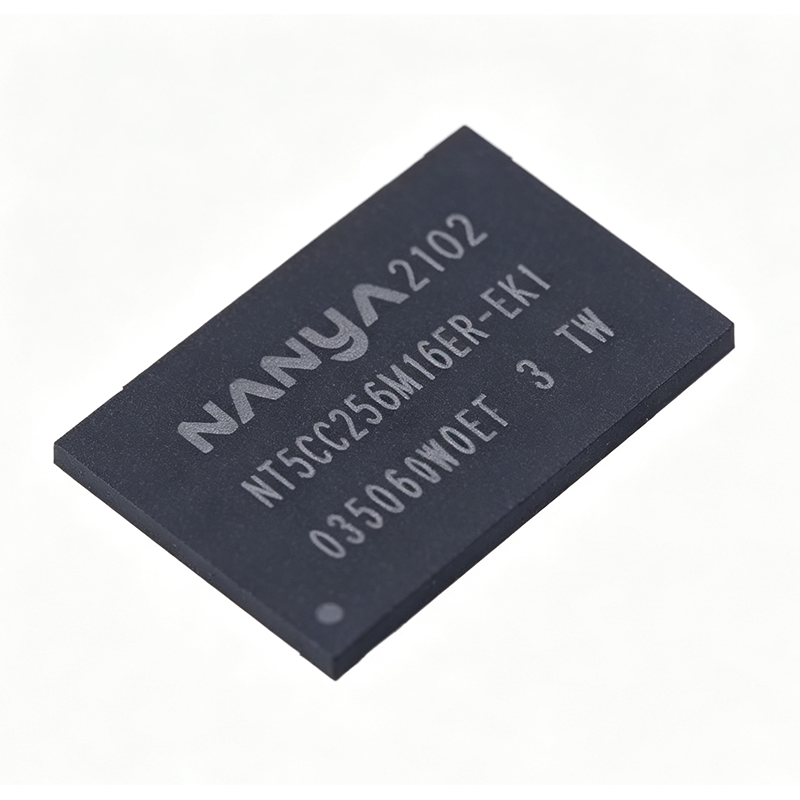
NT5CC256M16ER-EKI - 4Gb DDR3L SDRAM 256Mx16 | Nanya
The Nanya Technology NT5CC256M16ER-EKI is a 4Gb DDR3L SDRAM organized as 256M x 16, operating at 1.35V (also compatible with 1.5V) in a 96-ball TFBGA package. It is designed for commercial and industrial applications with a temperature range of -40°C to +95°C. This memory component supports data rates up to 933MHz (DDR3L-1866) and includes features such as auto self-refresh, auto precharge, asynchronous reset, write leveling, dynamic on-chip termination, and ZQ calibration. DDR3L SDRAM is a type of double data rate synchronous dynamic random-access memory that operates at a lower voltage (1.35V) compared to standard DDR3 (1.5V), reducing power consumption while maintaining high bandwidth. It is part of the memory hierarchy in computing systems, serving as the main system memory for processors, and is widely used in embedded systems, networking equipment, and industrial PCs. Key features include a 4Gb density, 16-bit data bus, 1.35V core voltage, and support for industrial temperature range. The device uses an 8n-prefetch architecture and supports burst lengths of 8 and 4 (with burst chop). It also features on-die termination (ODT) for improved signal integrity and a programmable CAS latency. The TFBGA-96 package provides a compact footprint suitable for space-constrained designs. Technically, the NT5CC256M16ER-EKI is fabricated using Nanya's advanced DRAM process technology, offering high reliability and low power consumption. The device includes a mode register set (MRS) for configuration, and supports DLL (delay-locked loop) for precise timing. It is compliant with JEDEC DDR3L standards, ensuring interoperability with a wide range of controllers. Typical applications include industrial computing, networking routers and switches, embedded systems, and automotive infotainment. Its industrial temperature rating makes it suitable for harsh environments. The low voltage operation is ideal for battery-powered and energy-efficient designs. When designing with this component, ensure proper decoupling capacitors near the power pins and follow the PCB layout guidelines in the datasheet to minimize signal integrity issues. Also, verify the memory controller supports 1.35V operation for optimal performance.
NT5CC256M16ER-EKT - 4Gb DDR3L SDRAM 256Mx16 | Nanya
The Nanya NT5CC256M16ER-EKT is a 4Gb (256Mx16) DDR3L SDRAM component operating at a nominal 1.35V, with backward compatibility to 1.5V DDR3 systems. It is housed in a 96-ball TFBGA package and supports DDR3L-1866 (1866 Mbps) with 13-13-13 timing (CL13). This device is designed for commercial and industrial temperature ranges (0°C to +95°C) and includes features such as auto self-refresh, auto precharge, asynchronous reset, data mask, write leveling, dynamic on-chip termination, and ZQ calibration. DDR3L (Double Data Rate 3 Low Voltage) SDRAM is a type of synchronous dynamic random-access memory that operates at a lower voltage (1.35V) compared to standard DDR3 (1.5V), reducing power consumption by up to 20% while maintaining similar performance. It is part of the DDR3 memory family, which uses double data rate signaling to transfer data on both edges of the clock, and is widely used in computing, networking, and embedded systems. Key features include a 4Gb density organized as 256Mx16, a 96-ball TFBGA package, and support for DDR3L-1866 speed grade. The device operates from a 1.35V supply (with 1.5V compatibility) and features programmable CAS latency, burst lengths of 8 and 4 (with burst chop), and on-die termination (ODT) for improved signal integrity. The industrial temperature range option (EKI suffix) is available for harsh environments. Technically, the NT5CC256M16ER-EKT uses an 8n-prefetch architecture with a 16-bit I/O interface, achieving data rates up to 1866 Mbps. It includes a mode register set (MRS) for configuration, DLL for timing alignment, and ZQ calibration for output driver and ODT impedance tuning. The device supports various power-saving modes including power-down and self-refresh, making it suitable for battery-powered applications. Typical applications include DDR3L memory modules for laptops and embedded systems, networking equipment such as routers and switches, industrial automation controllers, and automotive infotainment systems. Its low voltage and high density make it ideal for space-constrained designs requiring high memory bandwidth. When designing with this device, ensure proper decoupling capacitors near the VDD and VDDQ pins, and follow the PCB layout guidelines for DDR3 routing to maintain signal integrity. The ZQ pin requires a 240-ohm resistor to ground for calibration.
NT5CC256M16ER-FLNA - 4Gb DDR3L SDRAM 256Mx16 | Nanya
The Nanya NT5CC256M16ER-FLNA is a 4Gb DDR3L SDRAM organized as 256M x 16 bits, operating at 1.35V with a 96-ball TFBGA package. It is designed for commercial and industrial temperature ranges, supporting data rates up to 1866 Mbps. This memory device features auto self-refresh, auto precharge, asynchronous reset, data mask, write leveling, dynamic on-chip termination, and ZQ calibration, making it suitable for a wide range of computing and embedded applications. DDR3L (Double Data Rate 3 Low Voltage) is a type of synchronous dynamic random-access memory (SDRAM) that operates at a lower voltage (1.35V) compared to standard DDR3 (1.5V), reducing power consumption by about 20% while maintaining similar performance. It is part of the DDR3 family, which uses double data rate signaling to transfer data on both edges of the clock, and is widely used in laptops, servers, and industrial systems where energy efficiency is critical. Key features include a 4Gb density, 16-bit data bus, 1.35V core power supply, and support for 1.5V I/O for compatibility. The device offers programmable CAS latency, burst lengths of 8 and 4 (with burst chop), and on-die termination (ODT) for improved signal integrity. It also includes a temperature sensor for thermal management and supports auto refresh and self refresh modes to maintain data integrity. Architecturally, the NT5CC256M16ER-FLNA uses an 8-bank design with a 16n prefetch architecture, enabling high-speed data transfer. The TFBGA package provides excellent thermal and electrical performance, with a ball pitch of 0.8mm and dimensions of 13mm x 8mm. The device is RoHS compliant and lead-free, meeting environmental standards. Typical applications include DDR3L memory modules for laptops, embedded systems, networking equipment, and industrial PCs. Its low voltage and high density make it ideal for power-sensitive designs, while the industrial temperature grade (-40°C to +95°C) ensures reliable operation in harsh environments. When designing with this device, ensure proper decoupling capacitors near the power pins and follow the layout guidelines in the datasheet to minimize signal integrity issues. The ZQ calibration pin requires a 240-ohm resistor to ground for proper operation.
NT6AN512M32AV-1G - 16Gb LPDDR4 512Mx32 1.1V | Nanya
The Nanya NT6AN512M32AV-1G is a high-performance mobile LPDDR4 SDRAM organized as 512M x 32 bits, providing 16Gb (2GB) of memory density. It operates at a supply voltage of 1.1V and supports data rates up to 4267 Mbps (LPDDR4-4267), making it suitable for bandwidth-intensive applications in smartphones, tablets, AI edge devices, and embedded systems. The device is housed in a 200-ball BGA package, enabling compact PCB designs. LPDDR4 (Low Power Double Data Rate 4) is a type of synchronous DRAM designed for mobile and low-power applications. It achieves high bandwidth while operating at lower voltages (1.1V) compared to standard DDR4 (1.2V), reducing power consumption in battery-powered devices. LPDDR4 is part of the JEDEC LPDDR memory standard family, which includes LPDDR2, LPDDR3, LPDDR4, and LPDDR5, each offering increased speed and efficiency. As a mobile DRAM, it is optimized for low-power operation and high-density packaging, making it essential for modern portable electronics. Key features include a 16Gb density with a 512M x 32 organization, 1.1V core power supply, and support for data rates up to 4267 Mbps. The device includes a built-in temperature sensor for Temperature Compensated Self Refresh (TCSR), which adjusts refresh rates based on temperature to save power. It also supports ZQ calibration for DS/ODT impedance accuracy via an external ZQ pad (240Ω ± 1%) and Data Bus Inversion (DBI) to reduce power consumption and improve signal integrity. The 200-ball BGA package is designed for space-constrained applications. Technically, the NT6AN512M32AV-1G utilizes advanced DRAM process technology to achieve high density and low power. The device supports dual-channel operation in multi-die packages (DDP/QDP) for higher capacity. It includes features like DQ calibration for signal synchronization, training for signal synchronization, and a temperature sensor for TCSR. These features ensure reliable operation across a wide temperature range, making it suitable for industrial and automotive applications. Typical applications include mobile devices (smartphones, tablets), AI computers, video conferencing systems, and industrial control systems. The high bandwidth and low power consumption make it ideal for AI edge inference, where large data sets are processed locally. In video conferencing, the high data rate supports multiple high-resolution video streams simultaneously. When designing with this device, ensure proper power decoupling with 0.1uF and 1uF capacitors near the power pins. Follow the JEDEC LPDDR4 layout guidelines for signal integrity, especially for high-speed data lines. The ZQ pin requires a 240Ω ± 1% resistor to ground for impedance calibration.