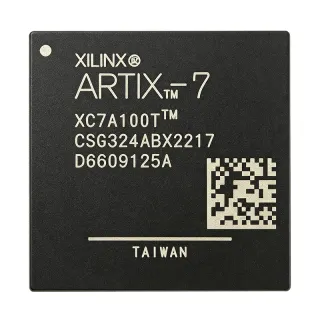
EP1M120F486I6 - 486-Pin Mercury FPGA | Altera | Embedded Logic
MPN: EP1M120F486I6 ✗ End of Life| Qty | Unit Price | Extended |
|---|---|---|
| 1 | $0 | $0.00 |
| 10 | $0 | $0.00 |
| 100 | $0 | $0.00 |
| 500 | $0 | $0.00 |
| 1,000 | $0 | $0.00 |
EP1M120F486I6 Overview
A field-programmable gate array is a semiconductor device whose logic functions are defined through programmable configuration rather than fixed mask-level interconnection. FPGAs occupy the programmable-logic branch of digital integrated circuits and provide a hardware hierarchy ranging from configurable logic blocks to programmable interconnect, I/O elements, configuration memory, and system-level interfaces. Mercury devices are presented in the source material as a programmable-logic family; EP1M120F486I6 is the industrial-grade, -6-speed member identified for this product record.
The principal verified ordering details are the EP1M120F486I6 MPN, the Altera brand identity, the Mercury PLD family association, the 486-ball FineLine BGA package reference, and the -6 speed-grade notation. The MPN structure is useful during procurement: the family name identifies the device family, F486 indicates the package-related ordering variant, I indicates the industrial-oriented ordering designation in the supplied record, and 6 indicates the speed grade. The supplied search results also identify a 484-BBGA EP1M120F484I6 variant, but it is not treated as a drop-in equivalent because the package designation differs.
From a system-design perspective, the device belongs to a programmable-logic architecture and should be evaluated using the manufacturer's complete EP1M120 documentation before schematic release. Configuration methodology, supported I/O standards, available user I/O, embedded memory, clock resources, power sequencing, and package-ball assignments must be confirmed from the official device documentation. The search results provide an EP1M120 datasheet link hosted by AllDataSheet and an Altera-semi PDF result for a related EP1M120F484I6 ordering code; neither source confirms every electrical characteristic of EP1M120F486I6.
Typical procurement and design uses include industrial control logic, communications equipment, test hardware, instrumentation, and embedded systems that need field-updatable digital processing. The device is especially relevant where a programmable implementation is preferred over a fixed-function ASIC or where late-stage logic changes are expected. Because exact electrical and timing data are not present in the supplied snippets, a replacement decision should not rely solely on the partial web results.
When selecting this part, verify the exact package drawing, ball map, supported configuration interface, voltage rails, thermal limits, and speed-grade timing tables from the manufacturer datasheet. Do not infer that the 484-ball EP1M120F484I6 can replace the 486-ball target without a pin-by-pin and package comparison. This page distinguishes verified ordering information from missing engineering data and avoids presenting cross-package or unverified drop-in substitutions.
Drop-in alternatives for EP1M120F486I6 — same package, pin-to-pin compatible. Different-package parts requiring PCB rework are excluded.
Variants in this series
Same-series models that are drop-in compatible with EP1M120F486I6 (same form factor and footprint) — differing in Family, Package.
Quick Comparison Tool — Select alternative parts for side-by-side comparison:
No drop-in alternatives available for this product.
Request AlternativesEP1M120F486I6 Maximum Ratings & Electrical Characteristics
| Manufacturer | Altera |
| Product Type | Programmable logic device |
| Family | Mercury PLD |
| Device Designation | FPGA |
| Ordering Code | EP1M120F486I6 |
| Speed Grade | -6 |
| Ordering Temperature Designation | I6 |
| Package | 486-ball FineLine BGA |
| Mounting Type | Surface Mount |
| Configuration Technology | SRAM-based programmable logic |
| Logic Function | Field-programmable digital logic |
| RoHS Status | unknown |
| REACH Status | unknown |
EP1M120F486I6 486-ball fineline bga Pin Configuration Guide
Pin configuration for EP1M120F486I6 (486-ball fineline bga package). This digital IC includes GPIO, communication interfaces (UART, SPI, I2C), and power pins. Refer to the manufacturer datasheet for alternate pin functions and configuration options. Essential for embedded system design and PCB layout.

No detailed pinout data available for EP1M120F486I6.
Refer to the datasheet for full pin configuration.
Typical Applications
EP1M120F486I6 is suitable for 6 applications: Industrial Control Logic, Communications Equipment, Test and Measurement Hardware, Embedded System Integration, Protocol Interface Bridging, Instrumentation Control and Signal Conditioning.
Industrial Control Logic
EP1M120F486I6 is identified as an Altera Mercury programmable-logic device and can be considered for industrial control equipment when the exact 486-ball package and manufacturer specifications are confirmed. Its programmable architecture is useful for implementing sequencing, state machines, sensor-interface glue logic, and protocol adaptation in a single configurable device. The MPN's I6 ordering designation suggests an industrial-oriented variant, but the supplied data does not verify the operating-temperature range, voltage limits, or qualification. Engineers should therefore check the official datasheet, package drawing, and timing tables before selecting it for a new industrial controller. A 486-ball FineLine BGA footprint also requires controlled PCB layout, complete ball escape planning, and verification of thermal performance. The part should be treated as a candidate for configurable control logic rather than as a confirmed drop-in replacement for any related device.
Recommended
Communications Equipment
EP1M120F486I6 may be evaluated for communications equipment that requires programmable digital processing and a 486-ball FineLine BGA implementation. The programmable-logic structure can support interface conversion, timing adjustment, channel logic, and control functions that may be revised during system development. The available search material confirms the Altera Mercury family association, the -6 speed grade, and the package designation, but it does not provide verified transceiver count, I/O standards, clock limits, power consumption, or supported protocols. Those parameters are essential for communications design closure and must be taken from the official EP1M120 documentation. The 486-ball package also requires signal-integrity planning, controlled impedance, return-path continuity, and careful placement of decoupling. Related EP1M120 devices should be compared only through verified package and timing data, not by family name alone.
Recommended
Test and Measurement Hardware
EP1M120F486I6 can be investigated for test and measurement hardware where programmable control, timing logic, and configurable signal routing are useful. The verified record identifies a -6 speed-grade Altera Mercury device in a 486-ball FineLine BGA package, making it a candidate for designs that need logic changes after prototype development. However, no exact logic-element count, I/O count, embedded-memory capacity, core voltage, or timing limit is included in the supplied web data. A measurement-system design should therefore validate those resources against the number of channels, required processing parallelism, clock rate, and interface standards. The device should be powered and decoupled according to the manufacturer reference design, while the 486-ball layout should be reviewed for signal integrity and thermal behavior. The 484-ball EP1M120F484I6 listing is not a verified substitute because its package designation differs.
Recommended
Embedded System Integration
EP1M120F486I6 is relevant to embedded-system integration when a design needs configurable digital logic between processors, memory, converters, and external interfaces. Its Altera Mercury family designation and programmable-logic classification support applications in which hardware functions may be updated independently of the main processor. The supplied evidence confirms the exact 486-ball FineLine BGA package and -6 speed-grade notation, but it does not verify logic resources, I/O count, configuration requirements, power rails, or supported I/O standards. Those details determine whether the device can meet the target system's throughput, pin count, and power budget. Designers should review the official device documentation and reference design, then validate configuration, clock distribution, decoupling, and PCB escape on the actual board. Any related EP1M120F484 variant should be considered only after a complete ball-map and electrical comparison.
Recommended
Protocol Interface Bridging
EP1M120F486I6 may be suitable for protocol-interface bridging in systems where logic must adapt between different buses, control signals, or timing domains. A programmable-logic device can implement glue logic, register translation, handshake generation, and data-path conditioning without requiring a new mask set. The verified evidence establishes the Altera Mercury family, the -6 speed grade, and the 486-ball FineLine BGA package, but it does not identify the number of I/O, supported I/O standards, clock resources, or power requirements. Those parameters must be checked against the bridge architecture and the signal-integrity budget. Because the related EP1M120F484I6 is identified as a 484-BBGA part, it cannot be assumed to fit the same footprint. A valid replacement must demonstrate package, pin, timing, electrical, and configuration compatibility, with a formal equivalence review before layout changes.
Recommended
Instrumentation Control and Signal Conditioning
EP1M120F486I6 can be evaluated for instrumentation control and signal-conditioning functions that require deterministic digital sequencing, configurable routing, or programmable timing. The supplied material identifies the device as an Altera Mercury PLD in a 486-ball FineLine BGA package and associates the ordering code with the -6 speed grade. It does not provide the exact number of logic resources, I/O channels, embedded memory, voltage rails, thermal limits, or timing characteristics. Those omissions are material for an instrumentation design, where noise, latency, channel count, and calibration behavior matter. Validate the device with the official EP1M120 datasheet, the applicable reference design, and an application-specific power and signal-integrity review. The package's 486-ball count also requires careful fan-out and controlled impedance. Do not substitute the listed 484-ball EP1M120F484I6 without a full PCB and electrical redesign assessment.
Recommended
Recommended Products Summary
Engineering reference data for EP1M120F486I6 — comparison, design guidance, and compliance information.
Selection Guide
Comparison with Alternatives
| Parameter | This Product |
|---|---|
| Brand | Altera |
| Package | 486-ball FineLine BGA |
| Product Type | Mercury PLD / FPGA |
| Speed Grade | -6 |
| Ordering Designation | I6 |
Key Differentiators
- Verified 486-ball FineLine BGA package designation (vs EP1M120F484I6)
- Verified Altera Mercury PLD family association (vs Unrelated competitor device)
- Verified -6 speed-grade ordering code (vs EP1M120F484C6)
Design Notes
Use the official package drawing and ball map before routing the 486-ball FineLine BGA footprint. Confirm ball numbering, escape direction, pitch, package body dimensions, and any required thermal or ground balls from the manufacturer documentation. The supplied web data does not provide a complete pin assignment for EP1M120F486I6, so a schematic based only on the MPN would be unsafe. Review fan-out density and via-in-pad restrictions with the selected PCB fabricator, and maintain uninterrupted return paths for high-speed or clock-sensitive nets.
Do not select decoupling capacitors or power rails from an unverified EP1M120F484I6 snippet. Obtain the EP1M120F486I6 datasheet and its reference-design power-up sequence, then verify every required voltage, tolerance, ramp condition, and current limit. Place the smallest high-frequency decoupling capacitors close to the associated power and ground balls, and separate bulk capacitance from the high-speed return path. The current record does not verify core voltage, I/O voltage, power consumption, or power sequencing, so these values remain marked [DATA_NEEDED] rather than estimated.
For clock, control, and interface signals, use controlled-impedance routing and confirm the supported I/O standards and timing constraints from the manufacturer datasheet. The -6 speed-grade notation is verified, but the supplied material does not expose the relevant timing tables, clock limits, or I/O specifications. Provide short clock paths, adequate spacing from noisy edges, and continuous reference planes. If a related 484-ball EP1M120F484I6 is considered, treat it as a different package candidate until ball-by-ball compatibility, signal mapping, and electrical limits are demonstrated.
Compliance Information
No verified compliance statements were present in the supplied source snippets. Compliance fields are therefore unknown rather than assumed.