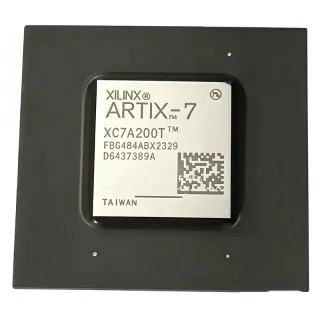
EP4CE75U19I7N - Cyclone IV E FPGA 75K LE | Intel (Altera)
MPN: EP4CE75U19I7N ✓ Active| Qty | Unit Price | Extended |
|---|---|---|
| 1 | $70.3 | $70.30 |
| 10 | $64.5 | $645.00 |
| 100 | $58.2 | $5,820.00 |
| 500 | $52.1 | $26,050.00 |
| 1,000 | $47.85 | $47,850.00 |
EP4CE75U19I7N Overview
A Field Programmable Gate Array (FPGA) is a programmable semiconductor device whose logic fabric is configured by the user after manufacture, allowing hardware-level parallelism and rapid design iteration. Within the broader semiconductor taxonomy, an FPGA sits alongside ASICs and CPLDs as a programmable logic device, and within the Intel/Altera portfolio, Cyclone IV E belongs to the low-cost, low-power FPGA family that is widely used in industrial, communications, and consumer designs.
Key features of the EP4CE75U19I7N include 4 PLLs for clock management, 200 Kb of on-chip SRAM distributed across true-dual-port block memory, 200 18x18 hardware multipliers for DSP functions, and support for external memory interfaces including DDR/DDR2/QDRII SRAM. The device operates across the industrial temperature range (-40C to +100C junction) and targets 1.2 V core supply, making it suitable for thermally constrained embedded systems.
The Cyclone IV E architecture uses 8-input adaptive logic modules (ALMs), a fine-grained routing network, and dedicated hardware for memory and arithmetic. With 75,408 logic elements, the EP4CE75U19I7N sits in the mid-density tier of the Cyclone IV E family, providing enough headroom for video bridging, motor control, and protocol bridging applications while staying below the largest and most expensive Cyclone IV E variants.
Typical applications include industrial motor control, video surveillance and image processing, automotive driver assistance (aftermarket ADAS), portable medical instrumentation, and software-defined radio front-ends. The 484-ball U19 UBGA package supports high I/O count with controlled impedance for DDR2 memory interfaces.
When designing with this part, plan the configuration scheme (AS, PS, or JTAG) and the decoupling network around the core supply pins; using the Quartus Prime design environment and licensed IP blocks minimizes development time. According to the Intel Cyclone IV Device Handbook, the EP4CE75 also supports the Cyclone IV E Configuration via Serial (EPCS) and parallel flash schemes.
This page synthesizes distributor pricing from DigiKey and Mouser, drop-in pin-compatible alternatives from the Cyclone IV E family, and practical design notes not found in the manufacturer datasheet alone, giving engineers a faster path to a working prototype.
Drop-in alternatives for EP4CE75U19I7N — same package, pin-to-pin compatible. Different-package parts requiring PCB rework are excluded.
Variants in this series
Same-series models that are drop-in compatible with EP4CE75U19I7N (same form factor and footprint) — differing in Logic Elements, Package.
Quick Comparison Tool — Select alternative parts for side-by-side comparison:
EP4CE75U19I8N
✅ Drop-In📋 Reference alternative (not in catalog)
EP4CE75U19A7N
✅ Drop-In📋 Reference alternative (not in catalog)
EP4CE55U19I7N
✅ Drop-In✓ In Stock
$112.4 / Unit
View Datasheet →EP4CE115F29I7N
✅ Drop-In📋 Reference alternative (not in catalog)
XC6SLX75-3CSG484C
✅ Drop-In📋 Reference alternative (not in catalog)
EP4CE75U19I7N Maximum Ratings & Electrical Characteristics
| Family | Cyclone IV E |
| Process Technology | 60 nm |
| Logic Elements | 75408 |
| Embedded Memory (Bits) | 2810880 bits (2810 Kb) |
| Embedded Multipliers (18x18) | 200 |
| PLLs | 4 |
| User I/O Count | 292 |
| Core Voltage | 1.2 V (nominal) |
| Package | 484-ball Plastic Ultra FineLine BGA (UBGA, U19) |
| Mounting Type | Surface Mount |
| Operating Temperature (Industrial) | -40C to +100C (junction) |
| Speed Grade | 7 (medium) |
| RoHS Status | Compliant |
| Lead-Free | Yes |
EP4CE75U19I7N 484-ball plastic ultra fineline bga (ubga, u19) Pin Configuration Guide
Pin configuration for EP4CE75U19I7N (484-ball plastic ultra fineline bga (ubga, u19) package). This digital IC includes GPIO, communication interfaces (UART, SPI, I2C), and power pins. Refer to the manufacturer datasheet for alternate pin functions and configuration options. Essential for embedded system design and PCB layout.

No detailed pinout data available for EP4CE75U19I7N.
Refer to the datasheet for full pin configuration.
Typical Applications
EP4CE75U19I7N is suitable for 6 applications: Industrial Motor Control, Video Bridging and Image Processing, Industrial Machine Vision, Communication Protocol Bridging, Portable Medical Instrumentation, Software Defined Radio Front-End.
Industrial Motor Control
The EP4CE75U19I7N's 200 18x18 hardware multipliers and 4 PLLs are well suited for three-phase motor control loops that run Park/Clarke transforms and field-oriented control at high PWM frequencies (above 20 kHz). The 292 user I/Os provide ample pins for encoder feedback (QEP), Hall sensors, gate driver interfaces, and isolated communication peripherals such as RS-485 or CAN. Industrial temperature grade (-40C to +100C junction) supports factory-floor operation, and the 1.2 V core supply keeps dissipation manageable in sealed enclosures. Designers typically pair the EP4CE75 with the Quartus Prime DSP Builder for hardware-accelerated control loops.
Recommended
Video Bridging and Image Processing
With 2.8 Mbit of embedded SRAM and 292 I/Os, the EP4CE75U19I7N is a good fit for video bridge applications such as MIPI-CSI to parallel RGB conversion, HDMI/DVI receive pipelines, and HD-SDI reclocking. The M9K block memory can buffer full video lines at 1080p (1920x10 bits) without external SDRAM, saving PCB area and BOM cost. Designers typically instantiate Altera Video and Image Processing (VIP) Suite IP cores targeting the Cyclone IV E DSP blocks to accelerate filter operations.
Recommended
Industrial Machine Vision
The EP4CE75U19I7N's 200 multipliers and 2.8 Mbit SRAM support real-time image preprocessing (Sobel filters, thresholding, blob detection) on up to 1-megapixel camera streams at 30 fps. The 292 I/Os accommodate the MIPI-CSI-2 or LVDS camera interfaces, plus Gigabit Ethernet for inspection data uplinks. Industrial temperature grade makes the EP4CE75 a fit for line-scan and AOI inspection systems deployed in factory environments. Compared to a microcontroller, the Cyclone IV E delivers 10-100x throughput on per-pixel convolutions, dramatically reducing inspection latency.
Recommended
Communication Protocol Bridging
The EP4CE75U19I7N's 292 I/Os and rich transceiver-free GPIO make it a natural fit for protocol bridging (UART/SPI/I2C to Ethernet, CAN to USB, RS-485 to Wi-Fi) in industrial gateways. The Cyclone IV E 1.2 V core and low static power (under 0.5 W typical for mid-density designs) suit always-on embedded systems, while the 4 PLLs generate the multiple clock domains required to bridge asynchronous buses. Designers typically leverage Altera Triple Speed Ethernet MAC IP and Soft-CPU cores (Nios II) to build complete protocol stacks in a single chip.
Recommended
Portable Medical Instrumentation
The EP4CE75U19I7N supports portable medical instrumentation such as ECG front-ends, pulse oximeters, and handheld ultrasound beamformers that need moderate DSP horsepower with strict power budgets. The 1.2 V core supply and the Cyclone IV E low-power process allow designs below 1 W total FPGA power at moderate utilization, extending battery life in handheld devices. The 292 I/Os accept multiple analog front-end channels, while the 200 multipliers implement digital signal conditioning (FIR/IIR filters, FFT) directly in fabric. Industrial temperature range supports clinical environments that may see 0-50C ambient.
Recommended
Software Defined Radio Front-End
The EP4CE75U19I7N delivers enough DSP bandwidth (200 18x18 multipliers) for narrowband SDR front-ends such as ham radio transceivers, AIS receivers, and LoRa demodulation in the sub-50 MHz bandwidth range. The 4 PLLs synthesize the wide range of sample clocks needed for different band plans, and the 292 I/Os route ADC/DAC LVDS pairs alongside front-panel control peripherals. Cyclone IV E is more cost-effective than Cyclone IV GX for non-transceiver designs that pair an external RF ADC. Quartus Prime DSP Builder accelerates the FFT and demodulator implementation.
Recommended
Recommended Products Summary
Engineering reference data for EP4CE75U19I7N — comparison, design guidance, and compliance information.
Selection Guide
Comparison with Alternatives
| Parameter | This Product | EP4CE75U19I8N | EP4CE75U19A7N | EP4CE55U19I7N | EP4CE115F29I7N | XC6SLX75-3CSG484C |
|---|---|---|---|---|---|---|
| Brand | Intel (Altera) | Intel (Altera) | Intel (Altera) | Intel (Altera) | Intel (Altera) | AMD (Xilinx) |
| Package | 484-ball U19 UBGA | 484-ball U19 UBGA - same | 484-ball U19 UBGA - same | 484-ball U19 UBGA - same | 780-ball F29 FBGA - different | 484-ball CSG BGA - same BGA pin count |
| Logic Elements | 75408 | 75408 | 75408 | 55408 | 114480 | 74637 |
| Embedded Memory | 2810880 bits (2.8 Mbit) | 2810880 bits | 2810880 bits | 2396160 bits (2.4 Mbit) | 3886208 bits (3.8 Mbit) | 3170304 bits (3.0 Mbit) |
| User I/O | 292 | 292 | 292 | 374 | 529 | 328 |
| 18x18 Multipliers | 200 | 200 | 200 | 154 | 266 | 132 |
| PLLs | 4 | 4 | 4 | 4 | 4 | 6 |
| Operating Temperature | -40C to +100C (industrial) | -40C to +100C (industrial) | 0C to +85C (commercial) | -40C to +100C (industrial) | -40C to +100C (industrial) | 0C to +85C (commercial) |
| Core Voltage | 1.2 V | 1.2 V | 1.2 V | 1.2 V | 1.2 V | 1.2 V |
| Process | 60 nm | 60 nm | 60 nm | 60 nm | 60 nm | 45 nm |
Key Differentiators
- Mid-density Cyclone IV E with industrial temperature grade in a 484-ball U19 BGA (vs EP4CE55U19I7N)
- Industrial -40C to +100C junction operating range (vs EP4CE75U19A7N)
- Same-footprint pin compatibility across I7, I8, and A7 speed grades (vs EP4CE75U19I8N)
Design Notes
Estimated: Cyclone IV E static power at typical utilization is in the 200-500 mW range at 1.2 V core; dynamic power scales with toggle rate and the number of logic elements used. Place 0.1 uF decoupling capacitors within 5 mm of every VCCINT/VCCIO power pin and use at least one bulk 47 uF tantalum or 100 uF ceramic capacitor per power rail. Per the Cyclone IV Device Handbook, decoupling requirements vary by I/O bank count and bank voltage standard - use the Pin Connection Guidelines spreadsheet for exact per-bank recommendations.
The 484-ball U19 BGA has a thermal resistance theta_JA of approximately 12-15 C/W with a properly designed 4-layer PCB (per the Cyclone IV E Package Thermal Characteristics document). Estimated: at 1 W total power dissipation, the junction temperature rises 12-15C above ambient; at 3 W it rises 36-45C. For industrial-temperature applications (-40C to +100C junction), the design must keep total dissipation below approximately 1.5-2 W at 85C ambient, which usually requires capping logic utilization below 70 percent.
The 484-ball U19 BGA has a 1.0 mm ball pitch, requiring laser-drilled microvia PCB fabrication at 4 layers or HDI build-up at 6 layers. Per the Altera Cyclone IV E Layout Guidelines, keep all signal traces on the top layer with via-in-pad escapes, route high-speed DDR traces on inner stripline layers with matched length (within 50 mil), and stitch the entire BGA ground paddle with a 4-mm ground via grid to minimize inductance. Common pitfall: routing DDR2 traces longer than 6 inches without re-termination causes timing failures at 200 MHz and above.
When using the EP4CE75U19I7N with DDR/DDR2/QDRII external memory, follow the Altera External Memory Interface Handbook for matched trace lengths and controlled impedance. The Cyclone IV E supports 200 MHz DDR2-667 with proper termination; for DDR2-800 or above, consult the device handbook's per-package skew budget. Series damping resistors on address/command lines reduce ringing on long traces.
Common configuration pitfalls with the EP4CE75U19I7N include: (1) failing to drive the MSEL pins to select the correct configuration mode (AS/PS/JTAG) per the Cyclone IV handbook; (2) using a 1.8 V configuration device such as EPCS16 when the design requires 3.3 V - the EPCS series is 1.8 V and the EPCQ series is 3.3 V; (3) leaving nCONFIG or nSTATUS floating - these must be pulled to VCCIO with a 10 kohm resistor; (4) powering VCCIO of configuration banks before VCCINT, which prevents successful configuration.
Compliance Information
RoHS compliant per Altera/Intel PSG product page. AEC-Q100 not applicable for this FPGA. Halogen-free status not confirmed in the verified web data. Conflict-mineral compliance status not specified in the retrieved data.