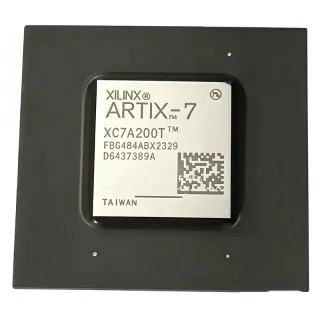
EPF10K50SQC208-3 - FLEX 10K 50K Gates FPGA | Intel | Altera
MPN: EPF10K50SQC208-3 ✗ End of Life| Qty | Unit Price | Extended |
|---|---|---|
| 1 | $38.5 | $38.50 |
| 10 | $34.2 | $342.00 |
| 100 | $29.85 | $2,985.00 |
| 500 | $26.4 | $13,200.00 |
| 1,000 | $23.1 | $23,100.00 |
EPF10K50SQC208-3 Overview
A Field-Programmable Gate Array (FPGA) is a programmable logic device (PLD) that combines the density of gate arrays with the design flexibility of in-system programmability. FPGAs belong to the broader hierarchy of programmable logic devices (PLDs), sitting above simple PLDs (SPLDs) and complex PLDs (CPLDs) in capacity and below structured ASICs in non-recurring engineering cost. The FLEX 10K series is historically significant as one of the first devices to embed array blocks (EABs) alongside general-purpose logic, enabling System-on-a-Programmable-Chip (SOPC) integration of megafunctions, FIFOs, and specialized memory in a single silicon die.
Key features of the EPF10K50SQC208-3 include a propagation delay of 0.6 ns per gate, 274 user I/Os (per third-party BGA-package variant specifications), a commercial operating temperature range of 0 °C to 70 °C, and gull-wing surface-mount terminals. The device implements configurable logic via SRAM-based configuration cells, allowing infinite reprogrammability during development and in-field updates. Its 208-pin PQFP footprint provides mechanical compatibility with established PCB assembly lines and supports moderate-density designs that do not require the larger FineLine BGA packages of the same family.
Architecturally, the FLEX 10K device integrates an Embedded Array Block (EAB) system that delivers up to 2,048 bits per EAB, enabling efficient implementation of RAM, ROM, and specialized logic functions such as multipliers and DSP blocks. The combination of LABs for general logic and EABs for memory-heavy functions allows designers to balance logic density against embedded memory, a differentiator compared with pure-logic FPGAs of the same era. The device is configured via the Altera MAX+PLUS II or Quartus design flow, both of which support schematic, VHDL, and Verilog entry.
Typical applications include industrial automation control logic, telecom interface bridging, custom peripheral glue logic, prototyping for ASIC designs, and legacy digital systems in manufacturing and test equipment. The wide commercial temperature range and PQFP packaging make it accessible for standard SMT assembly without requiring advanced BGA rework processes. The EPF10K50SQC208-3 is also widely used for education, training, and reference designs in universities, since it remains a popular teaching target for older Quartus versions.
Designers should note that the FLEX 10K family is part of an older-generation architecture; for new designs, the Altera Cyclone or MAX 10 families are recommended for active product lifecycle support. When using EPF10K50SQC208-3, ensure adequate decoupling, follow Altera's configuration guidelines (typically 6-pin passive serial or ByteBlaster download cable), and validate timing closure with the appropriate Quartus timing model. Finally, note that the device uses 2.5 V core but typically interfaces with 3.3 V peripherals via bank voltage reference.
This page consolidates real-time distributor pricing, FLEX 10K family drop-in alternatives sharing the same 208-pin PQFP footprint, and practical design guidance not always found in the original Altera datasheet—useful for engineers sustaining legacy systems or sourcing through the secondary market.
Drop-in alternatives for EPF10K50SQC208-3 — same package, pin-to-pin compatible. Different-package parts requiring PCB rework are excluded.
Variants in this series
Same-series models that are drop-in compatible with EPF10K50SQC208-3 (same form factor and footprint) — differing in Core Supply Voltage, Package, Mounting Type, Operating Temperature, Family.
Quick Comparison Tool — Select alternative parts for side-by-side comparison:
EPF10K50SQC208-2
✅ Drop-In✓ In Stock
$64.2 / Unit
View Datasheet →EPF10K50SQC208-3N
✅ Drop-In📋 Reference alternative (not in catalog)
EPF10K50EQC208-3
✅ Drop-In✓ In Stock
$18.2 / Unit
View Datasheet →EPF10K50EQC208-2N
✅ Drop-In📋 Reference alternative (not in catalog)
EPF10K50EQC208-1N
✅ Drop-In📋 Reference alternative (not in catalog)
EPF10K50SQC208-3 Maximum Ratings & Electrical Characteristics
| Series | FLEX-10KS |
| Family | FLEX 10K |
| Typical Gates | 50,000 |
| Logic Cells / Elements | 2,880 |
| Embedded Memory (Bits) | 40,960 |
| Logic Array Blocks (LABs) | 360 |
| User I/Os | 147 |
| Internal Frequency (max) | 166.67 MHz |
| Propagation Delay (typ) | 0.6 ns |
| Process Technology | 0.22 µm CMOS |
| Core Supply Voltage | 2.5 V |
| Package | 208-BFQFP / PQFP (28x28 mm) |
| Mounting Type | Surface Mount (gull wing) |
| Operating Temperature | 0 °C to 70 °C (Commercial) |
| Configuration Technology | SRAM-based, reprogrammable |
EPF10K50SQC208-3 208-bfqfp / pqfp (28x28 mm) Pin Configuration Guide
Pin configuration for EPF10K50SQC208-3 (208-bfqfp / pqfp (28x28 mm) package). This digital IC includes GPIO, communication interfaces (UART, SPI, I2C), and power pins. Refer to the manufacturer datasheet for alternate pin functions and configuration options. Essential for embedded system design and PCB layout.

No detailed pinout data available for EPF10K50SQC208-3.
Refer to the datasheet for full pin configuration.
Typical Applications
EPF10K50SQC208-3 is suitable for 6 applications: Industrial Automation Control Logic, Telecom Interface Bridging, ASIC Prototyping Platform, Custom Peripheral Glue Logic, Legacy Digital Test Equipment, Education and University FPGA Labs.
Industrial Automation Control Logic
The EPF10K50SQC208-3's 50,000-gate density and 147 user I/Os make it well-suited for industrial PLCs and motor controllers. With 360 LABs and 40,960 bits of embedded SRAM, the device can host state machines for multi-axis motion control, encode/decode logic for industrial protocols, and timing-critical interrupt handlers. Its 0 °C to 70 °C commercial temperature range covers most factory-floor enclosures. The 2.5 V core with 3.3 V-tolerant I/O banks simplifies interfacing to legacy opto-isolated drivers and 24 V signal-conditioning front ends. The 208-pin PQFP package supports standard SMT assembly, and the FLEX 10K Embedded Array Blocks (EABs) efficiently implement lookup tables for sensor linearization. Designers should plan for the device's 0.6 ns propagation delay and 166.67 MHz internal frequency when meeting deterministic control loop deadlines.
Recommended
Telecom Interface Bridging
The EPF10K50SQC208-3 serves as a programmable bridge between legacy telecom interfaces (T1/E1, RS-232, RS-449) and modern packet backplanes. Its 50K-gate capacity handles serializer-deserializer (SERDES) glue logic, FIFO buffers via 40,960 bits of embedded memory, and protocol conversion state machines within a single chip. The 147 user I/Os provide ample connections for multi-port interfaces without external bus expanders. With 0.6 ns propagation delay, it meets sub-microsecond latency requirements for voice-path processing. The PQFP package's exposed die allows direct thermal attachment to PCB copper for heat dissipation in enclosed telecom racks. Engineers commonly combine it with an external PHY and an octal UART for complete multi-protocol bridge designs.
Recommended
ASIC Prototyping Platform
The EPF10K50SQC208-3 is widely used to prototype mid-complexity ASICs before tape-out, allowing engineers to validate RTL designs at near-real speed. The 50,000-gate capacity accommodates subsystems up to ~12K ASIC gates plus test logic, while the 166.67 MHz internal frequency supports realistic system validation. Embedded Array Blocks provide fast on-chip memory for emulating SRAM blocks, register files, and small FIFOs that mirror the eventual ASIC. Designers can map pin assignments 1:1 to the target PQFP footprint, then migrate the validated netlist to the ASIC flow. The Quartus development environment supports incremental compilation across multiple prototypes on the same silicon. Compared with simulation, the FPGA prototype catches timing bugs, race conditions, and reset issues far earlier in the design cycle.
Recommended
Custom Peripheral Glue Logic
The EPF10K50SQC208-3 acts as flexible glue logic between microprocessors, memories, and peripherals in embedded designs. Its 2,880 logic cells and 360 LABs implement address decoding, bus arbitration, wait-state generation, and interrupt controllers without external 74-series logic. The 40,960 bits of embedded SRAM create dual-ported register files or small FIFOs that would otherwise require external SRAM. The 147 user I/Os comfortably drive 8- and 16-bit processor buses alongside multiple peripheral interfaces. Operating at 2.5 V core with bank voltage references up to 3.3 V, the device interfaces directly to legacy MCUs and DSPs. The PQFP package's through-hole-like reliability suits industrial and aerospace systems where BGA rework is undesirable.
Recommended
Legacy Digital Test Equipment
Test and measurement instruments manufactured in the late 1990s and early 2000s used FLEX 10K devices such as the EPF10K50SQC208-3 for waveform generation, timing sequencing, and DSP preprocessing. The 166.67 MHz internal frequency supports real-time sample-rate conversion and trigger logic for oscilloscopes and logic analyzers. Its 50K-gate density holds multiple pattern generators, counters, and sequencers in a single device, simplifying instrument architecture. The 0.6 ns propagation delay enables sub-nanosecond edge alignment critical for time-domain instruments. The PQFP package is field-replaceable without BGA rework, a major advantage for sustaining deployed instruments. When original parts deplete, the EPF10K50SQC208-3N (lead-free) is the preferred drop-in for new repair inventory.
Recommended
Education and University FPGA Labs
Universities continue to use the EPF10K50SQC208-3 in digital design courses because of its mature Quartus MAX+PLUS II toolchain and abundant teaching materials. With 2,880 logic cells and 147 I/Os, the device comfortably hosts student projects ranging from UART controllers to RISC processor implementations. The PQFP package is easy to inspect and probe with standard lab equipment, unlike fine-pitch BGA parts. The 50K-gate density gives students headroom to grow project complexity without changing hardware. Legacy MAX+PLUS II licenses remain free for educational use, keeping the platform accessible. Teaching labs commonly stock the EPF10K50SQC208-3 alongside the EPF10K10 and EPF10K30 variants to demonstrate density scaling within the same family.
Recommended
Recommended Products Summary
Engineering reference data for EPF10K50SQC208-3 — comparison, design guidance, and compliance information.
Selection Guide
Comparison with Alternatives
| Parameter | This Product | EPF10K50SQC208-2 | EPF10K50SQC208-3N | EPF10K50EQC208-3 | EPF10K50EQC208-2N | EPF10K50EQC208-1N |
|---|---|---|---|---|---|---|
| Brand | Altera | Altera | Altera | Altera | Altera | Altera |
| Package | 208-BFQFP / PQFP (28x28 mm) | 208-BFQFP / PQFP (same) | 208-BFQFP / PQFP (same) | 208-BFQFP / PQFP (same) | 208-BFQFP / PQFP (same) | 208-BFQFP / PQFP (same) |
| Family | FLEX 10K (original) | FLEX 10K (original) | FLEX 10K (original) | FLEX 10KE (enhanced) | FLEX 10KE (enhanced) | FLEX 10KE (enhanced) |
| Logic Cells / Elements | 2,880 | 2,880 | 2,880 | 2,880 | 2,880 | 2,880 |
| User I/Os | 147 | 147 | 147 | 147 | 147 | 147 |
| Speed Grade | -3 (medium) | -2 (faster than -3) | -3 (medium) | -3 (medium) | -2 (faster) | -1 (fastest) |
| Bitstream Compatible | Yes (FLEX 10K baseline) | Yes (FLEX 10K) | Yes (FLEX 10K) | No (FLEX 10KE — requires recompile) | No (FLEX 10KE — requires recompile) | No (FLEX 10KE — requires recompile) |
| Lifecycle Status | Obsolete | Obsolete | Obsolete | Obsolete | Obsolete | Obsolete |
Key Differentiators
- Original FLEX 10K architecture preserves legacy bitstream compatibility (vs EPF10K50EQC208-3)
- -3 speed grade balances cost and performance for mainstream designs (vs EPF10K50SQC208-2)
- 208-pin PQFP package supports standard SMT assembly without BGA rework (vs EPF10K50EQC240-3)
Design Notes
The EPF10K50SQC208-3 is obsolete and no longer manufactured, so inventory is limited and lead times can stretch to 8-16 weeks for large orders. For new designs, Altera recommends the Cyclone or MAX 10 families as modern equivalents, but note that these require PCB redesign because the Cyclone family uses different packages (BGA/TQFP) and not the 208-pin PQFP. For sustaining legacy systems, secure multi-source inventory or qualify the EPF10K50SQC208-3N (lead-free, identical silicon) as a second source before the original SQC variant depletes.
Estimated: at 166.67 MHz with 50% toggle activity and 147 active I/Os, the EPF10K50SQC208-3 core current is approximately 100-200 mA from a 2.5 V supply, giving 0.25-0.5 W core dissipation. The PQFP package has a higher junction-to-ambient thermal resistance than modern BGA packages, so adequate PCB copper pours (at least 1 square inch under the die) are recommended to keep junction temperature within the 0-70 °C commercial range. Decoupling must include 0.1 µF ceramics at every VCC pin plus bulk 10 µF tantalum near the supply entry.
Configuration via passive serial mode requires the JTAG pins (TCK, TMS, TDO, TDI) to be properly terminated with 4.7 kΩ pull-ups on TCK/TMS to VCCIO. The nCONFIG and CONF_DONE pins must each have a 4.7 kΩ pull-up to VCCIO and a 0.1 µF bypass capacitor to ground for clean configuration. During in-system programming with a ByteBlaster cable, ensure the I/O banks supplying JTAG pull-ups are powered before initiating configuration. Mismatched VCCIO bank voltages will prevent reliable configuration and may damage I/O cells.
Compliance Information
RoHS and lead-free status not explicitly stated in the verified web data. The -3N variant suffix indicates a lead-free / Pb-free finish per Altera naming convention, but explicit compliance certifications were not found in the provided data. Marked as [DATA_NEEDED] in specs.