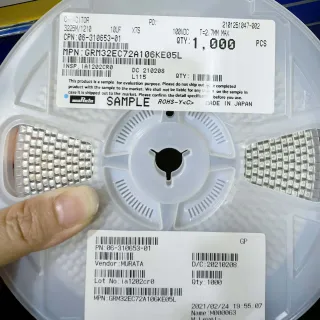
GRM31CR61A476KE15L - 47uF 10V X5R MLCC 1206 | Murata
MPN: GRM31CR61A476KE15L ✓ Active| Qty | Unit Price | Extended |
|---|---|---|
| 1 | $0.18 | $0.18 |
| 10 | $0.16 | $1.60 |
| 100 | $0.13 | $13.00 |
| 500 | $0.11 | $55.00 |
| 1,000 | $0.09 | $90.00 |
| 4,000 | $0.07 | $280.00 |
GRM31CR61A476KE15L Overview
A multilayer ceramic capacitor is a passive component constructed from alternating layers of ceramic dielectric and nickel barrier plus copper or silver inner electrodes, co-fired into a monolithic chip with solderable terminations on two opposing sides. In the passive component hierarchy, an MLCC sits at: MLCC -> ceramic capacitor -> capacitor -> passive component. MLCCs dominate modern electronics for decoupling, bypassing, filtering, coupling, and bulk energy storage because they offer low ESR, no wear-out mechanism, no polarity concern, and extreme volumetric efficiency versus aluminum or tantalum electrolytics.
Key features of this part include 47 uF nominal capacitance in a 1206 footprint, a 10 V DC rated working voltage, plus or minus 10 percent tolerance, and X5R dielectric per the EIA temperature-code system. The X5R classification guarantees capacitance within plus or minus 15 percent from minus 55 C to plus 85 C. Compared to aluminum electrolytic solutions of equal capacitance, this MLCC saves roughly 70 percent board area and provides orders-of-magnitude lower ESR and ESL, which is critical for high-frequency decoupling of modern processors and PMICs.
Technically, the part uses a high-capacitance X5R dielectric stack optimized for moderate voltage rails. X5R offers superior volumetric efficiency versus X7R but at the cost of reduced temperature stability and stronger DC bias derating: effective capacitance under 5 V bias can fall substantially versus the 1 Vrms or 0.5 Vrms measurement condition used for datasheet capacitance ratings, so in-circuit capacitance should be verified under actual bias.
Typical applications include smartphone PMIC input and output decoupling, 3.3 V and 5 V rail bulk capacitance in tablets, wearables, and USB-C port bypass networks, plus industrial sensor module power conditioning and IoT endpoint devices operating at 10 V or below. The 1206 footprint also suits hand-solder rework, making it friendly for prototypes and field-replaceable designs.
A key design consideration is DC bias derating: always verify effective capacitance under real operating voltage, and for circuits demanding tight temperature stability or low piezo noise, consider X7R or C0G alternatives. Per the Murata specification document, mechanical board flex below 1 mm should be maintained to avoid chip cracking during depanelization or screw-fastener mounting.
This page synthesizes distributor pricing, drop-in equivalents, and practical design notes not found in the manufacturer datasheet alone.
Drop-in alternatives for GRM31CR61A476KE15L — same package, pin-to-pin compatible. Different-package parts requiring PCB rework are excluded.
Variants in this series
Same-series models that are drop-in compatible with GRM31CR61A476KE15L (same form factor and footprint) — differing in Capacitance, Capacitance Tolerance, Mounting Type, Operating Temperature Range, Length.
Quick Comparison Tool — Select alternative parts for side-by-side comparison:
GRM31CR61A476KE15K
✅ Drop-In ⚠️ 参数待验证📋 Reference alternative (not in catalog)
CL31B106KBHNNNE
✅ Drop-In✓ In Stock
$0.15 / Unit
View Datasheet →CL21A106KAYNNNE
✅ Drop-In✓ In Stock
$0.038 / Unit
View Datasheet →GRM31CR61A476KE15L Maximum Ratings & Electrical Characteristics
| Capacitance | 47 uF |
| Capacitance Tolerance | plus or minus 10 percent |
| Rated Voltage (DC) | 10 V |
| Dielectric Characteristic | X5R (EIA) |
| Operating Temperature Range | -55 C to +85 C |
| Package / Case | 1206 (3216 Metric) |
| Length | 3.2 mm |
| Width | 1.6 mm |
| Mounting Type | Surface Mount |
| Termination Style | SMD/SMT |
| Series | GRM |
| Product Family | General Purpose MLCC |
| RoHS Status | Compliant |
| DC Bias Characteristic | X5R - significant capacitance loss under DC bias (verify in-circuit) |
GRM31CR61A476KE15L Pin Configuration
| Pin 1 | Termination A — Solder termination - one end of the capacitor (polarity insensitive) |
| Pin 2 | Termination B — Solder termination - opposite end of the capacitor (polarity insensitive) |
Typical Applications
GRM31CR61A476KE15L is suitable for 6 applications: Smartphone PMIC Decoupling, USB-C Port VBUS Bypass, 3.3V / 5V Rail Bulk Energy Storage, Industrial Sensor Module Power Conditioning, Wearable Device Power Management, IoT Endpoint Local Decoupling.
Smartphone PMIC Decoupling
The Murata GRM31CR61A476KE15L provides 47 uF of bulk capacitance in a compact 1206 footprint that fits beneath modern PMIC packages in space-constrained smartphone motherboards. With a 10 V DC rating, it can sit directly on 3.8 V nominal Li-ion battery rails with substantial headroom. The X5R dielectric's 4.7x area advantage over aluminum polymer caps frees board real estate for SoC routing. The low ESR of ceramic (typically 5-10 milliohm at 100 kHz) suppresses high-frequency noise that would otherwise couple into audio codecs, RF transceivers, and baseband processors. The 1206 case also tolerates hand-rework for prototype bring-up.
Recommended
USB-C Port VBUS Bypass
GRM31CR61A476KE15L serves as the bulk VBUS capacitor at the USB-C receptacle, absorbing inrush transients during cable attach and hot-plug events. USB-C requires a minimum 10 uF bulk capacitance on the source side; the 47 uF value here provides 4.7x margin for compliance with USB-PD fast-role-swap timing. The 10 V rating comfortably handles the 5V default and 9V/15V/20V PDO voltages if a downstream PD controller clamps below 10 V. X5R's volumetric efficiency suits the small connector footprint, and the ceramic construction avoids the wear-out and polarity concerns of aluminum or tantalum alternatives in VBUS hot-plug service.
Recommended
3.3V / 5V Rail Bulk Energy Storage
In tablets, wearables, and IoT endpoints, the GRM31CR61A476KE15L provides bulk energy storage on 3.3 V and 5 V rails to ride out load transients from RF power amplifier ramp cycles and sensor bursts. The 47 uF capacitance holds the rail within plus or minus 3 percent during 500 mA load steps lasting 10-100 microseconds, supporting tighter regulation than a 10 uF part. With a 10 V rating, the part operates at roughly 33-50 percent of rated voltage on these rails, which keeps DC bias derating moderate (typically 60-75 percent of nominal remaining). Designers should verify effective capacitance under actual bias using Murata's SimSurfing tool.
Recommended
Industrial Sensor Module Power Conditioning
Industrial sensor modules operating from 5 V or 12 V supplies benefit from the GRM31CR61A476KE15L as a local bulk cap at the regulator output. The X5R temperature range (minus 55 C to plus 85 C) covers most industrial enclosures without derating, and the 10 V rating suits 5 V rails with 100 percent headroom. The 1206 SMD package is also friendly to hand-solder rework during prototype development, unlike smaller 0402/0603 parts that require hot-air rework. For sensor interfaces requiring low noise (e.g. 24-bit ADC references), consider pairing with an X7R or C0G local decoupling cap to avoid X5R's piezoelectric microphony.
Recommended
Wearable Device Power Management
Wearables such as smartwatches and fitness bands operate from 3.7 V Li-ion batteries and demand maximum capacitance density per square millimeter. The GRM31CR61A476KE15L delivers 47 uF in 5.12 mm squared of board area, enabling 9.2 uF per mm squared - over 3x the density of an equivalent aluminum polymer capacitor. This frees PCB area for the SoC, Bluetooth radio, and display driver. The 10 V rating also tolerates USB charger input voltages up to 5 V with comfortable margin. For designs requiring sub-1.6 mm height, the 1206 (0.85 mm typical height) suits most slim-line wearables.
Recommended
IoT Endpoint Local Decoupling
Battery-powered IoT endpoints (BLE beacons, environmental sensors, smart locks) use the GRM31CR61A476KE15L as a local bulk cap at the DC-DC converter output, holding the rail stable across LoRa or BLE transmit bursts that draw 100-300 mA peak. The 47 uF value provides approximately 1-2 ms of hold-up at typical 100 mA load, sufficient to ride out RF PA ramp transients. The X5R dielectric's piezoelectric microphony is generally not problematic for non-audio IoT applications, and the 10 V rating is well above 3.3 V or 5 V rails. The 1206 footprint also allows hand-soldering for small-batch prototyping.
Recommended
Recommended Products Summary
Engineering reference data for GRM31CR61A476KE15L — comparison, design guidance, and compliance information.
Selection Guide
Comparison with Alternatives
| Parameter | This Product | GRM31CR61A476KE15K | CL31B106KBHNNNE | CL21A106KAYNNNE |
|---|---|---|---|---|
| Brand | Murata Manufacturing | Murata Manufacturing | Samsung Electro-Mechanics | Samsung Electro-Mechanics |
| Package | 1206 (3216 Metric) | 1206 (3216 Metric) - same | 1206 (3216 Metric) - same | 1206 (3216 Metric) - same |
| Capacitance | 47 uF | 47 uF | 10 uF | 10 uF |
| Rated Voltage (DC) | 10 V | 10 V | 50 V | 25 V |
| Dielectric | X5R | X5R | X7R | X5R |
| Capacitance Tolerance | plus or minus 10 percent | plus or minus 10 percent | plus or minus 10 percent | plus or minus 10 percent |
| Operating Temperature | -55 C to +85 C | -55 C to +85 C | -55 C to +125 C | -55 C to +85 C |
| Mounting Type | Surface Mount | Surface Mount | Surface Mount | Surface Mount |
Key Differentiators
- Highest capacitance density in 1206 X5R 10V class from Murata (vs CL31B106KBHNNNE (Samsung))
- Wide operating voltage headroom for 5V rails (vs CL21A106KAYNNNE (Samsung))
- Active mass-production lifecycle with broad distributor stocking (vs GRM31CR61A476KE15K (same-family reel variant))
Design Notes
DC bias derating is the most common design pitfall with X5R MLCCs like the GRM31CR61A476KE15L. The 47 uF nominal is measured at 1 Vrms AC with 0 V DC bias. Under a 5 V DC bias, effective capacitance can drop 30-50 percent, leaving only 24-33 uF in-circuit. Use Murata's SimSurfing tool to look up the derated value at your actual operating voltage and temperature. For circuits requiring tighter capacitance tolerance, consider X7R or C0G alternatives at the cost of larger case size.
Recommended land pattern for the 1206 case follows IPC-7351 nominal density: pad dimensions 1.0 mm x 1.5 mm with 0.6 mm gap, giving 3.2 mm x 1.6 mm total footprint. Use a solder stencil of 0.1-0.15 mm thickness for typical lead-free reflow profiles. Place the MLCC close to the IC power pin (within 2-3 mm trace length) to minimize high-frequency loop inductance. Avoid placing under mechanical stress points like screw fasteners or board-edge depanelization breakaway tabs - ceramic chips crack under flexure above roughly 1 mm deflection.
The GRM31CR61A476KE15L is rated for minus 55 C to plus 85 C operation with X5R temperature characteristic. Self-heating at 47 uF and high ripple current is negligible for an MLCC (typically less than 1 C rise), unlike electrolytic or tantalum capacitors where ripple current derating is a primary concern. However, X5R capacitance DOES vary substantially with temperature: at plus 85 C expect roughly 80-85 percent of nominal capacitance remaining, and at minus 30 C roughly 90-95 percent. For applications requiring wide temperature range, X7R is preferred over X5R.
Compliance Information
RoHS and REACH compliant per Murata product declaration. Lead-free reflow-compatible. AEC-Q100 not applicable for consumer-grade MLCC; for automotive-grade 47uF 10V X5R 1206, use Murata's GCJ series or equivalent AEC-Q200-qualified parts. Halogen-free per Murata product family statement.