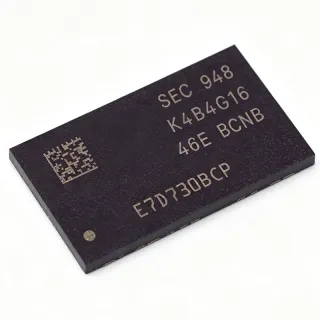
M25P16-VMN3PB - 16Mb SPI NOR Flash 75MHz SOIC-8 | Micron
MPN: M25P16-VMN3PB ✗ End of Life| Qty | Unit Price | Extended |
|---|---|---|
| 1 | $1.85 | $1.85 |
| 10 | $1.66 | $16.60 |
| 100 | $1.42 | $142.00 |
| 500 | $1.21 | $605.00 |
| 1,000 | $0.98 | $980.00 |
Drop-in alternatives for M25P16-VMN3PB — same package, pin-to-pin compatible. Different-package parts requiring PCB rework are excluded.
Quick Comparison Tool — Select alternative parts for side-by-side comparison:
M25P16-VMN3TPB
✅ Drop-In✓ In Stock
$0.63 / Unit
View Datasheet →M25P16-VMF3TPB
✅ Drop-In✓ In Stock
Contact for price
View Datasheet →M25P40-VMN3PB
✅ Drop-In✓ In Stock
$0.62 / Unit
View Datasheet →M25P32-VMF3TPB
✅ Drop-In✓ In Stock
$1.58 / Unit
View Datasheet →M25P16-VMN6P
✅ Drop-In📋 Reference alternative (not in catalog)
W25Q16JVSSIQ
✅ Drop-In📋 Reference alternative (not in catalog)
M25P16-VMN3PB Maximum Ratings & Electrical Characteristics
| Memory Type | Serial NOR Flash, SLC |
| Memory Density | 16 Mbit (16,777,216 bits) |
| Organization | 2 M x 8 (2,000,000 bytes x 8) |
| Interface | SPI |
| Maximum Clock Frequency | 75 MHz |
| Supply Voltage | 2.7 V to 3.6 V |
| Write/Erase Endurance | 100,000 cycles |
| Operating Temperature | -40C to +125C |
| Temperature Grade | Automotive |
| Package | 8-SO (SOIC, 208 mil SOP) |
| Number of Terminals | 8 |
| Maximum Seated Height | 1.75 mm |
| Mounting Type | Surface Mount |
| Product Longevity Program | Yes |
| Access Time | 15 ns |
| Write Protection | Hardware (WP#) and software block protection |
M25P16-VMN3PB Pin Configuration
| Pin 1 | S — Chip Select (active low) |
| Pin 2 | Q — Serial Data Output |
| Pin 3 | WP# — Write Protect (hardware protection, active low) |
| Pin 4 | VSS — Ground |
| Pin 5 | D — Serial Data Input |
| Pin 6 | C — Serial Clock |
| Pin 7 | HOLD# — Hold (pause serial communication, active low) |
| Pin 8 | VCC — Power supply (2.7 V to 3.6 V) |
Safe Operating Area (SOA) & Thermal Characteristics
No official SOA curve available for this digital IC. Always operate within absolute maximum ratings specified in the datasheet. Ensure adequate cooling and derate as needed.
Typical Applications
M25P16-VMN3PB is suitable for 6 applications: Automotive ECU Firmware Boot Storage, Industrial Controller Code and Data Storage, FPGA Configuration Storage, Embedded Data Logging, Networking and Communication Module Firmware, Consumer and Computing Module BIOS/Option Storage.
Automotive ECU Firmware Boot Storage
The M25P16-VMN3PB fits automotive ECU boot-code storage because it combines an automotive -40C to +125C operating grade with 16 Mbit of SLC NOR Flash that supports byte-random reads over SPI at up to 75 MHz. ECU microcontrollers typically fetch boot vectors and initialization code directly from NOR at power-up, and the 15 ns access behavior of the serial NOR array keeps boot latency low. Its 100,000 cycle endurance comfortably supports infrequent OTA firmware rewrites, while hardware WP# protection prevents accidental corruption of the bootloader sector. Because the part is in Micron's Product Longevity Program and has strong second-source drop-ins (ST M25P16-VMN6P, Winbond W25Q16JVSSIQ on the same SOIC-8 footprint), sourcing risk across a 10-15 year vehicle program is manageable. Place the device close to the MCU with short SPI traces and 100 nF decoupling for reliable reads across the full automotive temperature range.
Recommended
Industrial Controller Code and Data Storage
Industrial PLCs, motor controllers, and I/O modules use the M25P16-VMN3PB to store application firmware, parameter sets, and fault logs. The 16 Mb (2 M x 8) SLC array provides enough room for a primary and backup firmware image, supporting safe in-field update schemes with rollback. The 2.7 V to 3.6 V supply matches standard 3.3 V logic rails, and the SPI bus integrates easily with existing MCU peripherals without dedicating parallel address/data buses. The -40C to +125C range covers unconditioned factory-floor cabinets, and 100,000 write/erase cycles handle periodic parameter writes. Design consideration: implement software block protection on parameter sectors and use the HOLD# pin so the SPI bus can be shared with other peripherals without session loss. Because the M25P series is EOL, new industrial designs should dual-qualify the Winbond W25Q16JVSSIQ on the same 208-mil SOIC-8 footprint.
Recommended
FPGA Configuration Storage
The M25P16-VMN3PB serves as a configuration bitstream store for FPGAs and CPLDs that master their configuration from an SPI Flash at power-up. A 16 Mb array holds typical mid-range FPGA bitstreams, and the 75 MHz SPI clock shortens configuration time compared with slower legacy serial Flash. Many FPGA families support the M25P-style command set natively in their configuration logic, which historically made the M25P series a default companion device. The 8-SOIC package occupies minimal board area on dense modules. For robustness, enable hardware write protection via WP# after loading a golden bitstream, and verify that the FPGA's configuration clocking meets the Flash 75 MHz maximum and its read timing requirements. If bitstream size grows, the M25P32-VMF3TPB doubles density in a similar footprint, simplifying layout migration within the same Micron family.
Recommended
Embedded Data Logging
Data-logging nodes - energy meters, environmental sensors, fleet trackers - use the M25P16-VMN3PB as non-volatile event storage. The 2 M x 8 organization supports a page-oriented logging scheme where the MCU buffers records in RAM and writes full pages via page-program commands, maximizing endurance by avoiding partial-page writes. With 100,000 cycles per sector and simple wear-leveling firmware spreading writes across sectors, the device sustains years of periodic logging at automotive-grade -40C to +125C conditions. SPI reads at up to 75 MHz allow fast log dumps during maintenance or over a telemetry link. The HOLD# pin lets the shared SPI bus service real-time sensors mid-dump without dropping the session. Design tip: schedule erase operations during idle windows because sector erase latency is far longer than page program time on this NOR architecture.
Recommended
Networking and Communication Module Firmware
Routers, switches, gateways, and wireless modules store boot loaders and configuration images in the M25P16-VMN3PB. Serial NOR's random-read capability lets network processors execute or checksum-verify code in place, and 16 Mb typically accommodates a compressed boot image plus factory-default configuration. The 75 MHz SPI clock accelerates POST-time image verification, reducing visible boot delay. The 2.7 V to 3.6 V rail integrates directly with mainstream 3.3 V network SoCs, and the compact 8-SOIC (1.75 mm max height) suits low-profile modules and SFP-class form factors. For dual-bank fail-safe updates, the M25P32-VMF3TPB doubles capacity in the same Micron command architecture. Given the EOL status of the M25P line, communications OEMs should qualify Winbond W25Q16JVSSIQ as the long-term drop-in on the same SOIC-8 footprint before the next build cycle.
Recommended
Consumer and Computing Module BIOS/Option Storage
Embedded computing modules, set-top boxes, and peripherals use the M25P16-VMN3PB for BIOS, option ROM, and user-settings storage. The 16 Mb density suits U-Boot/BIOS loaders and configuration blobs, while SLC NOR retention preserves settings across power cycles without battery backup. The 3.3 V SPI interface connects to x86 embedded SoCs and ARM media processors alike, and 75 MHz fast-read commands keep BIOS POST times short. The device's 8-SOIC package and standard pinout (S, Q, WP#, VSS, D, C, HOLD#, VCC) simplify reuse of proven layouts across product generations. Because the M25P family is end-of-life, service and repair channels should stock remaining units and qualify the pin-compatible STMicroelectronics M25P16-VMN6P or Winbond W25Q16JVSSIQ for continued availability on identical SOIC-8 footprints.
Recommended
Recommended Products Summary
Engineering reference data for M25P16-VMN3PB — comparison, design guidance, and compliance information.
Selection Guide
Comparison with Alternatives
| Parameter | This Product | M25P16-VMN3TPB | M25P16-VMF3TPB | M25P40-VMN3PB | M25P32-VMF3TPB | M25P16-VMN6P | W25Q16JVSSIQ |
|---|---|---|---|---|---|---|---|
| Package | 8-SOIC (208 mil) | 8-SOIC (208 mil) - same | 8-SOIC (150 mil) | 8-SOIC (208 mil) - same | 8-SOIC (150 mil) | 8-SOIC - same footprint | 8-SOIC (208 mil) - same |
| Brand | Micron Technology | Micron Technology | Micron Technology | Micron Technology | Micron Technology | STMicroelectronics | Winbond Electronics |
| Density | 16 Mbit (2 M x 8) | 16 Mbit | 16 Mbit | 4 Mbit | 32 Mbit | 16 Mbit | 16 Mbit |
| Max SPI Clock | 75 MHz | 75 MHz | 75 MHz | 75 MHz | 75 MHz | 75 MHz | 133 MHz (fast read) |
| Supply Voltage | 2.7 V to 3.6 V | 2.7 V to 3.6 V | 2.7 V to 3.6 V | 2.7 V to 3.6 V | 2.7 V to 3.6 V | 2.7 V to 3.6 V | 2.7 V to 3.6 V |
| Operating Temperature | -40C to +125C (automotive) | -40C to +125C | -40C to +125C | -40C to +125C | [DATA_NEEDED] | -40C to +85C (industrial) | -40C to +85C (industrial) |
| Endurance | 100,000 cycles | 100,000 cycles | 100,000 cycles | 100,000 cycles | 100,000 cycles | 100,000 cycles | 100,000 cycles |
| Lifecycle Status | EOL (Product Longevity Program) | EOL (Micron M25P series) | EOL (Micron M25P series) | EOL (Micron M25P series) | EOL (Micron M25P series) | EOL (ST legacy SPI NOR) | Active (Winbond W25Q series) |
Key Differentiators
- Automotive -40C to +125C temperature grade (vs W25Q16JVSSIQ)
- Product Longevity Program coverage (vs M25P16-VMN6P)
- Command-set heritage compatibility (vs W25Q16JVSSIQ)
- Same-footprint density scaling (vs M25P32-VMF3TPB)
Design Notes
Supply the M25P16-VMN3PB from a clean 2.7 V to 3.6 V rail and place a 100 nF ceramic capacitor directly across VCC (pin 8) and VSS (pin 4), within a few millimeters of the pins. At 75 MHz SPI clocking, supply bounce manifests as corrupted read data during fast-read bursts, so also add a bulk 4.7 uF-10 uF capacitor near the device if sharing a rail with switching loads. Avoid powering the Flash from a rail that droops below 2.7 V during MCU program-flash write bursts, as a brownout during program/erase can corrupt the sector.
Keep SPI traces (S, C, D, Q) short - under 10 cm is comfortable at 75 MHz. Series-terminate the clock (22-33 ohm) at the driver if traces exceed ~8 cm to control ringing. Pull WP# and HOLD# to VCC with 10k resistors unless actively driven; a floating HOLD# pin can intermittently stall output reads when noise couples onto the trace. Ensure the 208-mil SOIC-8 land pattern matches the ordering code (VMN3 = 208 mil; VMF3 = 150 mil) before layout release.
The Micron M25P series is end-of-life; do not start new designs without a qualified second source. The most common failure mode during migration is command-set mismatch: Winbond W25Q16 uses extended commands and different status-register semantics, so revalidate erase/program drivers, not just the read path. Also, releasing HOLD# requires a falling edge on C to resume communication - mid-transaction bus arbitration schemes that toggle HOLD# must honor this, or reads will appear to hang.
Compliance Information
The part is designated an automotive temperature grade and Micron Product Longevity Program member, but explicit RoHS/REACH/AEC-Q100 qualification statements were not present in the provided verified web data.