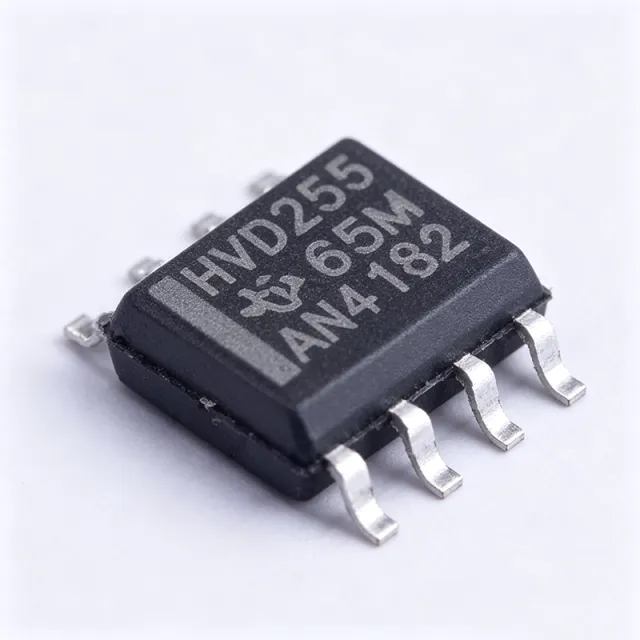
SN65HVD255DR - 1Mbps Turbo CAN Transceiver | TI
MPN: SN65HVD255DR ✓ Active| Qty | Unit Price | Extended |
|---|---|---|
| 1 | $1.39 | $1.39 |
| 10 | $1.25 | $12.50 |
| 100 | $1.05 | $105.00 |
| 500 | $0.9 | $450.00 |
| 1,000 | $0.78 | $780.00 |
Drop-in alternatives for SN65HVD255DR — same package, pin-to-pin compatible. Different-package parts requiring PCB rework are excluded.
Quick Comparison Tool — Select alternative parts for side-by-side comparison:
SN65HVD256DR
✅ Drop-In📋 Reference alternative (not in catalog)
SN65HVD255QDRQ1
✅ Drop-In✓ In Stock
$0.98 / Unit
View Datasheet →TCAN1051DR
✅ Drop-In📋 Reference alternative (not in catalog)
TJA1051T/3/1
✅ Drop-In✓ In Stock
$0.3 / Unit
View Datasheet →MCP2551-I/SN
✅ Drop-In📋 Reference alternative (not in catalog)
SN65HVD255DR Maximum Ratings & Electrical Characteristics
| Protocol | CAN (ISO 11898-2 High-Speed) |
| Data Rate | > 1 Mbps |
| Supply Voltage | 5 V nominal |
| Number of Drivers/Receivers | 1/1 |
| Duplex | Half duplex |
| Operating Temperature | -40C to +125C |
| Package | SOIC-8 (D) |
| Mounting Type | Surface Mount |
| Key Feature | Fast loop times for highly loaded networks |
| Protection | Thermal shutdown, short-circuit current limiting |
| Functional Safety Features | Yes (per TI datasheet) |
| EMC | Low electromagnetic emission, high immunity |
| RoHS Status | Compliant |
| Carrier / Packing | Tape & Reel (R suffix) |
| Typical Applications | Industrial automation, building automation, security, telecom base stations |
SN65HVD255DR Pin Configuration
| Pin 1 | TXD — Transmit data input from CAN controller |
| Pin 2 | GND — Ground |
| Pin 3 | VCC — 5V supply |
| Pin 4 | RXD — Receive data output to CAN controller |
| Pin 5 | VREF — Reference output voltage |
| Pin 6 | CANL — CAN low bus line |
| Pin 7 | CANH — CAN high bus line |
| Pin 8 | RS/S — Speed / mode select |
Safe Operating Area (SOA) & Thermal Characteristics
No official SOA curve available for this digital IC. Always operate within absolute maximum ratings specified in the datasheet. Ensure adequate cooling and derate as needed.
Typical Applications
SN65HVD255DR is suitable for 6 applications: Industrial Automation and Motor Drives, Building and Climate Control Automation, Security and Surveillance Systems, Telecom Base Station Status and Control, Automotive Body and Control Networks, Medical and Diagnostic Equipment Nodes.
Industrial Automation and Motor Drives
The SN65HVD255DR fits industrial CAN buses because its fast loop propagation times preserve timing margin on long, heavily loaded networks exceeding 1 Mbps. Connected between a CAN controller and the twisted pair via TXD/RXD and CANH/CANL, it drives 120-ohm terminated segments while its short-circuit limiting and thermal shutdown survive harsh motor-drive electrical environments. Low electromagnetic emission reduces EMI coupling into servo feedback paths.
Recommended
Building and Climate Control Automation
HVAC and building management systems use CAN for controller-area networking across floors and equipment rooms. The SN65HVD255DR suits these deployments with its -40C to +125C range for rooftop units and its ability to sustain more nodes and longer cable runs than standard transceivers thanks to fast loop times. Its 5V operation simplifies integration with legacy control logic, and VREF assists receiver threshold stability.
Recommended
Security and Surveillance Systems
Access control and security panels communicate over CAN segments where noise immunity matters. The SN65HVD255DR provides high receiver immunity per ISO 11898-2 and common-mode tolerance for long twisted-pair runs between panels. Its functional-safety-oriented features and short-circuit protection improve system dependability, while fast loop times allow daisy-chained reader controllers at bit rates above 1 Mbps without frame errors.
Recommended
Telecom Base Station Status and Control
Base station equipment aggregates status and control signals on CAN buses inside cabinets subject to wide temperature swings and electrical noise. The SN65HVD255DR operates from -40C to +125C, tolerates harsh transients, and its thermal shutdown protects against bus faults. Turbo CAN fast loop times support in-cabinet control networks that exceed 1 Mbps, and its low emission profile limits radiated interference with RF chains.
Recommended
Automotive Body and Control Networks
For vehicular subsystems, use the SN65HVD255QDRQ1 AEC-Q100 variant of the same die. It provides ISO 11898-2 compliant dominant/recessive drive on CANH/CANL, -40C to +125C operation, and fault robustness against bus short circuits to battery or ground. Fast loop times give timing margin for gateway-heavy, highly loaded body networks, and the shared SOIC-8 footprint simplifies qualification of drop-in upgrades.
Recommended
Medical and Diagnostic Equipment Nodes
Diagnostic instruments and lab automation use CAN to link motorized stages, sensors, and controllers. The SN65HVD255DR supports deterministic communication above 1 Mbps with fast loop times, while its short-circuit limiting and thermal shutdown protect expensive subsystems from wiring faults. Low electromagnetic emission helps meet EMC requirements for medical environments, and VREF simplifies receiver biasing designs.
Recommended
Recommended Products Summary
Engineering reference data for SN65HVD255DR — comparison, design guidance, and compliance information.
Selection Guide
Comparison with Alternatives
| Parameter | This Product | SN65HVD256DR | SN65HVD255QDRQ1 | TJA1051T | MCP2551-I/SN |
|---|---|---|---|---|---|
| Package | SOIC-8 (D) | SOIC-8 (D) - same | SOIC-8 (D) - same | SOIC-8 - same | SOIC-8 - same |
| Brand | Texas Instruments | Texas Instruments | Texas Instruments | NXP Semiconductors | Microchip Technology |
| Data Rate | > 1 Mbps (Turbo CAN) | > 1 Mbps | > 1 Mbps | up to 5 Mbps (CAN FD tolerant) | up to 1 Mbps |
| Supply Voltage | 5 V nominal | 5 V | 5 V | 5 V | 5 V |
| Operating Temperature | -40C to +125C | -40C to +125C | -40C to +125C | -40C to +125C | -40C to +125C |
| Automotive Grade | No (standard) | No | Yes (AEC-Q100) | AEC-Q100 variant available (TJA1051T/3) | No |
| Functional Safety Features | Yes | Yes | Yes | [DATA_NEEDED] | No |
| Protection | Thermal shutdown, current limiting | Thermal shutdown, current limiting | Thermal shutdown, current limiting | TXD dominant timeout, current limiting | Current limiting, thermal shutdown |
| Unit Price (1 pc) | $1.39 | [DATA_NEEDED] | [DATA_NEEDED] | [DATA_NEEDED] | [DATA_NEEDED] |
Key Differentiators
- Turbo CAN fast loop times (vs MCP2551-I/SN)
- Functional-safety-oriented features (vs MCP2551-I/SN)
- AEC-Q100 qualified variant available on same die (vs SN65HVD255QDRQ1)
- VREF output for receiver reference (vs TJA1051T)
Design Notes
Place a 0.1uF ceramic bypass capacitor within 2 mm of the VCC pin (pin 3) with a solid ground return to pin 2. Route CANH (pin 7) and CANL (pin 6) as a tightly coupled differential pair of equal length; keep stubs to the connector under 10 cm to avoid reflections at multi-Mbps loop timing. Terminate both physical bus ends with 120-ohm resistors rated for the fault conditions.
Do not leave the RS/S pin (pin 8) floating - tie it per the TI datasheet for the intended speed/slope mode, as an undefined level can degrade EMC or loop timing. Verify VREF loading: VREF is a reference output, not a supply, and excessive loading shifts receiver thresholds. When substituting the TJA1051T, note its VREF pin is an input, not an output - re-check schematics before drop-in.
Dissipation depends on bus load and dominant duty cycle; under a bus short-circuit the internal current limiting plus thermal shutdown protect the die, but sustained faults increase junction temperature. Provide at least a modest copper pour on the SOIC-8 GND pin to keep theta_JA low. For -40C to +125C ambient designs, calculate worst-case dominant duty cycle dissipation per the TI datasheet thermal table.
The SN65HVD255DR offers low electromagnetic emission, but achievable EMC depends on slope control via RS/S. For heavily shielded industrial cabinets, full-speed mode maximizes timing margin; for cost-sensitive unshielded cable runs, use slope-control mode to trade edge rate for lower emissions. Keep the CAN pair away from switching-regulator inductors to prevent common-mode coupling.
Compliance Information
RoHS compliant and lead-free per TI product page for SN65HVD255DR. AEC-Q100 qualification applies to the SN65HVD255QDRQ1 variant, not this standard part.