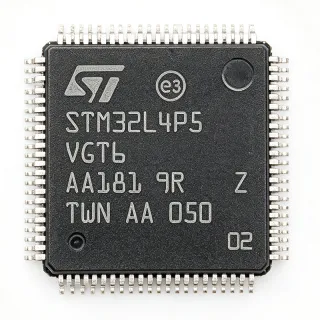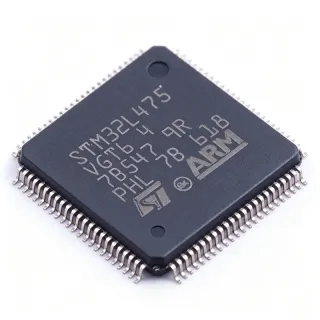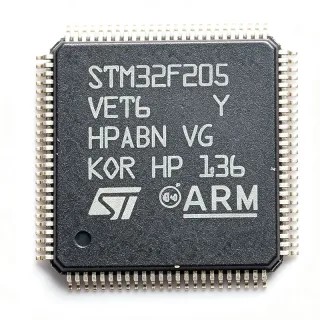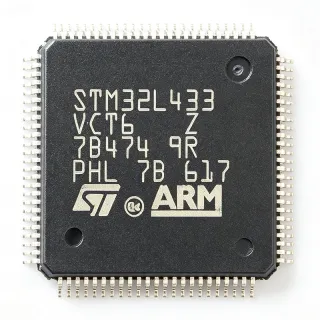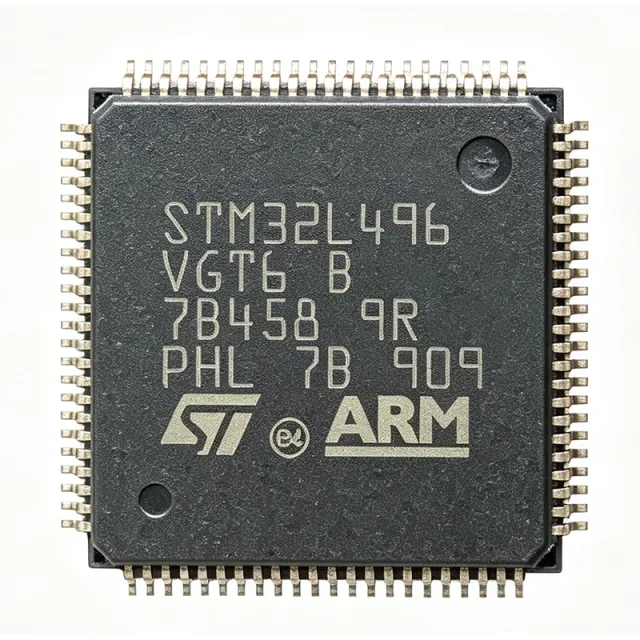
STM32L496VGT6 - Ultra-Low-Power ARM Cortex-M4F MCU | STMicroelectronics
MPN: STM32L496VGT6 ✓ Active| Qty | Unit Price | Extended |
|---|---|---|
| 1 | $16.3636 | $16.36 |
| 10 | $11.8182 | $118.18 |
| 100 | $10.4545 | $1,045.45 |
| 500 | $10 | $5,000.00 |
| 1,000 | $9.5455 | $9,545.50 |
Drop-in alternatives for STM32L496VGT6 — same package, pin-to-pin compatible. Different-package parts requiring PCB rework are excluded.
Quick Comparison Tool — Select alternative parts for side-by-side comparison:
STM32L476VGT6
✓ In Stock
$4.09 / Unit
View Datasheet →STM32L496VGT6P
📋 Reference alternative (not in catalog)
STM32L496VET6
📋 Reference alternative (not in catalog)
STM32L496VIT6
📋 Reference alternative (not in catalog)
GD32F450VGT6
📋 Reference alternative (not in catalog)
GD32F407VGT6
📋 Reference alternative (not in catalog)
STM32L496VGT6 Maximum Ratings & Electrical Characteristics
| Core | ARM Cortex-M4F with FPU |
| Maximum Clock Frequency | 80 MHz |
| Flash Memory | 1 MB (1M x 8) |
| SRAM | 320 KB |
| Supply Voltage Range | 1.71 V to 3.6 V |
| Operating Temperature Range | -40°C to 85/105/125°C |
| Package | 100-LQFP (14x14 mm) |
| Mounting Type | Surface Mount |
| Number of I/Os | Up to 114 |
| DMIPS Performance | 100 DMIPS |
| CoreMark Score | 273 |
| ADC | 2x 12-bit with hardware oversampling |
| DAC | 2x 12-bit |
| Communication Interfaces | USART, SPI, I2C, USB OTG FS, CAN, SDMMC |
| Low-Power Modes | Sleep, Low-power Run, Shutdown (25 nA) |
| VBAT Mode Current | 320 nA (RTC and 32x32-bit backup registers) |
| Process Technology | 40 nm |
| RoHS Status | Compliant |
STM32L496VGT6 Pin Configuration
| Pin 1 | VBAT — Battery backup supply for RTC and backup registers |
| Pin 2 | PC14 — GPIO or OSC32_IN |
| Pin 3 | PC15 — GPIO or OSC32_OUT |
| Pin 4 | PF0 — GPIO or OSC_IN |
| Pin 5 | PF1 — GPIO or OSC_OUT |
| Pin 6 | NRST — Reset (active low) |
| Pin 7 | PC0 — GPIO or ADC input |
| Pin 8 | PC1 — GPIO or ADC input |
| Pin 9 | PC2 — GPIO or ADC input |
| Pin 10 | PC3 — GPIO or ADC input |
| Pin 11 | VDD — Digital power supply |
| Pin 12 | VSS — Ground |
| Pin 13 | PC4 — GPIO or ADC input |
| Pin 14 | PC5 — GPIO or ADC input |
| Pin 15 | PB0 — GPIO or ADC input |
| Pin 16 | PB1 — GPIO or ADC input |
| Pin 17 | PB2 — GPIO or BOOT1 |
| Pin 18 | PB10 — GPIO or I2C2_SCL |
| Pin 19 | PB11 — GPIO or I2C2_SDA |
| Pin 20 | VDD — Digital power supply |
Safe Operating Area (SOA) & Thermal Characteristics
No official SOA curve available for this digital IC. Always operate within absolute maximum ratings specified in the datasheet. Ensure adequate cooling and derate as needed.
Typical Applications
STM32L496VGT6 is suitable for 6 applications: Industrial Sensors, Smart Meters, Medical Devices, Wearable Electronics, IoT Nodes, Smart Home Devices.
Industrial Sensors
The STM32L496VGT6 is ideal for industrial sensors due to its ultra-low-power modes and rich analog peripherals. Its 12-bit ADCs with hardware oversampling enable precise measurement of temperature, pressure, and flow. The device's 1 MB flash and 320 KB SRAM support complex signal processing algorithms, while multiple communication interfaces (USART, SPI, I2C, CAN) allow seamless integration into industrial networks. The wide operating temperature range (-40°C to 125°C) ensures reliability in harsh environments. In a typical sensor node, the MCU acquires data from sensors, processes it locally, and transmits results via Modbus or CAN bus. The low-power Shutdown mode (25 nA) allows the device to sleep between measurements, extending battery life in wireless sensor networks. The flexible clock tree enables optimization of performance versus power consumption, making it suitable for both continuous monitoring and duty-cycled operation.
Recommended
Smart Meters
The STM32L496VGT6 is well-suited for smart meters, including electricity, water, and gas meters. Its ultra-low-power modes (320 nA VBAT, 25 nA Shutdown) enable long battery life, essential for metering applications. The device's 1 MB flash provides ample storage for metering firmware and data logging, while 320 KB SRAM supports real-time data processing. The integrated cryptographic acceleration unit (AES, DES, 3DES) ensures secure communication with utility networks. The multiple communication interfaces, including USB OTG FS and CAN, allow connectivity to home area networks (HAN) and industrial protocols. In a typical smart meter, the MCU reads sensor data, calculates consumption, and communicates via wireless or wired interfaces. The low-power timer can wake the device periodically for measurements, minimizing energy consumption. The wide voltage range (1.71V-3.6V) accommodates battery voltage variations over the meter's lifetime.
Recommended
Medical Devices
The STM32L496VGT6 is suitable for portable medical devices such as glucose monitors, pulse oximeters, and wearable health trackers. Its ultra-low-power consumption (25 nA Shutdown) extends battery life, critical for continuous health monitoring. The 80 MHz Cortex-M4F core with FPU and DSP instructions enables real-time signal processing for ECG, EEG, and other biosignals. The two 12-bit ADCs with hardware oversampling provide high-resolution data acquisition from sensors. The device's 1 MB flash and 320 KB SRAM support complex algorithms and data buffering. The Chrom-ART Accelerator enhances graphical user interfaces on small displays. In a typical wearable, the MCU acquires biosignals, processes them, and displays results or transmits via Bluetooth (using an external module). The low-power modes allow the device to operate for weeks on a small battery. The cryptographic unit ensures secure data transmission, complying with medical data privacy regulations.
Recommended
Wearable Electronics
The STM32L496VGT6 is an excellent choice for wearable electronics, including smartwatches, fitness trackers, and smart glasses. Its ultra-low-power modes (25 nA Shutdown, 320 nA VBAT) enable extended battery life, essential for devices worn daily. The 80 MHz Cortex-M4F core provides sufficient processing power for sensor fusion, activity tracking, and user interface rendering. The device's 1 MB flash and 320 KB SRAM support complex applications and data logging. The integrated Chrom-ART Accelerator offloads graphics rendering, improving UI responsiveness while reducing CPU load. The multiple communication interfaces (SPI, I2C, USB OTG FS) allow connection to displays, sensors, and wireless modules. In a typical smartwatch, the MCU manages the display, collects sensor data (heart rate, accelerometer), and communicates with a smartphone via Bluetooth. The low-power timer enables periodic sensor sampling, minimizing energy consumption. The wide voltage range (1.71V-3.6V) supports direct battery connection.
Recommended
IoT Nodes
The STM32L496VGT6 is ideal for IoT nodes that require low power consumption and robust connectivity. Its ultra-low-power modes (25 nA Shutdown) allow battery-powered operation for years. The 80 MHz Cortex-M4F core with FPU and DSP instructions enables edge processing, reducing the need for cloud communication. The device's 1 MB flash and 320 KB SRAM support complex firmware and data buffering. The multiple communication interfaces (USART, SPI, I2C, USB OTG FS, CAN) allow connection to various wireless modules (LoRa, NB-IoT, Wi-Fi) and sensors. The cryptographic acceleration unit ensures secure data transmission. In a typical IoT node, the MCU collects sensor data, processes it locally, and transmits it via a wireless module. The low-power timer can wake the device periodically for data transmission, minimizing energy consumption. The wide voltage range (1.71V-3.6V) accommodates battery voltage variations. The device's rich analog peripherals (two 12-bit ADCs, two DACs) enable direct sensor interfacing.
Recommended
Smart Home Devices
The STM32L496VGT6 is well-suited for smart home devices such as smart thermostats, lighting controllers, and security systems. Its ultra-low-power modes (25 nA Shutdown) enable battery-powered operation for devices like wireless sensors and door locks. The 80 MHz Cortex-M4F core provides sufficient processing power for user interfaces and automation logic. The device's 1 MB flash and 320 KB SRAM support complex applications and voice recognition algorithms. The multiple communication interfaces (USART, SPI, I2C, USB OTG FS) allow connection to Wi-Fi, Zigbee, or Z-Wave modules. The Chrom-ART Accelerator enhances graphical displays on thermostats and control panels. In a typical smart thermostat, the MCU reads temperature sensors, controls HVAC relays, and communicates with a central hub. The low-power modes allow the device to sleep between readings, saving energy. The cryptographic unit ensures secure communication with smart home ecosystems.
Recommended
Recommended Products Summary
Engineering reference data for STM32L496VGT6 — comparison, design guidance, and compliance information.
Selection Guide
Comparison with Alternatives
| Parameter | This Product | STM32L496VGT6P | STM32L496VET6 | STM32L496VIT6 | STM32L476VGT6 | GD32F450VGT6 | GD32F407VGT6 |
|---|---|---|---|---|---|---|---|
| Package | 100-LQFP (14x14) | 100-LQFP (14x14) | 100-LQFP (14x14) | 100-LQFP (14x14) | 100-LQFP (14x14) | 100-LQFP (14x14) | 100-LQFP (14x14) |
| Brand | STMicroelectronics | STMicroelectronics | STMicroelectronics | STMicroelectronics | STMicroelectronics | GigaDevice | GigaDevice |
| Core | ARM Cortex-M4F | ARM Cortex-M4F | ARM Cortex-M4F | ARM Cortex-M4F | ARM Cortex-M4F | ARM Cortex-M4F | ARM Cortex-M4F |
| Maximum Clock Frequency | 80 MHz | 80 MHz | 80 MHz | 80 MHz | 80 MHz | 200 MHz | 168 MHz |
| Flash Memory | 1 MB | 1 MB | 512 KB | 2 MB | 1 MB | 1 MB | 1 MB |
| SRAM | 320 KB | 320 KB | 320 KB | 320 KB | 128 KB | 256 KB | 192 KB |
| Supply Voltage Range | 1.71V to 3.6V | 1.71V to 3.6V | 1.71V to 3.6V | 1.71V to 3.6V | 1.71V to 3.6V | 2.6V to 3.6V | 2.6V to 3.6V |
| Low-Power Shutdown Current | 25 nA | 25 nA | 25 nA | 25 nA | 30 nA | [DATA_NEEDED: shutdown current] | [DATA_NEEDED: shutdown current] |
Key Differentiators
- Ultra-low-power modes with 25 nA Shutdown and 320 nA VBAT (vs GD32F450VGT6)
- 1 MB flash and 320 KB SRAM in a 100-LQFP package (vs STM32L496VET6)
- Integrated cryptographic acceleration (AES, DES, 3DES) (vs STM32L476VGT6)
Design Notes
The STM32L496VGT6 operates from 1.71V to 3.6V. Use a low-dropout regulator (LDO) to provide a stable supply, and place 100 nF decoupling capacitors close to each VDD pin. For battery-powered designs, utilize the low-power modes (Shutdown 25 nA, VBAT 320 nA) to extend battery life. Ensure the VBAT pin is connected to a backup battery or tied to VDD if not used.
For the 100-LQFP package, ensure proper soldering with a stencil thickness of 0.125 mm. Provide a solid ground plane and route high-speed signals (USB, SDMMC) with controlled impedance. Place the crystal oscillator (if used) close to the OSC_IN/OSC_OUT pins and keep traces short to minimize parasitic capacitance. Follow ST's layout guidelines in AN4666 for optimal performance.
Avoid exceeding the absolute maximum ratings, especially on VDD (3.6V). Ensure the BOOT0 pin is correctly configured to boot from flash. When using the ADC, enable the internal voltage regulator and configure the sampling time appropriately for accurate readings. Do not leave unused GPIOs floating; configure them as outputs or enable pull-ups/pull-downs to reduce leakage current.
Compliance Information
RoHS compliant per STMicroelectronics product page. Not AEC-Q100 qualified; for automotive, consider STM32L496VGT6Q variant if available.