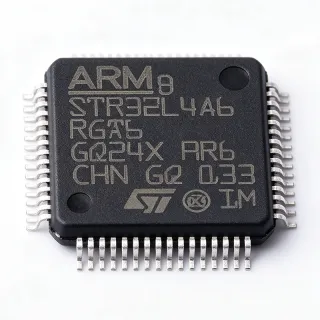
STM32L552RET6 - 110MHz Arm Cortex-M33 MCU with TrustZone | STMicroelectronics
MPN: STM32L552RET6 ✓ Active| Qty | Unit Price | Extended |
|---|---|---|
| 1 | $8.52 | $8.52 |
| 10 | $7.85 | $78.50 |
| 100 | $6.94 | $694.00 |
| 500 | $6.12 | $3,060.00 |
| 1,000 | $5.48 | $5,480.00 |
Drop-in alternatives for STM32L552RET6 — same package, pin-to-pin compatible. Different-package parts requiring PCB rework are excluded.
Quick Comparison Tool — Select alternative parts for side-by-side comparison:
STM32L552RET6Q
✅ Drop-In📋 Reference alternative (not in catalog)
STM32L552RCT6
✅ Drop-In📋 Reference alternative (not in catalog)
STM32L552RGT6
✅ Drop-In📋 Reference alternative (not in catalog)
GD32F550RET6
✅ Drop-In📋 Reference alternative (not in catalog)
GD32F550RGT6
✅ Drop-In📋 Reference alternative (not in catalog)
STM32L552RET6 Maximum Ratings & Electrical Characteristics
| Core | Arm Cortex-M33 with TrustZone and FPU |
| Maximum Clock Frequency | 110 MHz |
| Flash Memory | 512 KB |
| SRAM | 256 KB |
| Supply Voltage Range | 1.71 V to 3.6 V |
| Operating Temperature Range | -40°C to +85°C |
| Package | 64-LQFP (10x10 mm) |
| Mounting Type | Surface Mount |
| Number of I/O Pins | 51 |
| ADC Resolution | 16-bit with hardware oversampling |
| DAC Resolution | 12-bit (2 channels) |
| Communication Interfaces | I2C, SPI, USART, UART, LPUART, SAI, CAN, USB OTG FS, SDMMC |
| Security Features | TrustZone, TRNG, AES, RSA, ECC |
| Low-Power Modes | Sleep, Low-power Run, Low-power Sleep, Stop 0/1/2, Standby |
| Standby Current | 100 nA (typical with backup domain) |
| RoHS Status | Compliant |
STM32L552RET6 Pin Configuration
| Pin 1 | VBAT — Backup battery supply for RTC and backup registers |
| Pin 2 | PC14 — GPIO or OSC32_IN |
| Pin 3 | PC15 — GPIO or OSC32_OUT |
| Pin 4 | PF0 — GPIO or OSC_IN |
| Pin 5 | PF1 — GPIO or OSC_OUT |
| Pin 6 | NRST — Reset pin, active low |
| Pin 7 | VDD — Digital power supply |
| Pin 8 | VSS — Ground |
| Pin 9 | VDDA — Analog power supply |
| Pin 10 | VREF+ — ADC reference voltage positive |
| Pin 11 | VREF- — ADC reference voltage negative |
| Pin 12 | PA0 — GPIO or ADC input |
| Pin 13 | PA1 — GPIO or ADC input |
| Pin 14 | PA2 — GPIO or USART2_TX |
| Pin 15 | PA3 — GPIO or USART2_RX |
| Pin 16 | PA4 — GPIO or DAC_OUT1 |
| Pin 17 | PA5 — GPIO or DAC_OUT2 |
| Pin 18 | PA6 — GPIO or SPI1_MISO |
| Pin 19 | PA7 — GPIO or SPI1_MOSI |
| Pin 20 | PA8 — GPIO or USB_OTG_FS_SOF |
| Pin 21 | PA9 — GPIO or USB_OTG_FS_VBUS |
| Pin 22 | PA10 — GPIO or USB_OTG_FS_ID |
| Pin 23 | PA11 — GPIO or USB_OTG_FS_DM |
| Pin 24 | PA12 — GPIO or USB_OTG_FS_DP |
| Pin 25 | PA13 — GPIO or SWDIO |
| Pin 26 | PA14 — GPIO or SWCLK |
| Pin 27 | PA15 — GPIO or JTDI |
| Pin 28 | PB0 — GPIO or ADC input |
| Pin 29 | PB1 — GPIO or ADC input |
| Pin 30 | PB2 — GPIO or BOOT1 |
| Pin 31 | PB3 — GPIO or JTDO |
| Pin 32 | PB4 — GPIO or NJTRST |
| Pin 33 | PB5 — GPIO or I2C1_SMBA |
| Pin 34 | PB6 — GPIO or I2C1_SCL |
| Pin 35 | PB7 — GPIO or I2C1_SDA |
| Pin 36 | PB8 — GPIO or I2C1_SCL |
| Pin 37 | PB9 — GPIO or I2C1_SDA |
| Pin 38 | PB10 — GPIO or I2C2_SCL |
| Pin 39 | PB11 — GPIO or I2C2_SDA |
| Pin 40 | PB12 — GPIO or SPI2_NSS |
| Pin 41 | PB13 — GPIO or SPI2_SCK |
| Pin 42 | PB14 — GPIO or SPI2_MISO |
| Pin 43 | PB15 — GPIO or SPI2_MOSI |
| Pin 44 | PC0 — GPIO or ADC input |
| Pin 45 | PC1 — GPIO or ADC input |
| Pin 46 | PC2 — GPIO or ADC input |
| Pin 47 | PC3 — GPIO or ADC input |
| Pin 48 | PC4 — GPIO or ADC input |
| Pin 49 | PC5 — GPIO or ADC input |
| Pin 50 | PC6 — GPIO or SDMMC1_CK |
| Pin 51 | PC7 — GPIO or SDMMC1_CMD |
| Pin 52 | PC8 — GPIO or SDMMC1_D0 |
| Pin 53 | PC9 — GPIO or SDMMC1_D1 |
| Pin 54 | PC10 — GPIO or SDMMC1_D2 |
| Pin 55 | PC11 — GPIO or SDMMC1_D3 |
| Pin 56 | PC12 — GPIO or SDMMC1_CK |
| Pin 57 | PC13 — GPIO or RTC_TAMP1 |
| Pin 58 | PC14 — GPIO or OSC32_IN |
| Pin 59 | PC15 — GPIO or OSC32_OUT |
| Pin 60 | PD0 — GPIO or OSC_IN |
| Pin 61 | PD1 — GPIO or OSC_OUT |
| Pin 62 | PD2 — GPIO or SDMMC1_CK |
| Pin 63 | VDD — Digital power supply |
| Pin 64 | VSS — Ground |
Safe Operating Area (SOA) & Thermal Characteristics
No official SOA curve available for this digital IC. Always operate within absolute maximum ratings specified in the datasheet. Ensure adequate cooling and derate as needed.
Typical Applications
STM32L552RET6 is suitable for 6 applications: IoT Edge Devices, Smart Meters, Industrial Sensors, Medical Monitoring Equipment, Secure Access Control Systems, Portable Consumer Electronics.
IoT Edge Devices
The STM32L552RET6 is ideal for IoT edge devices due to its ultra-low-power modes and TrustZone security. In a typical IoT sensor node, the MCU wakes from Stop mode periodically to read sensors, process data, and transmit via LoRa or BLE. The 110 MHz Cortex-M33 core provides sufficient processing power for edge AI inference, while the 100 nA standby current extends battery life to years. The integrated AES and TRNG enable secure communication and data encryption, protecting against cyber threats. Designers can leverage the low-power UART and I2C interfaces to interface with sensors and radios, ensuring efficient power management.
Recommended
Smart Meters
The STM32L552RET6 is well-suited for smart meters, where it handles metering calculations, secure communication, and display updates. Its 16-bit ADC with hardware oversampling ensures accurate measurement of voltage and current, while the TrustZone technology protects metering data and firmware from tampering. The MCU's multiple low-power modes allow it to operate on battery power for extended periods, waking periodically to record consumption and transmit data to the utility. The integrated CAN interface enables communication with other metering devices, and the cryptographic acceleration ensures secure data transmission. The 512 KB flash provides ample storage for metering algorithms and data logs.
Recommended
Industrial Sensors
In industrial sensor applications, the STM32L552RET6 provides reliable performance in harsh environments with its -40°C to +85°C operating range. The MCU's 16-bit ADC and two 12-bit DACs enable precise analog signal conditioning, while the multiple communication interfaces (SPI, I2C, USART) allow seamless integration with industrial networks. The TrustZone security ensures that firmware updates are authenticated, preventing unauthorized modifications. The low-power modes are beneficial for battery-powered wireless sensors, and the 110 MHz core can handle real-time signal processing algorithms. The device's robust design and wide supply voltage range make it suitable for 24V industrial systems with appropriate voltage regulation.
Recommended
Medical Monitoring Equipment
The STM32L552RET6 is suitable for medical monitoring devices such as wearable health trackers and portable patient monitors. Its ultra-low-power consumption extends battery life, while the TrustZone security protects patient data and ensures compliance with medical data privacy regulations. The 16-bit ADC can interface with biosensors for ECG, heart rate, and oxygen saturation monitoring, and the FPU accelerates signal processing algorithms. The MCU's small LQFP-64 package allows for compact device designs, and the multiple low-power modes enable continuous monitoring with periodic data transmission. The integrated cryptographic acceleration ensures secure wireless communication with healthcare systems.
Recommended
Secure Access Control Systems
The STM32L552RET6 is ideal for secure access control systems such as smart locks, biometric readers, and authentication devices. The TrustZone technology provides a secure execution environment for cryptographic keys and authentication algorithms, protecting against side-channel attacks. The MCU's TRNG generates true random numbers for secure key generation, and the AES/RSA/ECC accelerators enable fast and secure authentication. The device's low-power modes allow battery-powered locks to operate for years, and the multiple communication interfaces (USB, SPI, I2C) enable connectivity with card readers, fingerprint sensors, and network modules. The 512 KB flash provides ample storage for firmware and user credentials.
Recommended
Portable Consumer Electronics
The STM32L552RET6 is well-suited for portable consumer electronics like smartwatches, fitness trackers, and remote controls. Its ultra-low-power modes and 100 nA standby current enable long battery life, while the 110 MHz Cortex-M33 core provides responsive user interfaces and sensor processing. The integrated DAC can drive audio outputs, and the USB OTG FS interface allows for charging and data transfer. The TrustZone security protects user data and enables secure firmware updates. The small LQFP-64 package and wide supply voltage range make it easy to integrate into compact designs. The MCU's rich peripheral set supports various sensors, displays, and wireless modules.
Recommended
Recommended Products Summary
Engineering reference data for STM32L552RET6 — comparison, design guidance, and compliance information.
Selection Guide
Comparison with Alternatives
| Parameter | This Product | STM32L552RET6Q | STM32L552RCT6 | STM32L552RGT6 | GD32F550RET6 |
|---|---|---|---|---|---|
| Package | 64-LQFP (10x10 mm) | 64-LQFP (10x10 mm) - same | 64-LQFP (10x10 mm) - same | 64-LQFP (10x10 mm) - same | 64-LQFP (10x10 mm) - same |
| Brand | STMicroelectronics | STMicroelectronics | STMicroelectronics | STMicroelectronics | GigaDevice |
| Core | Arm Cortex-M33 with TrustZone | ARM Cortex M33 | Arm Cortex-M33 with TrustZone | Arm Cortex-M33 with TrustZone | Arm Cortex-M33 |
| Maximum Clock Frequency | 110 MHz | 110 MHz | 110 MHz | 110 MHz | 110 MHz |
| Flash Memory | 512 KB | 512 KB | 256 KB | 1 MB | 512 KB |
| SRAM | 256 KB | 256 KB | 128 KB | 256 KB | 256 KB |
| Supply Voltage Range | 1.71V to 3.6V | 1.71V to 3.6V | 1.71V to 3.6V | 1.71V to 3.6V | 1.71V to 3.6V |
| Operating Temperature Range | -40°C to +85°C | -40°C to +85°C | -40°C to +85°C | -40°C to +85°C | -40°C to +85°C |
| TrustZone Support | Yes | Yes | Yes | Yes | No |
Key Differentiators
- Integrated TrustZone security (vs GD32F550RET6)
- Ultra-low-power modes with 100 nA standby current (vs STM32L552RCT6)
- Higher memory capacity (vs STM32L552RCT6)
Design Notes
For the STM32L552RET6, ensure proper power supply decoupling: place a 100 nF ceramic capacitor close to each VDD pin and a 4.7 uF capacitor at the main power input. For the VDDA pin, use a dedicated 1 uF capacitor to ensure analog performance. The device supports a wide supply range of 1.71V to 3.6V, but the analog peripherals require a clean VDDA supply for optimal ADC accuracy.
The STM32L552RET6 in LQFP-64 package requires careful PCB layout for signal integrity. Keep the crystal oscillator components close to the OSC_IN/OSC_OUT pins and ensure a solid ground plane. For the USB interface, route the differential pair with controlled impedance (90 ohms) and place the series resistors close to the MCU. Follow ST's layout guidelines in the datasheet for best performance.
A common pitfall is incorrect BOOT0 configuration. Ensure BOOT0 pin is pulled low for normal boot from flash, and high for boot from system memory. Also, the NRST pin should have a 100 nF capacitor to ground for reliable reset operation. When using TrustZone, ensure the secure and non-secure memory regions are correctly configured in the SAU and MPU to prevent unexpected faults.
Compliance Information
RoHS compliant per STMicroelectronics product page. Not AEC-Q100 qualified - this is a general-purpose MCU, not automotive grade.