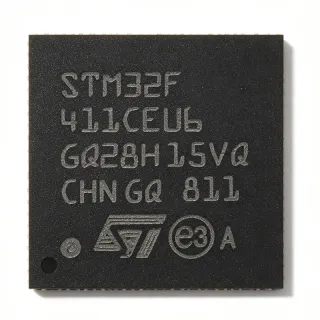
STM32WB30CEU6 - 2.4GHz Wireless MCU with BLE 5.0 | STMicroelectronics
MPN: STM32WB30CEU6 ✓ Active| Qty | Unit Price | Extended |
|---|---|---|
| 1 | $4.85 | $4.85 |
| 10 | $4.36 | $43.60 |
| 100 | $3.88 | $388.00 |
| 500 | $3.49 | $1,745.00 |
| 1,000 | $3.1 | $3,100.00 |
Drop-in alternatives for STM32WB30CEU6 — same package, pin-to-pin compatible. Different-package parts requiring PCB rework are excluded.
Quick Comparison Tool — Select alternative parts for side-by-side comparison:
STM32WB30CEU6A
✅ Drop-In📋 Reference alternative (not in catalog)
STM32WB30CEU5A
✅ Drop-In📋 Reference alternative (not in catalog)
STM32WB35CCU6
✅ Drop-In📋 Reference alternative (not in catalog)
STM32WB35CCU6A
✅ Drop-In📋 Reference alternative (not in catalog)
STM32WB55CCU6
✅ Drop-In📋 Reference alternative (not in catalog)
STM32WB30CEU6 Maximum Ratings & Electrical Characteristics
| Core | Arm Cortex-M4 + Cortex-M0+ |
| Max CPU Frequency | 64 MHz (M4), 32 MHz (M0+) |
| Flash Memory | 512 KB |
| SRAM | 96 KB |
| Wireless Protocols | Bluetooth Low Energy 5.0, IEEE 802.15.4 (Zigbee 3.0, Thread) |
| Radio Frequency | 2.4 GHz |
| RX Sensitivity | -96 dBm (BLE 1 Mbps), -100 dBm (802.15.4) |
| Output Power | Up to +4 dBm with 1 dB steps |
| Supply Voltage | 1.71 V to 3.6 V |
| Standby Current | 1.6 uA (with RTC) |
| ADC | 12-bit, multiple channels |
| Communication Interfaces | SPI, I2C, USART, LPUART |
| Cryptographic Acceleration | AES-256, TRNG |
| Package | UFQFPN-48 (7x7 mm) |
| Operating Temperature | -40C to +85C |
| RoHS Status | Compliant |
STM32WB30CEU6 Pin Configuration
| Pin 1 | VDD — Power supply |
| Pin 2 | VSS — Ground |
| Pin 3 | PA0 — GPIO / ADC input |
| Pin 4 | PA1 — GPIO / ADC input |
| Pin 5 | PA2 — GPIO / USART2_TX |
| Pin 6 | PA3 — GPIO / USART2_RX |
| Pin 7 | PA4 — GPIO / SPI1_NSS |
| Pin 8 | PA5 — GPIO / SPI1_SCK |
| Pin 9 | PA6 — GPIO / SPI1_MISO |
| Pin 10 | PA7 — GPIO / SPI1_MOSI |
| Pin 11 | PB0 — GPIO / ADC input |
| Pin 12 | PB1 — GPIO / ADC input |
| Pin 13 | PB2 — GPIO / BOOT1 |
| Pin 14 | PB10 — GPIO / I2C2_SCL |
| Pin 15 | PB11 — GPIO / I2C2_SDA |
| Pin 16 | PB12 — GPIO / SPI2_NSS |
| Pin 17 | PB13 — GPIO / SPI2_SCK |
| Pin 18 | PB14 — GPIO / SPI2_MISO |
| Pin 19 | PB15 — GPIO / SPI2_MOSI |
| Pin 20 | PC13 — GPIO / RTC_TAMP1 |
| Pin 21 | PC14 — GPIO / OSC32_IN |
| Pin 22 | PC15 — GPIO / OSC32_OUT |
| Pin 23 | PH0 — OSC_IN (32 MHz crystal) |
| Pin 24 | PH1 — OSC_OUT (32 MHz crystal) |
| Pin 25 | NRST — Reset (active low) |
| Pin 26 | VDDA — Analog power supply |
| Pin 27 | VSSA — Analog ground |
| Pin 28 | VREF+ — ADC reference voltage |
| Pin 29 | VREF- — ADC reference ground |
| Pin 30 | PA8 — GPIO / TIM1_CH1 |
| Pin 31 | PA9 — GPIO / USART1_TX |
| Pin 32 | PA10 — GPIO / USART1_RX |
| Pin 33 | PA11 — GPIO / USB_DM |
| Pin 34 | PA12 — GPIO / USB_DP |
| Pin 35 | PA13 — SWDIO |
| Pin 36 | PA14 — SWCLK |
| Pin 37 | PA15 — GPIO / JTDI |
| Pin 38 | PB3 — GPIO / JTDO |
| Pin 39 | PB4 — GPIO / NJTRST |
| Pin 40 | PB5 — GPIO / I2C1_SMBA |
| Pin 41 | PB6 — GPIO / I2C1_SCL |
| Pin 42 | PB7 — GPIO / I2C1_SDA |
| Pin 43 | PB8 — GPIO / I2C1_SCL |
| Pin 44 | PB9 — GPIO / I2C1_SDA |
| Pin 45 | VDD — Power supply |
| Pin 46 | VSS — Ground |
| Pin 47 | RF — RF input/output |
| Pin 48 | GND — Ground (exposed pad) |
Safe Operating Area (SOA) & Thermal Characteristics
No official SOA curve available for this digital IC. Always operate within absolute maximum ratings specified in the datasheet. Ensure adequate cooling and derate as needed.
Typical Applications
STM32WB30CEU6 is suitable for 6 applications: Smart Home Devices, Industrial Wireless Sensors, Healthcare Wearables, Asset Tracking, Smart Lighting, IoT Gateways.
Smart Home Devices
The STM32WB30CEU6 is ideal for smart home devices such as sensors, locks, and lighting due to its low power consumption and multiprotocol support (BLE, Zigbee, Thread). Its dual-core architecture allows the Cortex-M0+ to handle the wireless stack while the Cortex-M4 runs the application, ensuring responsive control. The device's 512 KB flash and 96 KB SRAM provide ample space for complex home automation logic and OTA updates. With standby current as low as 1.6 uA, battery-powered sensors can last years. The integrated AES-256 encryption ensures secure communication, critical for smart locks. The UFQFPN-48 package fits compact designs, and the wide supply voltage range (1.71V to 3.6V) accommodates various battery configurations. For a smart lock, the STM32WB30CEU6 can manage BLE for mobile app control and Zigbee for mesh networking, all while maintaining low power. Designers should ensure proper antenna layout for reliable range.
Recommended
Industrial Wireless Sensors
In industrial settings, the STM32WB30CEU6 provides reliable wireless connectivity for sensors monitoring temperature, vibration, or pressure. Its support for IEEE 802.15.4 (Zigbee and Thread) enables robust mesh networking, while the -100 dBm RX sensitivity ensures reliable communication in noisy environments. The device's low power modes allow battery-powered sensors to operate for extended periods. The dual-core architecture offloads the protocol stack to the Cortex-M0+, freeing the Cortex-M4 for sensor data processing and control algorithms. The 12-bit ADC can interface directly with analog sensors, and the SPI/I2C interfaces connect to digital sensors. The wide operating temperature range (-40C to +85C) suits industrial environments. The AES-256 accelerator secures data transmission, protecting sensitive industrial data. For a vibration sensor, the STM32WB30CEU6 can sample at high rates, process FFTs on the Cortex-M4, and transmit alerts via Zigbee, all while consuming minimal power.
Recommended
Healthcare Wearables
The STM32WB30CEU6 is well-suited for healthcare wearables like fitness trackers and heart rate monitors due to its ultra-low power consumption and BLE connectivity. The device can operate from a small coin cell battery, with standby current of 1.6 uA, extending battery life. The Cortex-M4 can run health monitoring algorithms, while the Cortex-M0+ handles BLE communication, ensuring efficient operation. The integrated AES-256 encryption secures patient data, complying with privacy regulations. The 12-bit ADC can interface with biosensors, and the LPUART can connect to external sensors. The compact UFQFPN-48 package fits into small wearable form factors. For a heart rate monitor, the STM32WB30CEU6 can process PPG signals, calculate heart rate, and transmit data to a smartphone via BLE 5.0, all while maintaining low power. Designers should optimize the RF layout for reliable BLE connectivity through the body.
Recommended
Asset Tracking
The STM32WB30CEU6 enables asset tracking devices that use BLE beacons or Zigbee mesh to locate and monitor assets. Its low power consumption allows battery-powered tags to operate for months or years. The device's BLE 5.0 support includes advertising extensions and long range, improving tracking accuracy. The dual-core architecture allows the Cortex-M0+ to handle beacon advertising while the Cortex-M4 processes sensor data (e.g., GPS, temperature). The 512 KB flash can store tracking logs, and the AES-256 accelerator secures location data. The wide supply voltage range supports various battery types. For a pallet tracker, the STM32WB30CEU6 can periodically broadcast its location via BLE, and when in range of a gateway, transmit detailed logs. The device's small package and low power make it ideal for embedding in assets. Designers should consider antenna placement for optimal signal propagation.
Recommended
Smart Lighting
The STM32WB30CEU6 is perfect for smart lighting systems, enabling BLE or Zigbee control of LED lights. Its multiprotocol support allows integration into existing smart home ecosystems. The device can control LED drivers via PWM timers, and its low power modes enable energy-efficient operation. The Cortex-M4 can run lighting effects and schedules, while the Cortex-M0+ handles wireless commands. The 12-bit ADC can monitor current for diagnostics. The AES-256 encryption ensures secure control. For a smart bulb, the STM32WB30CEU6 can receive commands via BLE from a smartphone app, adjust brightness and color, and report status. The compact package fits into bulb form factors. Designers should ensure proper thermal management for the LED driver and MCU.
Recommended
IoT Gateways
The STM32WB30CEU6 can serve as a low-power IoT gateway, bridging BLE devices to Wi-Fi or Ethernet via external modules. Its dual-core architecture allows the Cortex-M0+ to handle BLE and Zigbee concurrently, while the Cortex-M4 manages the gateway logic and communication with the cloud. The device's 512 KB flash and 96 KB SRAM support protocol translation and buffering. The AES-256 accelerator secures data in transit. For a home gateway, the STM32WB30CEU6 can collect data from BLE sensors and Zigbee devices, then forward it to a cloud service via a Wi-Fi module (e.g., ESP8266) over SPI or UART. The low power consumption allows the gateway to run on battery or energy harvesting. Designers should ensure adequate antenna isolation between the 2.4 GHz radio and external modules.
Recommended
Recommended Products Summary
Engineering reference data for STM32WB30CEU6 — comparison, design guidance, and compliance information.
Selection Guide
Comparison with Alternatives
| Parameter | This Product | STM32WB30CEU6A | STM32WB30CEU5A | STM32WB35CCU6 |
|---|---|---|---|---|
| Package | UFQFPN-48 (7x7 mm) | UFQFPN-48 (7x7 mm) - same | UFQFPN-48 (7x7 mm) - same | UFQFPN-48 (7x7 mm) - same |
| Brand | STMicroelectronics | STMicroelectronics | STMicroelectronics | STMicroelectronics |
| Core | Cortex-M4 + M0+ | Cortex-M4 + M0+ | Cortex-M4 + M0+ | Cortex-M4 + M0+ |
| Max CPU Frequency | 64 MHz (M4), 32 MHz (M0+) | 64 MHz (M4), 32 MHz (M0+) | 64 MHz (M4), 32 MHz (M0+) | 64 MHz (M4), 32 MHz (M0+) |
| Flash Memory | 512 KB | 512 KB | [DATA_NEEDED] | 1 MB |
| SRAM | 96 KB | 96 KB | [DATA_NEEDED] | 256 KB |
| Wireless Protocols | BLE 5.0, Zigbee 3.0, Thread | BLE 5.0, Zigbee 3.0, Thread | BLE 5.0, Zigbee 3.0, Thread | BLE 5.0, Zigbee 3.0, Thread |
| Supply Voltage | 1.71V to 3.6V | 1.71V to 3.6V | 1.71V to 3.6V | 1.71V to 3.6V |
| Standby Current | 1.6 uA (with RTC) | 1.6 uA (with RTC) | 1.6 uA (with RTC) | 1.6 uA (with RTC) |
Key Differentiators
- Dual-core architecture with dedicated Cortex-M0+ for radio stack (vs Single-core wireless MCUs like STM32WB15CCU6)
- Multiprotocol support (BLE 5.0, Zigbee 3.0, Thread) in a single device (vs BLE-only MCUs like nRF52832)
- Integrated balun reduces BOM cost (vs MCUs requiring external balun like CC2652R)
Design Notes
For the STM32WB30CEU6, pay careful attention to the RF layout. Use a 32 MHz crystal for the radio and a 32.768 kHz crystal for the RTC. Place the crystals close to the MCU pins (PH0/PH1 for 32 MHz, PC14/PC15 for 32.768 kHz) with proper load capacitors. Ensure a clean, continuous ground plane under the antenna and RF trace. The integrated balun reduces external components, but the antenna matching network must be tuned according to the datasheet recommendations. Keep the RF trace at 50 ohms impedance and minimize vias.
The STM32WB30CEU6 operates from 1.71V to 3.6V. Use a low-dropout regulator (LDO) or a DC-DC converter to provide a stable supply. Decouple each VDD pin with a 100 nF ceramic capacitor and a 4.7 uF bulk capacitor. For the VDDA pin, use a ferrite bead and a 1 uF capacitor to filter high-frequency noise. In low-power modes, ensure the supply voltage remains within the specified range to avoid brown-out resets. The standby current of 1.6 uA (with RTC) requires a low-leakage capacitor on the RTC supply.
The UFQFPN-48 package has an exposed pad that must be soldered to a thermal pad on the PCB for proper heat dissipation. Provide a thermal via array under the exposed pad to connect to the ground plane. The maximum junction temperature is 125C, and the power dissipation depends on the radio transmit power and CPU load. For continuous BLE transmission at +4 dBm, the current consumption is around 10 mA, resulting in about 36 mW at 3.6V. Ensure the PCB copper area is sufficient to keep the junction temperature below 125C in the operating environment.
Compliance Information
RoHS compliant per STMicroelectronics product page. Not AEC-Q100 qualified (not an automotive part). Lead-free per datasheet. Halogen-free status not specified in provided data.