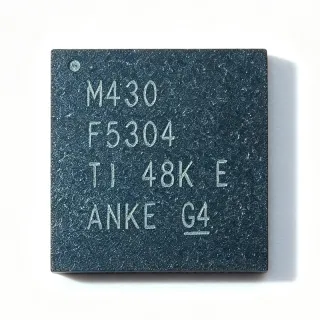
TMS320F28027PTT - 60MHz 32-bit C2000 Piccolo MCU 64KB Flash | TI
MPN: TMS320F28027PTT ✓ Active| Qty | Unit Price | Extended |
|---|---|---|
| 1 | $4.12 | $4.12 |
| 10 | $3.71 | $37.10 |
| 100 | $3.3 | $330.00 |
| 500 | $2.95 | $1,475.00 |
| 1,000 | $2.68 | $2,680.00 |
Drop-in alternatives for TMS320F28027PTT — same package, pin-to-pin compatible. Different-package parts requiring PCB rework are excluded.
Quick Comparison Tool — Select alternative parts for side-by-side comparison:
TMS320F28027FPTT
✅ Drop-In✓ In Stock
$1 / Unit
View Datasheet →TMS320F28027PTS
✅ Drop-In📋 Reference alternative (not in catalog)
TMS320F28026PTT
✅ Drop-In📋 Reference alternative (not in catalog)
TMS320F28022PTT
✅ Drop-In📋 Reference alternative (not in catalog)
TMS320F28027PTT Maximum Ratings & Electrical Characteristics
| Core Processor | C28x Piccolo (C2000) |
| Core Size | 32-Bit |
| Maximum Clock Frequency | 60 MHz |
| Flash Memory | 64KB (32K x 16) |
| SRAM | 12KB |
| Supply Voltage | 3.3 V (single-rail via internal regulator) |
| Package | 48-LQFP (7x7 mm) |
| Mounting Type | Surface Mount |
| Operating Temperature | -40C to +85C |
| Peripherals | ePWM, eCAP, eQEP, internal voltage regulator |
| ADC Resolution | 12-bit |
| Multiply-Accumulate | 32x32-bit MAC |
| MSL Level | 2 (260C, 1 year) |
| RoHS Status | Compliant |
| Code Compatibility | C28x code-compatible with previous C28x-based devices |
TMS320F28027PTT 48-lqfp (7x7 mm) Pin Configuration Guide
Complete pinout information for TMS320F28027PTT (48-lqfp (7x7 mm) package). This digital IC includes GPIO, communication interfaces (UART, SPI, I2C), and power pins. Refer to the manufacturer datasheet for alternate pin functions and configuration options. Essential for embedded system design and PCB layout.

No detailed pinout data available for TMS320F28027PTT.
Refer to the datasheet for full pin configuration.
Safe Operating Area (SOA) & Thermal Characteristics
No official SOA curve available for this digital IC. Always operate within absolute maximum ratings specified in the datasheet. Ensure adequate cooling and derate as needed.
Typical Applications
TMS320F28027PTT is suitable for 6 applications: Digital Motor Control, Solar Inverters and Power Factor Correction, Digital LED Lighting Power Supplies, Industrial Automation Control Nodes, Battery Chargers and DC-DC Conversion, Embedded Learning and C2000 Prototyping.
Digital Motor Control
The TMS320F28027PTT fits BLDC, PMSM, and ACIM motor drives because its 60 MHz C28x core with 32x32-bit MAC executes field-oriented control (FOC) loops at tens of kHz while multiple ePWM modules generate complementary six-step or SVM waveforms with hardware dead-band. The 12-bit ADC samples phase currents and bus voltage for closed-loop current control, and eQEP decodes incremental encoder feedback. In a typical topology the MCU drives a three-phase gate-driver stage from 3.3V logic, with the single-rail internal regulator simplifying the power tree. For sensorless designs, the InstaSPIN-enabled TMS320F28027FPTT adds motor auto-detection ROM on the identical footprint.
Recommended
Solar Inverters and Power Factor Correction
The TMS320F28027PTT suits solar micro-inverter and PFC front-end control where deterministic interrupt latency and fast control loops matter more than general-purpose throughput. Its ePWM modules implement phase-shifted or interleaved PWM stages, the 12-bit ADC samples input/output voltage and inductor current for MPPT and current-shaping loops, and eCAP captures grid frequency events. Running at 60 MHz, the C28x core closes MPPT and current loops in software without a separate controller. The single 3.3V rail from the internal regulator eases isolated-supply design. For grid-tie designs requiring larger memory or CLA accelerators, the TMS320F28034QPNTQ1 offers an upgrade path within the same C2000 architecture.
Recommended
Digital LED Lighting Power Supplies
In digital LED drivers, the TMS320F28027PTT provides constant-current and dimming control with the precision of a DSP-class core: ePWM outputs drive buck or boost LED stages with programmable resolution and shadow registers for flicker-free dimming, while the 12-bit ADC closes the current loop directly from the current-sense shunt. The 64KB flash stores multi-string sequencing and communication stacks, and the 3.3V single-rail operation with internal regulator reduces BOM count in compact lamp geometries. Control loops at tens of kHz achieve better dynamic response than analog-only drivers, supporting 0-10V, PWM, and DALI-style dimming interfaces on SCI/GPIO pins.
Recommended
Industrial Automation Control Nodes
As a control node in factory automation, the TMS320F28027PTT combines real-time closed-loop capability with serial connectivity: SCI (UART), SPI, and I2C peripherals link to sensors, HMIs, and field-bus transceivers, while eQEP interfaces rotary encoders for position feedback and eCAP measures pulse-train inputs. The 60 MHz C28x core processes PID loops with deterministic timing at rates unattainable by general-purpose MCUs in this price class. The 64KB flash accommodates protocol stacks and calibration tables, and the -40C to +85C operating range suits cabinet and floor-level environments. C2000Ware driver libraries shorten software bring-up on custom carrier boards.
Recommended
Battery Chargers and DC-DC Conversion
The TMS320F28027PTT governs digitally controlled battery chargers and DC-DC converters where adaptive charging profiles and telemetry are required. ePWM with cycle-by-cycle current limiting protects the power stage, the 12-bit ADC monitors cell voltage, current, and temperature for CC/CV/profiled charging algorithms, and software-defined control laws can be field-updated via the on-chip flash - a key advantage over fixed analog controllers. The Harvard-bus C28x core maintains stable switching frequencies into the hundreds of kHz, and the internal voltage regulator lets the controller share the 3.3V auxiliary rail. SCI/SPI ports provide charger-to-host telemetry for fleet management systems.
Recommended
Embedded Learning and C2000 Prototyping
The TMS320F28027PTT is the MCU mounted on TI's LAUNCHXL-F28027 LaunchPad, making it the canonical entry point for learning C2000 real-time control. Engineers and students can prototype motor-control, power-conversion, and digital-control algorithms using C2000Ware, Code Composer Studio, and the free controlSUITE libraries, then migrate designs directly to the identical 48-LQFP device on production PCBs - the same silicon on the LaunchPad removes porting risk. The 64KB flash is ample for teaching examples, and JTAG debugging via the onboard XDS100 emulator provides full breakpoint and memory visibility during algorithm development.
Recommended
Recommended Products Summary
Engineering reference data for TMS320F28027PTT — comparison, design guidance, and compliance information.
Selection Guide
Comparison with Alternatives
| Parameter | This Product | TMS320F28027FPTT | TMS320F28027PTS | TMS320F28026PTT | TMS320F28022PTT |
|---|---|---|---|---|---|
| Package | 48-LQFP (7x7 mm) | 48-LQFP (7x7 mm) - same | 48-LQFP (7x7 mm) - same | 48-LQFP (7x7 mm) - same | 48-LQFP (7x7 mm) - same |
| Brand | Texas Instruments | Texas Instruments | Texas Instruments | Texas Instruments | Texas Instruments |
| Core / Clock | C28x 32-bit, 60 MHz | C28x 32-bit, 60 MHz | C28x 32-bit, 60 MHz | C28x 32-bit, 60 MHz | C28x 32-bit, 60 MHz |
| Flash Memory | 64KB (32K x 16) | 64KB (32K x 16) | 64KB (32K x 16) | 32KB | 64KB |
| SRAM | 12KB | 12KB | 12KB | 6KB | 12KB |
| Special ROM Contents | Standard boot ROM | InstaSPIN motor firmware ROM | Standard boot ROM (no InstaSPIN) | Standard boot ROM | Standard boot ROM |
| Pin Compatibility | Reference (48-LQFP) | Pin-to-pin identical | Pin-to-pin identical | Pin-to-pin identical | Pin-to-pin identical |
| Supply Voltage | 3.3 V (internal regulator) | 3.3 V (internal regulator) | 3.3 V (internal regulator) | 3.3 V (internal regulator) | 3.3 V (internal regulator) |
Key Differentiators
- Lowest-cost entry into the C2000 real-time control ecosystem (vs TMS320F28035PNT)
- Largest memory in its pin-compatible subfamily (vs TMS320F28026PTT)
- Single-rail operation via integrated voltage regulator (vs TMS320F28335PTPQ)
Design Notes
The F2802x integrates a core voltage regulator enabled via the VREGENZ pin, allowing single-rail 3.3V operation. When the internal regulator is enabled, it supplies the 1.x V core from VDDIO - do not also drive VDD externally, or contention results. If you bypass the regulator (VREGENZ pulled to disable), supply the core rail externally and observe the power-up sequencing specified in the datasheet. Place 0.1uF decoupling capacitors at every VDDIO/VDD pin pair and one bulk 10uF per supply domain.
Use the 48-LQFP (7x7 mm) land pattern per IPC guidelines with the standard 0.5 mm pitch footprint. Keep the 12-bit ADC analog input traces short and away from ePWM switching nets; add an RC anti-alias filter on current-sense channels. Ground the ADC reference properly and dedicate an analog ground region connected to the digital ground at a single point. Reserve JTAG header access (TRST, TDI, TMS, TDO, TCK) in production boards for in-system flash programming with an XDS100 emulator.
The TMS320F28027PTT has 64KB flash versus 32KB on the TMS320F28026PTT - verify code size before substituting the smaller variant as a cost reduction. The F-suffix F28027FPTT differs only in InstaSPIN ROM contents; do not assume the standard part runs InstaSPIN motor examples. All GPIO are 3.3V only and are not 5V tolerant, so level-shift any 5V logic interfaces. Also confirm MSL 2 handling: floor-life after opening the moisture-barrier bag is 1 year before reflow.
At 60 MHz the C28x core's external clock net is modest, but ePWM edges driving gate drivers carry fast edges that can couple into the 12-bit ADC. Route PWM traces with series termination near the MCU if traces exceed a few centimeters, and separate the analog ADC input channel routing on an inner layer with ground guard traces. Use XCLKIN with a clean oscillator source rather than an RC network when ADC accuracy matters.
Compliance Information
RoHS compliant and MSL 2 (260C, 1 year) per PartGenie compliance data. REACH, halogen-free, and conflict-minerals status not stated in available data - confirm on TI's product page.