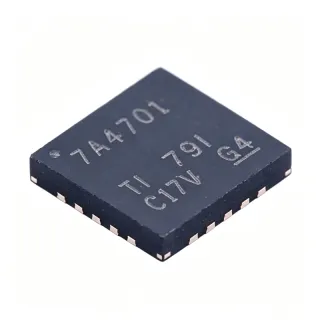
TPS566231 - 6A 18V Sync D-CAP3 Buck Regulator | TI
MPN: TPS566231 ✓ Active| Qty | Unit Price | Extended |
|---|---|---|
| 1 | $1.85 | $1.85 |
| 10 | $1.66 | $16.60 |
| 100 | $1.35 | $135.00 |
| 500 | $1.12 | $560.00 |
| 1,000 | $0.95 | $950.00 |
Drop-in alternatives for TPS566231 — same package, pin-to-pin compatible. Different-package parts requiring PCB rework are excluded.
Quick Comparison Tool — Select alternative parts for side-by-side comparison:
TPS566238RQFR
✅ Drop-In📋 Reference alternative (not in catalog)
TPS566231PRQFR
✅ Drop-In📋 Reference alternative (not in catalog)
TPS566238PRQFR
✅ Drop-In ⚠️ 参数待验证📋 Reference alternative (not in catalog)
TPS566231 Maximum Ratings & Electrical Characteristics
| Topology | Synchronous Step-Down (Buck) |
| Input Voltage Range | 3 V to 18 V |
| Maximum Output Current | 6 A |
| Output Voltage | Adjustable, 0.6 V reference |
| Number of Outputs | 1 |
| Control Architecture | D-CAP3 |
| Light Load Mode | Pulse Skip Mode |
| Maximum Duty Cycle | 98% |
| Soft Start | Adjustable via SS pin |
| Power Good Indicator | No (PG on TPS566231P variant) |
| Protection Features | OVP, OCP, UVLO, OTP, UVP with hiccup |
| Package | 9-PowerVFQFN (RQF) |
| Mounting Type | Surface Mount |
| FETs | Integrated high-side and low-side MOSFETs |
TPS566231 Pin Configuration
| Pin 1 | EN — Enable input, logic level |
| Pin 2 | SS — Soft-start programming pin |
| Pin 3 | VIN — Input supply, 3V to 18V |
| Pin 4 | SW — Switch node, connect to inductor |
| Pin 5 | PGND — Power ground |
| Pin 6 | VBST — Bootstrap for high-side gate driver |
| Pin 7 | FB — Feedback input, 0.6V reference |
| Pin 8 | AGND — Analog ground |
| Pin 9 | VREG5 — Internal 5V LDO output / decoupling |
Safe Operating Area (SOA) & Thermal Characteristics
No official SOA curve available for this component. Always operate within absolute maximum ratings specified in the datasheet. Ensure adequate cooling and derate as needed.
Typical Applications
TPS566231 is suitable for 6 applications: Networking Equipment POL Power, Server and Storage Power, Industrial Automation, FPGA and ASIC Power, Battery-Powered and Low-Bias Systems, Evaluation and Reference Design.
Networking Equipment POL Power
The TPS566231 fits switch, router, and access-point point-of-load rails where a 12V intermediate bus must step down to 5V or lower at up to 6A. Its 3V-to-18V input tolerates 12V bus variation, and D-CAP3 control delivers fast transient response to sudden traffic-driven load steps without external compensation. Pulse skip mode keeps light-load efficiency high for standby ports. Peak efficiency exceeds 90% in typical 12V-to-5V conversions per TI datasheet curves, minimizing thermal load in sealed enclosures.
Recommended
Server and Storage Power
In servers and SSD/NAS storage, the TPS566231 powers auxiliary and peripheral rails from 12V backplanes. Full protection (OVP, OCP, UVLO, OTP, UVP-hiccup) suits environments with hot-plug faults, while the 9-pin PowerVFQFN saves board space near drive bays. Use the TPS566231P variant where a PG signal sequences rails for processors or ASICs. Adjustable SS soft-start limits inrush when multiple converters start from a shared bulk capacitor bank.
Recommended
Industrial Automation
Factory systems commonly distribute 24V that is pre-regulated to 12V; the TPS566231 then efficiently creates 5V, 3.3V, or lower rails for sensors, controllers, and communication modules. Its wide 3V-to-18V input absorbs bus sag, the hiccup-mode UVP survives persistent short circuits on actuator harnesses, and OTP protects against enclosure overheating. ULQ ultra-low quiescent current benefits always-on monitoring nodes powered through limited bias supplies.
Recommended
FPGA and ASIC Power
FPGA and ASIC I/O and auxiliary banks often need 5A-to-6A at 1.0V-to-2.5V from a 12V rail. The TPS566231 adjustable output (0.6V reference) covers these levels, and D-CAP3 fast transient response handles the sharp load transients typical of switching logic fabric. Pairing with the TPS566231P variant provides PG flagging so upsteam supervisors can sequence core rails before I/O, protecting multi-rail devices.
Recommended
Battery-Powered and Low-Bias Systems
With 3V minimum input, the TPS566231 accepts 4S lithium-ion packs (12V-16.8V) or regulated battery buses, and ULQ ultra-low quiescent current minimizes standby drain. Pulse skip mode preserves efficiency at light standby loads common in battery-backed industrial devices and portable test instruments. The adjustable SS pin limits inrush from battery protection circuitry at power-up, and integrated FETs remove the cost and area of external power stages.
Recommended
Evaluation and Reference Design
TI offers the TPS566231EVM evaluation board (a D-CAP3 non-isolated step-down design) to accelerate prototypes. Engineers can validate efficiency, transient response, and loop behavior against datasheet curves before committing a layout. The EVM demonstrates recommended inductor, capacitor, and feedback component values for 12V-input operation, providing a proven starting point for 6A POL rails in networking, server, and industrial products.
Recommended
Recommended Products Summary
Engineering reference data for TPS566231 — comparison, design guidance, and compliance information.
Selection Guide
Comparison with Alternatives
| Parameter | This Product | TPS566238RQFR | TPS566231PRQFR | TPS566238PRQFR |
|---|---|---|---|---|
| Package | 9-PowerVFQFN (RQF) | 9-PowerVFQFN (RQF) - same | 9-PowerVFQFN (RQF) - same | 9-PowerVFQFN (RQF) - same |
| Brand | Texas Instruments | Texas Instruments | Texas Instruments | Texas Instruments |
| Input Voltage Range | 3 V to 18 V | 3 V to 18 V | 3 V to 18 V | 3 V to 18 V |
| Output Current | 6 A | 6 A | 6 A | 6 A |
| Control Topology | D-CAP3, pulse skip | D-CAP3, pulse skip | D-CAP3, pulse skip | D-CAP3, pulse skip |
| Power Good (PG) Pin | No | No | Yes | Yes |
| Soft Start | Adjustable via SS pin | Adjustable via SS pin | Adjustable via SS pin | Adjustable via SS pin |
| Protection | OVP, OCP, UVLO, OTP, UVP hiccup | OVP, OCP, UVLO, OTP, UVP hiccup | OVP, OCP, UVLO, OTP, UVP hiccup | OVP, OCP, UVLO, OTP, UVP hiccup |
| Evaluation Module | TPS566231EVM | [DATA_NEEDED] | TPS566231EVM (same die) | [DATA_NEEDED] |
Key Differentiators
- ULQ ultra-low quiescent current with pulse skip (vs TPS566238RQFR)
- 98% maximum duty cycle (vs TPS54302QDDCRQ1 (4A class))
- D-CAP3 control with no external compensation (vs TPS53624 (controller + external FETs))
Design Notes
Keep the SW node, input capacitor loop, and bootstrap capacitor loop as small as possible: place the input ceramic capacitor(s) within 2-3 mm of VIN and PGND, and the bootstrap cap directly across VBST and SW. Use solid PGND pour on layers 2-3 tied to the PowerVFQFN thermal pad with multiple vias; the integrated 6A FETs dump all switching losses into this pad, so copper area directly sets junction temperature.
For 12V-to-5V at 6A, verify inductor saturation rating above the OCP current threshold and choose output capacitance for the load transient targets; D-CAP3 uses the output ripple for regulation, so avoid excessive low-ESR-only capacitance stacking that starves the FB ripple. A mix of a small ESR capacitor and ceramics (per EVM BOM in TI datasheet SLUSB document set) preserves stability and fast transient response.
Do not exceed 18V input including transients - bulk bus ringing above VIN abs max destroys the integrated FETs. Reserve the base TPS566231 for single-rail designs; if multi-rail sequencing or supervisor handshaking is required, select TPS566231P (PG pin) before layout since the function is die-configured, not added externally. Set SS capacitor per inrush limits of upstream bulk caps.
Compliance Information
RoHS and lead-free per TI product page ordering data. Verify AEC-Q100 status on TI.com quality pages - not indicated in provided data.