Microcontrollers
Products (319)
STM8AF6246TCY - Automotive 8-bit MCU, 32KB Flash | STMicroelectronics
The STM8AF6246TCY is an automotive-grade 8-bit microcontroller from STMicroelectronics, featuring a high-performance STM8A core with Harvard architecture and a 3-stage pipeline. Operating at a maximum CPU frequency of 16 MHz, it delivers up to 10 MIPS for industry-standard benchmarks, making it suitable for real-time automotive control applications. The device integrates 32 Kbytes of Flash program memory and true data EEPROM, along with a 10-bit ADC, multiple timers, and communication interfaces including LIN, SPI, and I2C. An 8-bit microcontroller (MCU) is a single-chip computer with an 8-bit data bus, designed for embedded control tasks. It integrates a processor core, memory (Flash, RAM, EEPROM), and peripherals (timers, ADC, communication interfaces) on a single die. In the system hierarchy, an 8-bit MCU sits below 16-bit and 32-bit MCUs in processing power but offers cost-effectiveness, low power consumption, and ease of use for dedicated control functions. The STM8A core is specifically optimized for automotive applications, balancing performance with deterministic real-time behavior. Key features of the STM8AF6246TCY include AEC-Q10x qualification for automotive reliability, a wide supply voltage range of 3V to 5.5V, and an operating temperature range of -40°C to 125°C. The device provides 25 I/O ports, 2048 bytes of RAM, and 7 ADC channels in the LQFP-32 package. The integrated true data EEPROM allows for non-volatile data storage without external components, simplifying system design and reducing BOM cost. The STM8A core's Harvard architecture enables simultaneous instruction and data access, improving throughput compared to Von Neumann designs. The 3-stage pipeline further enhances execution efficiency, achieving an average of 1.6 cycles per instruction. This architectural efficiency, combined with the 16 MHz clock, delivers 10 MIPS performance, sufficient for closed-loop control algorithms, sensor processing, and communication protocol handling in automotive systems. Typical applications include body control modules, automotive lighting control, window lift and mirror control, and sensor interfaces. The LIN interface makes it ideal for low-cost automotive sub-networks, while the 10-bit ADC enables direct connection to analog sensors such as temperature and position sensors. The wide operating temperature range and AEC-Q10x qualification ensure reliable operation in harsh automotive environments. When designing with this MCU, consider the power supply decoupling: place a 100nF ceramic capacitor close to each VDD pin and a 4.7uF bulk capacitor near the power input. The STM8A core requires a stable clock source; use the internal RC oscillator for cost-sensitive designs or an external crystal for precision timing applications. Proper layout of the ADC input pins is critical to minimize noise and maintain conversion accuracy.

STM8AF6266TCY - 8-bit Automotive MCU, 32KB Flash, LQFP-32 | STMicroelectronics
The STMicroelectronics STM8AF6266TCY is an 8-bit automotive-grade microcontroller based on the STM8A core, operating at up to 16 MHz. It features 32 KB of Flash program memory, 2 KB of RAM, and 1 KB of EEPROM, all in a 32-pin LQFP package. This device is designed for body electronics, motor control, and sensor applications in automotive environments, with an extended temperature range of -40°C to +150°C and AEC-Q100 qualification. An 8-bit microcontroller (MCU) is a single-chip computer with an 8-bit central processing unit (CPU), memory, and peripherals integrated onto one integrated circuit. It is a type of embedded controller that executes instructions sequentially, processing data in 8-bit chunks. In the system hierarchy, an 8-bit MCU is a subset of microcontrollers, which are a type of embedded processor, which in turn falls under the broader category of integrated circuits (ICs) used in electronic systems. The STM8A core is an enhanced 8-bit architecture with a three-stage pipeline, delivering up to 16 MIPS at 16 MHz, making it suitable for real-time control tasks. Key features include a 16 MHz maximum CPU frequency, 32 KB Flash with read-while-write capability, 2 KB SRAM, and 1 KB true data EEPROM with up to 300k write/erase cycles. The device integrates a 10-bit ADC with up to 10 channels, two 16-bit timers, one 8-bit timer, a UART, SPI, and I2C interfaces. It also includes a CAN 2.0B controller, making it ideal for automotive networking. The LQFP-32 package offers a compact footprint with 25 general-purpose I/O pins, and the device operates from a 2.95V to 5.5V supply voltage. Technically, the STM8AF6266TCY uses a Harvard architecture with separate program and data buses, allowing simultaneous instruction fetch and data access. The embedded EEPROM supports byte-level programming and erasing, which is critical for storing calibration data and fault codes in automotive applications. The device also features a robust clock system with an internal 16 MHz RC oscillator, an external crystal oscillator, and a phase-locked loop (PLL) for clock multiplication. The CAN controller supports both 2.0A and 2.0B protocols, with message filtering and a 3-message mailbox. Typical applications include automotive body control modules (BCM), window lift and mirror control, HVAC control, and sensor interfaces. The CAN interface enables communication with the vehicle's main network, while the high-temperature rating and AEC-Q100 qualification ensure reliability in harsh under-hood environments. The low-power modes (Wait, Active-Halt, Halt) help reduce current consumption in battery-powered or always-on systems. When designing with this MCU, ensure proper decoupling of the VDD and VDDA pins with 100 nF capacitors placed close to the device. The VCAP pin requires a 470 nF capacitor for internal regulator stability. For CAN communication, a CAN transceiver such as the TJA1050 is needed to interface with the physical bus. The device supports in-application programming (IAP) via the UART or CAN, enabling firmware updates in the field.
STM8AF6286TCY - 8-bit Automotive MCU, 64KB Flash, 24MHz | STMicroelectronics
The STM8AF6286TCY is an 8-bit automotive-grade microcontroller from STMicroelectronics, featuring a high-performance STM8 core running at up to 24 MHz. It integrates 64 KB of Flash memory, 6 KB of RAM, and 2 KB of EEPROM, making it suitable for a wide range of automotive body and safety applications. The device is offered in a 32-pin LQFP package, providing a compact footprint for space-constrained designs. An 8-bit microcontroller (MCU) is a single-chip computer with an 8-bit data bus, typically used for embedded control applications. It integrates a processor core, memory, and peripherals on one chip, enabling cost-effective and efficient control of electronic systems. In the automotive domain, 8-bit MCUs are widely used for body control modules, lighting control, and sensor interfacing, where moderate processing power and low power consumption are essential. Key features of the STM8AF6286TCY include a 24 MHz CPU clock, 64 KB of Flash memory with read-while-write capability, 6 KB of RAM, and 2 KB of true data EEPROM with up to 300k write/erase cycles. It also offers a rich set of peripherals: two UARTs, one SPI, one I2C, a 10-bit ADC with up to 10 channels, and multiple 16-bit timers. The device operates over a supply voltage range of 3.0V to 5.5V and is specified for the automotive temperature range of -40°C to +150°C, meeting AEC-Q100 Grade 0 requirements. The STM8 core is based on a Harvard architecture with a 3-stage pipeline, achieving up to 20 MIPS at 24 MHz. It includes an extended instruction set with hardware multiply and divide, and supports a wide range of addressing modes. The Flash memory is organized with error correction code (ECC) for enhanced reliability, and the EEPROM is designed for high endurance, making it ideal for storing calibration data and fault codes in automotive systems. Typical applications include automotive body control modules (BCM), lighting control (LED and HID), seat control, window lift, and sensor interfaces. The device's robust ESD protection and wide operating temperature range make it well-suited for harsh automotive environments. Additionally, its low power modes (Active-Halt, Halt) help reduce battery drain in always-on systems. When designing with the STM8AF6286TCY, ensure proper decoupling of the VDD and VDDA pins with 100nF capacitors placed close to the pins. The device supports in-application programming (IAP) via the bootloader, allowing firmware updates in the field. For EMI-sensitive applications, use the internal clock divider and enable the clock security system to monitor the external crystal.
STM8AF6366 - Automotive 8-bit MCU, 32KB Flash, 16MHz | STMicroelectronics
The STM8AF6366 is an automotive-grade 8-bit microcontroller from STMicroelectronics, featuring an advanced STM8A core with Harvard architecture and a 3-stage pipeline. It operates at a maximum CPU frequency of 16 MHz, delivering up to 10 MIPS for industry-standard benchmarks. The device offers from 16 to 32 Kbyte of Flash program memory and integrated true data EEPROM, making it suitable for a wide range of automotive body electronics, lighting, and motor control applications. It is available in a 32-pin LQFP (7x7 mm) package, which is compact and suitable for space-constrained PCB designs. An 8-bit microcontroller (MCU) is a single-chip computer with an 8-bit central processing unit (CPU), memory, and programmable input/output peripherals. It is a type of embedded processor designed for control-oriented applications, often used in automotive, industrial, and consumer electronics. The STM8A family is part of the broader STM8 series, which is known for its cost-effectiveness, robustness, and ease of use. The STM8AF6366 sits in the medium-density segment of the STM8A product line, providing a balance of memory, performance, and peripheral integration for automotive systems. Key features of the STM8AF6366 include a 10-bit analog-to-digital converter (ADC) with up to 16 multiplexed channels, multiple communication interfaces (UART, SPI, I2C), and a variety of timers including a 16-bit advanced control timer for PWM generation. The device is AEC-Q10x qualified, ensuring reliability for automotive environments. It also features low-power modes, an integrated watchdog timer, and a clock security system for enhanced system robustness. From a technical perspective, the STM8A core is based on a Harvard architecture with separate instruction and data buses, enabling efficient execution. The 3-stage pipeline allows for an average of 1.6 cycles per instruction, resulting in high performance at a modest clock frequency. The integrated true data EEPROM provides non-volatile storage for calibration data or parameters, which is critical in automotive applications where data retention is essential. The device operates over a supply voltage range of 3.0V to 5.5V, making it compatible with standard automotive power rails. Typical applications include automotive body control modules, lighting control (e.g., LED and HID), motor control for fans and pumps, and sensor interfaces. The STM8AF6366 is also used in aftermarket automotive electronics and industrial control systems where its automotive qualification and robust feature set are advantageous. Its wide operating temperature range (-40°C to +150°C) ensures reliable operation in harsh environments. When designing with the STM8AF6366, it is important to consider proper decoupling of the power supply pins and careful layout of the crystal oscillator circuit to minimize noise and ensure stable clock operation. The device's low-power modes should be utilized to meet energy efficiency requirements in battery-powered or energy-conscious applications.
STM8AF6388 - 8-bit Automotive MCU, 64KB Flash | STMicroelectronics
The STMicroelectronics STM8AF6388 is an 8-bit automotive-grade microcontroller based on the STM8A core, offering up to 64KB of Flash memory and 6KB of RAM in a 48-pin LQFP package. It operates over a supply voltage range of 3.0V to 5.5V and is designed for harsh automotive environments with an extended temperature range of -40°C to +150°C. An 8-bit microcontroller (MCU) is a single-chip computer with an 8-bit central processing unit (CPU), memory, and programmable input/output peripherals. It is a subset of the broader microcontroller family, which falls under embedded systems and integrated circuits. The STM8A core is an enhanced 8-bit architecture with a three-stage pipeline, delivering up to 16 MIPS at 24 MHz, making it suitable for real-time control applications. Key features include 64KB of Flash memory with read-while-write capability, 6KB of SRAM, and 2KB of EEPROM with true data EEPROM. It integrates a 10-bit ADC with up to 16 channels, two 16-bit timers, one 8-bit timer, and a CAN 2.0B controller for automotive networking. The device also includes an SPI, I2C, and two UARTs for communication, along with a LIN interface for local interconnect networking. The STM8AF6388 is built on a high-density Flash technology, providing robust data retention and endurance. The automotive qualification (AEC-Q100) ensures reliability under extreme temperature and vibration conditions. The CAN controller supports both standard and extended frame formats, enabling seamless integration into vehicle networks. Typical applications include body control modules, automotive lighting control, sensor interfaces, and power window control. The device's low power consumption and wide voltage range make it ideal for battery-powered automotive systems. Its robust communication interfaces allow it to serve as a central node in distributed automotive networks. When designing with this MCU, ensure proper decoupling of the power supply pins and use the internal RC oscillator for cost-sensitive designs, or an external crystal for higher accuracy. The CAN bus requires proper termination resistors and common-mode chokes for EMC compliance.
STM8AL3146TAY - 8-bit Ultra-Low-Power MCU, 16KB Flash | STMicroelectronics
The STM8AL3146TAY is an 8-bit ultra-low-power microcontroller from STMicroelectronics, featuring an STM8A core running at up to 16 MHz. It integrates 16 KB of Flash memory, 2 KB of RAM, and 1 KB of EEPROM, making it suitable for battery-powered and energy-harvesting applications. The device operates from a 1.8V to 3.6V supply and is available in a 32-pin LQFP (7x7) package. An 8-bit microcontroller (MCU) is a single-chip computer with an 8-bit central processing unit (CPU), memory, and programmable input/output peripherals. It is a type of embedded processor used to control electronic systems, forming the core of many smart devices. In the hierarchy of computing devices, an 8-bit MCU is a subset of microcontrollers, which are a subset of embedded systems, which are a subset of electronic systems. The STM8AL3146TAY belongs to the STM8A family, which is designed for automotive and industrial applications requiring low power consumption and high reliability. Key features include multiple low-power modes (Wait, Active-Halt, Halt) with current consumption as low as 0.6 µA in Halt mode, a 12-bit ADC with up to 16 channels, two comparators, and a real-time clock (RTC). It also integrates a variety of communication interfaces: SPI, I2C, and UART, enabling flexible connectivity. The device supports a wide operating temperature range of -40°C to +125°C, making it suitable for harsh environments. The STM8AL3146TAY is built on a low-power 8-bit core with a Harvard architecture, featuring an extended instruction set and a single-wire debug interface (SWIM). It includes a 16-bit timer, a 16-bit low-power timer, and a watchdog timer for robust operation. The EEPROM allows data storage without external components, and the Flash memory supports in-application programming (IAP) for firmware updates. Typical applications include automotive body electronics (e.g., window lift, lighting control), industrial sensors, smart meters, and portable medical devices. Its ultra-low-power consumption extends battery life in remote monitoring systems, while the wide temperature range ensures reliable operation in automotive under-hood environments. When designing with this MCU, pay attention to the power supply decoupling: place a 100 nF capacitor close to each VDD pin and a 1 µF capacitor at the main supply. Use the low-power modes effectively to minimize average current consumption, and ensure the SWIM debug interface is accessible for programming and debugging.
STM8AL3166TAY - 8-bit Ultra-Low-Power MCU, 32KB Flash | STMicroelectronics
The STM8AL3166TAY is an 8-bit ultra-low-power microcontroller from STMicroelectronics, based on the STM8A core. It operates at a maximum frequency of 16 MHz and features 32 KB of Flash memory, 2 KB of RAM, and 1 KB of EEPROM. The device is housed in a 32-pin LQFP package (7x7 mm) and is designed for automotive and industrial applications requiring low power consumption and high reliability. An 8-bit microcontroller (MCU) is a single-chip computer with an 8-bit central processing unit (CPU), memory, and programmable input/output peripherals. It is a subset of the broader microcontroller family, which falls under embedded systems and integrated circuits. The STM8A core is an enhanced 8-bit architecture that provides efficient code density and low power operation, making it suitable for battery-powered and energy-harvesting applications. Key features of the STM8AL3166TAY include multiple low-power modes (Wait, Active-Halt, Halt) with typical current consumption as low as 0.6 µA in Halt mode, a 12-bit ADC with up to 16 channels, two comparators, and a real-time clock (RTC). It also integrates a variety of communication interfaces including SPI, I2C, and UART, along with a 16-bit timer and a 12-bit timer for precise timing control. The STM8AL3166TAY is built on a low-power process technology that enables a wide operating voltage range of 1.8V to 3.6V, with an extended temperature range of -40°C to +125°C for automotive-grade reliability. The device includes a brown-out reset (BOR) and a programmable voltage detector (PVD) for robust power management. Its EEPROM with write protection and read-out protection enhances data security in critical applications. Typical applications include automotive body control modules, battery management systems, industrial sensors, and portable medical devices. The ultra-low-power modes and rich analog peripherals make it ideal for applications that require long battery life and precise analog signal processing. When designing with this MCU, careful attention should be paid to decoupling the power supply with a 100nF capacitor close to each VDD pin and a 4.7µF bulk capacitor. The RTC requires a 32.768 kHz crystal for accurate timekeeping, and the ADC reference voltage should be filtered to minimize noise. Proper layout of the crystal and analog ground planes is essential for reliable operation.
STM8AL3188TCY - 8-bit Ultra-Low-Power MCU 64KB Flash | STMicroelectronics
The STM8AL3188TCY is an 8-bit ultra-low-power microcontroller from STMicroelectronics, part of the STM8AL series designed for battery-powered and energy-harvesting applications. It features a 16 MHz STM8 core with 64 KB of Flash memory, 4 KB of RAM, and 2 KB of EEPROM, packaged in a 48-pin LQFP (TCY) package. The device operates over a supply voltage range of 1.8V to 3.6V and is optimized for low power consumption with multiple low-power modes including Halt, Active-Halt, and Wait modes. An 8-bit microcontroller (MCU) is a single-chip computer containing a processor core, memory, and programmable input/output peripherals. The STM8AL3188TCY belongs to the STM8 family, which is a line of 8-bit MCUs known for their cost-effectiveness and low power consumption. In the hierarchy of embedded systems, an MCU is a type of integrated circuit that serves as the brain of a device, executing firmware to control sensors, actuators, and communication interfaces. The STM8AL series specifically targets applications requiring long battery life, such as portable medical devices, smart meters, and wireless sensor nodes. Key features of the STM8AL3188TCY include an ultra-low-power RTC with automatic wake-up, a 12-bit ADC with up to 25 channels, two comparators, and multiple communication interfaces (SPI, I2C, UART). It also integrates a low-power LCD driver supporting up to 8x40 segments, making it suitable for display-equipped portable devices. The MCU operates at up to 16 MHz, providing a balance between processing power and energy efficiency. Technically, the STM8AL3188TCY is built on a high-density Flash process, offering 64 KB of program memory and 2 KB of true EEPROM for data storage. The core is an 8-bit CISC architecture with a 3-stage pipeline, achieving 16 MIPS at 16 MHz. The device includes a flexible clock management system with internal and external oscillators, and a low-power mode that reduces current consumption to as low as 0.35 µA in Halt mode with RTC running. This makes it ideal for applications where power efficiency is critical. Typical applications include smart meters (gas, water, and electricity), portable medical devices like glucose meters and pulse oximeters, wireless sensor networks, and industrial monitoring systems. The ultra-low-power RTC and LCD driver make it particularly suitable for battery-powered devices that require timekeeping and display functionality. When designing with this MCU, careful attention should be paid to the power supply decoupling and the selection of low-power modes to maximize battery life. The device supports a wide operating temperature range of -40°C to +85°C, ensuring reliability in harsh environments.
STM8AL3L46TCY - 8-Bit 16MHz Automotive MCU, 16KB Flash | STMicroelectronics
The STM8AL3L46TCY is an automotive-grade, ultra-low-power 8-bit microcontroller from STMicroelectronics, part of the STM8AL3L4x/6x family. It features a 16MHz STM8A CPU core, 16KB of Flash memory, 2KB of RAM, and 1KB of EEPROM, all housed in a compact 32-pin LQFP (7x7mm) package. This device is designed for battery-powered and energy-efficient automotive applications, offering a wide operating voltage range of 1.8V to 3.6V and an extended temperature range of -40°C to +125°C. An 8-bit microcontroller (MCU) is a single-chip computer containing a processor core, memory, and programmable input/output peripherals. The STM8A core is an 8-bit CISC architecture optimized for low power consumption and high code density, making it ideal for cost-sensitive embedded control applications. In the hierarchy of embedded systems, an MCU sits between simple logic ICs and complex application processors, providing a self-contained computing platform for real-time control tasks. The STM8AL3L46TCY belongs to the STM8A family, which is specifically designed for automotive body electronics, sensor interfaces, and battery management systems. Key features of the STM8AL3L46TCY include an integrated LCD driver supporting up to 4x28 segments, a 12-bit analog-to-digital converter (ADC) with up to 16 channels, and multiple communication interfaces including I2C, SPI, and UART. The device also incorporates a low-power RTC, a watchdog timer, and a brown-out reset circuit. Its ultra-low-power modes, including Halt, Active-Halt, and Wait modes, enable significant battery life extension in portable and automotive applications. The 32-pin LQFP package provides a compact footprint while offering sufficient I/O pins for peripheral integration. From a technical architecture perspective, the STM8AL3L46TCY utilizes a Harvard architecture with separate instruction and data buses, allowing simultaneous instruction fetch and data access. The CPU core operates at up to 16MHz, delivering 16 MIPS throughput. The Flash memory is programmable in-system via the SWIM (Single Wire Interface Module) debug interface, facilitating firmware updates in the field. The integrated EEPROM provides non-volatile data storage for calibration parameters and system configuration, with endurance of up to 300k write/erase cycles. Typical applications for the STM8AL3L46TCY include automotive body control modules, smart sensors, battery management systems, and dashboard displays. Its combination of low power consumption, integrated LCD driver, and automotive qualification (AEC-Q100) makes it particularly suitable for in-vehicle infotainment, climate control panels, and tire pressure monitoring systems. The device's robust communication interfaces enable seamless integration with other automotive ECUs via CAN or LIN networks. When designing with this MCU, careful attention should be paid to power supply decoupling and PCB layout to minimize noise and ensure reliable operation. The SWIM debug interface should be brought out to a test point for programming and debugging. Additionally, the LCD driver requires proper configuration of the contrast control register and external bias resistors to achieve optimal display performance.
STM8AL3L66TCY - 8-bit Ultra-Low-Power MCU 32KB Flash | STMicroelectronics
The STM8AL3L66TCY is an 8-bit ultra-low-power microcontroller from STMicroelectronics, featuring a 16 MHz STM8 core with up to 32 KB of Flash memory and 2 KB of RAM. It operates over a supply voltage range of 1.8V to 3.6V and is available in a 32-pin LQFP (7x7) package, making it suitable for a wide range of battery-powered and energy-efficient automotive applications. An 8-bit microcontroller (MCU) is a compact integrated circuit that executes 8-bit instructions, typically used for embedded control tasks. The STM8AL3L66TCY belongs to the STM8AL series, which is part of the broader STM8 family of 8-bit MCUs. These devices are positioned between low-end 8-bit controllers and higher-performance 32-bit ARM-based MCUs, offering a balance of cost, power efficiency, and sufficient processing capability for many automotive and industrial applications. Key features of the STM8AL3L66TCY include multiple low-power modes (Wait, Active-Halt, and Halt) with typical current consumption as low as 0.6 µA in Halt mode, a 12-bit ADC with up to 16 channels, two comparators, and a real-time clock (RTC) with calendar. It also integrates a variety of communication interfaces including I2C, SPI, and UART, along with a 16-bit timer and a 12-bit timer for precise timing and PWM generation. The STM8AL3L66TCY is built on a low-power process technology that enables extended battery life in portable devices. Its architecture includes a single-wire debug interface (SWIM) for programming and debugging, and it supports in-application programming (IAP) for firmware updates. The device is designed for reliable operation in harsh environments, with an operating temperature range of -40°C to +85°C. Typical applications include smart meters, portable medical devices, sensor nodes, and industrial control systems. The ultra-low-power consumption and rich analog peripherals make it ideal for battery-operated applications where energy efficiency is critical. When designing with this MCU, careful attention should be paid to power supply decoupling and the selection of low-power modes to maximize battery life. The RTC can be powered from a separate backup battery to maintain timekeeping during main power loss.
STM8AL3L88TCY - 8-bit Ultra-Low-Power MCU, 64KB Flash | STMicroelectronics
The STM8AL3L88TCY is an 8-bit ultra-low-power microcontroller from STMicroelectronics, part of the STM8AL3L88 family. It features a 16 MHz STM8 core with 64 KB of Flash memory, 4 KB of RAM, and 2 KB of EEPROM. The device operates from 1.8V to 3.6V and is available in a 48-pin LQFP package (TCY suffix). It integrates a 12-bit ADC, two comparators, and multiple communication interfaces including SPI, I2C, and USART. An 8-bit microcontroller (MCU) is a compact integrated circuit designed for embedded control applications, executing instructions on an 8-bit data bus. It typically includes a CPU, memory (Flash, RAM, EEPROM), and peripherals such as timers, ADCs, and communication interfaces. In the system hierarchy, an MCU sits between a simple logic IC and a full application processor, providing programmable intelligence for devices like sensors, meters, and industrial controllers. The STM8AL3L88TCY is optimized for ultra-low-power operation, making it suitable for battery-powered and energy-harvesting applications. Key features include multiple low-power modes (Wait, Active-Halt, Halt) with current consumption as low as 0.35 µA in Halt mode, a 12-bit ADC with up to 25 channels, and a flexible clock system with an internal 16 MHz RC oscillator. The device also includes a real-time clock (RTC) with calendar, and a tamper detection feature for security-sensitive applications. The LQFP-48 package provides a compact footprint while offering sufficient I/O pins for complex designs. Technically, the STM8AL3L88TCY uses a Harvard architecture with a 3-stage pipeline, achieving up to 16 MIPS at 16 MHz. The ultra-low-power design is achieved through advanced power management, including a low-power oscillator and the ability to disable unused peripherals. The EEPROM allows data storage without external components, and the integrated bootloader supports in-application programming (IAP) for firmware updates. Typical applications include smart meters, portable medical devices, industrial sensors, and building automation systems. The ultra-low-power consumption extends battery life in remote monitoring applications, while the rich analog peripherals enable precise sensor interfacing. The wide operating voltage range and robust ESD protection make it suitable for harsh industrial environments. When designing with this device, pay attention to the power supply decoupling and the selection of the appropriate low-power mode for your application. The Halt mode offers the lowest power consumption but requires an external or RTC wake-up source. Ensure the clock configuration is optimized for your performance and power requirements.

STM8L001J3M3TR - Ultra-Low-Power 8-bit MCU, 8KB Flash | STMicroelectronics
The STM8L001J3M3TR is an ultra-low-power 8-bit microcontroller from STMicroelectronics, featuring the enhanced STM8 CPU core with up to 16 MIPS at 16 MHz. It comes in an 8-SOIC package and integrates 8 KB of Flash memory, 1.5 KB of RAM, and up to 2 KB of data EEPROM, making it ideal for battery-powered and energy-harvesting applications. An 8-bit microcontroller is a compact computing device that processes data in 8-bit chunks, balancing performance and power efficiency for embedded control tasks. The STM8L EnergyLite family is designed specifically for ultra-low-power operation, with multiple low-power modes including Halt, Active-Halt, and Wait, enabling extended battery life in portable and IoT devices. This MCU sits within the broader hierarchy of embedded systems, from simple 8-bit controllers to complex 32-bit processors, and is optimized for applications where energy efficiency is paramount. Key features include a 16 MHz CPU with 16 MIPS throughput, 8 KB Flash, 1.5 KB RAM, and 2 KB EEPROM with error correction. The device operates from 1.8V to 3.6V, with a low-power oscillator and multiple clock sources. It also integrates a 12-bit ADC, comparators, and a variety of communication interfaces including SPI, I2C, and UART, all in a compact 8-SOIC package. The STM8L001J3M3TR is built on ST's low-power process technology, achieving ultra-low current consumption in Halt mode (typically 0.4 µA) and fast wake-up times. The architecture includes a flexible clock system, power management with multiple low-power modes, and a rich set of peripherals, enabling efficient handling of sensor data and control tasks. Typical applications include portable medical devices, smart sensors, wearable electronics, and industrial monitoring systems. Its low power consumption and small footprint make it particularly suitable for battery-operated devices where long operational life is critical. When designing with this MCU, careful attention to the power supply decoupling and clock configuration is essential to achieve the specified low-power performance. The device supports in-application programming (IAP) and in-circuit programming (ICP), facilitating firmware updates in the field.

STM8L101F3P6 - 8-bit Ultra-Low-Power MCU, 8KB Flash | STMicroelectronics
The STM8L101F3P6 is an 8-bit ultra-low-power microcontroller from STMicroelectronics, part of the STM8L EnergyLite family. It features an enhanced STM8 CPU core running at up to 16 MHz, delivering up to 16 MIPS while maintaining the advantages of a CISC architecture with improved code density and a 24-bit linear addressing space. The device integrates 8 KB of Flash memory, 2 KB of RAM, and 1.5 KB of data EEPROM, making it suitable for a wide range of battery-operated and energy-efficient applications. An 8-bit microcontroller (MCU) is a single-chip computer with an 8-bit data bus, designed for embedded control applications. It integrates a processor core, memory (Flash, RAM, EEPROM), and peripherals (timers, communication interfaces, I/O ports) on a single integrated circuit. In the system hierarchy, an MCU is a type of embedded processor, which falls under the broader category of integrated circuits (ICs) and semiconductors. The STM8L101F3P6 is specifically optimized for ultra-low-power operation, making it a key component in the power management and energy-harvesting domain. Key features of the STM8L101F3P6 include a supply voltage range of 1.8V to 3.6V, ultra-low power consumption with Halt mode at 0.3 µA and Active-halt mode at 0.8 µA, and a rich set of peripherals including multifunction timers, comparators, USART, SPI, and I2C interfaces. The device is available in a 20-pin TSSOP package (0.173", 4.40mm width), which is ideal for space-constrained designs. It operates over a temperature range of -40°C to +85°C, ensuring reliability in industrial and consumer environments. From a technical depth perspective, the STM8L101F3P6 leverages ST's proprietary STM8 core, which is designed for low-power operation without compromising performance. The architecture includes a 24-bit linear addressing space, enabling efficient code execution and data handling. The device also features a flexible clock system with internal and external oscillators, allowing designers to optimize power consumption based on application requirements. The integrated data EEPROM provides non-volatile storage for calibration data or configuration parameters, reducing the need for external memory components. Typical applications for the STM8L101F3P6 include battery-powered devices such as portable medical monitors, smart sensors, and wearable electronics. Its ultra-low-power modes make it ideal for energy-harvesting systems and IoT edge nodes where power efficiency is critical. The device's communication interfaces (USART, SPI, I2C) enable seamless integration with sensors, displays, and wireless modules, making it a versatile choice for embedded system designers. When designing with the STM8L101F3P6, it is essential to consider the power supply decoupling and PCB layout to minimize noise and ensure stable operation. The device supports multiple low-power modes, and designers should leverage these modes to extend battery life in portable applications. Additionally, the STM8L101F3P6 is supported by ST's comprehensive development ecosystem, including the STM8CubeMX configuration tool and various IDEs, which accelerates firmware development and reduces time-to-market.

STM8L151C6T6 - 8-bit Ultra-Low-Power MCU, 32KB Flash | STMicroelectronics
The STM8L151C6T6 is an 8-bit ultra-low-power microcontroller from STMicroelectronics' STM8L EnergyLite family, featuring a 16 MHz STM8 core, 32 KB of Flash memory, 2 KB of RAM, and 1 KB of data EEPROM. Housed in a 48-pin LQFP (7x7 mm) package, this MCU is designed for energy-sensitive applications requiring long battery life and high integration. An 8-bit microcontroller (MCU) is a single-chip computer with an 8-bit data bus, integrating a processor core, memory, and programmable peripherals. The STM8L151C6T6 belongs to the STM8L ultra-low-power family, which is optimized for applications where power consumption is critical, such as portable medical devices, smart sensors, and industrial monitoring. As a member of the STM8L series, it balances processing capability with energy efficiency, making it a key component in the power management hierarchy of embedded systems. Key features include an operating power supply range of 1.8V to 3.6V, multiple low-power modes (Wait, Low-power Run, Low-power Wait, Active-halt, and Halt), and a rich set of peripherals: USART, I2C, SPI, 12-bit ADC, 12-bit DAC, comparators, timers, and an RTC. The device also supports an LCD driver (on STM8L152 variants) and offers up to 41 I/O pins. Its ultra-low-power design achieves typical current consumption as low as 0.3 µA in Halt mode, making it ideal for battery-powered applications. The STM8L151C6T6 is built on ST's proprietary STM8 core architecture, which is designed for high code density and efficient execution. The device includes a flexible clock system with internal and external oscillators, a comprehensive set of timers (including a basic timer, general-purpose timers, and a low-power timer), and a 12-bit ADC with up to 28 channels. The integrated EEPROM allows for data storage without external memory, simplifying system design and reducing BOM cost. Typical applications include portable medical devices (e.g., glucose meters, pulse oximeters), smart sensors for IoT nodes, industrial process control, and battery management systems. The ultra-low-power modes and wide operating voltage range make it particularly suited for devices powered by coin cells or energy harvesting. The rich analog peripherals (ADC, DAC, comparators) enable direct sensor interfacing without external components. When designing with this MCU, pay attention to the power supply decoupling: place a 100 nF capacitor close to each VDD pin and a 1 µF capacitor at the main power input. For lowest power consumption, use the Halt mode with the RTC running, and configure unused I/Os as analog inputs or outputs to avoid floating inputs. The STM8L151C6T6 is supported by ST's free development tools, including the ST Visual Develop (STVD) IDE and the STM8CubeMX configuration tool, which simplify firmware development and peripheral initialization.
STM8L151G6U6 - 8-bit Ultra-Low-Power MCU, 32KB Flash | STMicroelectronics
The STM8L151G6U6 is an 8-bit ultra-low-power microcontroller from STMicroelectronics' STM8L EnergyLite family. It operates at a clock speed of 16 MHz and features 32 KB of Flash memory, 2 KB of SRAM, and 1 KB of data EEPROM. The device is housed in a compact 28-pin UFQFPN (4x4 mm) package, making it ideal for space-constrained applications. An 8-bit microcontroller (MCU) is a single-chip computer with an 8-bit central processing unit (CPU), which processes data in 8-bit chunks. It integrates a processor core, memory (Flash, SRAM, EEPROM), and programmable peripherals (timers, communication interfaces, ADC, DAC) on a single integrated circuit. In the system hierarchy, an 8-bit MCU is a type of embedded controller, which falls under the broader category of microcontrollers, which are themselves a subset of integrated circuits used in embedded systems. The STM8L151G6U6 is specifically optimized for ultra-low-power operation, targeting battery-powered and energy-harvesting applications. Key features of the STM8L151G6U6 include a 16 MHz CPU clock, 32 KB Flash memory, 2 KB SRAM, and 1 KB data EEPROM. It also integrates a 12-bit ADC, a 12-bit DAC, two comparators, an RTC, LCD driver, and multiple communication interfaces (USART, I2C, SPI). The device supports a wide supply voltage range of 1.8V to 3.6V, and its ultra-low-power modes include a Halt mode with 0.35 µA current consumption, making it suitable for battery-powered devices. The STM8L151G6U6 is built on ST's low-power 8-bit core, which is designed for energy efficiency. It features a modular peripheral set that is shared across STM8 and STM32 families, simplifying code migration. The device includes a 4-channel DMA controller, which offloads data transfer tasks from the CPU, improving overall system performance. The ultra-low-power design extends battery life in portable applications. Typical applications include portable medical devices, sensor nodes, smart meters, and industrial control systems. The device's low power consumption and rich peripheral set make it ideal for applications requiring long battery life and reliable operation. For example, in a wireless sensor node, the STM8L151G6U6 can wake up periodically, read sensors, and transmit data via its USART or SPI interface, then return to Halt mode to conserve power. When designing with the STM8L151G6U6, ensure proper decoupling of the power supply pins with 100 nF capacitors placed close to the VDD and VSS pins. The device's low-power modes require careful configuration of the clock system and peripheral clocks to achieve the specified current consumption. Additionally, the UFQFPN-28 package has an exposed pad that should be connected to ground for optimal thermal performance.
STM8L152C6T6 - 8-bit Ultra-Low-Power MCU 32KB Flash | STMicroelectronics
The STM8L152C6T6 is an 8-bit ultra-low-power microcontroller from STMicroelectronics' STM8L EnergyLite family, featuring a 16 MHz STM8 core, 32 KB of Flash memory, 2 KB of RAM, and 1 KB of data EEPROM. It is housed in a 48-pin LQFP (7x7 mm) package and operates over a supply voltage range of 1.8V to 3.6V, with a temperature range of -40°C to 125°C. This device integrates a rich set of peripherals including an LCD driver, real-time clock (RTC), timers, USART, I2C, SPI, 12-bit ADC, 12-bit DAC, and comparators, making it ideal for battery-powered and energy-sensitive applications. An 8-bit microcontroller is a single-chip computer with an 8-bit data bus, executing instructions on 8-bit words. It typically integrates a CPU, memory (Flash, RAM, EEPROM), and peripherals (timers, communication interfaces, ADC) on a single die. In the system hierarchy, an 8-bit MCU sits below 16-bit and 32-bit MCUs in processing power but excels in ultra-low-power operation and cost-effectiveness for simple control tasks. The STM8L152C6T6 belongs to the STM8L ultra-low-power family, which is designed for applications where energy efficiency is paramount, such as portable medical devices, smart meters, and wireless sensor nodes. Key features of the STM8L152C6T6 include its ultra-low-power modes (Halt, Active-Halt, Wait) with current consumption as low as 0.35 µA in Halt mode, a 16 MHz CPU clock, and a 12-bit ADC with up to 28 channels. The integrated LCD driver supports up to 4x28 segments, enabling direct connection to segment LCDs without external drivers. The device also includes a true data EEPROM with up to 1 KB, allowing non-volatile data storage without external memory. The RTC provides accurate timekeeping with a separate clock domain, and the multiple communication interfaces (USART, I2C, SPI) facilitate connectivity with sensors and other peripherals. From a technical architecture perspective, the STM8L152C6T6 is built on a Harvard architecture with a 3-stage pipeline, achieving up to 16 MIPS at 16 MHz. The core includes an 8-bit accumulator, 16-bit index registers, and a 16-bit stack pointer, with a rich instruction set optimized for C and assembly programming. The device features a flexible clock system with multiple internal and external oscillator options, including a low-speed internal RC oscillator for low-power operation. The power management unit provides multiple low-power modes and a programmable voltage detector, enabling fine-grained control over energy consumption. Typical applications for the STM8L152C6T6 include smart meters (electricity, water, gas), portable medical devices (glucose meters, pulse oximeters), remote controls, and battery-powered sensor nodes. Its ultra-low-power consumption and integrated LCD driver make it particularly well-suited for devices that require long battery life and direct LCD display. The device is also used in industrial control and home automation systems where reliability and low power are critical. When designing with the STM8L152C6T6, engineers should pay attention to the power supply decoupling, placing a 100 nF capacitor close to each VDD pin and a 1 µF capacitor on the main supply. The VDDA pin should be connected to VDD through a ferrite bead to reduce noise for the ADC. Additionally, the LCD driver requires a charge pump capacitor (typically 100 nF) between the VLCD pin and ground, and the RTC requires a 32.768 kHz crystal for accurate timekeeping. Proper layout of the crystal and decoupling capacitors is essential for reliable operation.

STM8L152R8T6 - 8-Bit Ultra-Low-Power MCU, 64KB Flash | STMicroelectronics
The STM8L152R8T6 is an 8-bit ultra-low-power microcontroller from STMicroelectronics, part of the STM8L EnergyLite family. It features an enhanced STM8 CPU core running at up to 16 MHz, 64 KB of Flash memory, 4 KB of RAM, and 2 KB of data EEPROM. The device is housed in a 64-pin LQFP (10x10 mm) package and operates over a supply voltage range of 1.8V to 3.6V, with a temperature range of -40°C to 125°C. It integrates a rich set of peripherals including an LCD driver, real-time clock (RTC), timers, USART, I2C, SPI, ADC, DAC, and comparators, making it suitable for a wide range of low-power applications. An 8-bit microcontroller is a single-chip computer with an 8-bit data bus, typically used in embedded systems where cost, power efficiency, and simplicity are prioritized over raw processing power. The STM8L152R8T6 belongs to the STM8L series, which is specifically designed for ultra-low-power operation, featuring multiple low-power modes (Wait, Low-power Run, Low-power Wait, Active-halt, and Halt) to minimize energy consumption. In the broader hierarchy, it sits as a microcontroller -> 8-bit MCU -> ultra-low-power MCU -> STM8L EnergyLite family, and is a key component in battery-powered and energy-harvesting applications. Key features include an ultra-low-power STM8 core with up to 16 MHz operation, 64 KB Flash with read-while-write capability, 4 KB RAM, 2 KB true data EEPROM with error correction code (ECC), and a 12-bit ADC with up to 28 channels. The device also integrates a 12-bit DAC, two comparators, an LCD driver supporting up to 8x40 segments, and a real-time clock with calendar and alarm functions. Its low-power design achieves typical current consumption of 3.4 µA in Halt mode with RTC on, and 0.35 µA in Halt mode without RTC, making it ideal for battery-powered devices. From a technical depth perspective, the STM8L152R8T6 uses a Harvard architecture with a 3-stage pipeline, allowing most instructions to execute in a single clock cycle. The Flash memory supports read-while-write, enabling firmware updates without halting the CPU. The device includes a flexible clock system with internal and external oscillators, a phase-locked loop (PLL) for frequency multiplication, and a clock security system for fail-safe operation. The ultra-low-power design is achieved through advanced process technology and multiple power domains, allowing independent power management of the core, peripherals, and I/O. Typical applications include portable medical devices (e.g., glucose meters, pulse oximeters), smart meters, wireless sensor nodes, and industrial control systems. The STM8L152R8T6's low power consumption and rich analog peripherals make it particularly well-suited for battery-powered applications where long battery life is critical. Its LCD driver and RTC also make it ideal for consumer electronics like digital thermometers and smart watches. When designing with this device, pay careful attention to the power supply decoupling: place a 100 nF capacitor close to each VDD pin and a 1 µF capacitor at the main power input. Additionally, configure the unused I/O pins to analog mode or low-power mode to minimize leakage current, and use the low-power modes effectively to extend battery life.
STM8L162M8T6 - 8-Bit Ultra-Low-Power MCU, 64KB Flash | STMicroelectronics
The STM8L162M8T6 is an 8-bit ultra-low-power microcontroller from STMicroelectronics' STM8L EnergyLite family. It features a 16 MHz STM8 core, 64 KB of Flash memory, 4 KB of RAM, and 68 I/O pins in an 80-pin LQFP package (14x14 mm). Operating from 1.8V to 3.6V, it is designed for energy-efficient applications requiring long battery life. An 8-bit microcontroller (MCU) is a single-chip computer with an 8-bit data bus, executing instructions sequentially. It integrates a processor core, memory (Flash, RAM), and peripherals (timers, UART, SPI, I2C, ADC) on one IC. In the hierarchy of embedded systems, an MCU is a type of integrated circuit, specifically a microcontroller, which falls under the broader category of semiconductors. The STM8L EnergyLite series is optimized for ultra-low-power operation, making it a key component in battery-powered and energy-harvesting designs. Key features include multiple low-power modes (Wait, Low-power Run, Low-power Wait, Active-halt, Halt) with current consumption as low as 0.3 µA in Halt mode, a 12-bit ADC, two comparators, a real-time clock (RTC), and a wide range of communication interfaces (USART, SPI, I2C). The device also includes an LCD driver (up to 8x40 segments), a 12-bit DAC, and a DMA controller, enhancing its versatility for sensor and display applications. The STM8L162M8T6 is built on a low-leakage CMOS process, achieving industry-leading energy efficiency. Its architecture supports fast wake-up times (as low as 4 µs) and dynamic voltage scaling, allowing designers to balance performance and power consumption. The integrated bootloader and in-application programming (IAP) capabilities simplify firmware updates in the field. Typical applications include portable medical devices (glucose meters, pulse oximeters), smart meters, wireless sensor nodes, and industrial process control. Its ultra-low-power modes and rich analog peripherals make it ideal for battery-powered systems where every microamp matters. When designing with this MCU, pay attention to the power supply decoupling: place a 100 nF capacitor close to each VDD pin and a 1 µF capacitor at the main supply. Use the low-power modes strategically to extend battery life, and ensure the crystal oscillator layout is clean to maintain accurate timing.
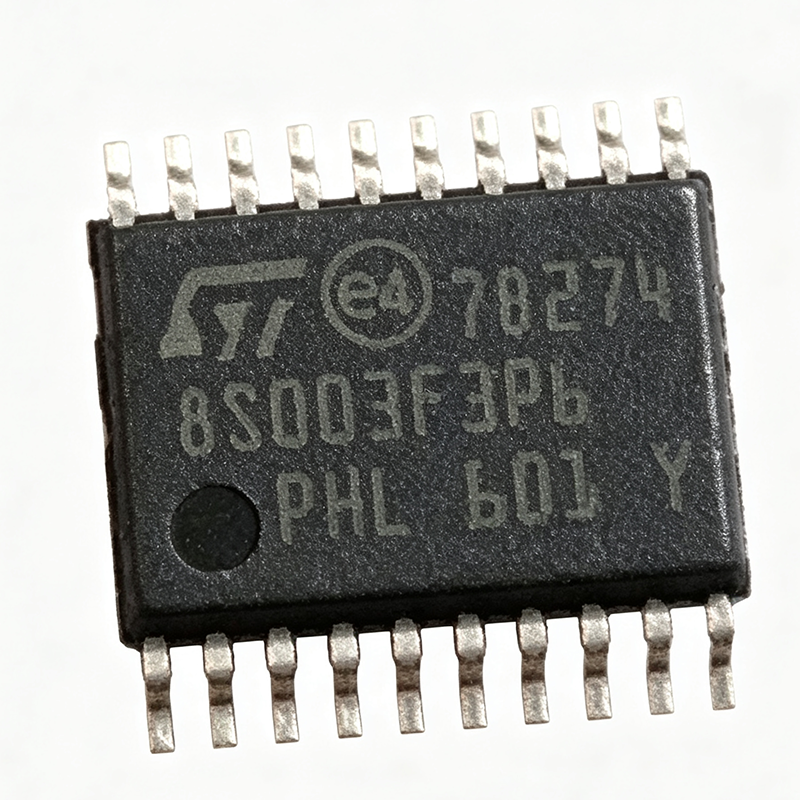
STM8S003F3P6 - 8-bit MCU, 8KB Flash, 16MHz | STMicroelectronics
The STM8S003F3P6 is an 8-bit microcontroller from STMicroelectronics based on the STM8 core, operating at up to 16 MHz with 8 KB of Flash memory and 1 KB of RAM. It comes in a 20-pin TSSOP package and is designed for cost-sensitive applications requiring robust performance and a rich set of peripherals. Data verified as of 2026-08-05. An 8-bit microcontroller (MCU) is a single-chip computer with an 8-bit central processing unit (CPU), memory, and programmable input/output peripherals. It is the most common type of MCU used in embedded systems, balancing cost, power consumption, and performance. The STM8S003F3P6 sits in the STM8S series, which is part of the broader STM8 family of 8-bit MCUs, positioned below the 32-bit STM32 series in STMicroelectronics' product hierarchy. Key features include 8 KB of Flash memory, 1 KB of RAM, and 640 bytes of EEPROM, along with a 10-bit analog-to-digital converter (ADC) with up to 5 channels, a UART, SPI, and I2C interface. The device operates from 2.95V to 5.5V, making it suitable for both 3.3V and 5V systems. It also features a 16-bit timer, an 8-bit timer, and a watchdog timer for reliable operation. The STM8S003F3P6 uses a Harvard architecture with a pipeline, achieving 16 MIPS at 16 MHz. It includes an internal 16 MHz RC oscillator, eliminating the need for an external crystal in many applications. The device supports low-power modes including Halt, Active-Halt, and Wait, with typical power consumption of 3.6 mA in Run mode at 16 MHz and 1 µA in Halt mode. Typical applications include home appliances, industrial control, consumer electronics, and sensor interfaces. Its wide voltage range and robust I/O make it ideal for white goods, power tools, and battery-powered devices. The integrated EEPROM allows data storage without external memory, reducing BOM cost. When designing with this MCU, ensure proper decoupling of the VDD pin with a 100 nF capacitor placed close to the device. The internal RC oscillator is accurate to ±2% over temperature, but for applications requiring precise timing, an external crystal can be connected to the OSC pins. The device supports in-circuit programming via SWIM, simplifying firmware updates. This page synthesizes distributor pricing, drop-in alternatives, and practical design notes not found in the ST datasheet, providing a comprehensive resource for engineers evaluating the STM8S003F3P6.

STM8S003F3P6TR - 8-bit MCU, 8KB Flash, 16MHz | STMicroelectronics
The STMicroelectronics STM8S003F3P6TR is an 8-bit microcontroller based on the STM8 core, offering 8KB of Flash memory, 1KB of RAM, and 640 bytes of EEPROM in a 20-pin TSSOP package. It operates at a maximum frequency of 16 MHz and supports a supply voltage range of 2.95V to 5.5V, making it suitable for a wide range of cost-sensitive embedded applications. Data verified as of 2026-08-05. An 8-bit microcontroller (MCU) is a compact integrated circuit that contains a processor core, memory, and programmable input/output peripherals on a single chip. The STM8 core is an 8-bit CISC architecture designed for high code density and efficient performance in low-cost applications. As a member of the STM8S series, this MCU sits within the broader hierarchy of microcontrollers, which are themselves a subset of embedded processors used in everything from consumer electronics to industrial control systems. Key features include 8KB of Flash program memory, 1KB of SRAM, and 640 bytes of true data EEPROM with write protection. The device integrates a 10-bit analog-to-digital converter (ADC) with up to 5 channels, a UART, SPI, and I2C interface, and a 16-bit timer with PWM capability. It also includes a watchdog timer, a clock security system, and a low-power mode to minimize energy consumption. The STM8S003F3P6TR is built on a robust 8-bit architecture with a 3-stage pipeline, enabling most instructions to execute in a single clock cycle. The device supports a wide operating temperature range from -40°C to +85°C, making it reliable for industrial environments. The TSSOP-20 package offers a compact footprint of 6.4mm x 4.4mm, ideal for space-constrained PCB designs. Typical applications include home appliances, small appliances, lighting control, power tools, and sensor interfaces. Its rich peripheral set and low cost make it a popular choice for high-volume consumer products where cost efficiency is paramount. When designing with this MCU, ensure proper decoupling of the VDD pin with a 100nF capacitor placed close to the device. The NRST pin should be connected to VDD through a 100nF capacitor and a pull-up resistor to prevent spurious resets. For programming, the SWIM interface requires a single-wire connection, simplifying in-circuit programming. This page synthesizes distributor pricing, drop-in alternatives, and practical design notes not found in the ST datasheet, providing engineers with a comprehensive resource for evaluating the STM8S003F3P6TR.
STM8S005C6T6 - 8-bit MCU, 32KB Flash, 16MHz | STMicroelectronics
The STM8S005C6T6 is an 8-bit microcontroller from STMicroelectronics' STM8S value line, featuring a 16 MHz STM8 core, 32 Kbytes of Flash program memory, and 128 bytes of data EEPROM. It is housed in a 48-pin LQFP (7x7 mm) package, offering a compact footprint for space-constrained embedded applications. An 8-bit microcontroller (MCU) is a single-chip computer with an 8-bit data bus, integrating a processor core, memory, and programmable peripherals. The STM8S005C6T6 belongs to the STM8S family, which is part of the broader STM8 8-bit MCU category, positioned below 32-bit ARM Cortex-M devices in the microcontroller hierarchy. It provides a cost-effective solution for applications requiring moderate processing power and rich peripheral integration without the complexity of 32-bit architectures. Key features include a 16 MHz CPU clock, 32 KB Flash, 2 KB RAM, 128 bytes EEPROM, and a comprehensive set of peripherals: 10-bit ADC, UART, SPI, I2C, timers, and up to 38 I/O pins. The device operates from a 2.95V to 5.5V supply, making it suitable for both 3.3V and 5V systems. Its robust ESD protection and wide operating temperature range (-40°C to +85°C) enhance reliability in industrial environments. The STM8S005C6T6 is built on ST's proprietary STM8 core, which delivers up to 20 MIPS at 16 MHz, providing efficient code execution for control-oriented tasks. The integrated EEPROM allows data storage without external components, simplifying BOM and reducing system cost. The device supports in-circuit programming and debugging via SWIM interface, enabling rapid firmware development. Typical applications include home appliances, industrial control, sensor interfaces, and consumer electronics. Its 5V-tolerant I/Os and rich peripheral set make it ideal for motor control, lighting, and power management systems. The wide voltage range and low power consumption support battery-powered devices. When designing with this MCU, ensure proper decoupling of the VDD pins with 100nF capacitors and a bulk capacitor. The SWIM pin should be pulled high for programming. For EMC-sensitive designs, follow ST's layout guidelines for the LQFP package to minimize noise coupling.

STM8S007C8T6 - 8-Bit MCU, 64KB Flash, 24MHz | STMicroelectronics
The STM8S007C8T6 is an 8-bit microcontroller from STMicroelectronics' STM8S Value Line family, featuring a 24MHz advanced STM8 core with Harvard architecture and a 3-stage pipeline. It comes in a 48-pin LQFP package and offers 64KB of Flash memory, 6KB of RAM, and true data EEPROM. With 38 programmable I/O lines, 9 timers/counters, and interfaces including I2C, SPI, and 2 UARTs, this MCU is designed for cost-sensitive embedded applications requiring robust performance and low power consumption. An 8-bit microcontroller is a single-chip computer with an 8-bit central processing unit (CPU), memory, and programmable input/output peripherals. It is a type of embedded microcontroller, which is a compact integrated circuit designed to govern a specific operation in an embedded system. The STM8S007C8T6 belongs to the STM8 family, which is a line of 8-bit microcontrollers from STMicroelectronics, positioned between low-end 8-bit MCUs and higher-performance 32-bit ARM Cortex-M devices. Its Harvard architecture separates instruction and data buses, enabling simultaneous access and faster execution, while the 3-stage pipeline increases throughput at a given clock frequency. Key features of the STM8S007C8T6 include a maximum CPU frequency of 24MHz with 0 wait states at 16MHz, 64KB of Flash memory, 6KB of RAM, and true data EEPROM for non-volatile data storage. It integrates a 10-bit ADC, multiple timers, and communication interfaces (I2C, SPI, 2 UARTs), making it versatile for various control and monitoring tasks. The device operates over a temperature range of -40°C to 85°C and has a maximum power dissipation of 443mW, suitable for industrial and consumer environments. Technically, the STM8 core is an advanced 8-bit architecture with a 3-stage pipeline, allowing most instructions to execute in a single clock cycle. The 24MHz clock speed provides up to 24 MIPS throughput, which is competitive for 8-bit MCUs. The Flash memory supports in-application programming (IAP) and in-circuit programming (ICP), enabling firmware updates in the field. The true data EEPROM allows for byte-level read/write operations, useful for storing calibration data or system parameters without external memory. Typical applications include home appliances, industrial control, sensor interfacing, and automotive body electronics. The rich peripheral set and 38 I/O lines make it suitable for motor control, lighting systems, and human-machine interfaces. Its low power consumption and wide operating voltage range (typically 2.95V to 5.5V) support battery-powered devices and 5V logic systems. When designing with this MCU, consider the power supply decoupling and crystal oscillator layout. Use a 0.1uF capacitor close to each VDD pin and a 10uF bulk capacitor. For the external crystal, place it near the OSC pins with proper load capacitors as specified in the datasheet. Ensure the reset pin has a pull-up resistor and a capacitor for reliable power-on reset.
STM8S105C6T6 - 8-bit MCU, 16MHz, 32KB Flash | STMicroelectronics
The STM8S105C6T6 is an 8-bit microcontroller from STMicroelectronics' STM8S access line, featuring a 16 MHz advanced STM8 core with Harvard architecture and a 3-stage pipeline. It offers 32 KB of Flash program memory, 2 KB of RAM, and 1 KB of true data EEPROM, making it a cost-effective solution for a wide range of embedded control applications. The device is housed in a 48-pin LQFP package (7x7 mm) and operates over a supply voltage range of 2.95V to 5.5V, with an operating temperature range of -40°C to +85°C. An 8-bit microcontroller (MCU) is a single-chip computer with an 8-bit data bus, integrating a processor core, memory, and programmable input/output peripherals. The STM8S105C6T6 belongs to the STM8S family, which is part of the broader STM8 microcontroller series, positioned below the 32-bit STM32 family in STMicroelectronics' product hierarchy. It is designed for applications requiring moderate processing power, low power consumption, and rich peripheral integration, such as industrial control, home appliances, and automotive body electronics. Key features include a 10-bit analog-to-digital converter (ADC) with up to 10 channels, multiple 16-bit timers, and a full set of communication interfaces: UART, SPI, and I2C. The device also integrates a true data EEPROM with up to 300,000 write/erase cycles, enabling data storage without external memory. The STM8 core operates at up to 16 MHz, delivering 16 MIPS throughput, and supports a wide range of clock sources including internal RC oscillators and external crystals. The STM8S105C6T6 is built on a high-density Flash technology, providing robust program memory endurance and fast programming. The architecture includes a nested interrupt controller with 28 interrupt vectors, enhancing real-time responsiveness. The device also features a low-power mode with typical current consumption of 5 µA in Halt mode, making it suitable for battery-powered applications. Typical applications include industrial automation, home appliances (e.g., washing machines, air conditioners), power tools, and automotive body control modules. The rich peripheral set and 5V-tolerant I/Os allow direct interfacing with sensors, relays, and displays without level shifting. The LQFP-48 package provides 38 I/O pins, offering ample connectivity for control and communication. When designing with this MCU, ensure proper decoupling of the VDD and VDDA pins with 100 nF capacitors placed close to the device. The NRST pin should be connected to a 100 nF capacitor to ground for reliable reset. For applications requiring precise timing, use an external crystal oscillator with load capacitors as specified in the datasheet.
STM8S105K4T6 - 8-bit MCU, 16KB Flash, 16MHz | STMicroelectronics
The STM8S105K4T6 is an 8-bit microcontroller from STMicroelectronics' STM8S access line, featuring a 16 MHz STM8 core, 16 KB of Flash program memory, and 1 KB of true data EEPROM. It comes in a 32-pin LQFP package, offering a compact footprint for space-constrained embedded applications. The device operates over a supply voltage range of 2.95V to 5.5V, making it suitable for both 3.3V and 5V systems. An 8-bit microcontroller (MCU) is a single-chip computer containing a processor core, memory, and programmable input/output peripherals. The STM8S105K4T6 belongs to the STM8S family, which is designed for cost-sensitive industrial and consumer applications. As a medium-density device, it balances performance and peripheral integration, providing a 10-bit ADC, multiple timers, and standard communication interfaces like UART, SPI, and I2C. This makes it a versatile choice for control and monitoring tasks. Key features include a 16 MHz CPU clock, 16 KB Flash with read-while-write capability, 1 KB EEPROM with up to 300k write/erase cycles, and a 10-bit ADC with up to 7 channels. The device also integrates a variety of timers, including a 16-bit advanced control timer, two 16-bit general-purpose timers, and a basic timer. Communication interfaces include UART, SPI, and I2C, enabling easy connectivity with sensors, displays, and other peripherals. The STM8S105K4T6 is built on a high-performance STM8 core with a Harvard architecture and a 3-stage pipeline, achieving up to 16 MIPS at 16 MHz. It includes an embedded debug module (SWIM) for in-circuit debugging and programming, reducing development time. The device also features a robust clock system with internal and external oscillator options, including a low-power crystal oscillator and a phase-locked loop for clock multiplication. Typical applications include industrial control, home appliances, sensor interfaces, and motor control. Its wide operating voltage range and industrial temperature grade (-40°C to +85°C) make it suitable for harsh environments. The integrated EEPROM eliminates the need for external storage in many applications, reducing BOM cost. When designing with this MCU, ensure proper decoupling of the power supply pins and consider the thermal characteristics of the LQFP-32 package. The SWIM interface should be reserved for programming and debugging. For low-power applications, utilize the device's multiple low-power modes, including Active-halt and Halt modes, to minimize current consumption.