Microcontrollers
Products (319)
STM32N657VGT6 - 600MHz Cortex-M7 MCU with 2MB Flash | STMicroelectronics
The STMicroelectronics STM32N657VGT6 is a high-performance Arm Cortex-M7 microcontroller operating at up to 600 MHz, delivering exceptional compute capability for advanced embedded applications. It features 2 MB of flash memory and 1.5 MB of SRAM, along with a rich set of peripherals including multiple communication interfaces, advanced timers, and a comprehensive security suite. The device is housed in a 100-pin LQFP package (LQFP100), providing a compact yet powerful solution for industrial, consumer, and IoT designs. What is a microcontroller? A microcontroller (MCU) is a compact integrated circuit designed to govern a specific operation in an embedded system. It integrates a processor core, memory (flash and SRAM), and programmable input/output peripherals on a single chip. Microcontrollers are the brains of countless devices, from automotive engine control units to smart home sensors. In the system hierarchy, the STM32N657VGT6 sits at the application processor level, capable of running complex algorithms and real-time control tasks, often serving as the central processing unit in a system-on-chip (SoC) architecture. Key features of the STM32N657VGT6 include a 600 MHz Arm Cortex-M7 core with double-precision floating-point unit (FPU), 2 MB of flash memory, 1.5 MB of SRAM, and a comprehensive set of peripherals. It supports a wide range of communication interfaces including Ethernet, USB 2.0, CAN-FD, SPI, I2C, UART, and SDMMC. The device also integrates advanced security features such as a hardware cryptographic accelerator, true random number generator (TRNG), and secure boot, making it suitable for secure IoT applications. The operating temperature range is -40°C to +125°C, and the supply voltage is 1.71V to 3.6V. Technically, the STM32N657VGT6 is built on a high-performance process technology, enabling 600 MHz operation while maintaining low power consumption. The Cortex-M7 core includes an instruction cache, data cache, and a memory protection unit (MPU), enhancing real-time performance and reliability. The device supports external memory interfaces, allowing expansion of code and data storage. The rich peripheral set is complemented by a flexible clock tree, multiple power modes, and a comprehensive set of development tools, including the STM32Cube ecosystem. Typical applications include industrial control systems, motor control, advanced human-machine interfaces (HMI), IoT gateways, and edge AI devices. The high clock speed and FPU make it ideal for digital signal processing (DSP) tasks, while the security features enable secure firmware updates and data protection. The device is also suitable for audio processing, smart home hubs, and robotics. When designing with the STM32N657VGT6, ensure adequate decoupling on all power supply pins and a proper ground plane for high-speed signal integrity. The device requires a stable clock source, typically a 25 MHz crystal for Ethernet, and careful layout of the high-speed interfaces to minimize EMI. The STM32CubeMX tool can be used to configure the device and generate initialization code, simplifying development.
STM32N657ZGT6 - 600MHz Cortex-M55 MCU with 4MB Flash | STMicroelectronics
The STMicroelectronics STM32N657ZGT6 is a high-performance Arm Cortex-M55 based microcontroller with a maximum clock speed of 600 MHz, delivering exceptional compute capability for advanced embedded applications. It integrates 4 MB of flash memory and 3.2 MB of SRAM, enabling complex algorithms and large data buffers to be handled on-chip. The device is housed in a 144-pin LQFP package (LQFP144) with a 20x20 mm body, providing ample I/O for connectivity and control. What is a microcontroller? A microcontroller (MCU) is a compact integrated circuit designed to govern a specific operation in an embedded system. It contains a processor core, memory (flash for program storage, SRAM for data), and programmable input/output peripherals on a single chip. MCUs are the brains of countless devices, from automotive engine control units to smart home sensors. In the system hierarchy, the STM32N657ZGT6 sits at the application processor level, above simple 8-bit MCUs but below full application processors like those in smartphones, offering a balance of performance, power efficiency, and real-time responsiveness. Key features of the STM32N657ZGT6 include the Arm Cortex-M55 core with Arm Helium technology for DSP and ML acceleration, a rich set of communication interfaces (including Ethernet, USB, CAN FD, and multiple SPI/I2C/UART), advanced security features (TrustZone, cryptographic accelerators), and a comprehensive set of timers and analog peripherals. The device operates from 1.71V to 3.6V supply, with a temperature range of -40°C to +125°C, making it suitable for industrial and automotive environments. Technically, the STM32N657ZGT6 leverages the Armv8.1-M architecture, which introduces features like TrustZone for secure code execution and Helium vector extensions for signal processing. The 600 MHz clock, combined with a 4 MB flash and 3.2 MB SRAM, allows for sophisticated applications such as real-time audio processing, motor control with high-resolution PWM, and edge AI inference. The device also includes a hardware cryptographic module supporting AES, RSA, and ECC, ensuring secure communication. Typical applications include industrial automation (PLC, robotics), smart energy (smart meters, grid monitoring), advanced motor control (servo drives, drones), and edge AI (anomaly detection, predictive maintenance). The high-speed processing and extensive connectivity make it ideal for gateway devices that aggregate sensor data and communicate over Ethernet or wireless protocols. When designing with this MCU, pay attention to power supply decoupling: place 100nF capacitors close to each VDD pin and a bulk capacitor (e.g., 4.7uF) at the power entry. Also, ensure proper grounding for the exposed pad (EP) to enhance thermal performance. The device supports multiple boot modes, so configure the BOOT pins correctly for your application.

STM32U073RCT6 - Ultra-Low-Power Arm Cortex-M0+ MCU | STMicroelectronics
The STM32U073RCT6 is an ultra-low-power 32-bit microcontroller from STMicroelectronics, based on the Arm Cortex-M0+ core. It operates at a maximum frequency of 56 MHz and features 256 KB of flash memory and 40 KB of SRAM. The device is housed in a 64-pin LQFP package (LQFP64) and is designed for a wide range of battery-powered and energy-efficient applications. What is a microcontroller? A microcontroller (MCU) is a compact integrated circuit designed to govern a specific operation in an embedded system. It contains a processor core, memory (flash and SRAM), and programmable input/output peripherals on a single chip. Microcontrollers are the backbone of embedded systems, enabling control, monitoring, and communication in devices ranging from consumer electronics to industrial automation. The STM32U073RCT6 belongs to the STM32U0 series, which is part of the broader STM32 family of 32-bit microcontrollers known for their performance, efficiency, and extensive peripheral integration. Key features of the STM32U073RCT6 include an ultra-low-power mode with a typical current consumption of 1.6 µA in standby mode, making it ideal for battery-operated devices. It integrates a 12-bit ADC with up to 16 channels, multiple timers, and a wide range of communication interfaces including I2C, SPI, USART, and LPUART. The device also supports USB 2.0 full-speed device mode, which is essential for many portable applications. The operating voltage range is from 1.65V to 3.6V, allowing flexible power supply design. From a technical perspective, the STM32U073RCT6 leverages a 90nm process technology that balances performance and power consumption. The Cortex-M0+ core is optimized for low-power operation, and the device includes a flexible power management unit with multiple low-power modes (Sleep, Stop, Standby) to minimize energy usage. The flash memory supports read-while-write, enabling firmware updates without halting the system. The device also includes a hardware cryptographic accelerator for AES-128/256, enhancing security for IoT applications. Typical applications include smart meters, portable medical devices, IoT sensors, and wearable electronics. The ultra-low-power consumption and rich peripheral set make it suitable for applications that require long battery life and reliable operation. For instance, in a smart meter, the STM32U073RCT6 can handle data acquisition, processing, and communication while maintaining low power consumption. When designing with this device, it is crucial to pay attention to the power supply decoupling and the layout of the crystal oscillator. Use a 1µF and 100nF capacitor close to each VDD pin, and place the crystal and its load capacitors as close as possible to the OSC pins to ensure stable clock generation. Additionally, configure the GPIO pins appropriately to avoid floating inputs, which can increase power consumption.
STM32U083ZCT6 - Ultra-Low-Power Cortex-M0+ MCU | STMicroelectronics
The STM32U083ZCT6 is an ultra-low-power 32-bit microcontroller from STMicroelectronics, based on the ARM Cortex-M0+ core. It operates at a maximum frequency of 56 MHz and features 256 KB of flash memory and 40 KB of SRAM. The device is housed in a 144-pin LQFP package (LQFP144) and is designed for a wide range of battery-powered and energy-efficient applications. What is a microcontroller? A microcontroller (MCU) is a compact integrated circuit designed to govern a specific operation in an embedded system. It contains a processor core, memory (flash and SRAM), and programmable input/output peripherals on a single chip. Microcontrollers are the backbone of embedded systems, enabling control, monitoring, and communication in devices ranging from consumer electronics to industrial automation. The STM32U0 series is part of the broader STM32 family, which is a leading ARM-based MCU platform known for its scalability, performance, and rich peripheral set. Key features of the STM32U083ZCT6 include multiple low-power modes (Sleep, Stop, Standby, and Shutdown) with typical current consumption as low as 100 nA in Standby mode, making it ideal for energy-harvesting and battery-operated devices. It integrates a 12-bit ADC, multiple timers, communication interfaces (I2C, SPI, USART, LPUART), and an LCD controller, providing a comprehensive solution for sensor hubs, smart meters, and portable medical devices. The device also supports a wide supply voltage range from 1.65V to 3.6V, ensuring compatibility with various power sources. Technically, the STM32U083ZCT6 leverages ST's advanced ultra-low-power process technology, which optimizes leakage current and dynamic power consumption. The Cortex-M0+ core is a 32-bit processor with a von Neumann architecture, offering a good balance between performance and energy efficiency. The MCU includes a memory protection unit (MPU) for enhanced security and a nested vectored interrupt controller (NVIC) for efficient interrupt handling. The LCD controller supports up to 8x40 or 4x44 segments, enabling direct drive of segment LCDs without external drivers. Typical applications include smart home devices, wearable fitness trackers, industrial sensors, and portable medical monitoring equipment. The ultra-low-power consumption extends battery life in these applications, while the rich peripheral set reduces system cost and complexity. For example, in a smart meter, the STM32U083ZCT6 can manage data acquisition, display, and communication while operating for years on a single battery. When designing with this MCU, it is crucial to implement proper power supply decoupling with 100 nF capacitors close to each VDD pin and a bulk capacitor (e.g., 4.7 uF) on the main supply. Additionally, the use of the low-power modes requires careful configuration of the RTC and wakeup sources to achieve the desired power budget. The device supports in-circuit programming and debugging via SWD, facilitating development and production.

STM32U535RET6 - Ultra-Low-Power Cortex-M33 MCU | STMicroelectronics
The STM32U535RET6 is an ultra-low-power 32-bit microcontroller from STMicroelectronics, built around the high-performance Arm® Cortex®-M33 core with TrustZone® and FPU. It operates at up to 160 MHz, delivering 240 DMIPS, and integrates 512 KB of flash memory and 274 KB of SRAM. The device is housed in a 64-pin LQFP (10x10 mm) package, making it suitable for space-constrained, battery-powered applications. An ultra-low-power microcontroller (MCU) is a system-on-chip designed to minimize energy consumption while maintaining computational performance. These devices are the foundation of battery-operated embedded systems, such as wearables, IoT sensors, and medical monitors. The STM32U5 series sits at the top of ST's ultra-low-power portfolio, balancing the Cortex-M33 core's efficiency with advanced power-saving modes, including multiple low-power states and a flexible clock gating architecture. Key features include the Arm TrustZone for hardware-enforced security, a 160 MHz Cortex-M33 core with FPU, 512 KB flash, 274 KB SRAM, and a rich set of peripherals. The device supports a wide supply voltage range and offers several low-power modes, including shutdown, standby, and stop modes, with wake-up times in the microsecond range. The LQFP-64 package provides a compact footprint while offering sufficient I/O for complex designs. The STM32U535RET6 leverages ST's advanced 40 nm process technology, enabling a balance of performance and power efficiency. The Cortex-M33 core includes a Memory Protection Unit (MPU) and DSP instructions, enhancing both security and computational throughput. The integrated TrustZone isolates secure and non-secure code, making it ideal for applications requiring secure boot and firmware updates. Typical applications include smart wearables, industrial sensors, medical devices, and IoT edge nodes. The ultra-low-power modes extend battery life in portable devices, while the security features protect sensitive data in connected systems. The device also supports a wide range of communication interfaces, including USART, SPI, I2C, and USB, enabling seamless integration into diverse systems. When designing with this MCU, careful attention to the power supply decoupling and clock configuration is essential. Use a 1.8V to 3.6V supply with appropriate bypass capacitors, and configure the internal or external oscillator to meet the application's timing requirements. The device's low-power modes require proper configuration of the power management unit to achieve optimal energy savings.

STM32U545RET6 - Ultra-Low-Power Cortex-M33 MCU | STMicroelectronics
The STM32U545RET6 is an ultra-low-power microcontroller from STMicroelectronics, featuring a high-performance Arm® Cortex®-M33 32-bit RISC core with TrustZone® and FPU. It operates at up to 160 MHz and delivers 240 DMIPS, making it suitable for a wide range of power-sensitive applications. The device integrates 512 KB of flash memory and 274 KB of SRAM, along with advanced cryptographic hardware acceleration. It is housed in a 64-pin LQFP package (10x10 mm), offering a compact footprint for space-constrained designs. An ultra-low-power microcontroller (MCU) is a system-on-chip that combines a processor core, memory, and peripherals on a single integrated circuit, optimized for minimal power consumption while maintaining computational performance. The STM32U5 series represents the pinnacle of STMicroelectronics' low-power portfolio, targeting battery-powered and energy-harvesting applications. These MCUs are part of the broader Arm Cortex-M ecosystem, which includes a wide range of microcontrollers from various manufacturers, all sharing a common instruction set and development tools. Key features of the STM32U545RET6 include its 160 MHz Arm Cortex-M33 core with TrustZone for secure execution, 512 KB flash, 274 KB SRAM, and a rich set of peripherals including multiple UARTs, SPIs, I2Cs, USB, and advanced analog capabilities. The device also integrates a hardware cryptographic accelerator supporting AES, RSA, and ECC, along with a true random number generator (TRNG) for secure applications. Its ultra-low-power modes, including shutdown, standby, and stop modes, enable extended battery life in IoT and wearable devices. From a technical depth perspective, the STM32U545RET6 leverages ST's advanced 40nm process technology, which contributes to its exceptional power efficiency. The Cortex-M33 core includes a DSP instruction set and a floating-point unit (FPU) for signal processing tasks. The TrustZone technology provides hardware-enforced isolation between secure and non-secure software, essential for applications requiring robust security. The device also features a sophisticated clocking system with multiple PLLs and an internal 16 MHz RC oscillator, reducing external component count. Typical applications include smart wearables, medical monitoring devices, industrial sensors, and secure IoT nodes. Its combination of low power, high performance, and security makes it ideal for battery-operated devices that require advanced processing and secure communication. For instance, in a smartwatch, the STM32U545RET6 can handle sensor fusion, display control, and wireless protocol stacks while maintaining long battery life. When designing with this device, pay careful attention to power supply decoupling and PCB layout to minimize noise and ensure reliable operation. Use the multiple low-power modes effectively to extend battery life, and leverage the hardware crypto accelerator to offload security processing from the CPU. The device supports a wide operating voltage range of 1.71V to 3.6V, allowing direct battery connection in many cases.
STM32U575RGT6 - Ultra-Low-Power Cortex-M33 MCU | STMicroelectronics
The STM32U575RGT6 is an ultra-low-power 32-bit microcontroller from STMicroelectronics, built around the high-performance Arm® Cortex®-M33 RISC core with TrustZone® and FPU. It operates at up to 160 MHz and provides 1 Mbyte of Flash memory and 786 KB of SRAM, delivering 240 DMIPS of processing power. The device is housed in a 64-pin LQFP (10x10 mm) package, making it suitable for space-constrained embedded applications. A microcontroller (MCU) is a compact integrated circuit designed to govern a specific operation in an embedded system. It contains a processor core, memory, and programmable input/output peripherals on a single chip. The STM32U5 series represents the ultra-low-power segment of ST's STM32 portfolio, targeting battery-powered and energy-harvesting applications where power efficiency is paramount. As a member of the STM32 family, it benefits from the extensive STM32Cube ecosystem, including HAL libraries, middleware, and development tools. Key features of the STM32U575RGT6 include the Arm Cortex-M33 core with TrustZone for hardware-enforced security, a floating-point unit (FPU) for efficient mathematical computation, and a rich set of peripherals such as multiple UARTs, SPIs, I2Cs, USB, and advanced timers. The device supports a wide supply voltage range and offers multiple low-power modes, including Sleep, Stop, and Standby, with typical current consumption in the microamp range. It also integrates a 12-bit ADC, DAC, and various communication interfaces, making it versatile for IoT, industrial, and consumer applications. From a technical depth perspective, the STM32U575RGT6 leverages a 40nm process technology, enabling a balance between performance and power consumption. The TrustZone technology provides secure boot and isolated execution environments, critical for applications handling sensitive data. The FPU accelerates single-precision floating-point operations, beneficial for signal processing and control algorithms. The device also includes a memory protection unit (MPU) and a cryptographic accelerator, enhancing overall system security and performance. Typical applications include smart meters, wearable devices, medical monitoring equipment, and industrial sensors. In smart meters, the ultra-low-power consumption extends battery life, while the security features protect metering data. For wearables, the compact LQFP package and low-power modes enable continuous operation from small batteries. In medical devices, the reliable operation and security features ensure patient data integrity. When designing with the STM32U575RGT6, it is essential to plan the power supply and decoupling carefully. Use a stable 3.3V supply with 100nF decoupling capacitors close to each power pin. For low-power operation, configure the clock system to use the low-speed external oscillator (LSE) and utilize the Stop mode with RTC wake-up to minimize current draw. Additionally, ensure proper grounding and layout for the LQFP package to avoid noise issues.
STM32U585RGT6 - Ultra-Low-Power Cortex-M33 MCU | STMicroelectronics
The STM32U585RGT6 is an ultra-low-power 32-bit microcontroller from STMicroelectronics, based on the high-performance Arm® Cortex®-M33 processor core with TrustZone® for Armv8-M, DSP, and floating-point unit (FPU). It operates at a frequency of up to 160 MHz, delivering 240 DMIPS of processing power. The device is part of the STM32U5 series, which extends the STM32 ultra-low-power portfolio with advanced security features and energy efficiency. What is a microcontroller? A microcontroller (MCU) is a compact integrated circuit designed to govern a specific operation in an embedded system. It contains a processor core, memory (Flash and SRAM), and programmable input/output peripherals on a single chip. Microcontrollers are the brains of countless electronic devices, from automotive engine control units to wearable health monitors. The STM32U585RGT6 fits into the hierarchy of microcontrollers → 32-bit MCUs → Arm Cortex-M33 MCUs → ultra-low-power MCUs, representing the pinnacle of energy-efficient processing with integrated security. Key features of the STM32U585RGT6 include up to 2 MB of Flash memory and 786 KB of SRAM, providing ample space for complex applications. The device supports a power supply range of 1.71 V to 3.6 V and operates over a temperature range of -40 °C to +85/125 °C. It includes a low-power background autonomous mode (LPBAM) that allows autonomous peripherals with DMA, reducing power consumption in standby modes. The MCU also features advanced cryptographic hardware acceleration, including AES, RSA, and ECC, making it suitable for secure IoT applications. Technically, the STM32U585RGT6 leverages ST's patented ultra-low-power technology, FlexPowerControl, which enables fine-grained power management. The Cortex-M33 core with TrustZone provides hardware-enforced isolation for secure code execution, a critical feature for applications handling sensitive data. The device also includes a rich set of communication interfaces, such as USART, SPI, I2C, USB, and CAN, along with advanced analog peripherals like ADCs, DACs, and comparators. Typical applications include smart meters, industrial sensors, wearable devices, medical monitoring equipment, and secure IoT nodes. The combination of ultra-low power consumption, high performance, and robust security makes it ideal for battery-powered devices that require long operational life and data protection. When designing with this device, engineers should leverage the LPBAM feature to minimize power consumption in active and standby modes. Proper decoupling of the power supply and careful PCB layout are essential to maintain signal integrity and achieve the specified performance. The device's extensive documentation and STM32Cube ecosystem facilitate rapid development and debugging.
STM32U595ZJT6 - Ultra-Low-Power Cortex-M33 MCU 160MHz 4MB Flash | STMicroelectronics
The STM32U595ZJT6 is an ultra-low-power 32-bit microcontroller from STMicroelectronics, based on the high-performance Arm Cortex-M33 RISC core with TrustZone and FPU. It operates at a frequency of up to 160 MHz and features 4 Mbytes of Flash memory and 2.5 Mbytes of SRAM, making it suitable for a wide range of power-sensitive applications. An ultra-low-power microcontroller (MCU) is a type of integrated circuit designed to minimize energy consumption while providing computational capabilities. It typically integrates a processor core, memory, and peripherals on a single chip, enabling battery-powered or energy-harvesting devices to operate for extended periods. The STM32U5 series represents the pinnacle of ST's ultra-low-power portfolio, offering advanced power management features such as multiple low-power modes, adaptive voltage scaling, and a highly efficient DC-DC converter. Key features of the STM32U595ZJT6 include a 160 MHz Arm Cortex-M33 core with TrustZone for hardware-enforced security, 4 Mbytes of Flash memory, 2.5 Mbytes of SRAM, and a rich set of peripherals including multiple UARTs, SPIs, I2Cs, USB, and advanced analog capabilities. The device also integrates a cryptographic accelerator, a true random number generator, and a secure boot mechanism, making it ideal for IoT and security-critical applications. From a technical perspective, the STM32U595ZJT6 leverages a 40nm process technology, enabling exceptional energy efficiency. It supports a wide supply voltage range from 1.71V to 3.6V, and its power consumption can be as low as 19 µA in standby mode with RTC. The MCU also features a Chrom-ART Accelerator for graphics, a digital filter for sigma-delta modulators, and a 14-bit ADC with hardware oversampling, providing high precision for sensor interfacing. Typical applications include smart meters, wearable devices, medical monitoring equipment, industrial sensors, and IoT edge nodes. The combination of ultra-low power, high performance, and advanced security makes it a preferred choice for designers who need to balance energy efficiency with computational capability. When designing with this device, it is crucial to pay attention to the power supply decoupling and the selection of the appropriate low-power mode to maximize battery life. The STM32CubeU5 software package provides comprehensive drivers and examples to accelerate development.
STM32U599ZJT6 - Ultra-Low-Power Cortex-M33 MCU 160MHz 4MB Flash | ST
The STM32U599ZJT6 is an ultra-low-power microcontroller from STMicroelectronics' STM32U5 series, built around the high-performance Arm Cortex-M33 32-bit RISC core with TrustZone and FPU. It operates at up to 160 MHz and integrates 4 MB of Flash memory and 2.5 MB of SRAM, making it suitable for a wide range of power-conscious embedded applications. The device is available in a 144-pin LQFP package (20x20 mm) and supports a supply voltage range of 1.71 V to 3.6 V, with an operating temperature range of -40°C to +85°C or +125°C depending on the variant. A microcontroller (MCU) is a compact integrated circuit designed to govern a specific operation in an embedded system. It contains a processor core, memory (Flash and SRAM), and programmable input/output peripherals. The STM32U5 series represents the ultra-low-power segment of STM32 MCUs, targeting battery-powered and energy-harvesting applications where power efficiency is critical. The Cortex-M33 core adds TrustZone security and DSP instructions, positioning this MCU within the broader hierarchy of Arm-based embedded processors, from simple 8-bit MCUs to high-end application processors. Key features of the STM32U599ZJT6 include the Arm Cortex-M33 core with TrustZone, a floating-point unit (FPU), 4 MB of dual-bank Flash memory, and 2.5 MB of SRAM. It supports a rich set of peripherals, including multiple UART, SPI, I2C, USB, and advanced analog features such as a 14-bit ADC. The device also integrates a Chrom-ART Accelerator for graphics and a hardware cryptographic accelerator, enhancing its suitability for secure and display-oriented applications. The ultra-low-power design incorporates FlexPowerControl, allowing independent power domains and low-power background autonomous mode (LPBAM) for peripherals with DMA. From a technical depth perspective, the STM32U599ZJT6 leverages ST's patented ultra-low-power technology, achieving exceptional energy efficiency. The Cortex-M33 core with TrustZone provides hardware-enforced security, isolating critical code and data. The device includes a rich set of communication interfaces, including Ethernet, USB OTG, and CAN FD, enabling connectivity in industrial and IoT applications. The 144-pin LQFP package offers a balance between I/O count and board space, with a thermal resistance suitable for moderate power dissipation. Typical applications include smart meters, medical devices, wearable electronics, and industrial sensors. The ultra-low-power consumption and advanced security features make it ideal for battery-powered devices that require long operational life and secure data handling. The high Flash and SRAM capacities support complex firmware and real-time operating systems. When designing with this MCU, careful attention to power supply decoupling and PCB layout is essential to achieve the specified low-power performance. The device supports multiple low-power modes, and designers should leverage the LPBAM feature to minimize power consumption in standby states. Additionally, the TrustZone security features require proper configuration to ensure secure boot and runtime isolation.

STM32WB30CEU6 - 2.4GHz Wireless MCU with BLE 5.0 | STMicroelectronics
The STM32WB30CEU6 is a dual-core wireless microcontroller from STMicroelectronics, integrating a 32-bit Arm Cortex-M4 application processor running at 64 MHz and a dedicated Arm Cortex-M0+ network processor for the 2.4 GHz radio stack. It supports Bluetooth Low Energy 5.0, 802.15.4 (Zigbee, Thread), and proprietary 2.4 GHz protocols, making it a versatile solution for IoT and smart connected devices. The device is housed in a 48-pin UFQFPN package (7x7 mm) with an exposed pad, offering a compact footprint for space-constrained designs. A wireless MCU (Microcontroller Unit) is a system-on-chip that combines a general-purpose microcontroller core with an integrated radio transceiver, enabling wireless communication without external RF chips. In the system hierarchy, a wireless MCU sits above a standalone MCU and below a full application processor, providing a balance of processing power, connectivity, and low power consumption. The STM32WB30CEU6 exemplifies this category by pairing a powerful Cortex-M4 for application code with a Cortex-M0+ that offloads the real-time radio stack, ensuring deterministic wireless performance. Key features include 512 KB of flash memory and 96 KB of SRAM, sufficient for complex applications and over-the-air (OTA) updates. The radio supports BLE 5.0 with 2 Mbps data rate, long range, and advertising extensions, as well as Zigbee 3.0 and Thread for mesh networking. The device operates from 1.71V to 3.6V, with multiple low-power modes including Sleep, Stop, and Standby, consuming as low as 1.6 uA in Standby mode with RTC. It also integrates a 12-bit ADC, multiple timers, and a rich set of communication interfaces (SPI, I2C, USART, LPUART). The dual-core architecture is a key differentiator: the Cortex-M0+ runs the wireless protocol stack (e.g., BLE stack) independently, while the Cortex-M4 runs the user application. This separation improves real-time performance and simplifies certification. The device also features a hardware cryptographic accelerator (AES-256) and a true random number generator (TRNG) for secure connections. Typical applications include smart home devices (sensors, locks, lighting), industrial wireless sensors, healthcare wearables, and asset tracking. The integrated radio and low power consumption make it ideal for battery-powered IoT nodes that require long battery life and reliable wireless connectivity. When designing with the STM32WB30CEU6, pay attention to the RF layout: use a 32 MHz crystal for the radio and a 32.768 kHz crystal for the RTC, and ensure a clean ground plane under the antenna. The device supports firmware updates via the built-in bootloader, simplifying field updates.
STM32WB30CEU7 - 2.4GHz Dual-Core Wireless MCU | STMicroelectronics
The STM32WB30CEU7 is a dual-core wireless microcontroller from STMicroelectronics, combining an Arm Cortex-M4 application processor running at 64 MHz with a dedicated Arm Cortex-M0+ network processor for Bluetooth Low Energy 5.0 and 802.15.4 (Zigbee, Thread) connectivity. It is housed in a 48-pin UFQFPN package (7x7 mm) and offers 512 KB of flash memory and 96 KB of SRAM, making it suitable for a wide range of IoT and smart connected devices. A wireless MCU (Microcontroller Unit) integrates a general-purpose processor with a radio transceiver on a single chip, enabling embedded systems to communicate wirelessly without external RF components. The STM32WB30CEU7 belongs to the STM32WB series, which is part of the broader STM32 family of 32-bit Arm Cortex-M microcontrollers. This architecture allows developers to leverage the rich STM32 ecosystem, including STM32CubeMX, STM32CubeWB firmware packages, and extensive middleware support for BLE and Zigbee protocols. Key features of the STM32WB30CEU7 include a 2.4 GHz radio supporting BLE 5.0 (with 2 Mbps, long range, and advertising extensions) and 802.15.4 (Zigbee 3.0, Thread), a 12-bit ADC with up to 16 channels, multiple communication interfaces (USART, SPI, I2C, USB 2.0 FS), and a rich set of timers. The dual-core architecture offloads real-time radio stack processing to the Cortex-M0+, freeing the Cortex-M4 for application code, which improves system responsiveness and power efficiency. The device operates from a 1.71V to 3.6V supply and features multiple low-power modes, including Sleep, Stop, and Standby, with typical current consumption as low as 2.8 uA in Stop mode with RTC. The integrated SMPS (Switched-Mode Power Supply) can be enabled to reduce RF power consumption, making it ideal for battery-powered devices. The radio achieves a sensitivity of -96 dBm for BLE and -100 dBm for 802.15.4, ensuring reliable communication in challenging environments. Typical applications include smart home devices (sensors, locks, lighting), industrial wireless sensor networks, healthcare wearables, and asset tracking. The STM32WB30CEU7 is also supported by the STM32Cube ecosystem, which provides a comprehensive set of tools, middleware, and examples to accelerate development. When designing with this device, pay attention to the RF layout: use a proper ground plane, place decoupling capacitors close to the supply pins, and follow the antenna design guidelines in the datasheet. The device requires a 32.768 kHz crystal for the RTC and a 32 MHz crystal for the radio, both of which must be placed near the corresponding pins to minimize parasitic capacitance.

STM32WB35CEU6 - 2.4GHz Wireless MCU with BLE 5.4 | STMicroelectronics
The STM32WB35CEU6 is a dual-core wireless microcontroller from STMicroelectronics, integrating a 64 MHz Arm Cortex-M4 application processor and a 32 MHz Arm Cortex-M0+ radio processor in a single UFQFPN-48 package. It supports Bluetooth Low Energy 5.4 and 802.15.4 (Zigbee, Thread) protocols, making it a versatile solution for IoT, smart home, and industrial wireless applications. A wireless MCU is a microcontroller that combines a general-purpose processing core with a radio transceiver on a single chip, enabling wireless communication without external RF components. The STM32WB35CEU6 belongs to the STM32WB series, which is part of the broader STM32 family of 32-bit Arm Cortex-M microcontrollers. This integration reduces system cost, board space, and design complexity compared to discrete MCU-plus-radio solutions. Key features include 512 KB of flash memory and 128 KB of SRAM, providing ample space for application code and data. The device operates from 1.71V to 3.6V supply voltage and supports an extended temperature range of -40°C to +85°C. It includes a rich set of peripherals: 12-bit ADC, multiple timers, USART, SPI, I2C, and a USB 2.0 FS interface. The radio subsystem delivers +6 dBm output power and -96 dBm sensitivity for BLE, ensuring reliable wireless links. The dual-core architecture allows the Cortex-M0+ to handle the radio stack independently, offloading the main Cortex-M4 core for application processing. This separation improves real-time performance and reduces power consumption. The device also features a TrustZone-compatible secure enclave (via STM32CubeWB firmware) for secure key storage and authentication, enhancing IoT security. Typical applications include smart home devices (sensors, locks, lighting), industrial wireless sensor networks, healthcare wearables, and asset tracking. The integrated radio and rich peripherals enable compact, low-power designs. For example, in a smart thermostat, the STM32WB35CEU6 can manage temperature sensing, display control, and BLE communication with a smartphone app. When designing with this device, pay attention to antenna matching and PCB layout for optimal RF performance. Use the reference design from ST's application notes (e.g., AN5185) for the balun and antenna. Also, ensure proper decoupling of the supply pins and follow the recommended power sequencing to avoid latch-up.
STM32WB50CGU6 - Dual-Core Wireless MCU BLE 5.0 | STMicroelectronics
The STM32WB50CGU6 is a dual-core wireless microcontroller from STMicroelectronics, integrating a 32-bit Arm Cortex-M4 application processor running at 64 MHz and a dedicated Arm Cortex-M0+ network processor for Bluetooth Low Energy (BLE) 5.0 and IEEE 802.15.4 wireless protocols. It comes in a UFQFPN-48 (7x7 mm) package, offering a compact solution for connected embedded applications. A wireless MCU (Microcontroller Unit) is a system-on-chip that combines a general-purpose microcontroller core with a radio transceiver, enabling wireless communication in embedded systems. The STM32WB50CGU6 belongs to the STM32WB series, which is part of the broader STM32 family of 32-bit Arm Cortex-M microcontrollers. This hierarchy places it within the categories of wireless microcontrollers, microcontrollers, and embedded processors, making it a key component in the Internet of Things (IoT) ecosystem. Key features include 1 Mbyte of flash memory and 128 Kbytes of SRAM, providing ample storage for application code and data. The device supports BLE 5.0 with a data rate of 2 Mbps, along with Zigbee 3.0 and Thread protocols via IEEE 802.15.4. It operates from a 1.71V to 3.6V supply, with a typical current consumption of 4.5 mA in RX mode and 4.5 mA in TX mode at 0 dBm. The integrated balun eliminates the need for external RF matching components, simplifying PCB design. The dual-core architecture allows the Cortex-M0+ to handle the wireless protocol stack independently, offloading the main Cortex-M4 core for application processing. This separation enhances real-time performance and reduces power consumption. The device includes a rich set of peripherals, including UART, SPI, I2C, ADC, timers, and GPIOs, along with hardware cryptographic acceleration (AES, RSA, ECC) for secure communication. Typical applications include smart home devices, industrial wireless sensors, healthcare wearables, and asset tracking systems. The STM32WB50CGU6 is particularly suited for battery-powered devices due to its low power consumption and support for multiple low-power modes, including Stop and Standby modes. When designing with this device, ensure proper antenna layout and RF decoupling to achieve optimal wireless performance. The device requires a 32 MHz crystal for the RF subsystem and a 32.768 kHz crystal for the RTC, which should be placed close to the respective pins. Additionally, the supply voltage must be decoupled with a 100 nF capacitor near each VDD pin to minimize noise.
STM32WB55CEU6 - Dual-Core Wireless MCU with BLE 5.4 | STMicroelectronics
The STMicroelectronics STM32WB55CEU6 is a dual-core wireless microcontroller that integrates a 64 MHz Arm Cortex-M4 application processor with a 32 MHz Arm Cortex-M0+ radio processor, enabling concurrent Bluetooth Low Energy 5.4 and IEEE 802.15.4 (Zigbee, Thread) connectivity. It comes in a 48-pin UFQFPN package (7x7 mm) and offers 512 KB of flash memory and 128 KB of SRAM, making it suitable for a wide range of IoT, smart home, and industrial wireless applications. A wireless MCU (Microcontroller Unit) is a system-on-chip that combines a general-purpose microcontroller core with a radio transceiver, allowing embedded systems to communicate wirelessly without external host processors. In the system hierarchy, the STM32WB55CEU6 sits at the application processor level, managing both the user application and the wireless protocol stack, with the Cortex-M0+ core dedicated to real-time radio tasks. This dual-core architecture offloads the main CPU, ensuring deterministic wireless performance and lower power consumption. Key features include a 2.4 GHz radio supporting BLE 5.4, Zigbee 3.0, and Thread, with a transmit power of up to +6 dBm and a receiver sensitivity of -96 dBm for BLE. The device supports a supply voltage range of 1.71V to 3.6V, with multiple low-power modes including Sleep, Stop, and Standby, achieving as low as 1.62 uA in Standby mode with RTC. It also integrates a rich set of peripherals: 12-bit ADC, multiple timers, USART, SPI, I2C, USB 2.0 FS, and a Touch Sensing controller. The STM32WB55CEU6 is built on ST's ultra-low-power technology, featuring a proprietary radio IP that balances performance and energy efficiency. The dual-core design allows the Cortex-M0+ to handle the wireless protocol stack independently, while the Cortex-M4 runs the application, reducing software complexity and improving real-time responsiveness. The device also includes a hardware cryptographic accelerator (AES-256) and a true random number generator (TRNG) for secure wireless communication. Typical applications include smart home hubs, wireless sensor nodes, asset tracking beacons, and industrial IoT gateways. Its support for multiple wireless protocols in a single chip makes it ideal for products that need to bridge BLE and Zigbee/Thread networks. The integrated USB and rich analog peripherals further expand its use in portable medical devices and wearable electronics. When designing with this device, pay attention to the RF layout: use a 50-ohm impedance-controlled antenna trace and place decoupling capacitors close to the VDD pins. The dual-core architecture requires careful firmware partitioning to avoid resource contention between the two cores. Also, ensure the supply voltage stays within 1.71V to 3.6V and consider using the SMPS (switched-mode power supply) mode for improved efficiency in battery-powered designs.
STM32WLE5JC - 32-bit Arm Cortex-M4 LoRa SoC | STMicroelectronics
The STMicroelectronics STM32WLE5JC is a 32-bit Arm Cortex-M4 microcontroller with integrated LoRa transceiver, designed for long-range, low-power wireless applications. It operates at up to 48 MHz and features 256 KB of flash memory and 64 KB of SRAM. The device is housed in a 48-pin UFQFPN package (7x7 mm) and supports a supply voltage range of 1.8V to 3.6V. A System-on-Chip (SoC) integrates a microcontroller core with a radio transceiver on a single die, enabling compact and cost-effective designs for IoT and smart agriculture. The STM32WLE5JC combines an Arm Cortex-M4 core with a LoRa (Long Range) modem, providing sub-GHz wireless connectivity with excellent sensitivity and low power consumption. This integration reduces system complexity and bill of materials compared to discrete MCU + radio solutions. Key features include a LoRa modem supporting frequencies from 150 MHz to 960 MHz, a transmit power of up to +22 dBm, and a receiver sensitivity of -123 dBm at 10.4 kbps. The device also includes an AES-256 hardware encryption engine, a true random number generator (TRNG), and multiple low-power modes including Sleep, Stop, and Standby. The integrated SMPS (switched-mode power supply) enhances efficiency, reducing current consumption to as low as 1.4 uA in Standby mode with RTC. The STM32WLE5JC is built on ST's advanced 40nm process technology, balancing performance and power efficiency. The Arm Cortex-M4 core with FPU (floating-point unit) and DSP instructions enables complex signal processing, while the LoRa modem handles spread-spectrum modulation for robust long-range communication. The device supports both LoRa and (G)FSK modulation, offering flexibility for various wireless protocols. Typical applications include smart agriculture (soil moisture monitoring, livestock tracking), smart metering (gas, water, electricity), asset tracking, and industrial IoT sensors. The long-range capability and low power consumption make it ideal for battery-powered devices requiring years of operation. The integrated radio eliminates the need for external RF components, simplifying PCB design and reducing time-to-market. When designing with the STM32WLE5JC, pay attention to the RF matching network and antenna design to achieve optimal range. The device requires a 32 MHz crystal for the radio and a 32.768 kHz crystal for the RTC. Proper decoupling of the supply pins and a clean ground plane are essential for reliable RF performance. The SMPS can be configured to optimize efficiency versus noise trade-offs.
STM8AF5266TCY - Automotive 8-bit MCU, 64KB Flash, 24MHz | STMicroelectronics
The STM8AF5266TCY is an automotive-grade 8-bit microcontroller from STMicroelectronics, featuring a 24 MHz CPU core, 64 Kbytes of Flash memory, and integrated true data EEPROM. It is housed in a 32-pin LQFP package with gull-wing terminals, providing a compact solution for automotive body electronics and industrial control applications. An 8-bit microcontroller (MCU) is a single-chip computer with an 8-bit data bus, integrating a processor core, memory, and programmable input/output peripherals. In the automotive domain, 8-bit MCUs like the STM8AF5266TCY serve as the 'brain' of electronic control units (ECUs), managing functions such as window lifts, seat control, and lighting. They sit within the broader hierarchy of embedded processing, from simple 4-bit controllers to complex 32-bit systems-on-chip, offering a balance of cost, power efficiency, and real-time responsiveness for dedicated control tasks. Key features of the STM8AF5266TCY include 25 I/O lines, 10-bit ADC channels, PWM channels, and a rich set of communication interfaces including LIN, CAN, USART, SPI, and I2C. The device operates over a supply voltage range of 3V to 5.5V, making it suitable for direct battery connection in automotive environments. The integrated true data EEPROM allows for non-volatile data storage without external components, simplifying system design and reducing BOM cost. The STM8AF5266TCY is built on ST's advanced 8-bit core architecture, which delivers up to 20 MIPS at 24 MHz, providing ample processing headroom for real-time control loops. The inclusion of a CAN controller enables robust communication in automotive networks, while the LIN interface supports lower-cost sub-networks for body electronics. The device also features a 10-bit ADC with multiple channels, enabling direct sensor interfacing for temperature, position, and current sensing. Typical applications include automotive body control modules, lighting control, seat and mirror adjustment, and industrial automation. The wide operating voltage range and automotive qualification make it a reliable choice for harsh environments. For designs requiring higher memory, the STM8AF52A9TCY offers 128 Kbytes of Flash in the same package, providing a scalable upgrade path. When designing with this MCU, ensure proper decoupling of the power supply pins and consider the thermal characteristics of the LQFP-32 package. The device supports in-application programming (IAP) and in-circuit debugging, facilitating firmware updates and system diagnostics in the field.

STM8AF5268TCY - 8-bit Automotive MCU, 32KB Flash, LQFP48 | STMicroelectronics
The STM8AF5268TCY is an 8-bit automotive-grade microcontroller from STMicroelectronics, based on the STM8A core. It operates at a maximum frequency of 24 MHz and provides 32 KB of Flash program memory, 2 KB of RAM, and 1 KB of EEPROM. The device is housed in a 48-pin LQFP package (7x7 mm) and is designed for a wide range of automotive body and chassis applications. An 8-bit microcontroller (MCU) is a compact integrated circuit that executes instructions on 8-bit data words, typically used for control-oriented tasks in embedded systems. The STM8A core is an enhanced 8-bit architecture with a three-stage pipeline, offering high code density and efficient execution for cost-sensitive automotive modules. As a member of the STM8AF series, this MCU sits within the broader hierarchy of microcontrollers, which are themselves a subset of integrated circuits used in electronic control units (ECUs) across the automotive industry. Key features include a rich set of peripherals: two UARTs, two SPI interfaces, two I2C interfaces, a 10-bit ADC with up to 16 channels, multiple 16-bit timers, and a CAN 2.0B controller. The device supports a supply voltage range of 3.0V to 5.5V, making it compatible with both 3.3V and 5V systems. It also includes an internal 16 MHz RC oscillator and a low-power RTC, reducing external component count. The automotive qualification (AEC-Q100 Grade 1) ensures operation from -40°C to +150°C ambient temperature, suitable for under-hood environments. The STM8AF5268TCY is built on a robust 130nm embedded Flash process, providing high reliability and endurance (up to 100k write/erase cycles). The CAN controller supports both 2.0A and 2.0B protocols, enabling seamless integration into vehicle networks. The device also features a 10-bit ADC with programmable sampling time, which is essential for accurate sensor readings in engine management and battery monitoring. Typical applications include body control modules (BCM), door and window control, seat control, HVAC (heating, ventilation, and air conditioning) systems, and lighting control. Its CAN interface makes it ideal for distributed automotive networks, while the low-power modes (Halt, Active-Halt, Wait) help meet stringent quiescent current requirements in battery-backed systems. When designing with this MCU, ensure proper decoupling of the VDD and VDDA pins with 100nF capacitors placed close to the device. The internal RC oscillator is factory-calibrated to ±1% accuracy, but for applications requiring higher precision, an external crystal can be connected to the OSC_IN/OSC_OUT pins. The device supports in-application programming (IAP) via the bootloader, simplifying firmware updates in the field.
STM8AF5286TCY - 8-bit Automotive MCU, 64KB Flash, LQFP64 | STMicroelectronics
The STMicroelectronics STM8AF5286TCY is an 8-bit automotive-grade microcontroller based on the STM8A core, operating at up to 24 MHz. It features 64 KB of Flash program memory, 6 KB of RAM, and 2 KB of EEPROM, all in a 64-pin LQFP package. This device is designed for automotive body electronics, motor control, and safety-critical applications, with an extended temperature range of -40°C to +150°C and AEC-Q100 qualification. An 8-bit microcontroller (MCU) is a single-chip computer with an 8-bit central processing unit (CPU), memory, and programmable input/output peripherals. It is a subset of the broader microcontroller family, which includes 16-bit and 32-bit devices. In the system hierarchy, an 8-bit MCU sits below 16-bit and 32-bit MCUs in processing power but offers lower cost, lower power consumption, and simpler architecture, making it ideal for cost-sensitive, high-volume automotive and industrial applications. The STM8A core is an enhanced 8-bit architecture with a three-stage pipeline, delivering up to 20 MIPS at 24 MHz. Key features include a 24 MHz maximum CPU frequency, 64 KB Flash with read-while-write capability, 6 KB SRAM, and 2 KB true EEPROM with up to 300k write/erase cycles. The device integrates a 10-bit ADC with up to 16 channels, two 16-bit timers, one 8-bit timer, a UART, SPI, and I2C interfaces. It also includes a CAN 2.0B controller, making it suitable for automotive networking. The LQFP64 package provides 52 I/O pins, with 5V-tolerant inputs for direct interfacing with legacy automotive sensors and actuators. The STM8AF5286TCY is built on ST's proprietary 130nm embedded Flash process, which balances performance, power efficiency, and reliability. The core operates from a 3.3V to 5V supply, with a low-power mode consuming as little as 1 µA in halt mode. The device includes a comprehensive set of safety features, including a window watchdog, clock security system, and a cyclic redundancy check (CRC) unit, supporting ISO 26262 ASIL-B functional safety requirements. Typical applications include automotive body control modules (BCM), power window and seat control, HVAC control, and motor control for pumps and fans. The CAN interface enables communication with the vehicle's network, while the robust I/O and wide temperature range ensure reliable operation in harsh environments. The device is also used in industrial automation and smart sensors where automotive-grade reliability is required. When designing with this MCU, ensure proper decoupling of the VDD and VDDA pins with 100nF and 4.7µF capacitors. The NRST pin requires an external pull-up resistor and a capacitor for reliable reset. For CAN communication, a CAN transceiver such as the TJA1051 is required. The device supports in-application programming (IAP) via the UART or CAN, enabling firmware updates in the field.
STM8AF5288TCY - 8-bit Automotive MCU, 64KB Flash, 24MHz | STMicroelectronics
The STM8AF5288TCY is an 8-bit automotive-grade microcontroller from STMicroelectronics, based on the high-performance STM8A core. It operates at a maximum frequency of 24 MHz and provides 64 KB of Flash program memory, 6 KB of RAM, and 2 KB of EEPROM. The device is housed in a 48-pin LQFP package (7x7 mm) and is designed for a wide range of automotive body and chassis applications. An 8-bit microcontroller (MCU) is a single-chip computer with an 8-bit data bus, integrating a CPU, memory, and peripherals. In the automotive domain, 8-bit MCUs like the STM8AF5288TCY are widely used for cost-sensitive, real-time control tasks such as window lift, wiper control, and lighting modules. They offer a balance of performance, power efficiency, and deterministic behavior, making them ideal for safety-critical and time-constrained applications. Key features of the STM8AF5288TCY include a 24 MHz CPU clock, 64 KB Flash with read-while-write capability, 6 KB SRAM, and 2 KB true data EEPROM with up to 300k write/erase cycles. It integrates a 10-bit ADC with up to 16 channels, multiple timers (including a 16-bit advanced control timer), and standard communication interfaces such as SPI, I2C, and UART. The device also features a CAN 2.0B controller, making it suitable for in-vehicle networking. The STM8A core is based on a Harvard architecture with a 3-stage pipeline, achieving up to 20 MIPS at 24 MHz. It includes an extended instruction set with hardware multiply and divide, and supports a wide operating voltage range of 3.0V to 5.5V. The MCU is AEC-Q100 qualified (Grade 1, -40°C to +125°C), ensuring reliable operation in harsh automotive environments. Typical applications include body control modules, door modules, seat control, HVAC control, and lighting systems. The integrated CAN interface enables communication with other ECUs in the vehicle network, while the rich timer and ADC peripherals support motor control and sensor interfacing. When designing with this MCU, ensure proper decoupling of the power supply pins and a clean ground plane. The EEPROM endurance of 300k cycles allows frequent data logging, but careful management of write operations is recommended to maximize lifetime. For safety-critical applications, the built-in watchdog timer and clock security system should be enabled.
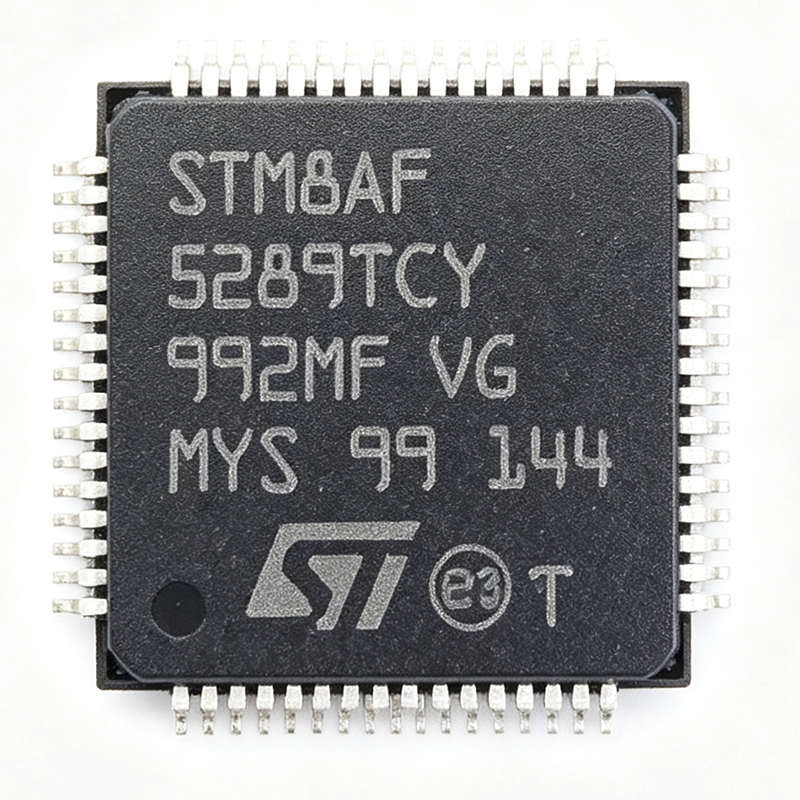
STM8AF5289TCY - 8-bit Automotive MCU, 128KB Flash | STMicroelectronics
The STM8AF5289TCY is an 8-bit automotive-grade microcontroller from STMicroelectronics, featuring a high-performance STM8A core running at up to 24 MHz. It integrates 128 KB of Flash program memory, 6 KB of RAM, and 2 KB of EEPROM, making it suitable for body control modules, motor control, and other automotive applications. The device operates over a supply voltage range of 3.0V to 5.5V and is available in a 64-pin LQFP package. An 8-bit microcontroller (MCU) is a single-chip computer with an 8-bit data bus, typically used for embedded control applications. It integrates a CPU, memory (Flash, RAM, EEPROM), and peripherals such as timers, ADCs, and communication interfaces. In the automotive domain, 8-bit MCUs like the STM8AF series provide a cost-effective solution for real-time control tasks, bridging the gap between simple logic ICs and more complex 32-bit processors. They are part of the broader microcontroller hierarchy: 8-bit MCU -> microcontroller -> embedded processor -> integrated circuit. Key features of the STM8AF5289TCY include a 24 MHz maximum CPU frequency, 128 KB Flash with read-while-write capability, 6 KB SRAM, and 2 KB true EEPROM with up to 300k write/erase cycles. It offers a rich set of peripherals: two 16-bit timers, one 8-bit timer, a 12-bit ADC with up to 16 channels, and multiple communication interfaces including SPI, I2C, UART, and LIN. The device is AEC-Q100 qualified, ensuring reliability for automotive environments, and operates over a temperature range of -40°C to +150°C. Technically, the STM8A core is based on a Harvard architecture with a 3-stage pipeline, achieving up to 20 MIPS at 24 MHz. The Flash memory supports in-application programming (IAP) and in-circuit programming (ICP), enabling firmware updates in the field. The EEPROM is separate from Flash, allowing data storage without affecting program memory. The device includes a comprehensive set of safety features, such as a watchdog timer, clock security system, and low-voltage detection, which are essential for automotive safety-critical applications. Typical applications include automotive body control modules (BCM), window lift and mirror control, HVAC control, and motor control for pumps and fans. The STM8AF5289TCY's robust communication interfaces (LIN, SPI, I2C, UART) make it ideal for in-vehicle networking, while its high-temperature rating and AEC-Q100 qualification ensure reliable operation under harsh conditions. When designing with this MCU, ensure proper decoupling of the VDD and VDDA pins with 100nF capacitors placed close to the pins. The NRST pin requires a 100nF capacitor to ground for reliable reset. For automotive applications, consider using the internal watchdog and clock security system to enhance system reliability. The device supports low-power modes (Wait, Active-Halt, Halt) to reduce current consumption in standby conditions.
STM8AF52AATCY - 8-bit Automotive MCU, 128KB Flash, LQFP64 | STMicroelectronics
The STMicroelectronics STM8AF52AATCY is an 8-bit automotive-grade microcontroller based on the STM8A core, operating at up to 24 MHz. It features 128 KB of Flash program memory, 6 KB of RAM, and 2 KB of EEPROM, all in a 64-pin LQFP package. This device is designed for automotive body electronics, motor control, and safety-critical applications, offering a robust set of peripherals including CAN, LIN, SPI, I2C, UART, and a 10-bit ADC. An 8-bit microcontroller (MCU) is a single-chip computer with an 8-bit data bus, typically used for embedded control applications where cost, power, and simplicity are prioritized over raw processing power. The STM8A core is an enhanced 8-bit architecture with a three-stage pipeline, allowing most instructions to execute in a single clock cycle. This places the STM8AF52AATCY in the hierarchy: 8-bit MCU -> microcontroller -> embedded processor -> semiconductor, and it competes with other 8-bit automotive MCUs like the Renesas RL78 and Microchip PIC18 families. Key features include a wide operating voltage range of 3.0V to 5.5V, an operating temperature range of -40°C to +150°C (AEC-Q100 Grade 0), and a rich set of communication interfaces. The integrated CAN 2.0B controller and LIN support make it ideal for automotive networking. The 10-bit ADC with up to 16 channels enables precise sensor monitoring, while the advanced timer peripherals support PWM generation for motor control. The device also includes a true EEPROM with up to 300k write/erase cycles, eliminating the need for external EEPROM in many designs. Architecturally, the STM8AF52AATCY uses a Harvard architecture with separate program and data memory buses, allowing simultaneous instruction fetch and data access. The core includes a 24-bit program counter, 16-bit stack pointer, and a rich instruction set optimized for control applications. The Flash memory is organized into 128 KB with read-while-write capability, enabling firmware updates without halting the system. The device also features a flexible clock system with internal and external oscillators, including a low-power RC oscillator for standby modes. Typical applications include automotive body control modules (BCM), power window and seat control, HVAC systems, and motor control for pumps and fans. The CAN interface allows seamless integration into vehicle networks, while the LIN interface supports low-cost sub-networks. The wide temperature range and AEC-Q100 qualification ensure reliable operation in harsh automotive environments. When designing with this MCU, pay attention to the power supply decoupling: place a 100nF capacitor close to each VDD pin and a 4.7uF bulk capacitor on the main supply. The STM8A core is 5V tolerant, but ensure the ADC reference voltage is stable for accurate conversions. Also, configure the option bytes correctly for the desired clock source and watchdog settings before production.
STM8AF6166 - 8-bit Automotive MCU, 32KB Flash | STMicroelectronics
The STMicroelectronics STM8AF6166 is an 8-bit automotive-grade microcontroller based on the STM8A core, operating at up to 16 MHz with 32 KB of Flash memory and 2 KB of RAM. It is housed in a 48-pin LQFP package and is designed for body electronics, motor control, and other automotive applications requiring robust performance and reliability. An 8-bit microcontroller (MCU) is a single-chip computer with an 8-bit data bus, integrating a CPU, memory, and peripherals. The STM8A family is optimized for automotive environments, offering a wide operating temperature range (-40°C to +150°C) and compliance with AEC-Q100 standards. As a member of the STM8A series, it provides a cost-effective solution for real-time control tasks in vehicles. Key features include a 16 MHz CPU clock, 32 KB of program Flash, 2 KB of RAM, and 1 KB of EEPROM with error correction code (ECC). It integrates a 10-bit analog-to-digital converter (ADC) with up to 10 channels, two 16-bit timers, one 8-bit timer, and a UART, SPI, and I2C interface. The device operates from a 3.0V to 5.5V supply, making it suitable for direct battery connection in automotive systems. The STM8AF6166 uses a Harvard architecture with a pipeline, achieving up to 16 MIPS at 16 MHz. It includes an embedded boot ROM for in-application programming (IAP) and supports single-wire debug (SWIM) for programming and debugging. The MCU features a low-power mode with a typical current consumption of 10 µA in halt mode, extending battery life in always-on applications. Typical applications include automotive body control modules (BCM), window lift control, seat control, and motor control for pumps and fans. Its robust EMC performance and wide temperature range make it ideal for under-hood and in-cabin electronics. The integrated EEPROM allows for storing calibration data and fault codes without external memory. When designing with this MCU, ensure proper decoupling of the VDD and VDDA pins with 100 nF capacitors placed close to the device. The SWIM pin should be pulled up with a 10 kΩ resistor for reliable programming. For automotive applications, consider using the internal watchdog timer to enhance system reliability.
STM8AF6226TCY - 8-bit Automotive MCU, 8KB Flash, 16MHz | STMicroelectronics
The STM8AF6226TCY is an 8-bit automotive-grade microcontroller from STMicroelectronics, featuring an STM8A core running at up to 16 MHz. It integrates 8 KB of Flash memory, 1 KB of RAM, and 128 bytes of EEPROM, making it suitable for cost-sensitive automotive body and lighting applications. The device is offered in a 32-pin LQFP package (7x7 mm) and operates over a wide temperature range of -40°C to +150°C, meeting AEC-Q100 Grade 0 requirements. An 8-bit microcontroller (MCU) is a single-chip computer with an 8-bit central processing unit (CPU), memory, and programmable input/output peripherals. It is a subset of the broader microcontroller family, which includes 16-bit and 32-bit devices. In the hierarchy of embedded systems, an 8-bit MCU sits below 16-bit and 32-bit parts, offering lower cost and power consumption while still providing sufficient performance for control-oriented tasks such as reading sensors, driving actuators, and managing communication protocols. The STM8A core is an enhanced 8-bit architecture with a three-stage pipeline, enabling most instructions to execute in a single clock cycle. Key features of the STM8AF6226TCY include a 16 MHz maximum CPU frequency, 8 KB of Flash with read-while-write capability, 1 KB of SRAM, and 128 bytes of true EEPROM. It also integrates a 10-bit analog-to-digital converter (ADC) with up to 7 channels, two 16-bit timers, one 8-bit timer, and a UART, SPI, and I2C interface. The device supports a supply voltage range of 3.0V to 5.5V, making it compatible with standard automotive battery systems. Its low-power modes, including Active-Halt and Halt, help reduce current consumption to as low as 1.5 µA in Halt mode. From a technical architecture perspective, the STM8AF6226TCY is built on a high-density Flash process, providing robust data retention and endurance. The embedded EEPROM supports up to 300,000 write/erase cycles, which is critical for storing calibration data and fault codes in automotive applications. The device also includes a clock security system (CSS) that detects clock failures and automatically switches to an internal oscillator, enhancing system reliability. The ADC offers a conversion time of 3 µs at 4 MHz, enabling real-time monitoring of analog signals such as battery voltage and temperature. Typical applications include automotive body control modules, lighting control (LED and halogen), seat control, window lift, and sensor interfaces. The wide temperature range and AEC-Q100 qualification make it ideal for under-hood and in-cabin environments where reliability is paramount. The device's rich peripheral set allows designers to consolidate multiple discrete components into a single MCU, reducing BOM cost and board space. When designing with the STM8AF6226TCY, ensure proper decoupling of the VDD and VDDA pins with 100 nF ceramic capacitors placed close to the device. The NRST pin should be connected to a 100 nF capacitor to ground for reliable reset operation. For automotive applications, consider using the internal watchdog timer (IWDG) to prevent software lockups, and implement a brown-out reset (BOR) to handle voltage dips during cranking.