Microcontrollers
Products (319)
STM32L452VCT6 - Ultra-Low-Power ARM Cortex-M4 MCU | STMicroelectronics
The STM32L452VCT6 is an ultra-low-power 32-bit microcontroller from STMicroelectronics, based on the ARM Cortex-M4 core with FPU. It operates at a maximum frequency of 80 MHz and delivers 100 DMIPS with 1.25 DMIPS/MHz, making it suitable for a wide range of battery-powered and energy-efficient applications. The device features 256 KB of Flash memory and 160 KB of SRAM, providing ample storage for complex firmware and data buffering. What is an ARM Cortex-M4 microcontroller? It is a 32-bit processor core designed for embedded systems, offering a balance of performance, power efficiency, and rich peripheral integration. The Cortex-M4 includes a floating-point unit (FPU) and DSP instructions, enabling efficient handling of mathematical and signal-processing tasks. In the system hierarchy, a microcontroller (MCU) integrates a processor core, memory, and programmable peripherals on a single chip, serving as the 'brain' of embedded systems. The STM32L4 series specifically targets ultra-low-power applications, extending battery life in portable and IoT devices. Key features of the STM32L452VCT6 include multiple low-power modes (Sleep, Low-power run, Low-power sleep, Stop 0/1/2, Standby, and Shutdown) with current consumption as low as 28 µA in Stop 2 mode with SRAM retention. It integrates a 12-bit ADC with 5 Msps, two 12-bit DACs, two comparators, and two operational amplifiers. Communication interfaces include I2C, SPI, USART, UART, LPUART, SAI, and CAN, along with USB 2.0 full-speed device/host/OTG. The device also features a true random number generator (TRNG), a CRC calculation unit, and a 96-bit unique ID. The STM32L452VCT6 is built on ST's ultra-low-power technology with an adaptive voltage scaling and a flexible power architecture. It includes a multi-speed internal RC oscillator (16 MHz) and a low-power internal oscillator (32 kHz), reducing external component count. The device supports external crystal oscillators for high-accuracy timing and includes a real-time clock (RTC) with calendar and alarm functions. The integrated LCD driver supports up to 8x40 segments, enabling direct connection to segment LCDs without external drivers. Typical applications include industrial sensors, smart meters, healthcare devices, wearable fitness trackers, and IoT edge nodes. Its ultra-low-power modes and rich analog peripherals make it ideal for battery-operated systems that require long operational life. The device also supports secure firmware updates with its read-out protection and memory protection unit, enhancing system security. When designing with the STM32L452VCT6, pay attention to the power supply decoupling: place a 100 nF capacitor close to each VDD pin and a 4.7 µF capacitor on the main VDD rail. Use the internal LDO or external SMPS step-down converter for optimal power efficiency. The VBAT pin should be connected to a backup battery or tied to VDD if not used. For low-power operation, configure unused GPIOs as analog inputs to minimize leakage current.

STM32L471RET6 - ARM Cortex-M4F 80MHz MCU | STMicroelectronics
The STMicroelectronics STM32L471RET6 is a high-performance ARM Cortex-M4F based microcontroller with floating-point unit (FPU) running at up to 80 MHz. It is part of the STM32L4 series, designed for ultra-low-power applications without compromising performance. The device integrates 512 KB of flash memory and 128 KB of SRAM, along with a rich set of peripherals including multiple 12-bit ADCs, DACs, comparators, op-amps, and advanced communication interfaces such as USART, SPI, I2C, CAN, and USB OTG FS. It is available in a 64-pin LQFP package (LQFP64) with a 10x10 mm body and 0.5 mm pitch. What is a microcontroller? A microcontroller (MCU) is a compact integrated circuit designed to govern a specific operation in an embedded system. It contains a processor core, memory (flash and SRAM), and programmable input/output peripherals on a single chip. Microcontrollers are the brains of countless electronic devices, from automotive engine control units to wearable health monitors. In the system hierarchy, a microcontroller is a type of embedded processor, which falls under the broader category of integrated circuits (ICs) and semiconductors. The STM32L471RET6 is a mid-range MCU in the STM32L4 family, positioned between the lower-power STM32L0/L1 series and the higher-performance STM32F4 series, offering a balance of energy efficiency and processing capability. Key features of the STM32L471RET6 include its ultra-low-power modes (Sleep, Low-power run, Low-power sleep, Stop 0/1/2, Standby, and Shutdown) with current consumption as low as 100 nA in Shutdown mode. The device supports a wide supply voltage range of 1.71V to 3.6V, making it suitable for battery-powered applications. It also features a 12-bit ADC with hardware oversampling, a 12-bit DAC, and a true random number generator (TRNG). The FPU accelerates mathematical computations, which is beneficial for signal processing and control algorithms. The MCU is manufactured using ST's 90 nm process technology, enabling low dynamic power consumption. Technical depth: The STM32L471RET6 is built around the ARM Cortex-M4F core with DSP instructions and a single-precision FPU. It includes a memory protection unit (MPU) for enhanced security and reliability. The device supports up to 8x32-bit timers, including a low-power timer (LPTIM) that can operate in Stop mode. Communication peripherals include 3x USART, 3x SPI, 3x I2C, 1x CAN, 1x USB OTG FS, and 1x SAI (serial audio interface). The ADC has a resolution of 12 bits with up to 16 external channels and can operate at up to 5 Msps. The DAC has two channels with 12-bit resolution. The device also includes a flexible memory controller (FMC) for external memory expansion, supporting SRAM, PSRAM, NOR, and NAND flash. Typical applications include industrial sensors and actuators, smart meters, medical devices (e.g., glucose monitors, infusion pumps), wearable fitness trackers, IoT nodes, and portable instrumentation. The ultra-low-power modes and rich analog peripherals make it ideal for battery-operated devices that require long battery life and precise analog measurements. For example, in a smart meter, the STM32L471RET6 can handle metrology calculations, communication protocols, and display control while consuming minimal power in sleep mode between measurements. Design consideration: When designing with the STM32L471RET6, pay attention to the power supply decoupling. Place a 100 nF ceramic capacitor close to each VDD pin and a 4.7 uF capacitor at the main power input. For the VDDA pin, use a dedicated 1 uF capacitor to ensure stable analog performance. Also, configure the clock system carefully: the device can run from an internal 16 MHz HSI oscillator, but for precise timing, use an external 8 MHz crystal with appropriate load capacitors. The boot pins (BOOT0 and BOOT1) must be set correctly for the desired boot mode (flash, system memory, or SRAM).
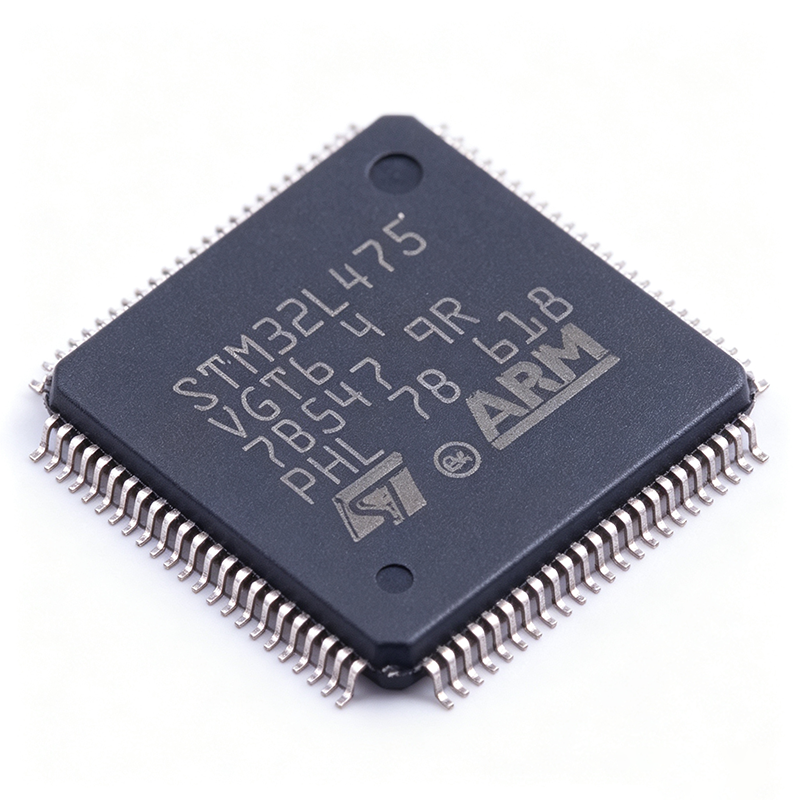
STM32L475VGT6 - Ultra-Low-Power Cortex-M4 MCU 1MB Flash | STMicroelectronics
The STM32L475VGT6 is an ultra-low-power 32-bit microcontroller from STMicroelectronics, based on the high-performance Arm® Cortex®-M4 32-bit RISC core with a floating-point unit (FPU) supporting single-precision arithmetic. It operates at a frequency of up to 80 MHz and provides 1 MB of Flash memory and 128 KB of SRAM, making it suitable for a wide range of battery-powered and energy-conscious applications. A microcontroller (MCU) is a compact integrated circuit designed to govern a specific operation in an embedded system. It contains a processor core, memory, and programmable input/output peripherals on a single chip. The STM32L475VGT6 belongs to the STM32L4 series, which is part of the broader STM32 family of 32-bit microcontrollers. These devices are known for their ultra-low-power consumption, making them ideal for IoT devices, wearables, and other applications where energy efficiency is critical. Key features of the STM32L475VGT6 include a 32-bit Arm Cortex-M4 core with FPU, 80 MHz maximum clock speed, 1 MB of Flash memory, 128 KB of SRAM, and a rich set of peripherals such as USB OTG FS, DFSDM (digital filter for sigma-delta modulators), multiple 12-bit ADCs, DACs, timers, and communication interfaces (I2C, SPI, USART, CAN, SAI). The device also supports a wide supply voltage range from 1.71V to 3.6V and offers multiple low-power modes, including Sleep, Low-power run, and Standby, to minimize energy consumption. The STM32L475VGT6 is built on ST's ultra-low-power technology, which combines the efficiency of the Cortex-M4 core with advanced power management. The FPU accelerates mathematical computations, while the DSP instructions enhance signal processing capabilities. The device includes a memory protection unit (MPU) and a wide range of security features, such as a true random number generator (TRNG) and a CRC calculation unit, ensuring robust operation in safety-critical applications. Typical applications include smart meters, industrial sensors, medical devices, wearable fitness trackers, and IoT gateways. Its low-power consumption and high performance make it an excellent choice for battery-operated devices that require complex processing and connectivity. The device is available in a 100-pin LQFP package (14x14 mm), which is suitable for space-constrained designs. When designing with the STM32L475VGT6, it is essential to provide proper decoupling capacitors on the power supply pins and to follow the layout guidelines in the datasheet to ensure stable operation. The device supports in-circuit programming and debugging via SWD and JTAG interfaces, facilitating firmware development and testing.
STM32L476VGT6 - Ultra-Low-Power Cortex-M4 MCU 80MHz 1MB Flash | STMicroelectronics
The STM32L476VGT6 is an ultra-low-power 32-bit microcontroller from STMicroelectronics, based on the high-performance Arm® Cortex®-M4 32-bit RISC core with floating-point unit (FPU). It operates at a frequency of up to 80 MHz, delivering 100 DMIPS performance while maintaining exceptional energy efficiency. The device features 1 Mbyte of Flash memory and 128 Kbytes of SRAM, making it suitable for a wide range of battery-powered and energy-conscious applications. What is a microcontroller? A microcontroller (MCU) is a compact integrated circuit designed to govern a specific operation in an embedded system. It integrates a processor core, memory (Flash and SRAM), and programmable input/output peripherals on a single chip. Microcontrollers are the brains of countless electronic devices, from automotive engine controllers to wearable health monitors. The STM32L476VGT6 belongs to the STM32L4 series, which is optimized for ultra-low-power operation without compromising performance, positioning it within the broader hierarchy of embedded processors and controllers. Key features of the STM32L476VGT6 include its 80 MHz Arm Cortex-M4 core with FPU, 1 MB Flash, 128 KB SRAM, and a rich set of peripherals such as USB OTG FS, LCD controller, and digital filters for sigma-delta modulators (DFSDM). It supports a wide supply voltage range from 1.71V to 3.6V, enabling direct battery operation. The device also integrates advanced low-power modes, including Sleep, Low-power Run, and Stop modes, with typical current consumption in the microamp range, extending battery life in portable applications. Technically, the STM32L476VGT6 leverages ST's proprietary ultra-low-power technology, featuring multiple power domains and dynamic voltage scaling. The FPU accelerates mathematical computations, beneficial for signal processing and control algorithms. The device includes a 12-bit ADC with hardware oversampling, multiple timers, and communication interfaces (I2C, SPI, USART, CAN, and USB). The LCD controller supports up to 8x40 segments, ideal for direct display driving without external components. Typical applications include smart meters, medical devices (e.g., glucose monitors, hearing aids), industrial sensors, and IoT edge nodes. Its ultra-low-power consumption and rich analog peripherals make it ideal for battery-operated devices that require long operational life. The 100-pin LQFP package (14x14 mm) offers a compact footprint with ample I/O for complex designs. When designing with this MCU, pay attention to the power supply decoupling: place a 100 nF capacitor close to each VDD pin and a 4.7 uF bulk capacitor on the main supply. Also, utilize the low-power modes effectively by configuring the RTC and wakeup sources to minimize average current consumption.
STM32L486JGY6TR - Ultra-low-power ARM Cortex-M4F MCU | STMicroelectronics
The STM32L486JGY6TR is an ultra-low-power 32-bit microcontroller from STMicroelectronics, based on the ARM Cortex-M4F core with FPU, operating at up to 80 MHz. It is part of the STM32L4 series, designed for high efficiency and long battery life in a wide range of applications. The device integrates 1 Mbyte of Flash memory and 128 Kbytes of SRAM, along with a rich set of peripherals including analog, digital, and communication interfaces. What is an ARM Cortex-M4F microcontroller? It is a 32-bit processor core designed for embedded systems, featuring a floating-point unit (FPU) for efficient handling of mathematical operations, and a memory protection unit (MPU) for enhanced security. The Cortex-M4F is part of the ARM Cortex-M family, which includes the M0, M0+, M3, M4, and M7 cores, each offering different performance and power trade-offs. In the system hierarchy, a microcontroller (MCU) integrates a processor core, memory, and peripherals on a single chip, enabling it to control electronic systems in applications ranging from consumer electronics to industrial automation. Key features of the STM32L486JGY6TR include its ultra-low-power modes (Sleep, Low-power run, Low-power sleep, Stop 0/1/2, Standby, and Shutdown), which are critical for battery-powered devices. It also features a 12-bit ADC with hardware oversampling, a 12-bit DAC, two comparators, and operational amplifiers. The device supports multiple communication interfaces: I2C, SPI, USART, UART, LPUART, SAI, CAN, USB OTG FS, and SDMMC. Additionally, it includes a true random number generator (TRNG), a CRC calculation unit, and a 96-bit unique ID. The STM32L486JGY6TR is manufactured using ST's 40nm process technology, which contributes to its low power consumption. The core operates at 1.8V to 3.6V, with a wide temperature range of -40°C to +85°C. The device is available in a 73-ball WLCSP package (0.4mm pitch), making it suitable for space-constrained designs. The package is lead-free and RoHS compliant. Typical applications include wearable devices, smart sensors, medical monitoring equipment, industrial sensors, and IoT edge nodes. The ultra-low-power modes and rich analog peripherals make it ideal for battery-operated devices that require long operational life. For example, in a wearable health monitor, the STM32L486JGY6TR can sample sensor data, process it with the FPU, and communicate via BLE (through an external module) while consuming minimal power. When designing with this device, pay attention to the power supply decoupling: place a 100nF capacitor close to each VDD pin and a 1uF capacitor on the main supply. Also, use the low-power modes effectively by configuring the RTC and wake-up sources to maximize battery life. The device supports a wide range of development tools, including STM32CubeMX and STM32CubeIDE, which simplify configuration and code generation.
STM32L486RGT6 - ARM Cortex-M4F 80MHz MCU | STMicroelectronics
The STMicroelectronics STM32L486RGT6 is a high-performance, ultra-low-power ARM Cortex-M4F microcontroller with floating-point unit (FPU) and DSP instructions, operating at up to 80 MHz. It is part of the STM32L4 series, designed for applications requiring low power consumption without compromising performance. The device features 1 Mbyte of Flash memory and 128 Kbytes of SRAM, along with a rich set of peripherals including analog, digital, and communication interfaces. What is an ARM Cortex-M4F microcontroller? It is a 32-bit processor core from ARM Holdings that includes a floating-point unit (FPU) for hardware-accelerated single-precision math, and DSP instructions for signal processing. In the system hierarchy, it sits as the central processing unit (CPU) within a microcontroller (MCU), which integrates memory, peripherals, and I/O on a single chip. The Cortex-M4F is widely used in embedded systems where a balance of performance, power efficiency, and cost is required, such as in IoT devices, industrial control, and consumer electronics. Key features of the STM32L486RGT6 include: 1 Mbyte Flash, 128 Kbytes SRAM, 80 MHz CPU, ultra-low-power modes (down to 100 nA in shutdown), a 12-bit ADC with 5 Msps, a 12-bit DAC, multiple timers, and communication interfaces including USART, SPI, I2C, USB OTG FS, CAN, and SDMMC. It also integrates a hardware cryptographic accelerator (AES, DES, 3DES) and a true random number generator (TRNG) for security applications. The STM32L486RGT6 is built on ST's ultra-low-power technology, featuring multiple power modes (Sleep, Low-power run, Low-power sleep, Stop 0/1/2, Standby, Shutdown) that allow designers to optimize energy consumption. The device operates from 1.71V to 3.6V supply, making it suitable for battery-powered applications. Its advanced analog peripherals, including op-amps and comparators, enable sensor signal conditioning without external components. Typical applications include smart meters, medical devices, wearable fitness trackers, industrial sensors, and IoT edge nodes. The combination of low power, high performance, and security features makes it ideal for applications that require long battery life and secure data handling. When designing with this MCU, pay attention to the power supply decoupling: place a 100 nF capacitor close to each VDD pin and a 4.7 uF bulk capacitor. For low-power modes, configure the clock source and voltage regulator appropriately to achieve the desired current consumption. The STM32L4 series offers a comprehensive set of development tools, including STM32CubeMX and STM32CubeIDE, which simplify configuration and code generation.
STM32L486VGT6 - ARM Cortex-M4F MCU 1MB Flash | STMicroelectronics
The STMicroelectronics STM32L486VGT6 is a high-performance, ultra-low-power ARM Cortex-M4F based microcontroller with 1MB of Flash memory and 128KB of SRAM, packaged in a 100-pin LQFP (VGT6 suffix). It operates at a maximum frequency of 80 MHz, delivering 100 DMIPS with DSP instructions and a hardware floating-point unit (FPU) for signal processing and control applications. What is an ARM Cortex-M4F microcontroller? It is a 32-bit processor core designed for embedded systems that require a balance of performance, energy efficiency, and advanced digital signal processing. The Cortex-M4F includes a single-precision FPU and DSP instructions, making it suitable for applications involving real-time control, sensor fusion, and audio processing. In the system hierarchy, it sits above simple 8-bit MCUs but below application processors, offering deterministic real-time behavior with low power consumption. Key features of the STM32L486VGT6 include an ultra-low-power mode with 100 nA shutdown current, a 12-bit ADC with 5 MSPS, two 12-bit DACs, multiple communication interfaces (USART, SPI, I2C, USB OTG FS, CAN, SAI), and a true random number generator (TRNG). It also integrates a cryptographic acceleration unit (AES, DES, and hash) for secure applications. The device supports a wide supply voltage range of 1.71V to 3.6V, making it ideal for battery-powered devices. The STM32L486VGT6 is built on ST's ultra-low-power technology, featuring multiple low-power modes (Sleep, Low-power Run, Low-power Sleep, Stop 2, Standby, Shutdown) that allow designers to optimize energy consumption. The FlexPowerControl feature enables independent power domains for the core, I/Os, and backup domain, providing flexibility in power management. The device also includes a 32-bit low-power timer, a real-time clock (RTC) with calendar, and a touch sensing controller. Typical applications include industrial sensors, smart meters, medical devices, wearable electronics, and IoT nodes. Its combination of low power, high performance, and rich peripherals makes it suitable for applications requiring long battery life without compromising on processing capability. For example, in a smart meter, the STM32L486VGT6 can handle metrology calculations, communication protocols, and display control while maintaining low average power consumption. When designing with this device, pay attention to the power supply decoupling: place a 100 nF capacitor close to each VDD pin and a 4.7 uF capacitor at the main supply. For low-power operation, configure unused GPIOs as analog inputs to avoid leakage currents. The device supports in-application programming (IAP) and in-circuit programming (ICP) via SWD or JTAG, facilitating firmware updates in the field.
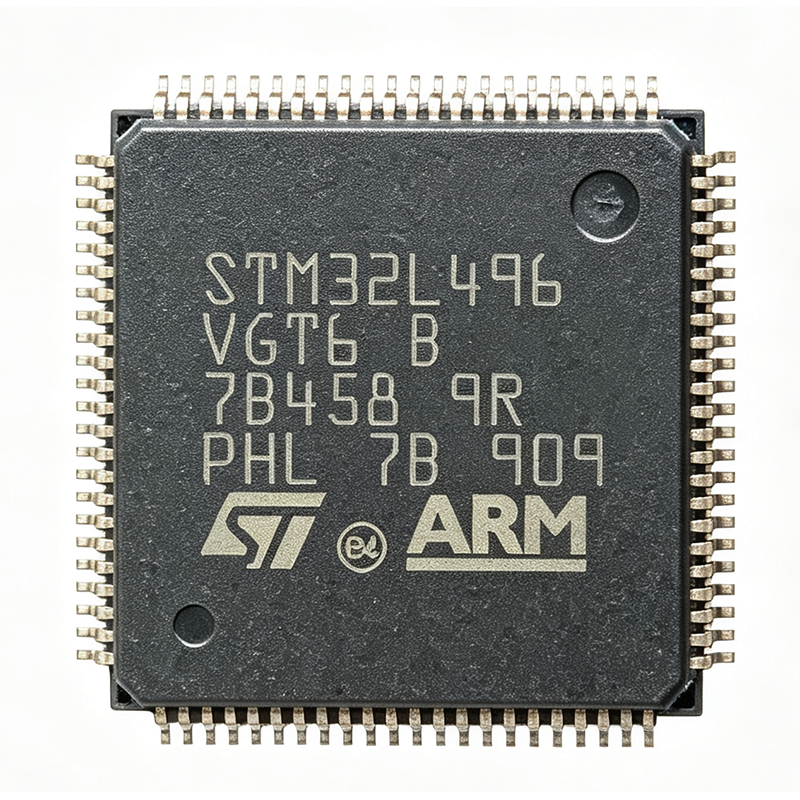
STM32L496VGT6 - Ultra-Low-Power ARM Cortex-M4F MCU | STMicroelectronics
The STM32L496VGT6 is an ultra-low-power 32-bit microcontroller from STMicroelectronics, based on the ARM Cortex-M4F core with FPU, running at up to 80 MHz. It integrates 1 MB of flash memory and 320 KB of SRAM, making it suitable for complex embedded applications requiring significant code and data storage. The device operates from a 1.71V to 3.6V supply and features a rich set of peripherals including multiple USARTs, SPIs, I2Cs, USB OTG FS, CAN, SDMMC, and advanced analog capabilities with two 12-bit ADCs, two DACs, and an internal voltage reference. What is an ultra-low-power microcontroller? An ultra-low-power microcontroller is a type of embedded processor designed to minimize energy consumption while maintaining computational performance. It belongs to the broader category of microcontrollers, which are integrated circuits containing a processor core, memory, and programmable peripherals on a single chip. In the system hierarchy, an ultra-low-power MCU sits above basic 8-bit controllers but below application processors, offering a balance of efficiency and capability for battery-powered and energy-harvesting devices. The STM32L496VGT6 exemplifies this class with multiple low-power modes, including Sleep, Low-power Run, and Shutdown, enabling extended battery life in portable and IoT applications. Key features of the STM32L496VGT6 include its 80 MHz ARM Cortex-M4F core with DSP instructions and single-precision FPU, 1 MB flash, 320 KB SRAM, and a comprehensive set of communication interfaces. It also features a Chrom-ART Accelerator for enhanced graphic performance, a true random number generator, and a cryptographic acceleration unit supporting AES, DES, and 3DES. The device is manufactured using ST's 40 nm process technology, contributing to its low power consumption and high integration density. Technically, the STM32L496VGT6 offers up to 100 DMIPS performance, with a CoreMark score of 273. It includes a flexible memory controller supporting external memory, and a large number of GPIOs (up to 114) in the LQFP100 package. The analog subsystem includes two 12-bit ADCs with hardware oversampling, two 12-bit DACs, and an internal voltage reference buffer. The device also supports a wide range of timers, including advanced-control timers for motor control and a low-power timer for wake-up from low-power modes. Typical applications include industrial sensors, smart meters, medical devices, wearable electronics, and IoT nodes. Its ultra-low-power modes and rich analog peripherals make it ideal for battery-powered data acquisition systems, while its connectivity options enable seamless integration into industrial networks and cloud platforms. When designing with this device, pay attention to the power supply decoupling and the selection of the appropriate low-power mode for your application. The STM32L496VGT6 supports a flexible clock tree with multiple PLLs, allowing optimization of performance versus power consumption. Ensure proper configuration of the voltage regulator range to balance performance and energy efficiency.
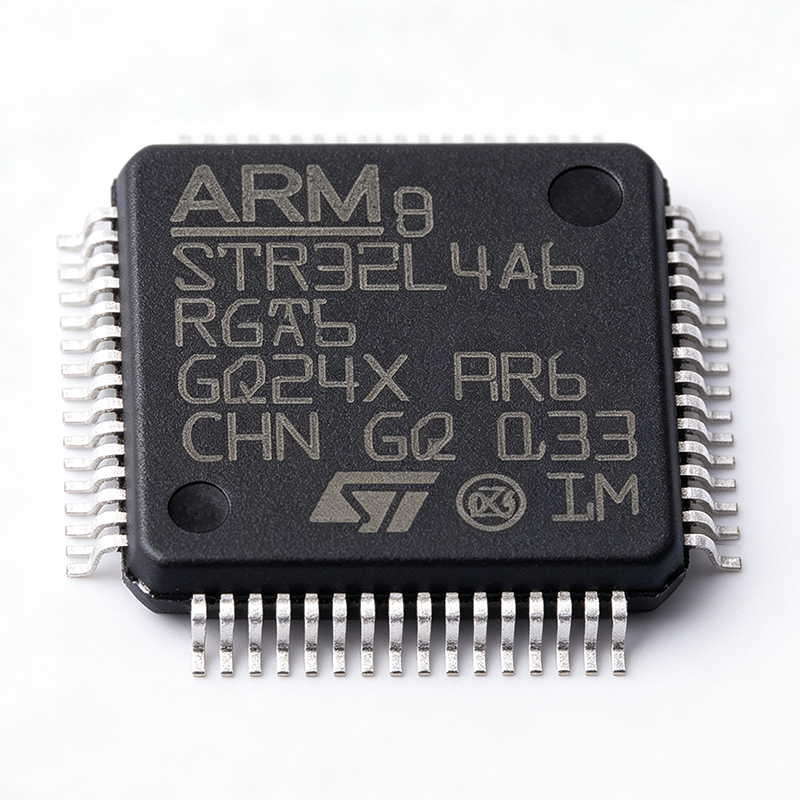
STM32L4A6RGT6 - Ultra-Low-Power ARM Cortex-M4F MCU | STMicroelectronics
The STM32L4A6RGT6 is an ultra-low-power 32-bit microcontroller from STMicroelectronics, based on the ARM Cortex-M4 core with floating-point unit (FPU). It operates at a maximum frequency of 80 MHz and delivers 100 DMIPS with 1.25 DMIPS/MHz. The device integrates 1 Mbyte of flash memory and 320 Kbytes of SRAM, making it suitable for complex applications requiring substantial code and data storage. An ultra-low-power microcontroller (MCU) is a system-on-chip designed to minimize energy consumption while maintaining processing capability. It combines a processor core, memory, and peripherals on a single chip, enabling battery-powered or energy-harvesting devices to operate for extended periods. The STM32L4 series is part of the STM32 family, which spans from low-power to high-performance MCUs, and is positioned as a leader in energy efficiency within the ARM Cortex-M ecosystem. Key features include a rich set of analog peripherals: two 12-bit DACs, two operational amplifiers, two ultra-low-power comparators, and a 16-bit ADC with hardware oversampling. It also offers advanced digital interfaces: two CAN 2.0B controllers, USB OTG full-speed, SDMMC, and multiple USART, SPI, and I2C ports. The device supports a wide supply voltage range from 1.71V to 3.6V and features multiple low-power modes, including a shutdown mode with current consumption as low as 28 nA. The STM32L4A6RGT6 is built on a 40 nm process technology, which contributes to its low power consumption. It includes a flexible memory protection unit (MPU), a true random number generator (TRNG), and a cryptographic acceleration unit (AES) for secure applications. The device also features a Chrom-ART Accelerator for enhanced graphic performance and a 16-bit advanced motor-control timer. Typical applications include industrial sensors, medical devices, smart meters, wearable devices, and IoT endpoints. Its combination of low power, high performance, and rich peripherals makes it ideal for battery-operated systems that require advanced processing and connectivity. When designing with this MCU, careful attention to power supply decoupling and PCB layout is essential to achieve the specified low-power performance. Use of the internal LDO or external SMPS step-down converter can optimize efficiency, and the multiple low-power modes should be leveraged to extend battery life.
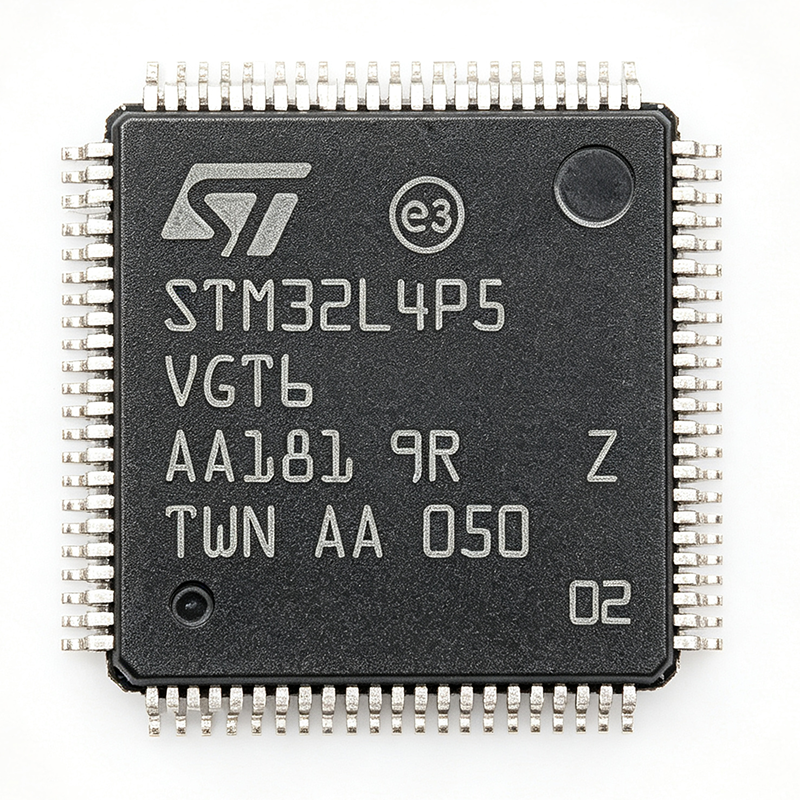
STM32L4P5VGT6 - Ultra-Low-Power Cortex-M4 MCU | STMicroelectronics
The STMicroelectronics STM32L4P5VGT6 is an ultra-low-power 32-bit microcontroller based on the ARM Cortex-M4 core with FPU, operating at up to 120 MHz. It delivers 213 DMIPS and 550 CoreMark, making it suitable for a wide range of battery-powered and energy-efficient applications. The device is housed in a 100-pin LQFP package (14x14 mm) and offers up to 1 MB of flash memory and 320 KB of SRAM. What is an ARM Cortex-M4 microcontroller? It is a 32-bit processor core designed for embedded systems, featuring a single-cycle multiply-accumulate (MAC) unit, hardware divide, and optional single-precision floating-point unit (FPU). The Cortex-M4 is part of the ARM Cortex-M family, which includes the M0, M0+, M3, M4, and M7 cores, each optimized for different performance and power trade-offs. In the system hierarchy, a microcontroller (MCU) integrates the processor core, memory, and peripherals on a single chip, serving as the central processing unit in embedded systems such as IoT devices, industrial controllers, and consumer electronics. Key features include a rich set of analog peripherals: two 12-bit DACs, three 12-bit ADCs with hardware oversampling, two operational amplifiers, two comparators, and an internal voltage reference buffer. The device also integrates advanced digital peripherals: two CAN FD controllers, one USB 2.0 OTG FS/HS, one SDMMC interface, and a flexible memory controller (FMC) for external memory expansion. The STM32L4P5VGT6 supports multiple low-power modes, including Sleep, Low-power Run, Low-power Sleep, Stop 0/1/2, and Standby, with a typical current consumption of 100 nA in Standby mode with backup domain. The STM32L4P5VGT6 is built on ST's ultra-low-power technology, featuring a dynamic voltage scaling (DVS) capability that adjusts the core voltage to optimize power consumption at different operating frequencies. The device includes a hardware cryptographic accelerator (AES, DES, 3DES) and a true random number generator (TRNG), enhancing security for connected applications. The rich set of timers includes two advanced-control timers, six general-purpose timers, two basic timers, and two low-power timers, providing precise timing and PWM generation. Typical applications include IoT nodes, smart meters, portable medical devices, industrial sensors, and wearable devices. The ultra-low-power modes and high integration make it ideal for battery-powered systems requiring long operational life. The device also supports a wide operating temperature range of -40°C to +85°C, suitable for industrial environments. When designing with this MCU, pay attention to the power supply decoupling: place a 100 nF capacitor close to each VDD pin and a 4.7 uF capacitor at the main power input. For low-power operation, configure the GPIOs to analog mode when unused to reduce leakage current. The STM32L4P5VGT6 is supported by STM32CubeMX and STM32CubeL4 firmware package, simplifying development.
STM32L4Q5VGT6 - Ultra-Low-Power ARM Cortex-M4 MCU | STMicroelectronics
The STM32L4Q5VGT6 is an ultra-low-power microcontroller from STMicroelectronics, featuring an ARM Cortex-M4 core with FPU and DSP instructions, running at up to 120 MHz. It is part of the STM32L4 series, designed for high performance and low power consumption, making it ideal for battery-powered and energy-efficient applications. An ARM Cortex-M4 microcontroller is a 32-bit processor core designed for embedded systems, offering a balance of performance and power efficiency. It includes a floating-point unit (FPU) for efficient mathematical computations and DSP instructions for signal processing. The STM32L4 series is known for its ultra-low-power modes, including sleep, stop, and standby, which are critical for extending battery life in portable devices. Key features of the STM32L4Q5VGT6 include 1 MB of flash memory and 320 KB of SRAM, providing ample storage for complex applications. It operates from 1.71V to 3.6V, with a wide temperature range of -40°C to +85°C. The device integrates a rich set of peripherals, including multiple USART, SPI, I2C, USB OTG FS, CAN, and advanced analog features such as a 16-bit ADC and a 12-bit DAC. It also includes a true random number generator (TRNG) and a cryptographic acceleration unit for secure applications. The STM32L4Q5VGT6 is built on a 40nm process technology, enabling low dynamic power consumption. It features a flexible power management system with multiple power domains, allowing designers to optimize power usage. The device supports various low-power modes, with typical current consumption as low as 100 nA in standby mode, making it suitable for always-on applications. Typical applications include industrial sensors, smart meters, medical devices, wearable devices, and IoT nodes. Its combination of performance, low power, and rich peripherals makes it a versatile choice for a wide range of embedded systems. When designing with this MCU, it is essential to consider the power supply decoupling and proper grounding to ensure stable operation. The device requires a 1.8V to 3.6V supply, and it is recommended to use a 100nF capacitor close to each power pin. Additionally, the internal LDO can be used to generate the core voltage, but external regulators may be needed for higher efficiency in battery-powered designs.
STM32L4S5VIT6 - Ultra-Low-Power ARM Cortex-M4F MCU | STMicroelectronics
The STM32L4S5VIT6 is an ultra-low-power 32-bit microcontroller from STMicroelectronics, based on the ARM Cortex-M4 core with floating-point unit (FPU). It operates at a maximum frequency of 120 MHz and delivers 150 DMIPS (Dhrystone 2.1) performance. The device integrates 2 MB of flash memory and 640 KB of SRAM, making it suitable for complex applications requiring substantial code and data storage. It is housed in a 100-pin LQFP package (LQFP100) with a 14x14 mm body and 0.5 mm pitch, providing a compact footprint for space-constrained designs. What is an ultra-low-power microcontroller? An ultra-low-power microcontroller is a type of embedded processor designed to minimize energy consumption while maintaining computational capability. It typically features multiple low-power modes, such as sleep, stop, and standby, allowing the system to conserve power when idle. In the system hierarchy, an ultra-low-power MCU is a subset of microcontrollers, which are a type of integrated circuit used in embedded systems. The STM32L4 series is specifically optimized for battery-powered and energy-harvesting applications, balancing performance with power efficiency. Key features of the STM32L4S5VIT6 include a rich set of peripherals: multiple 12-bit ADCs, DACs, timers, communication interfaces (USART, SPI, I2C, CAN, USB OTG), and advanced security features such as a true random number generator (TRNG) and cryptographic acceleration. The device supports a wide supply voltage range from 1.71V to 3.6V, with a typical operating temperature range of -40°C to +85°C. It also features a flexible memory protection unit (MPU) and a memory-mapped external memory interface for expanding storage. Technically, the STM32L4S5VIT6 leverages ST's proprietary ultra-low-power technology, including a low-power UART, low-power timer, and a real-time clock (RTC) with calendar. The MCU achieves a current consumption as low as 100 nA in standby mode with backup domain, and 3.4 µA in stop mode with RTC. This makes it ideal for always-on sensing applications. The device also includes a high-speed USB OTG controller with PHY, enabling direct connection to USB hosts without external PHY. Typical applications include industrial sensors, smart meters, wearable devices, medical monitoring equipment, and IoT edge nodes. Its combination of low power, high performance, and rich peripherals allows designers to implement complex algorithms while extending battery life. For example, in a smart meter, the MCU can handle metrology calculations, communication protocols, and display updates while spending most of its time in low-power modes. When designing with this MCU, pay attention to power supply decoupling: place a 100 nF capacitor close to each VDD pin and a 4.7 µF capacitor on the main supply. Also, configure the clock system carefully to balance performance and power consumption, using the MSI (multi-speed internal) oscillator for low-power operation and the HSE (high-speed external) crystal for precise timing when needed.
STM32L4S9ZIT6 - Ultra-Low-Power ARM Cortex-M4F MCU | STMicroelectronics
The STM32L4S9ZIT6 is an ultra-low-power 32-bit microcontroller from STMicroelectronics, based on the ARM Cortex-M4 core with floating-point unit (FPU). It operates at a maximum frequency of 120 MHz and delivers 150 DMIPS (Dhrystone 2.1) performance. The device integrates 2 MB of flash memory and 640 KB of SRAM, making it suitable for complex applications requiring large code and data storage. It is housed in a 144-pin LQFP package (LQFP144) with a 20x20 mm body and 0.5 mm pitch, providing ample I/O for peripheral-rich designs. A microcontroller (MCU) is a compact integrated circuit designed to govern a specific operation in an embedded system. It contains a processor core, memory (flash and SRAM), and programmable input/output peripherals on a single chip. The STM32L4 series is part of STMicroelectronics' ultra-low-power portfolio, targeting battery-powered and energy-harvesting applications. The Cortex-M4 core with FPU enables efficient digital signal processing (DSP) instructions and single-precision floating-point arithmetic, bridging the gap between general-purpose MCUs and higher-end application processors. Key features include a rich set of analog peripherals: three 12-bit ADCs with up to 5 MSPS, two 12-bit DACs, two operational amplifiers, two comparators, and an internal voltage reference buffer. For connectivity, it offers multiple communication interfaces: 6x I2C, 6x USART/UART, 3x SPI, 2x SAI (serial audio interface), 1x SDMMC, 1x CAN, 1x USB OTG FS, and 1x camera interface (DCMI). The device also includes a Chrom-ART Accelerator (DMA2D) for 2D graphics, a true random number generator (TRNG), and a hardware cryptographic accelerator (AES, DES, 3DES, and SHA-1/SHA-256). The STM32L4S9ZIT6 is built on a 40 nm process technology, achieving ultra-low power consumption: 100 nA in shutdown mode, 3.6 uA in standby mode with RTC, and 28 uA/MHz in run mode. It supports a wide supply voltage range of 1.71V to 3.6V, with an internal voltage regulator and power management unit. The device includes a flexible power controller with multiple low-power modes (Sleep, Low-power run, Low-power sleep, Stop 0/1/2, Standby, Shutdown) to optimize energy efficiency. Typical applications include industrial sensors, smart meters, medical devices, wearable devices, IoT nodes, and audio processing. The large memory and rich peripherals make it ideal for applications requiring local data logging, advanced user interfaces, or real-time signal processing. The Chrom-ART accelerator and TFT-LCD controller (LTDC) support graphical displays without burdening the CPU. When designing with this device, pay attention to power supply decoupling: place a 100 nF capacitor close to each VDD pin and a 4.7 uF capacitor on the main supply. For low-power modes, configure the RTC and wakeup sources carefully to minimize current consumption. The device supports in-circuit programming and debugging via SWD and JTAG interfaces, facilitating development.
STM32L552RET6 - 110MHz Arm Cortex-M33 MCU with TrustZone | STMicroelectronics
The STMicroelectronics STM32L552RET6 is an ultra-low-power 32-bit microcontroller based on the Arm Cortex-M33 core with TrustZone for Armv8-M, delivering 110 MHz maximum clock frequency. It integrates 512 KB of flash memory and 256 KB of SRAM, along with a rich set of peripherals including advanced analog, timers, communication interfaces, and security features. The device is housed in a 64-pin LQFP package (10x10 mm) and operates over a supply voltage range of 1.71V to 3.6V, with an extended temperature range of -40°C to +85°C. What is an Arm Cortex-M33 microcontroller? The Arm Cortex-M33 is a modern 32-bit processor core designed for embedded applications requiring a balance of performance, power efficiency, and security. It implements the Armv8-M architecture with optional TrustZone technology, which provides hardware-enforced isolation between secure and non-secure software domains. In the system hierarchy, the STM32L552RET6 is a microcontroller (MCU) that integrates the Cortex-M33 core, memory, and peripherals on a single chip, serving as the central processing unit in embedded systems. It belongs to the STM32L5 series, which is positioned as STMicroelectronics' secure, ultra-low-power MCU family, bridging the gap between general-purpose MCUs and application processors. Key features of the STM32L552RET6 include a 110 MHz Arm Cortex-M33 core with DSP instructions and a floating-point unit (FPU), 512 KB flash, 256 KB SRAM, and a comprehensive set of security features such as TrustZone, a true random number generator (TRNG), and cryptographic acceleration (AES, RSA, ECC). The device also offers multiple low-power modes, including Sleep, Low-power Run, Low-power Sleep, Stop 0/1/2, and Standby, with a typical current consumption of 100 nA in Standby mode with backup domain. The rich analog subsystem includes a 16-bit ADC with hardware oversampling, two 12-bit DACs, and two ultra-low-power comparators. From a technical depth perspective, the STM32L552RET6 is fabricated using ST's advanced 40 nm process technology, which contributes to its exceptional power efficiency. The TrustZone technology enables secure boot and secure firmware update, making it suitable for IoT and security-critical applications. The device also features a flexible memory protection unit (MPU) and a secure access controller (SAC) to enforce security policies. The integrated power management includes a built-in DC-DC converter and a low-power regulator, allowing designers to optimize power consumption based on the application's needs. Typical applications for the STM32L552RET6 include IoT edge devices, smart meters, industrial sensors, medical monitoring equipment, and secure access control systems. Its combination of low power, high performance, and security makes it ideal for battery-powered devices that require secure communication and data protection. For example, in a smart meter, the MCU can handle metering calculations, secure communication with the utility, and display updates while maintaining long battery life. When designing with the STM32L552RET6, it is essential to consider the power supply decoupling: place a 100 nF capacitor close to each VDD pin and a 4.7 uF capacitor at the main power input. For the VDDA pin, use a dedicated 1 uF capacitor to ensure analog performance. Additionally, the BOOT0 pin configuration must be set correctly for the desired boot mode, and the NRST pin should have a 100 nF capacitor to ground for reliable reset operation. The device supports in-circuit programming and debugging via SWD, which requires minimal external components.
STM32L552ZET6 - Ultra-Low-Power ARM Cortex-M33 MCU | STMicroelectronics
The STM32L552ZET6 is an ultra-low-power 32-bit microcontroller from STMicroelectronics, based on the ARM Cortex-M33 core with TrustZone for enhanced security. It operates at a maximum frequency of 110 MHz and provides 512 KB of flash memory and 256 KB of SRAM, making it suitable for a wide range of battery-powered and energy-efficient applications. What is a microcontroller? A microcontroller (MCU) is a compact integrated circuit designed to govern a specific operation in an embedded system. It integrates a processor core, memory, and programmable input/output peripherals on a single chip. In the system hierarchy, a microcontroller is a type of embedded processor, which falls under the broader category of integrated circuits. The STM32L552ZET6 is part of the STM32L5 series, which is positioned as a high-performance, ultra-low-power MCU family within STMicroelectronics' extensive STM32 portfolio. Key features of the STM32L552ZET6 include an ARM Cortex-M33 core with DSP instructions and a floating-point unit (FPU) for efficient signal processing, a TrustZone security extension for secure boot and secure firmware updates, and a rich set of peripherals including multiple UARTs, SPIs, I2Cs, USB, and an advanced 12-bit ADC. The device also features a low-power mode with current consumption as low as 33 µA/MHz in Run mode and 0.29 µA in Standby mode, enabling extended battery life in portable devices. Technically, the STM32L552ZET6 is fabricated using a 40 nm process technology, which contributes to its low power consumption and high performance. The Cortex-M33 core supports the ARMv8-M architecture, providing hardware-enforced isolation between secure and non-secure software domains. This makes it ideal for IoT devices, smart meters, and medical devices where security and energy efficiency are critical. Typical applications include smart home devices, industrial sensors, wearable health monitors, and battery-operated consumer electronics. The device's low power consumption and security features make it particularly well-suited for IoT edge nodes that require secure communication and long battery life. When designing with the STM32L552ZET6, consider using the STM32CubeMX tool for pin configuration and code generation, and ensure proper decoupling of the power supply pins with 100 nF capacitors. The device supports a wide supply voltage range of 1.71 V to 3.6 V, allowing direct battery operation. For optimal performance, use the internal multi-speed internal (MSI) RC oscillator or an external crystal for precise timing.
STM32L562RET6 - 512KB Flash, 110MHz Cortex-M33 MCU | STMicroelectronics
The STMicroelectronics STM32L562RET6 is an ultra-low-power 32-bit microcontroller based on the Arm Cortex-M33 core with TrustZone, running at up to 110 MHz. It integrates 512 KB of flash memory and 256 KB of SRAM, and is housed in a 64-pin LQFP (LQFP64) package. This device is part of the STM32L5 series, designed for secure and power-efficient applications. What is a microcontroller? A microcontroller (MCU) is a compact integrated circuit containing a processor core, memory, and programmable input/output peripherals on a single chip. It is the brain of embedded systems, executing firmware to control devices such as sensors, motors, and displays. In the system hierarchy, a microcontroller is a type of embedded processor, which falls under the broader category of integrated circuits (ICs) and semiconductors. The STM32L562RET6 specifically combines high performance with ultra-low power consumption, making it suitable for battery-powered and energy-harvesting applications. Key features include the Arm Cortex-M33 core with TrustZone for hardware-enforced security, a floating-point unit (FPU) for math-intensive tasks, and a rich set of peripherals including multiple UARTs, SPIs, I2Cs, USB, and an advanced 12-bit ADC. The device supports a wide supply voltage range of 1.71V to 3.6V and operates over a temperature range of -40°C to +85°C. It also features a low-power mode with current consumption as low as 100 nA in standby mode, extending battery life in portable devices. Technically, the STM32L562RET6 is built on a 40nm process technology, enabling high performance with low leakage. The TrustZone security feature isolates critical code and data, protecting against software attacks. The device includes a hardware cryptographic accelerator supporting AES, RSA, and ECC, as well as a true random number generator (TRNG) for secure key generation. These features make it ideal for IoT devices requiring secure communication and data protection. Typical applications include secure IoT nodes, smart meters, wearable health monitors, industrial sensors, and battery-powered medical devices. The combination of ultra-low power and security makes it a preferred choice for edge devices that must operate for years on a single battery while protecting sensitive data. When designing with this MCU, ensure proper decoupling of the power supply pins with 100nF capacitors placed close to each VDD pin. The VDDA pin requires a separate 1uF capacitor for analog noise filtering. For low-power operation, configure the clock to use the low-speed internal oscillator (LSI) and enable the low-power modes in the firmware to achieve the specified standby current.
STM32L562ZET6 - Ultra-Low-Power ARM Cortex-M33 MCU | STMicroelectronics
The STM32L562ZET6 is an ultra-low-power microcontroller from STMicroelectronics, featuring an ARM Cortex-M33 core with TrustZone, running at up to 110 MHz. It integrates 512 KB of flash memory and 256 KB of SRAM, making it suitable for secure IoT, industrial, and medical applications. The device operates from 1.71V to 3.6V and is available in the LQFP-144 package. What is an ARM Cortex-M33 microcontroller? The ARM Cortex-M33 is a modern 32-bit processor core designed for embedded systems, offering enhanced security features such as TrustZone for Armv8-M, which provides hardware-enforced isolation between secure and non-secure software. It is part of the ARM Cortex-M family, which includes the popular Cortex-M0, M3, and M4 cores. The Cortex-M33 is optimized for low-power operation and real-time performance, making it ideal for battery-powered devices and applications requiring robust security. Key features of the STM32L562ZET6 include a 110 MHz Cortex-M33 core with DSP instructions and a floating-point unit (FPU), 512 KB of flash memory, 256 KB of SRAM, and a rich set of peripherals. It supports TrustZone for secure boot and secure firmware updates, along with hardware cryptographic accelerators (AES, RSA, ECC) and a true random number generator (TRNG). The device also features multiple low-power modes, including Sleep, Low-power Run, and Standby, with a typical current consumption of 100 nA in Standby mode. The STM32L562ZET6 is built on STMicroelectronics' ultra-low-power technology, which leverages a 40 nm process to achieve industry-leading energy efficiency. The core operates at 110 MHz while consuming only 19 µA/MHz in Run mode, and the device supports dynamic voltage scaling to further optimize power consumption. The integrated security features, including TrustZone and cryptographic accelerators, enable secure communication and data protection without external components. Typical applications include secure IoT nodes, smart meters, industrial control systems, medical devices, and wearable electronics. The device's rich analog peripherals, including a 12-bit ADC, 12-bit DAC, and multiple comparators, make it suitable for sensor interfacing and data acquisition. The LQFP-144 package provides ample GPIOs for complex system integration. When designing with the STM32L562ZET6, ensure proper decoupling of the power supply pins with 100 nF capacitors placed close to each VDD pin. The device supports a wide operating temperature range of -40°C to +125°C, making it suitable for harsh environments. For security-critical applications, enable TrustZone and use the secure boot feature to protect firmware integrity.
STM32MP153CAC3 - Dual Cortex-A7 + Cortex-M4 MPU | STMicroelectronics
The STMicroelectronics STM32MP153CAC3 is a high-performance heterogeneous microprocessor (MPU) that combines a dual-core Arm Cortex-A7 application processor running up to 650 MHz with a Cortex-M4 real-time core running up to 209 MHz. This device is designed for industrial, IoT, and embedded applications requiring both rich operating system support (Linux/Android) and deterministic real-time control. The STM32MP153CAC3 is part of the STM32MP1 series, which integrates advanced security features, rich connectivity, and a comprehensive power management architecture. A microprocessor unit (MPU) is a complete computing engine that typically runs a full operating system, unlike a microcontroller (MCU) which runs bare-metal or RTOS code. The STM32MP1 series bridges the gap by integrating both an MPU-class application processor and an MCU-class real-time core on a single chip, enabling a single-chip solution for applications that need both high-level processing and low-latency control. This architecture is part of the broader system hierarchy: MPU -> application processor -> system-on-chip (SoC) -> embedded computing platform. Key features of the STM32MP153CAC3 include a dual-core Cortex-A7 at 650 MHz, a Cortex-M4 at 209 MHz, a 3D GPU (Graphics Processing Unit) for advanced user interfaces, and a rich set of peripherals including Ethernet, USB, CAN, and multiple serial interfaces. The device supports up to 1 GB of DDR3/DDR3L memory and features a comprehensive security suite including secure boot, hardware cryptographic accelerators, and a true random number generator (TRNG). The STM32MP153CAC3 is available in a TFBGA361 package with 361 balls, offering a compact footprint for space-constrained designs. The STM32MP153CAC3 is built on a 28nm FD-SOI process technology, providing a balance of performance and power efficiency. The dual-core architecture allows symmetric multiprocessing (SMP) for Linux, while the Cortex-M4 core can run bare-metal or FreeRTOS for real-time tasks. The device includes a rich set of power modes, including standby, stop, and low-power modes, enabling energy-efficient operation in battery-powered or always-on applications. Typical applications include industrial automation controllers, smart gateways, human-machine interfaces (HMIs), medical monitoring devices, and IoT edge nodes. The combination of high-performance processing and real-time control makes it ideal for applications that require both complex algorithms and deterministic response times. When designing with the STM32MP153CAC3, careful attention must be paid to power supply sequencing, DDR memory layout, and thermal management. The device requires multiple power rails (VDD, VDD_IO, VDD_CORE) with specific sequencing requirements. The TFBGA361 package requires a multi-layer PCB with proper decoupling and thermal vias to ensure reliable operation at high clock speeds.
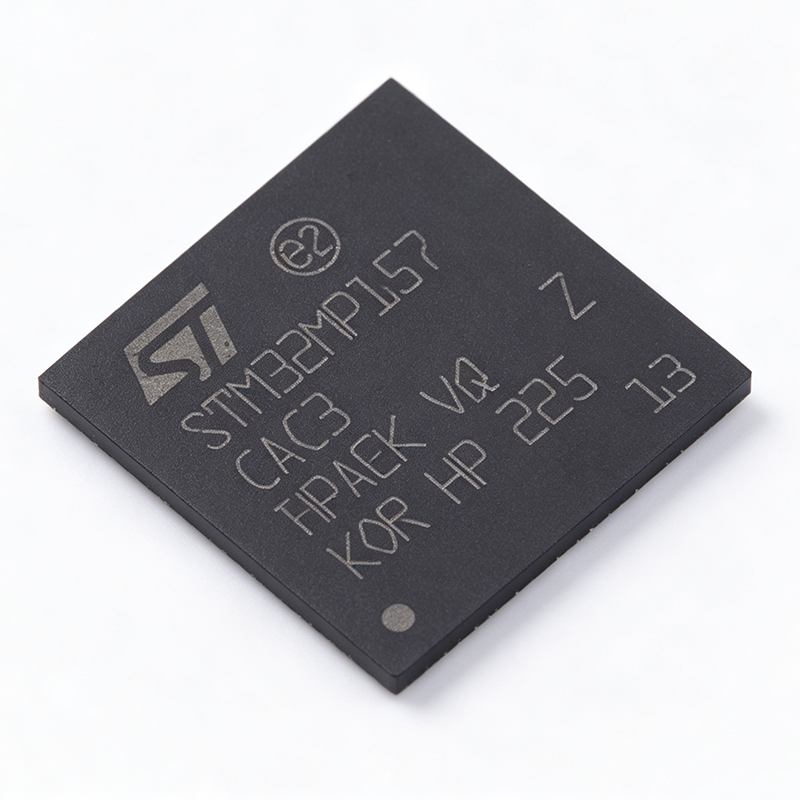
STM32MP157CAC3 - Dual Cortex-A7 + M4 MPU | STMicroelectronics
The STMicroelectronics STM32MP157CAC3 is a high-performance heterogeneous microprocessor (MPU) that combines a dual-core Arm Cortex-A7 application processor running up to 650 MHz with a Cortex-M4 real-time core running up to 209 MHz. This device is designed for advanced embedded applications requiring both rich operating system support (Linux, Android) and deterministic real-time control. It is housed in a 361-ball TFBGA package (18x18 mm, 0.8 mm pitch) and operates over a temperature range of -40°C to +125°C. A microprocessor (MPU) is a general-purpose computing unit that executes complex operating systems and application software, distinct from a microcontroller (MCU) which typically integrates memory and peripherals for simpler control tasks. The STM32MP157CAC3 belongs to the STM32MP1 series, which bridges the gap between MCUs and application processors by offering both a Linux-capable Cortex-A7 subsystem and a real-time Cortex-M4 core. This architecture enables a single chip to handle both high-level user interfaces and time-critical control loops, reducing system complexity and BOM cost. Key features include a rich set of connectivity options: 2x Ethernet (GMAC with TSN support), 2x USB 2.0 OTG, 8x UART, 5x I2C, 5x SPI, 2x CAN FD, and SDMMC interfaces. The device integrates a 3D GPU (OpenGL ES 2.0) for graphical user interfaces, a MIPI DSI display controller, and a 12-bit ADC with up to 16 channels. Memory interfaces include 16-bit DDR3/DDR3L/LPDDR2/LPDDR3 support, plus flexible external memory controller for NAND, NOR, and SRAM. Security features include a cryptographic accelerator (AES, DES, 3DES, SHA-1, SHA-256, MD5) and a secure boot option. The STM32MP157CAC3 is built on a 28nm FD-SOI process, offering a balance of performance and power efficiency. The dual Cortex-A7 cores provide up to 1300 DMIPS, while the Cortex-M4 adds 240 DMIPS for real-time tasks. The device supports a wide range of power supply voltages (VDD from 1.8V to 3.3V for I/O, core at 1.2V) and includes multiple low-power modes (Sleep, Stop, Standby) to optimize energy consumption in battery-powered or energy-conscious designs. Typical applications include industrial HMI (Human-Machine Interface) panels, smart home gateways, medical monitoring devices, and IoT edge nodes that require both connectivity and local processing. The dual-core architecture allows Linux to run complex applications while the M4 core handles sensor acquisition and motor control in real time. The integrated GPU and display controller make it ideal for graphical interfaces in industrial automation and consumer electronics. When designing with the STM32MP157CAC3, careful attention must be paid to power sequencing (VDD, VDD_CPU, VDD_IO) and decoupling of the multiple power rails. The device requires a PMIC (e.g., STPMIC1) for proper power management. Additionally, DDR3 routing requires impedance-controlled traces and proper termination for signal integrity at high speeds.
STM32MP157FAD7 - Dual Cortex-A7 + M4 MPU | STMicroelectronics
The STMicroelectronics STM32MP157FAD7 is a high-performance heterogeneous microprocessor (MPU) that combines a dual-core Arm Cortex-A7 application processor running up to 650 MHz with a Cortex-M4 real-time core running at 209 MHz. This device is part of the STM32MP1 series, designed for industrial, IoT, and embedded applications requiring both rich operating system support (Linux/Android) and deterministic real-time control. The STM32MP157FAD7 is housed in a 448-pin LFBGA package (18x18 mm, 0.8 mm pitch) and operates over a temperature range of -40°C to +125°C. A microprocessor (MPU) is a complete processing unit that integrates one or more CPU cores, memory interfaces, and peripheral controllers on a single chip, distinct from a microcontroller (MCU) which typically has embedded flash and simpler peripherals. The STM32MP157FAD7 belongs to the class of heterogeneous multicore MPUs, which combine application-class cores (Cortex-A7) with a real-time core (Cortex-M4) to handle both high-level operating systems and time-critical tasks. This architecture enables a single chip to replace a multi-chip solution, reducing system cost and complexity. Key features include a rich set of connectivity options: dual Ethernet (10/100/1000 Mbps), USB 2.0 OTG, multiple UARTs, SPI, I2C, CAN FD, and SDMMC interfaces. It also integrates a 3D GPU (OpenGL ES 2.0), a 2D graphics accelerator, and a display controller supporting up to 1080p resolution, making it suitable for human-machine interface (HMI) applications. The device supports external DDR3/DDR3L/LPDDR2 memory with a 16-bit bus, and includes a comprehensive security suite with cryptographic accelerators and secure boot. The STM32MP157FAD7 is built on a 28nm FD-SOI process, offering a balance of performance and power efficiency. The dual Cortex-A7 cores provide up to 650 MHz each, while the Cortex-M4 runs at 209 MHz, enabling real-time control. The device includes a memory protection unit (MPU) for each core, ensuring isolation between the application and real-time domains. The power management unit (PMU) supports multiple low-power modes, including standby and shutdown, with wake-up sources from GPIO, RTC, and Ethernet. Typical applications include industrial PLCs, smart gateways, medical monitoring devices, and advanced HMI systems. The combination of high-performance processing, rich connectivity, and real-time capabilities makes it ideal for edge computing nodes that require both Linux-based applications and deterministic control. For example, in a smart factory, the STM32MP157FAD7 can run a Linux-based HMI while simultaneously controlling a robotic arm via the Cortex-M4 core. When designing with this device, careful attention must be paid to power sequencing and decoupling. The device requires multiple supply rails (VDD, VDD_IO, VDD_3V3, etc.) with specific power-up sequences. A dedicated PMIC (such as the STPMIC1) is recommended to manage the power rails and ensure proper sequencing. Additionally, the DDR memory interface requires careful PCB layout with controlled impedance and length matching to ensure signal integrity at high speeds.

STM32MP257F - Dual Cortex-A35 1.5GHz MPU | STMicroelectronics | Industrial IoT
The STMicroelectronics STM32MP257F is a high-performance heterogeneous microprocessor (MPU) combining a dual-core Arm Cortex-A35 64-bit application processor running at up to 1.5 GHz and a single Cortex-M33 real-time core at up to 400 MHz. It is designed for industrial IoT, smart factory, and edge computing applications, integrating advanced security features, rich connectivity, and a comprehensive set of peripherals, making it a versatile platform for Linux-based and real-time systems. A microprocessor (MPU) is a complete computing engine that typically runs a full operating system like Linux, in contrast to a microcontroller (MCU) which runs bare-metal or RTOS. The STM32MP257F belongs to the STM32MP2 series, which is part of the broader STM32 family of 32-bit Arm-based devices. This MPU sits at the top of the STM32 performance hierarchy, offering the processing power of an application processor with the real-time capabilities of a microcontroller core. Key features include a dual-core Cortex-A35 running up to 1.5 GHz, a Cortex-M33 at 400 MHz, and a dedicated 3D GPU for graphical user interfaces. It supports up to 2 GB of DDR4/LPDDR4 memory, providing ample bandwidth for data-intensive applications. The device also includes a hardware cryptographic accelerator, secure boot, and a TrustZone architecture for robust security. Technically, the STM32MP257F is built on a 28nm FD-SOI process, offering a balance of performance and power efficiency. It features a rich set of peripherals including multiple Ethernet ports (up to 2x GbE with TSN), USB 2.0/3.0, CAN-FD, and a wide range of serial interfaces. The dual-core architecture allows asymmetric multiprocessing (AMP) where the A35 cores run Linux while the M33 core handles real-time tasks, enabling a single-chip solution for complex systems. Typical applications include industrial PLCs, HMI panels, smart gateways, and edge AI devices. The combination of high-performance processing, real-time control, and rich connectivity makes it ideal for Industry 4.0 deployments where deterministic control and data processing are required. When designing with the STM32MP257F, careful attention must be paid to power sequencing and thermal management. The device requires multiple supply rails (1.8V, 3.3V, and core voltage) with proper sequencing to avoid latch-up. A thermal solution is recommended for sustained operation at maximum frequency, especially in enclosed industrial enclosures.
STM32MP257FAE3 - Dual Cortex-A7 + M4 MPU | STMicroelectronics
The STMicroelectronics STM32MP257FAE3 is a high-performance heterogeneous microprocessor (MPU) combining a dual-core Arm Cortex-A7 application processor and a Cortex-M4 microcontroller core in a single device. It is designed for industrial and embedded applications requiring both rich operating system support (Linux/Android) and real-time control. The device integrates advanced security features, rich connectivity, and a comprehensive set of peripherals, making it a versatile platform for a wide range of products. A microprocessor (MPU) is a general-purpose computing unit that executes complex operating systems and application software, typically requiring external memory (DDR, NAND, NOR) and storage. In contrast, a microcontroller (MCU) integrates memory, peripherals, and a simpler core for real-time, deterministic tasks. The STM32MP257FAE3 belongs to the STM32MP2 series, which is part of the broader STM32 family of 32-bit microcontrollers and microprocessors. This device bridges the gap between MCUs and high-end application processors, offering the best of both worlds: the real-time responsiveness of an MCU and the processing power of an MPU. Key features of the STM32MP257FAE3 include a dual-core Arm Cortex-A7 running up to 1.2 GHz, a Cortex-M4 core at 800 MHz, and a comprehensive set of peripherals including multiple UARTs, SPI, I2C, USB 2.0, Ethernet, and camera interfaces. It supports up to 4 GB of external DDR4/LPDDR4 memory and features a rich set of security functions such as secure boot, cryptographic accelerators, and a TrustZone-enabled architecture. The device is available in a TFBGA package with 448 balls, offering a compact footprint for space-constrained designs. From a technical depth perspective, the STM32MP257FAE3 leverages ST's advanced 28nm FD-SOI process technology, which provides low power consumption and high performance. The heterogeneous architecture allows for efficient task partitioning: the Cortex-A7 cores handle high-level operating systems and complex algorithms, while the Cortex-M4 core handles real-time control and low-latency I/O. The device also includes a dedicated GPU for graphics acceleration, making it suitable for human-machine interface (HMI) applications. Typical applications include industrial automation, smart gateways, medical devices, and consumer electronics. In industrial automation, the STM32MP257FAE3 can serve as the central controller for PLCs, robotics, and vision systems, leveraging its real-time capabilities and rich connectivity. In smart gateways, it can aggregate data from multiple sensors and protocols, providing edge computing and cloud connectivity. The device's security features make it ideal for secure payment terminals and IoT devices requiring secure boot and encrypted communication. When designing with the STM32MP257FAE3, careful attention must be paid to power supply sequencing and decoupling. The device requires multiple voltage rails (1.8V, 3.3V, and core voltage) with proper sequencing to ensure reliable operation. A well-designed PCB with adequate ground planes and decoupling capacitors is essential to minimize noise and ensure signal integrity, especially for high-speed interfaces like DDR and Ethernet.
STM32N645VGT6 - 800MHz Arm Cortex-M55 MCU | STMicroelectronics
The STMicroelectronics STM32N645VGT6 is a high-performance microcontroller based on the Arm Cortex-M55 core, operating at up to 800 MHz. It is part of the STM32N6 series, designed for edge AI and advanced signal processing applications. The device integrates 4 MB of flash memory and 1.6 MB of SRAM, along with a Neural Processing Unit (NPU) for accelerated machine learning inference. It is housed in a 100-pin LQFP package (LQFP100) with a 14x14 mm body and 0.5 mm pitch, suitable for surface-mount assembly. What is a microcontroller? A microcontroller (MCU) is a compact integrated circuit designed to govern a specific operation in an embedded system. It contains a processor core, memory (RAM and flash), and programmable input/output peripherals on a single chip. Microcontrollers are the backbone of embedded systems, ranging from simple household appliances to complex industrial automation. The STM32N645VGT6 belongs to the STM32 family, which is a broad portfolio of 32-bit microcontrollers based on Arm Cortex cores, offering scalability from low-power to high-performance variants. Within the hierarchy, it sits as a high-performance MCU with integrated AI acceleration, bridging the gap between traditional MCUs and application processors. Key features of the STM32N645VGT6 include the Arm Cortex-M55 core with Arm Helium technology for DSP and ML performance, a dedicated NPU delivering up to 600 GOPS for edge AI inference, and a rich set of connectivity options including Ethernet, USB, CAN-FD, and multiple SPI/I2C/UART interfaces. The device also features advanced security with TrustZone, cryptographic accelerators, and secure boot. With 4 MB of flash and 1.6 MB of SRAM, it can handle complex applications without external memory in many cases. Technically, the STM32N645VGT6 leverages the Cortex-M55 architecture, which introduces Armv8.1-M mainline extensions, including M-profile Vector Extension (MVE) for efficient DSP and ML workloads. The integrated NPU offloads neural network inference from the CPU, enabling real-time AI applications with lower power consumption compared to CPU-only processing. The device operates over a supply voltage range of 1.71V to 3.6V and supports an ambient temperature range of -40°C to +85°C (industrial grade). Typical applications include smart home devices, industrial predictive maintenance, vision-based quality inspection, voice-controlled systems, and battery-powered IoT edge nodes. The combination of high CPU performance, NPU, and rich peripherals makes it suitable for applications that require on-device AI processing without cloud connectivity. When designing with this device, ensure adequate decoupling on all power supply pins and follow the layout guidelines in the datasheet for high-speed interfaces. The NPU requires careful power sequencing and thermal management, especially when running sustained inference workloads. Use the STM32CubeMX tool for pin configuration and peripheral initialization to accelerate development.
STM32N645ZGT6 - 800MHz Cortex-M55 MCU with 4MB Flash | STMicroelectronics
The STMicroelectronics STM32N645ZGT6 is a high-performance Arm Cortex-M55 based microcontroller with an operating frequency of up to 800 MHz, delivering exceptional compute capability for advanced embedded applications. It integrates 4 MB of flash memory and 2.5 MB of SRAM, along with a rich set of peripherals including Ethernet, USB, and advanced security features. The device is housed in a 144-pin LQFP package (LQFP144, 20x20 mm), making it suitable for space-constrained yet performance-demanding designs. What is a microcontroller? A microcontroller (MCU) is a compact integrated circuit designed to govern a specific operation in an embedded system. It contains a processor core, memory (flash and SRAM), and programmable input/output peripherals on a single chip. Microcontrollers are the brain of countless electronic devices, from automotive engine control units to industrial robots and IoT sensors. In the system hierarchy, a microcontroller sits between a microprocessor (which requires external memory and peripherals) and a system-on-chip (SoC, which integrates more complex subsystems like GPUs). The STM32N645ZGT6 belongs to the STM32N6 series, which is STMicroelectronics' flagship high-performance MCU family, positioned above the STM32H7 series in terms of raw processing power and AI acceleration capabilities. Key features of the STM32N645ZGT6 include an Arm Cortex-M55 core with Arm Helium technology for DSP and AI workloads, a Neural Processing Unit (NPU) capable of up to 600 GOPS for on-device machine learning, and a comprehensive security suite including TrustZone, cryptographic accelerators, and secure boot. The device supports a wide supply voltage range of 1.71V to 3.6V and operates over a temperature range of -40°C to +125°C, making it suitable for industrial and automotive environments. It also features a rich set of connectivity options, including 10/100 Ethernet MAC, USB 2.0 OTG, multiple SPI, I2C, UART, and CAN-FD interfaces. From a technical architecture perspective, the STM32N645ZGT6 leverages a dual-core design with the Cortex-M55 and an independent power management unit, enabling efficient handling of real-time tasks and AI inference simultaneously. The inclusion of the NPU offloads intensive neural network computations from the CPU, freeing it for control and communication tasks. The device also incorporates advanced memory protection and error correction codes (ECC) on both flash and SRAM, enhancing reliability in safety-critical applications. Typical applications for the STM32N645ZGT6 include industrial automation and robotics, where its high-speed processing and real-time control capabilities are essential; smart home and IoT gateways, leveraging its connectivity and AI features for edge intelligence; and medical devices, where its security and reliability are paramount. The device's ability to run complex algorithms locally reduces latency and bandwidth requirements, making it ideal for edge AI applications. When designing with the STM32N645ZGT6, engineers should pay careful attention to power supply decoupling, using multiple 100nF and 10uF capacitors close to the power pins to ensure stable operation at high frequencies. The device's high-speed interfaces require careful PCB layout to maintain signal integrity, including controlled impedance traces and proper grounding. Additionally, the thermal design must account for the power dissipation of the core and NPU, potentially requiring a heatsink or forced airflow in high-load scenarios.