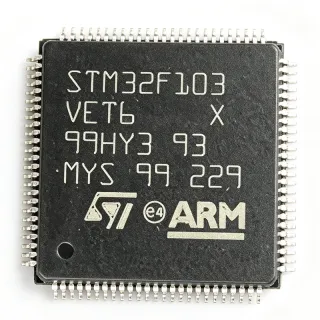
STM8AL3L66TCY - 8-bit Ultra-Low-Power MCU 32KB Flash | STMicroelectronics
MPN: STM8AL3L66TCY ✓ Active| Qty | Unit Price | Extended |
|---|---|---|
| 1 | $1.11 | $1.11 |
| 10 | $1.05 | $10.50 |
| 100 | $0.98 | $98.00 |
| 500 | $0.92 | $460.00 |
| 1,000 | $0.85 | $850.00 |
Drop-in alternatives for STM8AL3L66TCY — same package, pin-to-pin compatible. Different-package parts requiring PCB rework are excluded.
Quick Comparison Tool — Select alternative parts for side-by-side comparison:
STM8AL3L68TCY
✅ Drop-In📋 Reference alternative (not in catalog)
STM8AL3L46TCY
✅ Drop-In✓ In Stock
$1.45 / Unit
View Datasheet →STM8AL3L48TCY
✅ Drop-In📋 Reference alternative (not in catalog)
STM8AL3L66TCY Maximum Ratings & Electrical Characteristics
| Core | STM8A 8-bit CISC |
| Maximum Clock Frequency | 16 MHz |
| Flash Memory Size | 32 KB (32K x 8) |
| RAM Size | 2 KB |
| Data EEPROM Size | [DATA_NEEDED: Data EEPROM size] |
| Supply Voltage Range | 1.8V to 3.6V |
| Package | 32-LQFP (7x7) |
| Mounting Type | Surface Mount |
| Operating Temperature Range | -40°C to +85°C |
| Number of I/O Pins | [DATA_NEEDED: Number of I/O pins] |
| ADC Resolution | 12-bit |
| ADC Channels | 16 |
| Communication Interfaces | I2C, SPI, UART |
| Timers | 16-bit timer, 12-bit timer |
| Low-Power Modes | Wait, Active-Halt, Halt |
| Halt Mode Current | 0.6 µA (typical) |
| Debug Interface | SWIM |
| Automotive Grade | AEC-Q100 |
| RoHS Status | Compliant |
STM8AL3L66TCY Pin Configuration
| Pin 1 | VSS — Ground |
| Pin 2 | VDD — Power supply |
| Pin 3 | PA0 — General purpose I/O or ADC input |
| Pin 4 | PA1 — General purpose I/O or ADC input |
| Pin 5 | PA2 — General purpose I/O or ADC input |
| Pin 6 | PA3 — General purpose I/O or ADC input |
| Pin 7 | NRST — Reset (active low) |
| Pin 8 | PA4 — General purpose I/O or ADC input |
| Pin 9 | PA5 — General purpose I/O or ADC input |
| Pin 10 | PA6 — General purpose I/O or ADC input |
| Pin 11 | PA7 — General purpose I/O or ADC input |
| Pin 12 | VSS — Ground |
| Pin 13 | VDD — Power supply |
| Pin 14 | PB0 — General purpose I/O or timer input |
| Pin 15 | PB1 — General purpose I/O or timer input |
| Pin 16 | PB2 — General purpose I/O or timer input |
| Pin 17 | PB3 — General purpose I/O or timer input |
| Pin 18 | PB4 — General purpose I/O or timer input |
| Pin 19 | PB5 — General purpose I/O or timer input |
| Pin 20 | PB6 — General purpose I/O or timer input |
| Pin 21 | PB7 — General purpose I/O or timer input |
| Pin 22 | VSS — Ground |
| Pin 23 | VDD — Power supply |
| Pin 24 | PC0 — General purpose I/O or ADC input |
| Pin 25 | PC1 — General purpose I/O or ADC input |
| Pin 26 | PC2 — General purpose I/O or ADC input |
| Pin 27 | PC3 — General purpose I/O or ADC input |
| Pin 28 | PC4 — General purpose I/O or ADC input |
| Pin 29 | PC5 — General purpose I/O or ADC input |
| Pin 30 | PC6 — General purpose I/O or ADC input |
| Pin 31 | PC7 — General purpose I/O or ADC input |
| Pin 32 | VDD — Power supply |
Safe Operating Area (SOA) & Thermal Characteristics
No official SOA curve available for this digital IC. Always operate within absolute maximum ratings specified in the datasheet. Ensure adequate cooling and derate as needed.
Typical Applications
STM8AL3L66TCY is suitable for 6 applications: Automotive Body Control Module, Smart Metering, Portable Medical Devices, Industrial Sensor Nodes, Smart Home Devices, Battery Management Systems.
Automotive Body Control Module
The STM8AL3L66TCY is ideal for automotive body control modules due to its AEC-Q100 qualification, wide operating temperature range, and low-power modes. It can manage lighting, window lifts, and door locks with its rich peripheral set including timers, ADC, and communication interfaces. The 16 MHz core provides sufficient processing power for real-time control tasks, while the 0.6 µA halt mode ensures minimal battery drain when the vehicle is off. Its 32 KB Flash is adequate for body control firmware, and the 12-bit ADC can monitor analog sensors for temperature and position feedback. The I2C, SPI, and UART interfaces enable communication with other ECUs and diagnostic tools. The device's robustness and automotive-grade reliability make it a trusted choice for safety-critical applications.
Recommended
Smart Metering
The STM8AL3L66TCY is well-suited for smart metering applications such as electricity, water, and gas meters. Its ultra-low-power consumption extends battery life, which is critical for meters that operate for years without maintenance. The 12-bit ADC with 16 channels can accurately measure voltage and current from sensors, while the RTC provides precise timekeeping for billing and data logging. The communication interfaces (I2C, SPI, UART) allow connection to communication modules like PLC or RF transceivers for remote data transmission. The 32 KB Flash is sufficient for metering firmware, and the device's wide supply voltage range (1.8V to 3.6V) accommodates battery voltage variations. The halt mode current of 0.6 µA ensures minimal power draw during idle periods, maximizing battery life.
Recommended
Portable Medical Devices
The STM8AL3L66TCY is ideal for portable medical devices like glucose meters, pulse oximeters, and blood pressure monitors. Its low-power operation is essential for battery-powered devices that need to last between charges. The 12-bit ADC can interface with various sensors to measure physiological signals, and the UART/I2C interfaces allow connection to displays and wireless modules for data transmission. The device's small 32-pin LQFP package is suitable for compact designs, and its wide operating temperature range ensures reliable operation in various environments. The 32 KB Flash is sufficient for medical device firmware, and the low-power modes help extend battery life during continuous monitoring. The device's reliability and long-term availability make it a trusted choice for medical applications.
Recommended
Industrial Sensor Nodes
The STM8AL3L66TCY is well-suited for industrial sensor nodes used in condition monitoring, process control, and environmental sensing. Its low-power consumption allows deployment in remote locations with battery or energy harvesting power sources. The 12-bit ADC with 16 channels can interface with various analog sensors, while the I2C, SPI, and UART interfaces enable connection to digital sensors and communication modules. The device's robust design and wide temperature range (-40°C to +85°C) ensure reliable operation in harsh industrial environments. The 32 KB Flash is sufficient for sensor node firmware, and the low-power modes help extend battery life in remote deployments. The device's automotive-grade quality also ensures high reliability in industrial settings.
Recommended
Smart Home Devices
The STM8AL3L66TCY is a great fit for smart home devices like thermostats, smart locks, and lighting controls. Its low-power consumption is crucial for battery-powered devices, and its rich peripheral set allows integration with sensors, actuators, and communication modules. The 12-bit ADC can read temperature and light sensors, while the UART/I2C interfaces enable connection to Wi-Fi or Zigbee modules for smart home integration. The device's small package and wide supply voltage range make it easy to integrate into compact designs. The 32 KB Flash is sufficient for smart home firmware, and the low-power modes help extend battery life in devices that are mostly in standby. The device's reliability and long-term availability make it a trusted choice for consumer applications.
Recommended
Battery Management Systems
The STM8AL3L66TCY can be used in battery management systems (BMS) for monitoring and protecting lithium-ion batteries. Its 12-bit ADC can measure cell voltages and temperatures, while the communication interfaces allow connection to battery protection ICs and host controllers. The device's low-power consumption is beneficial for BMS in portable devices, where it can monitor battery status without draining the battery. The 32 KB Flash is sufficient for BMS firmware, and the wide supply voltage range (1.8V to 3.6V) is compatible with battery voltages. The device's automotive-grade quality ensures reliable operation in demanding applications. The low-power modes help extend battery life in standby, and the RTC can track battery age and usage history.
Recommended
Recommended Products Summary
Engineering reference data for STM8AL3L66TCY — comparison, design guidance, and compliance information.
Selection Guide
Comparison with Alternatives
| Parameter | This Product | STM8AL3L68TCY | STM8AL3L46TCY | STM8AL3L48TCY |
|---|---|---|---|---|
| Package | 32-LQFP (7x7) | 32-LQFP (7x7) - same | 32-LQFP (7x7) - same | 32-LQFP (7x7) - same |
| Brand | STMicroelectronics | STMicroelectronics | STMicroelectronics | STMicroelectronics |
| Flash Memory | 32 KB | 64 KB | 16 KB | 16 KB |
| RAM Size | 2 KB | 4 KB | 2 KB | 2 KB |
| Maximum Clock Frequency | 16 MHz | 16 MHz | 16 MHz | 16 MHz |
| Supply Voltage Range | 1.8V to 3.6V | 1.8V to 3.6V | 1.8V to 3.6V | 1.8V to 3.6V |
| ADC Resolution | 12-bit | 12-bit | 12-bit | 12-bit |
| Automotive Grade | AEC-Q100 | AEC-Q100 | AEC-Q100 | AEC-Q100 |
Key Differentiators
- Ultra-low-power consumption with 0.6 µA halt mode current (vs STM8AL3L68TCY)
- AEC-Q100 automotive qualification (vs STM8AL3L46TCY)
- 32 KB Flash memory in a 32-pin LQFP package (vs STM8AL3L48TCY)
Design Notes
The STM8AL3L66TCY operates from 1.8V to 3.6V. Use a low-dropout regulator (LDO) to provide a stable supply voltage, and place a 100nF decoupling capacitor close to each VDD pin and a 4.7µF bulk capacitor on the main supply. For battery-powered designs, utilize the low-power modes (Wait, Active-Halt, Halt) to minimize current consumption. In Halt mode, the typical current is 0.6 µA, which is ideal for extending battery life.
For the 32-pin LQFP package, ensure proper PCB layout with a solid ground plane and short traces for high-frequency signals. Place the decoupling capacitors as close as possible to the VDD and VSS pins. The exposed pad (if present) should be connected to ground for thermal and electrical performance. Follow the layout guidelines in the STM8AL3L66 datasheet for optimal EMC performance.
Avoid exceeding the absolute maximum ratings for supply voltage and I/O pins. Ensure the reset pin (NRST) is properly pulled up with a 100nF capacitor to ground to prevent spurious resets. When using the ADC, ensure the reference voltage is stable and bypassed with a capacitor. Also, be aware that the Flash memory has a limited number of write cycles; use wear-leveling if frequent writes are required.
Compliance Information
AEC-Q100 qualified per ST product page. RoHS compliant per distributor listings. Other compliance details not specified in the provided data.