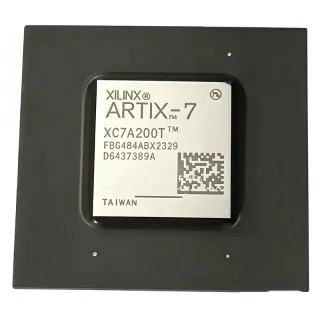
EP20K200CQ240C7ES - APEX 20KC FPGA 200K Gates | Intel
MPN: EP20K200CQ240C7ES ✗ End of Life| Qty | Unit Price | Extended |
|---|---|---|
| 1 | $18.5 | $18.50 |
| 10 | $16.25 | $162.50 |
| 100 | $13.8 | $1,380.00 |
| 500 | $11.6 | $5,800.00 |
| 1,000 | $9.95 | $9,950.00 |
EP20K200CQ240C7ES Overview
An FPGA is a reconfigurable integrated circuit whose logic fabric, routing, and I/O behavior are defined after manufacturing by a configuration bitstream. The field-programmable gate array category sits above programmable logic devices in the digital logic hierarchy and includes APEX 20KC as a 1.8 V SRAM-based device architecture. Designers use FPGAs when they need hardware parallelism, mid-volume flexibility, or protocol agility that fixed ASICs or microcontrollers cannot easily provide.
Key features include 200K system gates, 8,320 logic elements, 106,496 RAM bits, and 168 user I/Os. The 240-pin PQFP package provides a practical balance between routing capability and board-level manufacturability at 0.5 mm-style quad flat pack density. The 1.8 V core supply and 0.15 um CMOS process reduce dynamic power compared with older 2.5 V or 3.3 V programmable logic families while retaining a large I/O count for parallel applications.
The APEX 20KC architecture combines a programmable logic core with embedded RAM and high-speed interconnect. The 8,320 logic elements can implement state machines, datapaths, and parallel processing functions, while the 106,496 RAM bits support FIFOs, small packet buffers, and lookup tables without external memory. The 168 I/Os are important for buses such as 32-bit parallel interfaces, telecommunication backplanes, or video pixel buses. The device is configured over JTAG or through an Altera configuration device such as EPC16 or EPC2.
Typical applications include telecom line-card bridging, industrial control and PLC I/O processing, video/image capture preprocessing, medical instrumentation, ASIC prototyping, and interface adaptation. The engineering-sample suffix makes the part suitable for lab bring-up and prototype validation; a production-grade equivalent is normally preferred for volume systems.
A key design consideration is that the FPGA is volatile and must be configured after each power-up. For the EP20K200CQ240C7ES, use a stable 1.8 V core supply and provide adequate decoupling. Take care to verify power-up sequencing and configuration source before relying on the device at system reset.
This page synthesizes distributor pricing, APEX 20KC family alternatives, design notes, and datasheet locations that are not all present in a single manufacturer marketing page, giving engineers a more complete starting point for selection and procurement.
Drop-in alternatives for EP20K200CQ240C7ES — same package, pin-to-pin compatible. Different-package parts requiring PCB rework are excluded.
Variants in this series
Same-series models that are drop-in compatible with EP20K200CQ240C7ES (same form factor and footprint) — differing in Process Technology, Package / Case, Speed Grade, Family, Product Type.
Quick Comparison Tool — Select alternative parts for side-by-side comparison:
EP20K200CQ240C7
✅ Drop-In✓ In Stock
$42.3 / Unit
View Datasheet →EP20K200CQ240C8
✅ Drop-In ⚠️ 参数待验证📋 Reference alternative (not in catalog)
EP20K200CQ240C9
✅ Drop-In ⚠️ 参数待验证📋 Reference alternative (not in catalog)
EP20K200CQ240I7
✅ Drop-In ⚠️ 参数待验证📋 Reference alternative (not in catalog)
EP20K200CQ240I8
✅ Drop-In ⚠️ 参数待验证📋 Reference alternative (not in catalog)
EP20K200CQ240C7ES Maximum Ratings & Electrical Characteristics
| FPGA Family | APEX 20KC |
| Total Gates | 200,000 system gates |
| Number of Logic Elements | 8,320 |
| Total RAM Bits | 106,496 bits |
| Number of User I/O | 168 |
| Maximum Internal Frequency | 375.94 MHz |
| Core Supply Voltage | 1.8 V |
| Process Technology | 0.15 um CMOS |
| Package Type | 240-Pin PQFP (BFQFP) |
| Pin Count | 240 |
| Mounting Type | Surface Mount |
| Speed Grade | C7 (commercial speed grade, per C7 suffix) |
| Configuration Type | SRAM-based; external configuration device required |
| Product Status | Obsolete legacy APEX 20KC family |
| RoHS Status | unknown |
EP20K200CQ240C7ES 240-pin pqfp (bfqfp) Pin Configuration Guide
Pin configuration for EP20K200CQ240C7ES (240-pin pqfp (bfqfp) package). This digital IC includes GPIO, communication interfaces (UART, SPI, I2C), and power pins. Refer to the manufacturer datasheet for alternate pin functions and configuration options. Essential for embedded system design and PCB layout.

No detailed pinout data available for EP20K200CQ240C7ES.
Refer to the datasheet for full pin configuration.
Typical Applications
EP20K200CQ240C7ES is suitable for 6 applications: Telecommunications Line Card Bridging, Industrial PLC and Motion Control, Real-Time Video and Image Processing, Medical Instrumentation and Diagnostics, Automotive Test and Data Acquisition, ASIC Prototyping and Interface Adaptation.
Telecommunications Line Card Bridging
The EP20K200CQ240C7ES is suited for telecom line-card bridging because its 168 user I/Os can connect multiple 8-bit and 16-bit buses while 8,320 logic elements implement protocol adaptation and small state machines. The 106,496 RAM bits provide FIFO buffering for rate matching between line-side and switch-side interfaces in compact PQFP-240 systems. A designer can place the FPGA between a serial backplane and a parallel bus, using an EPC16 configuration device at power-up. The 1.8 V core and 0.15 um process help keep power reasonable in dense line-card layouts, though external bus transceivers may still be required for high-voltage legacy interfaces.
Recommended
Industrial PLC and Motion Control
In industrial PLC and motion-control systems, the EP20K200CQ240C7ES provides parallel logic capacity for encoder counting, position-compare outputs, and high-speed alarm handling. The 8,320 logic elements can implement multiple timer/counter channels without burdening an external host processor, while 168 user I/Os directly connect optocouplers, relay drivers, and differential encoder inputs. The 106,496 RAM bits can store small recipe tables or parameter blocks. Since the industrial environment often needs commercial to extended temperature support, designers should choose the I7 or I8 production variant instead of the C7ES when the final system must operate outside normal indoor temperature limits. The SRAM configuration must be reloaded after each power cycle.
Recommended
Real-Time Video and Image Processing
Real-time video processing needs parallel pixel manipulation, making the EP20K200CQ240C7ES a practical choice for preprocessing tasks such as Bayer interpolation, color-space conversion, and edge filtering. Its 8,320 logic elements can implement many arithmetic operators in parallel, and 106,496 RAM bits are sufficient for small line buffers holding several horizontal video lines. The 168 user I/Os can connect to CMOS image sensors or DRAM-like video buses through appropriate level shifting. A 375.94 MHz internal frequency ceiling gives ample headroom for common 25 MHz to 100 MHz pixel clocks. For production video products, use a non-ES C7 or equivalent code rather than the engineering sample.
Recommended
Medical Instrumentation and Diagnostics
Medical diagnostic systems often require sensor data acquisition, synchronization, and signal preprocessing in one device. The EP20K200CQ240C7ES can gather parallel ADC data on several channels, qualify samples with simple state machines, and buffer results in its 106,496 RAM bits before a processor supervises the system. Its 168 I/Os and 8,320 logic elements are enough for multichannel acquisition front ends without requiring a dense BGA package. The commercial C7ES version may be used in early medical prototype validation, but production medical equipment should use a fully qualified production-grade variant with documented component qualification and compliance review. Separate the analog ground plane and digital core supply to preserve signal integrity.
Recommended
Automotive Test and Data Acquisition
Automotive test systems use FPGAs to capture multiple high-rate sensor streams, decode serial bus frames, and trigger logging events with deterministic timing. The EP20K200CQ240C7ES offers 168 user I/Os and 8,320 logic elements for tasks such as CAN/lower-speed serial interface adaptation and synchronized pulse-width measurement. Its 1.8 V core helps reduce power on distributed data-acquisition boards. Because the C7ES is an engineering sample, an automotive qualification should instead use an industrial- or automotive-qualified variant listed by the manufacturer and approved for the target temperature range. Always validate timing closure against the exact speed grade and operating condition required by the test standard.
Recommended
ASIC Prototyping and Interface Adaptation
EP20K200CQ240C7ES can be used for FPGA-based ASIC prototyping when the target ASIC is roughly 200K gates or less. The 8,320 logic elements map synthesized RTL blocks, 106,496 RAM bits model small memories, and 168 I/Os connect to prototype peripherals. Because the device is SRAM-based, each prototype power cycle requires configuration from an EPC device or JTAG download cable. The CQ240 package is easier to hand-assemble and debug than a large BGA during early prototypes. However, engineering sample parts should be replaced with a production EP20K200CQ240C7 before long-running laboratory tests or system integration builds.
Recommended
Recommended Products Summary
Engineering reference data for EP20K200CQ240C7ES — comparison, design guidance, and compliance information.
Selection Guide
Comparison with Alternatives
| Parameter | This Product | EP20K200CQ240C7 | EP20K200CQ240C8 | EP20K200CQ240C9 | EP20K200CQ240I7 | EP20K200CQ240I8 |
|---|---|---|---|---|---|---|
| Package | PQFP-240 (BFQFP) | PQFP-240 (BFQFP) same | PQFP-240 (BFQFP) same | PQFP-240 (BFQFP) same | PQFP-240 (BFQFP) same | PQFP-240 (BFQFP) same |
| Brand | Intel / Altera | Intel / Altera | Intel / Altera | Intel / Altera | Intel / Altera | Intel / Altera |
| FPGA Family | APEX 20KC | APEX 20KC | APEX 20KC | APEX 20KC | APEX 20KC | APEX 20KC |
| Logic Elements | 8,320 | 8,320 | 8,320 | 8,320 | 8,320 | 8,320 |
| Total RAM Bits | 106,496 | 106,496 | 106,496 | 106,496 | 106,496 | 106,496 |
| User I/O | 168 | 168 | 168 | 168 | 168 | 168 |
| Core Supply Voltage | 1.8 V | 1.8 V | 1.8 V | 1.8 V | 1.8 V | 1.8 V |
| Speed Grade | C7ES (commercial, engineering sample) | C7 commercial production | C8 commercial, slower grade | C9 commercial alternate grade | I7 industrial grade | I8 industrial lower grade |
Key Differentiators
- Engineering-sample traceability in the part number (vs EP20K200CQ240C7)
- Same footprint family for grade migration (vs EP20K200CQ240I7)
- High logic-to-package ratio (vs EP20K100CQ240C7)
Design Notes
The EP20K200CQ240C7ES core requires a clean 1.8 V supply. Place at least one 100 nF ceramic capacitor close to each core power pin and add 10 uF bulk capacitance at the board entry point. The FPGA is SRAM-based and may draw significant inrush current during configuration; use a regulator with adequate peak current capability. Because no exact VCCINT current table is available in the provided web data, estimate the current using the design resource utilization and clock frequency, then verify with the Altera APEX 20K power calculator or laboratory measurement.
For the 240-pin PQFP package, use complete ground and power planes under the device and keep decoupling capacitance close to the package leads. Route high-speed I/O with length matching appropriate for the signal group and avoid splitting reference planes under configuration and clock pins. If the board must also host an EPC16 or EPC2 configuration device, place the configuration interface traces with controlled impedance and minimize stub lengths. Confirm the exact PCB land pattern from the PQFP-240 package drawing in the datasheet before fabrication.
Do not mistake the ES suffix for a production-qualified device. EP20K200CQ240C7ES should be used only for lab validation, characterization, or pre-release systems unless Intel/Altera explicitly approves it for production. The FPGA is volatile and loses its configuration on power-down, so verify that the configuration device, JTAG download, or host controller reconfigures the part at every power-on reset. Also check speed grade, temperature grade, and RoHS status before fitting a replacement variant.
Compliance Information
No RoHS, REACH, lead-free, or conflict-mineral statement was provided in the verified web data. The EP20K200CQ240C7ES is an older APEX 20KC engineering sample, so compliance should be confirmed from the manufacturer material declaration or distributor documentation.