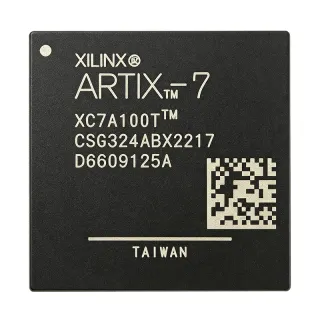
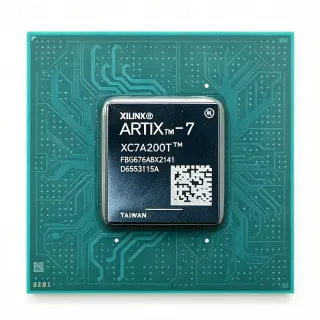
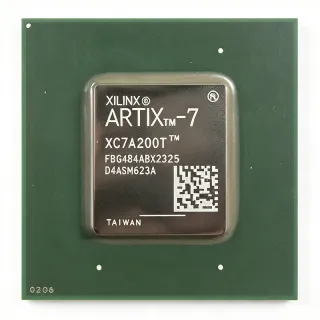
EP20K200CQ240C8N - APEX 20KC FPGA 200K Gates | Altera
MPN: EP20K200CQ240C8N ✗ End of Life| Qty | Unit Price | Extended |
|---|---|---|
| 1 | $28.5 | $28.50 |
| 10 | $25.1 | $251.00 |
| 100 | $21.4 | $2,140.00 |
| 500 | $18.2 | $9,100.00 |
| 1,000 | $15.8 | $15,800.00 |
EP20K200CQ240C8N Overview
An FPGA is an integrated circuit whose logic fabric and routing are configured after manufacturing to implement arbitrary digital logic. EP20K200CQ240C8N sits in the programmable logic hierarchy: FPGA -> programmable logic device -> logic IC -> integrated circuit. This older APEX 20KC family was designed for system-level integration without the high cost of custom ASICs. On a board, it replaces discrete glue logic, microprocessor peripherals, memory controllers, and bus-bridge circuits, while retaining in-system reprogrammability through a configuration device.
Key features include the large 200K-gate capacity, 8,320 logic elements for medium-density designs, 168 bidirectional I/O lines for wide parallel buses, and a rated 301.21 MHz maximum internal clock frequency. The 1.8 V core reduces dynamic power compared with earlier 2.5 V/3.3 V FPGA families, while the 0.15 um geometry provides a practical balance between density and speed. The 240-pin PQFP package is a board-friendly, conventional surface-mount format for 2000-era equipment and remains available through the legacy/surplus channel.
Architecturally, the APEX 20KC family implements programmable logic with an embedded array for memory and high-speed I/O in a single device. The EP20K200 datasheet states that an Altera enhanced configuration device—a single-device, high-speed, advanced configuration solution for high-density FPGAs—contains a configuration controller and flash memory. This architecture allows the FPGA to be loaded from industry-standard configuration devices and, where necessary, re-loaded during board bring-up. The commercial C-grade and 8 speed grade balance cost and performance for communication and industrial boards.
Typical applications include protocol bridging, communication line-card logic integration, DSP pre/post processing, video-image pipelines, industrial automation I/O control, and legacy FPGA replacement. The 168 I/O lines provide sufficient connectivity for 32-bit processor buses, SRAM/SDRAM interfaces, and multiple serial ports. The 301.21 MHz internal frequency supports demanding data-path applications while the 1.8 V core maintains moderate power dissipation in 240-pin boards.
When designing with EP20K200CQ240C8N, provide clean, low-impedance decoupling on all 1.8 V core pins, place a suitable configuration device near the FPGA, and confirm every VCCIO bank voltage against the I/O standard used. Because this is an older device, thermal and power calculations should be checked with an early prototype before committing to the final layout.
This page synthesizes distributor specifications, same-package drop-in alternatives, price tiers, and practical design notes not included in the single datasheet PDF, helping engineers select and validate this legacy FPGA faster.
Drop-in alternatives for EP20K200CQ240C8N — same package, pin-to-pin compatible. Different-package parts requiring PCB rework are excluded.
Variants in this series
Same-series models that are drop-in compatible with EP20K200CQ240C8N (same form factor and footprint) — differing in Process Technology, Package / Case, Family, Total RAM Bits, Logic Elements / Cells.
Quick Comparison Tool — Select alternative parts for side-by-side comparison:
EP20K200CQ240C7N
✅ Drop-In ⚠️ 参数待验证✓ In Stock
$133.39 / Unit
View Datasheet →EP20K200CQ240C7ES
✅ Drop-In ⚠️ 参数待验证✓ In Stock
$9.95 / Unit
View Datasheet →EP20K200CQ240C7
✅ Drop-In ⚠️ 参数待验证✓ In Stock
$42.3 / Unit
View Datasheet →EP20K200CQ240C8ES
✅ Drop-In ⚠️ 参数待验证✓ In Stock
$95 / Unit
View Datasheet →EP20K200CQ240C8ES
✅ Drop-In✓ In Stock
$95 / Unit
View Datasheet →EP20K200CQ240C8N Maximum Ratings & Electrical Characteristics
| Product Type | Loadable Programmable Logic Device (PLD / FPGA) |
| Manufacturer | Altera Corporation |
| Series | EP20K200 |
| Family | APEX 20KC |
| Total Gates (typical) | 200K gates |
| Logic Elements / Cells | 8,320 cells |
| Dedicated I/O Lines | 168 |
| Input Terminals | 164 |
| Dedicated I/O Pins | 160 |
| Maximum Clock Frequency | 301.21 MHz |
| Process Technology | 0.15 um |
| Core Supply Voltage | 1.8 V |
| Package / Case | 240-Pin PQFP (CQ240) |
| Mounting Type | Surface Mount |
| Speed Grade | 8 (from C8N suffix) |
| Configuration Device Support | Altera enhanced configuration device (from EP20K200 datasheet description) |
EP20K200CQ240C8N 240-pin pqfp (cq240) Pin Configuration Guide
Pin configuration for EP20K200CQ240C8N (240-pin pqfp (cq240) package). This digital IC includes GPIO, communication interfaces (UART, SPI, I2C), and power pins. Refer to the manufacturer datasheet for alternate pin functions and configuration options. Essential for embedded system design and PCB layout.

No detailed pinout data available for EP20K200CQ240C8N.
Refer to the datasheet for full pin configuration.
Typical Applications
EP20K200CQ240C8N is suitable for 6 applications: High-Speed Communications Line Card, Protocol Bridging and System Glue Logic, DSP Co-Processing and Pre/Post-Processing, Video and Image Processing, Industrial Automation I/O Controller, Legacy FPGA Replacement and Transparent Upgrade.
High-Speed Communications Line Card
The EP20K200CQ240C8N suits high-speed communication line cards because its 168 user I/O pins can connect many serial/parallel PHYs and framers while the 8,320 logic elements absorb protocol glue. The 301.21 MHz maximum internal clock lets data-path state machines run close to the backplane rate; when mapping Ethernet, SONET/SDH, or telecom buses, use a configuration device such as an EPC16 to load the APEX 20KC bitstream at power-up. In a typical line-card design, the FPGA sits between the system controller and the physical-layer transceivers, translating bus formats and performing byte alignment. Because this is a 1.8 V core FPGA, generate core power from a local regulator and keep the VCCIO supplies independent for each bank to match 3.3 V/2.5 V PHY logic. Verify timing using the EP20K200 timing models for 0.15 um APEX 20KC.
Recommended
Protocol Bridging and System Glue Logic
The EP20K200CQ240C8N is effective for protocol bridging because its 8,320 logic elements can implement state machines, FIFOs, address decoders, and bus-width converters between different processor and peripheral buses. The 168 I/O lines provide enough pins to connect a host CPU bus, SRAM, dual-port memory, or custom ASIC, while the 301.21 MHz speed supports low-latency translation. In a typical bridge application, the FPGA monitors bus control signals, buffers data in internal logic, and drives the target bus with the required protocol timing. The 1.8 V core and 0.15 um process keep power manageable on dense boards. Use an EPC2 or EPC16 configuration device to make the bridge self-initializing after power-on, and verify I/O standard compatibility on each bank before routing the final PCB.
Recommended
DSP Co-Processing and Pre/Post-Processing
The EP20K200CQ240C8N can implement DSP pre- and post-processing at 301.21 MHz using its 8,320 logic elements as soft multipliers, adders, accumulators, and control logic. The 168 I/O pins allow direct connection to ADC/DAC data buses and external SRAM for coefficient storage. In a wireless or audio signal chain, the FPGA can perform filtering, interpolation, decimation, and data formatting before the signal reaches a host processor. Because the APEX 20KC has no hard DSP blocks in the fetched specifications, designers should synthesize arithmetic cores with carry-chain-aware logic and budget for routing delays. Place the FPGA close to the data converters, fan out each 1.8 V core supply pin, and use the configuration device to load the DSP bitstream at reset.
Recommended
Video and Image Processing
The EP20K200CQ240C8N can be used as a video- and image-processing engine where medium-density programmable logic is sufficient for line buffers, color-space conversion, pixel format packing, and display timing generation. Its 8,320 logic elements implement line-delay FIFOs and small frame-buffer control circuits, while the 168 I/O lines connect to camera sensors, video decoders, memories, and display drivers. The 301.21 MHz internal frequency supports pixel clocks common in standard-definition and early high-definition video systems, and the 1.8 V core minimizes board-level switching noise. For a complete imaging pipeline, include an external SDRAM controller implemented in logic or an embedded controller companion. Use the C7N variant if the timing budget is tight and place the FPGA near the memory devices to shorten critical traces.
Recommended
Industrial Automation I/O Controller
The EP20K200CQ240C8N is suitable for industrial automation I/O control because its 168 I/O lines can handle triac/MOSFET drive logic, encoder inputs, limit switches, and serial fieldbus interfaces simultaneously. In a PLC or CNC I/O card, the FPGA scans digital inputs, performs debouncing and edge detection, updates output registers, and communicates with a host microcontroller over a parallel or serial bus. The 8,320 logic elements are sufficient for moderately complex real-time control state machines, while the 301.21 MHz internal clock allows deterministic sub-microsecond response. Because commercial temperature-grade assumptions are not explicitly verified from the fetched data, confirm the ordering code supports your operating environment. Plan separate VCCIO supplies for each connected I/O standard and use robust ground planes beneath the 240-pin PQFP.
Recommended
Legacy FPGA Replacement and Transparent Upgrade
When an existing APEX 20K board uses the EP20K200CQ240C8N, a same-socket transparent upgrade is usually available from the EP20K200CQ240 family: C7N, C7, C7ES, C8ES, or C8. Engineers can preserve the PCB layout, pin assignments, and 240-pin PQFP foot print while changing only the speed-grade or suffix ordering code. For a new design that must interoperate with legacy backplanes, the C8N part provides the original baseline timing; choose C7N when you need extra timing margin or improved Fmax. Always compare the EP20K200 configuration bitstream, VCCIO settings, and environmental rating before replacing a part. In many cases this strategy avoids a full board redesign and maintains compatibility with existing configuration devices and firmware images.
Recommended
Recommended Products Summary
Engineering reference data for EP20K200CQ240C8N — comparison, design guidance, and compliance information.
Selection Guide
Comparison with Alternatives
| Parameter | This Product | EP20K200CQ240C7N | EP20K200CQ240C7ES | EP20K200CQ240C7 | EP20K200CQ240C8ES | EP20K200CQ240C8 |
|---|---|---|---|---|---|---|
| Brand | Altera | Altera | Altera | Altera | Altera | Altera |
| Package | 240-Pin PQFP (CQ240) | 240-Pin PQFP (CQ240) | 240-Pin PQFP (CQ240) | 240-Pin PQFP (CQ240) | 240-Pin PQFP (CQ240) | 240-Pin PQFP (CQ240) |
| Family | APEX 20KC | APEX 20KC | APEX 20KC | APEX 20KC | APEX 20KC | APEX 20KC |
| Logic Elements | 8,320 cells | 8,320 cells (EP20K200 family) | 8,320 cells (EP20K200 family) | 8,320 cells (EP20K200 family) | 8,320 cells (EP20K200 family) | 8,320 cells (EP20K200 family) |
| Dedicated I/O Lines | 168 | 168 (EP20K200 Q240 family) | 168 (EP20K200 Q240 family) | 168 (EP20K200 Q240 family) | 168 (EP20K200 Q240 family) | 168 (EP20K200 Q240 family) |
| Core Supply Voltage | 1.8 V | 1.8 V | 1.8 V | 1.8 V | 1.8 V | 1.8 V |
| Speed Grade | 8 | 7 | 7 | 7 | 8 | 8 |
| Ordering Finish / Qualification | C8N production commercial | C7N production commercial, N suffix | C7ES engineering sample | C7 production commercial, non-N suffix | C8ES engineering sample | C8 production commercial, non-N suffix |
Key Differentiators
- Baseline commercial C8 speed-grade production part with an N-suffix ordering code (vs EP20K200CQ240C7N)
- N-suffix variant is likely the right production choice where Pb-free assembly is required (vs EP20K200CQ240C8)
- Production commercial part instead of engineering-sample status (vs EP20K200CQ240C8ES)
Design Notes
Estimated: The EP20K200CQ240C8N requires a low-impedance 1.8 V core rail, but the fetched data does not provide a core-current specification. Place 100 nF ceramic capacitors adjacent to every VCCINT/VCC pin group and a 10 uF bulk capacitor near the package; keep the 1.8 V plane continuous beneath the PQFP. I/O banks should have separate VCCIO supplies matching the connected interface standard. Use an LDO or low-noise regulator for analog-sensitive interfaces and a switching regulator when bank current is large. Estimate core current from the Altera power calculator before sizing the regulator.
For a 240-pin PQFP, maintain correct pin-1 orientation by matching the package corner marker with the silkscreen dot on the PCB. Fan out all power and ground pins with short traces or vias-in-pad if the assembly process permits, and route critical configuration and clock pins as point-to-point nets with controlled impedance where necessary. Keep the configuration device near the FPGA configuration pins. Use a ground plane under the whole device and add small ground stitching vias around the package to reduce ground-loop inductance. Do not rely on long flying leads for the 1.8 V supply.
Do not assume an FPGA from another manufacturer is socket-compatible; no cross-brand drop-in was found for the EP20K200CQ240C8N. Also ensure the selected configuration device supports APEX 20KC loading, and check whether your required density exceeds the 8,320 logic elements and 200K gates. If you are replacing an obsolete C8N, verify the C7N/C7/C8 variant's temperature grade and finish with the distributor. The commercial C suffix does not by itself guarantee the exact temperature range; consult the ordering information table in the EP20K200 datasheet before placing a large assembly order.
Compliance Information
The fetched distributor data does not include explicit RoHS/REACH/lead-free certificates. The N suffix in Altera ordering codes often denotes lead-free finish, but that was not explicitly confirmed in the verified snippets. Confirm compliance with the requesting body before procurement.