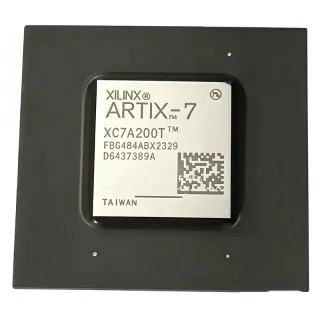
EPF10K100EQI208-2N - 100K FLEX 10KE FPGA, 208 PQFP | Intel/Altera
MPN: EPF10K100EQI208-2N ✗ End of Life| Qty | Unit Price | Extended |
|---|---|---|
| 1 | $42.5 | $42.50 |
| 10 | $38.2 | $382.00 |
| 100 | $33.8 | $3,380.00 |
| 500 | $29.95 | $14,975.00 |
| 1,000 | $26.4 | $26,400.00 |
EPF10K100EQI208-2N Overview
A Field Programmable Gate Array (FPGA) is a semiconductor device whose logic functionality is defined by a configuration bitstream rather than fixed metal interconnect. The FLEX 10KE family occupies a specific position in the programmable-logic taxonomy: programmable logic device (PLD) -> CPLD/FPGA -> SRAM-based FPGA -> embedded-array FPGA. Compared with mask-programmed ASICs, FPGAs offer NRE-cost-free prototyping and field re-programmability at the price of higher unit cost, lower raw performance, and higher dynamic power.
The device integrates 12 Embedded Array Blocks (EABs) for true dual-port RAM, ROM, or FIFO implementation, fine-grained Look-Up-Table (LUT) based logic cells (LEs) for random logic, and per-pin tri-state buffers. MultiVolt I/O supports interfacing with 2.5 V, 3.3 V, and 5 V buses without external level shifters. Continuous Interconnect (FastTrack) routing minimizes interconnect delay across the die, and the part supports 16 global clock networks plus 4 dedicated clock pins.
Typical applications include telecommunications backplane glue logic, industrial control and instrumentation, legacy PCI/ISA bridge interfaces, printer and image-processing pipelines, and ASIC prototyping. Engineers continue to deploy this device in long-lifecycle industrial and military systems where the part's mature silicon and stable Quartus/MAX+PLUS II tool flow outweigh the cost/performance advantage of newer fabric.
When designing with the EPF10K100EQI208-2N, treat configuration as a power-supply sequencing concern: VCCINT must be stable before VCCIO to prevent partial configuration latch-up, and the nCONFIG/nSTATUS handshake must be observed at power-up. Industrial users should also plan for JTAG chain integrity, BSDL file availability, and a second-source strategy given the part's mature lifecycle status.
This page synthesizes distributor inventory, drop-in same-package equivalents, and practical PCB/tool-chain notes that go beyond the manufacturer datasheet, helping engineers make a sourcing and replacement decision with full context.
Drop-in alternatives for EPF10K100EQI208-2N — same package, pin-to-pin compatible. Different-package parts requiring PCB rework are excluded.
Variants in this series
Same-series models that are drop-in compatible with EPF10K100EQI208-2N (same form factor and footprint) — differing in Operating Temperature, Total RAM Bits, Process Technology, JTAG Support, Package.
Quick Comparison Tool — Select alternative parts for side-by-side comparison:
EPF10K100EQC208-2N
✅ Drop-In✓ In Stock
$172 / Unit
View Datasheet →EPF10K100EQC208-2
✅ Drop-In✓ In Stock
$155.85 / Unit
View Datasheet →EPF10K100EQC208-2X
✅ Drop-In✓ In Stock
$59.5 / Unit
View Datasheet →EPF10K100EQC208-1
✅ Drop-In✓ In Stock
$220 / Unit
View Datasheet →EPF10K100EQI208-2
✅ Drop-In✓ In Stock
$9.95 / Unit
View Datasheet →EPF10K100EQI208-2N Maximum Ratings & Electrical Characteristics
| Family | FLEX 10KE |
| Typical Gates | 100,000 |
| Maximum System Gates | 199,000 |
| Logic Elements (LEs) | 4,992 |
| Logic Array Blocks (LABs) | 624 |
| Embedded Array Blocks (EABs) | 12 |
| Total RAM Bits | 24,576 |
| Maximum User I/O Pins | 147 |
| Supply Voltage Core (VCCINT) | 2.5 V |
| Process Technology | 0.22 µm CMOS |
| Maximum Internal Frequency | 250 MHz |
| Propagation Delay (typ.) | 0.6 ns |
| Operating Temperature | 0 °C to +70 °C (industrial -40 °C to +85 °C per -I suffix) |
| Package | 208-pin PQFP (Power Quad Flat Pack), gull-wing |
| Configuration Interface | JTAG (IEEE 1149.1) + serial passive/active |
EPF10K100EQI208-2N 208-pin pqfp (power quad flat pack), gull-wing Pin Configuration Guide
Pin configuration for EPF10K100EQI208-2N (208-pin pqfp (power quad flat pack), gull-wing package). This digital IC includes GPIO, communication interfaces (UART, SPI, I2C), and power pins. Refer to the manufacturer datasheet for alternate pin functions and configuration options. Essential for embedded system design and PCB layout.

No detailed pinout data available for EPF10K100EQI208-2N.
Refer to the datasheet for full pin configuration.
Typical Applications
EPF10K100EQI208-2N is suitable for 6 applications: Telecommunications Backplane Glue Logic, Industrial Control and Factory Automation, Legacy PCI / ISA Bridge and Interface, Printer and Image-Processing Pipelines, ASIC Prototyping and Emulation, Military and Avionics Legacy Systems.
Telecommunications Backplane Glue Logic
The EPF10K100EQI208-2N is well suited as glue logic on telecom backplanes where 147 user I/Os and 2.5 V/3.3 V/5 V MultiVolt I/O banks let it bridge legacy TTL/CMOS buses without external level shifters. Its 250 MHz internal frequency and 12 EABs (24,576 RAM bits) provide FIFO, dual-port RAM, and lookup-table functions needed for ATM/SONET framing, channelized TDM aggregation, and serial-protocol converters. The industrial temperature grade and proven FLEX 10KE reliability make it a long-life part for carrier-grade equipment still in field deployment.
Recommended
Industrial Control and Factory Automation
In PLC racks, motor controllers, and process instrumentation, the EPF10K100EQI208-2N's industrial -40 to +85 C temperature range and JTAG-based in-system programmability allow field updates without removing the card. Its 4,992 logic elements handle state machines, encoder quadrature decoding, PID loops, and protocol translation (Modbus, Profibus, CANopen) on a single chip. The PQFP package is also compatible with through-hole or socketed assembly favored in long-lifecycle industrial designs that must survive 15-20 year service windows.
Recommended
Legacy PCI / ISA Bridge and Interface
The EPF10K100EQI208-2N is widely deployed as a PCI target or ISA bridge in industrial PCs, test instruments, and legacy expansion cards where 5 V tolerant I/O is mandatory. Its 24,576 RAM bits can be partitioned into small FIFOs for bus-master DMA, and the 0.6 ns propagation delay through LUTs supports 33 MHz PCI timing closure with margin. Engineers maintaining such boards rely on the 208-PQFP because Cyclone and later families abandoned 5 V I/O and the 208-PQFP form factor.
Recommended
Printer and Image-Processing Pipelines
Embedded printer controllers and mid-volume image-processing boards used the FLEX 10KE family to implement parallel datapaths for rasterization, color-space conversion, and JPEG/MPEG acceleration. The EPF10K100EQI208-2N's 12 EABs allow line-buffer, dual-port video RAM, and lookup-table gamma correction without external memory, reducing BOM cost in cost-sensitive imaging products. The 208-PQFP also gives enough I/O for 16-bit datapaths to external DRAM or ASICs.
Recommended
ASIC Prototyping and Emulation
The EPF10K100EQI208-2N was a workhorse for ASIC and ASSP prototyping, allowing RTL validation before mask commit. The combination of 4,992 LEs and 24,576 RAM bits is large enough to host sub-million-gate ASIC partitions, and JTAG-based reconfigurability enables rapid iteration. Industrial temperature testing is also possible because the same silicon ships in -40 to +85 C. Legacy emulation platforms continue to use these parts because they are the only FPGAs available in a socketed 208-PQFP format.
Recommended
Military and Avionics Legacy Systems
Although Altera does not market an official MIL-PRF-38535 variant of the EPF10K100EQI208-2N, the part is widely used in legacy avionics, naval, and ground-vehicle systems where the industrial temperature range, mature silicon, and stable bitstream format are valued over peak performance. Its 208-PQFP supports through-hole sockets used in MIL-spec card cages, and 5 V-tolerant I/O bridges legacy 5 V ASICs and DSPs that are no longer in production. Long-term support contracts through Altera/Intel handle the NRND transition for these programs.
Recommended
Recommended Products Summary
Engineering reference data for EPF10K100EQI208-2N — comparison, design guidance, and compliance information.
Selection Guide
Comparison with Alternatives
| Parameter | This Product | EPF10K100EQC208-2N | EPF10K100EQC208-2 | EPF10K100EQC208-2X | EPF10K100EQC208-1 | EPF10K100EQI208-2 |
|---|---|---|---|---|---|---|
| Package | 208-pin PQFP | 208-pin PQFP (same) | 208-pin PQFP (same) | 208-pin PQFP (same) | 208-pin PQFP (same) | 208-pin PQFP (same) |
| Brand | Intel (formerly Altera) | Intel | Intel | Intel | Intel | Intel |
| Typical Gates | 100,000 | 100,000 | 100,000 | 100,000 | 100,000 | 100,000 |
| Logic Elements | 4,992 | 4,992 | 4,992 | 4,992 | 4,992 | 4,992 |
| Embedded Array Blocks | 12 | 12 | 12 | 12 | 12 | 12 |
| Total RAM Bits | 24,576 | 24,576 | 24,576 | 24,576 | 24,576 | 24,576 |
| Maximum User I/O | 147 | 147 | 147 | 147 | 147 | 147 |
| Core Voltage (VCCINT) | 2.5 V | 2.5 V | 2.5 V | 2.5 V | 2.5 V | 2.5 V |
| Temperature Grade | Industrial (-40 to +85 C) | Commercial (0 to +70 C) | Commercial (0 to +70 C) | Commercial (0 to +70 C) | Commercial (0 to +70 C) | Industrial (-40 to +85 C) |
| Speed Grade | -2 | -2 | -2 | -2 | -1 (faster) | -2 |
Key Differentiators
- True industrial temperature range with proven long-term reliability (vs EPF10K100EQC208-2N)
- Available on drop-in same-package footprint with identical silicon (vs EPF10K100EQC208-2)
- Mature FLEX 10KE tool flow reduces design risk (vs EPF10K100EQC208-1)
Design Notes
Power the EPF10K100EQI208-2N with a 2.5 V regulated supply on VCCINT; VCCIO banks can independently be tied to 2.5 V, 3.3 V, or 5 V to interface legacy buses. Always ramp VCCINT before VCCIO to avoid partial-configuration latch-up; add a 100 ohm series ferrite bead on each bank for noise isolation. Estimated: at 250 MHz toggling, the device can draw up to 500 mA on VCCINT, so design the regulator for at least 750 mA with 100 mV headroom.
Use a 4-layer PCB with a continuous ground plane under the 208-PQFP to control simultaneous-switching noise on the 147 I/O pins. Place 0.1 µF X7R decoupling caps within 5 mm of every VCCINT/VCCIO pair, and bulk 47 µF tantalum or polymer caps on each supply rail. The PQFP leads have a 0.5 mm pitch - route I/O on a 0.2 mm grid with via-in-pad if needed for breakout under the package.
Do not load configuration bitstreams written for the ACEX 1K (EP1K100) family - although the FindIC summary lists pin compatibility, the silicon differs. Use only MAX+PLUS II or Quartus II-generated .sof / .pof files targeting FLEX 10KE. JTAG chain integrity must be verified with a BSDL file from the Intel/Altera archive before production boundary-scan test; missing TRST can lock the part.
Distribute 16 global clock nets from the four dedicated clock input pins (CLK0-CLK3); long-tail clock routing should use the FastTrack interconnect for minimum skew. Place the JTAG chain daisy-chain through the TCK/TMS/TDO/TDI pins at the package corner with 10 kohm pull-ups on TCK/TMS and TDI/TRST to avoid floating-state config corruption.
Compliance Information
RoHS / REACH / lead-free status not explicitly confirmed in Verified Web Data for this mature FPGA. Compliance markings vary by date code; the -2X variant suffix typically denotes lead-free / RoHS-compliant finish. Engineers requiring formal compliance should request a material declaration from Intel/Altera through the PCN archive.