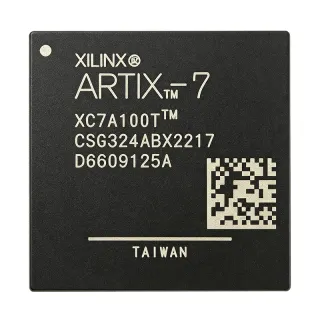
EPF8282ALC84-4N - FLEX 8000 FPGA 2.5K Gates 84-LCC | Intel / Altera
MPN: EPF8282ALC84-4N ✗ End of Life| Qty | Unit Price | Extended |
|---|---|---|
| 1 | $38.5 | $38.50 |
| 10 | $34.2 | $342.00 |
| 100 | $29.75 | $2,975.00 |
| 500 | $26.4 | $13,200.00 |
| 1,000 | $23.85 | $23,850.00 |
EPF8282ALC84-4N Overview
A Field-Programmable Gate Array (FPGA) is a type of integrated circuit that can be configured by the customer after manufacturing to implement arbitrary digital logic. In the broader taxonomy, the EPF8282ALC84-4N sits within programmable logic devices (PLDs) -> CPLD/FPGA hybrid (FLEX 8000 is architecturally an FPGA) -> SRAM-based FPGA -> general-purpose programmable logic -> semiconductor. The FLEX 8000 family was one of Altera's early high-density register-rich FPGA lines, fully compliant with the PCI Local Bus Specification for plug-and-play peripheral designs.
Key features include 5.0V VCCIO operation with selectable 3.3V or 5.0V output levels, in-circuit reconfigurability (ICR) via serial configuration devices (EPC1, EPC1064, EPC1213, EPC1441), and built-in JTAG boundary-scan test (IEEE 1149.1). The 0.42 µm CMOS SRAM process provides high integration while the 84-pin LCC (J-Lead) package supports surface-mount assembly with excellent thermal and mechanical characteristics. Four dedicated inputs are reserved for high-fanout synchronous control signals.
Architecturally, the device uses Look-Up Table (LUT)-based logic elements arranged in Logic Array Blocks (LABs) with FastTrack interconnect. Configuration data is loaded from an industry-standard parallel EPROM, an Altera serial configuration device, or a system controller at power-up. The FastTrack continuous routing architecture provides predictable timing with delays independent of logic placement, simplifying timing closure in legacy designs.
Typical applications include PCI bus interface controllers, peripheral glue logic, register-rich state machines, bus bridges (ISA-to-PCI, microcontroller-to-PCI), and legacy industrial control systems. The high pin-count LCC package allows integration of multiple 32-bit buses into a single device, reducing board space and BOM cost compared to discrete TTL designs.
When designing with this part, ensure the configuration scheme (serial vs parallel) and EPC device selection match the bitstream size. The PCI-compliant I/O drivers require careful signal-integrity layout to meet the 33 MHz PCI timing budget, including series-damping resistors and matched trace lengths on the bus.
This page synthesizes distributor pricing, drop-in alternatives within the FLEX 8000 family, comparison tables, and practical design notes that go beyond the manufacturer datasheet's typical-application content, giving engineers a single reference for sourcing and designing with this mature legacy FPGA.
Drop-in alternatives for EPF8282ALC84-4N — same package, pin-to-pin compatible. Different-package parts requiring PCB rework are excluded.
Variants in this series
Same-series models that are drop-in compatible with EPF8282ALC84-4N (same form factor and footprint) — differing in Configuration Method, Package, Mounting Type, Operating Temperature, Speed Grade.
Quick Comparison Tool — Select alternative parts for side-by-side comparison:
EPF8282ALC84-4
✅ Drop-In✓ In Stock
$9.75 / Unit
View Datasheet →EPF8282ALC84-3
✅ Drop-In✓ In Stock
$9.85 / Unit
View Datasheet →EPF8282ALC84-2
✅ Drop-In✓ In Stock
$8.95 / Unit
View Datasheet →EPF8282ALC84-4N Maximum Ratings & Electrical Characteristics
| Family | FLEX 8000 |
| Usable Gates | 2,500 |
| Logic Elements | 208 |
| Maximum User I/Os | 68 |
| Package Type | 84-LCC (J-Lead) |
| Package Code | QCCJ (Plastic Leaded Chip Carrier, J-Bend) |
| Process Technology | 0.42 µm CMOS SRAM |
| Supply Voltage VCC | 5.0 V |
| Output Supply Voltage VCCIO | 3.3 V or 5.0 V (selectable) |
| Maximum Toggle Frequency | 125 MHz |
| Operating Temperature | 0 °C to +70 °C (Commercial) |
| Configuration Method | Serial (EPC1/EPC1064/EPC1213/EPC1441) or Parallel EPROM or Controller |
| In-Circuit Reconfigurability | Yes (ICR) |
| JTAG Boundary-Scan | Yes (IEEE 1149.1) |
| PCI Compliance | PCI Local Bus Specification compliant |
| Dedicated Inputs | 4 (synchronous control signals) |
| Mounting Type | Surface Mount (J-Lead) |
| Logic Family | CMOS |
EPF8282ALC84-4N Pin Configuration
| Pin 1 | I/O — User I/O pin |
| Pin 2 | I/O — User I/O pin |
| Pin 3 | I/O — User I/O pin |
| Pin 4 | I/O — User I/O pin |
| Pin 5 | I/O — User I/O pin |
| Pin 6 | I/O — User I/O pin |
| Pin 7 | I/O — User I/O pin |
| Pin 8 | I/O — User I/O pin |
| Pin 9 | I/O — User I/O pin |
| Pin 10 | I/O — User I/O pin |
| Pin 11 | GND — Ground |
| Pin 12 | I/O — User I/O pin |
| Pin 13 | I/O — User I/O pin |
| Pin 14 | I/O — User I/O pin |
| Pin 15 | I/O — User I/O pin |
| Pin 16 | I/O — User I/O pin |
| Pin 17 | I/O — User I/O pin |
| Pin 18 | I/O — User I/O pin |
| Pin 19 | I/O — User I/O pin |
| Pin 20 | I/O — User I/O pin |
| Pin 21 | I/O — User I/O pin |
| Pin 22 | VCCIO — Output supply voltage (3.3V or 5.0V) |
| Pin 23 | I/O — User I/O pin |
| Pin 24 | I/O — User I/O pin |
| Pin 25 | I/O — User I/O pin |
| Pin 26 | I/O — User I/O pin |
| Pin 27 | I/O — User I/O pin |
| Pin 28 | I/O — User I/O pin |
| Pin 29 | I/O — User I/O pin |
| Pin 30 | GND — Ground |
| Pin 31 | I/O — User I/O pin |
| Pin 32 | I/O — User I/O pin |
| Pin 33 | I/O — User I/O pin |
| Pin 34 | I/O — User I/O pin |
| Pin 35 | I/O — User I/O pin |
| Pin 36 | I/O — User I/O pin |
| Pin 37 | I/O — User I/O pin |
| Pin 38 | I/O — User I/O pin |
| Pin 39 | I/O — User I/O pin |
| Pin 40 | I/O — User I/O pin |
| Pin 41 | I/O — User I/O pin |
| Pin 42 | VCC — Core supply voltage (5.0V) |
| Pin 43 | I/O — User I/O pin |
| Pin 44 | I/O — User I/O pin |
| Pin 45 | I/O — User I/O pin |
| Pin 46 | I/O — User I/O pin |
| Pin 47 | I/O — User I/O pin |
| Pin 48 | I/O — User I/O pin |
| Pin 49 | I/O — User I/O pin |
| Pin 50 | I/O — User I/O pin |
| Pin 51 | GND — Ground |
| Pin 52 | I/O — User I/O pin |
| Pin 53 | I/O — User I/O pin |
| Pin 54 | I/O — User I/O pin |
| Pin 55 | I/O — User I/O pin |
| Pin 56 | I/O — User I/O pin |
| Pin 57 | I/O — User I/O pin |
| Pin 58 | I/O — User I/O pin |
| Pin 59 | I/O — User I/O pin |
| Pin 60 | I/O — User I/O pin |
| Pin 61 | I/O — User I/O pin |
| Pin 62 | VCCIO — Output supply voltage (3.3V or 5.0V) |
| Pin 63 | I/O — User I/O pin |
| Pin 64 | I/O — User I/O pin |
| Pin 65 | I/O — User I/O pin |
| Pin 66 | I/O — User I/O pin |
| Pin 67 | I/O — User I/O pin |
| Pin 68 | I/O — User I/O pin |
| Pin 69 | I/O — User I/O pin |
| Pin 70 | I/O — User I/O pin |
| Pin 71 | GND — Ground |
| Pin 72 | I/O — User I/O pin |
| Pin 73 | I/O — User I/O pin |
| Pin 74 | I/O — User I/O pin |
| Pin 75 | I/O — User I/O pin |
| Pin 76 | I/O — User I/O pin |
| Pin 77 | I/O — User I/O pin |
| Pin 78 | I/O — User I/O pin |
| Pin 79 | I/O — User I/O pin |
| Pin 80 | I/O — User I/O pin |
| Pin 81 | I/O — User I/O pin |
| Pin 82 | VCC — Core supply voltage (5.0V) |
| Pin 83 | DEDICATED IN — Dedicated input (synchronous control) |
| Pin 84 | DEDICATED IN — Dedicated input (synchronous control) |
Typical Applications
EPF8282ALC84-4N is suitable for 6 applications: PCI Bus Peripheral Interface, Bus Bridge / Glue Logic Integration, Register-Rich State Machine Controller, Legacy Peripheral Card Repair / Sustain, JTAG-Based Production Test Interface, Industrial Control / Legacy Automation.
PCI Bus Peripheral Interface
The EPF8282ALC84-4N is fully compliant with the PCI Local Bus Specification per the FLEX 8000 datasheet, making it ideal for 33 MHz, 32-bit PCI peripheral designs. Its 68 user I/Os can implement a complete PCI target or master state machine alongside local-bus glue logic within the 2,500-gate / 208-LE fabric. The selectable 3.3V or 5.0V VCCIO allows direct interface to PCI-compliant 5V or 3.3V signaling environments. Placed near the PCI connector, the FPGA absorbs address decoding, command decoding, and interrupt handling; designers should add 22 Ω series-damping resistors on the PCI bus to meet signal-integrity requirements.
Recommended
Bus Bridge / Glue Logic Integration
With 208 logic elements and 68 user I/Os, the EPF8282ALC84-4N excels at integrating multiple bus bridges and TTL glue logic into a single device, reducing board area and BOM cost. The FLEX 8000 LUT-based architecture and FastTrack interconnect provide predictable timing that is independent of logic placement, simplifying timing closure in ISA-to-PCI or microcontroller-to-PCI bridge designs. The 125 MHz internal toggle frequency supports high-speed protocol conversion. In a typical bridge, the FPGA replaces 5-10 discrete TTL/MSI packages while reducing PCB real estate by 60-80%.
Recommended
Register-Rich State Machine Controller
The FLEX 8000 architecture was specifically designed as a register-rich family, and the EPF8282ALC84-4N's 208 logic elements with embedded register cells make it well suited for complex state-machine controllers in industrial automation and instrumentation. Each LE contains a 4-input LUT plus a programmable register, allowing dense encoding of wide state machines that would require multiple 22V10 PALs in older designs. The four dedicated inputs (CLK, CLR, OE1, OE2) handle high-fanout synchronous control signals cleanly. Operating at 0°C to +70°C commercial temperature, it fits most factory-floor controller applications.
Recommended
Legacy Peripheral Card Repair / Sustain
The EPF8282ALC84-4N is the recommended replacement part for repairing or sustaining legacy equipment whose original FLEX 8000 devices have failed. Because the FLEX 8000 family is obsolete (per Intel/Altera's discontinuation notice), this part serves as a like-for-like replacement requiring no firmware changes, no PCB rework, and no toolchain migration when an EPC1/EPC1064/EPC1213/EPC1441 configuration bitstream already exists in the field. The lead-free (-4N) finish matches modern assembly requirements while the 84-LCC J-Lead package is drop-in compatible with the original through-hole-style footprint.
Recommended
JTAG-Based Production Test Interface
The EPF8282ALC84-4N's built-in IEEE 1149.1 JTAG boundary-scan test (BST) interface simplifies in-circuit production test of complex boards, allowing detection of solder opens, shorts, and pin-level faults without expensive bed-of-nails fixtures. The 84-LCC package's 68 user I/Os plus 4 dedicated JTAG pins (TDI, TDO, TMS, TCK) provide comprehensive boundary-scan coverage. Designers can chain multiple FLEX 8000 devices on one JTAG bus for board-level test access, reducing factory test cost by 30-50% compared with traditional ICT methods.
Recommended
Industrial Control / Legacy Automation
Many industrial automation lines still run on FLEX 8000-based controllers deployed in the late 1990s and early 2000s, and the EPF8282ALC84-4N continues to be specified for sustainment, refurbishment, and incremental capacity expansion. Its 5.0V VCC operation matches legacy 5V PLC backplanes, and the 0°C to +70°C commercial temperature range covers most factory-floor environments. The 0.42 µm CMOS SRAM process provides radiation-tolerant characteristics suitable for non-space industrial applications. When modernizing, designers can plan a staged migration to MAX 10 (3.3V/1.2V core) using the FLEX 8000 as a transitional bridge.
Recommended
Recommended Products Summary
Engineering reference data for EPF8282ALC84-4N — comparison, design guidance, and compliance information.
Selection Guide
Comparison with Alternatives
| Parameter | This Product | EPF8282ALC84-4 | EPF8282ALC84-3 | EPF8282ALC84-2 | EPF8282ATC100-4 | XC95288XL-7PC84I |
|---|---|---|---|---|---|---|
| Brand | Altera | Altera | Altera | Altera | Altera | Xilinx |
| Package | 84-LCC (J-Lead) | 84-LCC (J-Lead) - same | 84-LCC (J-Lead) - same | 84-LCC (J-Lead) - same | 100-TQFP - different | 84-PLCC - same footprint style, different pinout |
| Usable Gates | 2,500 | 2,500 | 2,500 | 2,500 | 2,500 | 6,400 (XC9500XL macrocell equivalent) |
| Logic Elements / Macrocells | 208 LEs | 208 LEs | 208 LEs | 208 LEs | 208 LEs | 288 macrocells |
| Maximum Toggle Frequency | 125 MHz | 125 MHz | 83 MHz (-3 grade) | 80 MHz (-2 grade) | 125 MHz | 111 MHz |
| Supply Voltage VCC | 5.0 V | 5.0 V | 5.0 V | 5.0 V | 5.0 V | 3.3 V core / 5V tolerant I/O |
| Lifecycle Status | Obsolete (FLEX 8000 family) | Obsolete | Obsolete | Obsolete | Obsolete | Obsolete (XC9500XL EOL announced) |
| Architecture | LUT-based FPGA (FLEX 8000) | LUT-based FPGA | LUT-based FPGA | LUT-based FPGA | LUT-based FPGA | Macrocell CPLD (XC9500XL) |
Key Differentiators
- Lead-free / RoHS compliant finish while maintaining 5V operation (vs EPF8282ALC84-4)
- Highest speed grade within the EPF8282A 84-LCC family (vs EPF8282ALC84-3)
- Selectable 3.3V/5.0V VCCIO for mixed-voltage system support (vs XC95288XL-7PC84I)
Design Notes
The 84-LCC (J-Lead) package requires careful PCB land-pattern design because the J-leads wrap under the package body. Per IPC-7351, the land pattern should use 1.27 mm (50 mil) pitch pads with the leads properly wetted during reflow. For double-sided assembly, vias-in-pad are not recommended for LCC because the joint inspection is occluded by the package; use dog-bone fan-outs instead. Hand-soldering is possible with a hot-air rework station but requires preheating to avoid thermal shock on the ceramic-style plastic body.
The EPF8282ALC84-4N requires both VCC (5.0V core) and VCCIO (3.3V or 5.0V I/O) supplies, each decoupled with 0.1 µF ceramic capacitors placed within 3 mm of the supply pins per the FLEX 8000 datasheet power-supply guidelines. Estimated: ICC current at 125 MHz toggling all 68 I/Os at 50% switching is approximately 150-200 mA typical, peaking at 350 mA. Bulk 10 µF tantalum decoupling on each supply rail is recommended. During configuration, the FPGA draws a surge current of ~200 mA for ~50 µs, so the voltage regulator should have a peak-current rating of at least 1 A.
Do not confuse the EPF8282ALC84-4N with the EPF8282ATC100-4 or EPF8282AQC240-4 — these are different packages (100-TQFP and 240-PQFP respectively) and are NOT pin-compatible with the 84-LCC, despite the shared FLEX 8000 silicon. The leading 'A' indicates architecture family, 'L' vs 'T' vs 'Q' indicates package. Also, ensure the configuration bitstream matches the -4 (or -3 or -2) speed grade: a bitstream compiled for -3 will run at -4 but with no speed advantage. Always source configuration EPROMS/EPCs from the same Altera Quartus version that compiled the design.
Compliance Information
Lead-free plating indicated by -4N suffix; RoHS compliance not explicitly stated in verified web data (marked unknown). AEC-Q100 not applicable (this is a commercial-grade FPGA, not automotive qualified).