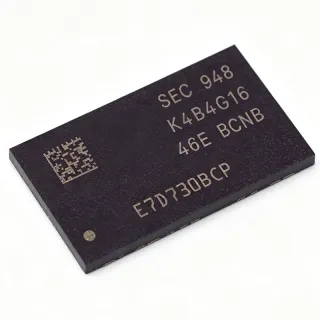
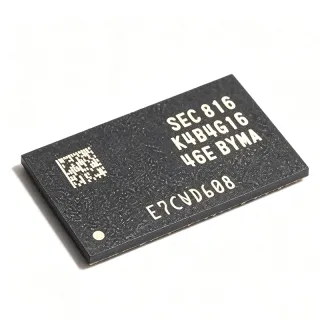
K4AAG165WA-BCRC - 16Gb DDR4 SDRAM, FBGA-96 | Samsung | DRAM
MPN: K4AAG165WA-BCRC ✓ Active| Qty | Unit Price | Extended |
|---|---|---|
| 1 | $79.74 | $79.74 |
| 10 | $76.5 | $765.00 |
| 100 | $72.1 | $7,210.00 |
| 500 | $68.4 | $34,200.00 |
| 1,000 | $64.9 | $64,900.00 |
Drop-in alternatives for K4AAG165WA-BCRC — same package, pin-to-pin compatible. Different-package parts requiring PCB rework are excluded.
Quick Comparison Tool — Select alternative parts for side-by-side comparison:
K4AAG165WA-BCWE
✅ Drop-In✓ In Stock
$62.4 / Unit
View Datasheet →K4AAG165WA-BCPB
✅ Drop-In ⚠️ 参数待验证✓ In Stock
$63.79 / Unit
View Datasheet →K4AAG165WC-BCWE
✅ Drop-In📋 Reference alternative (not in catalog)
K4AAG165WC-BCRC
✅ Drop-In📋 Reference alternative (not in catalog)
K4AAG165WA-BCRC Maximum Ratings & Electrical Characteristics
| Memory Type | DDR4 SDRAM (Volatile DRAM) |
| Memory Size | 16 Gb (2 GB) |
| Memory Organization | 1G x 16 |
| Memory Interface | DDR4 SDRAM Interface |
| Supply Voltage | 1.2 V |
| Technology | DDR4 |
| Package | FBGA-96 (96-ball Fine-Pitch Ball Grid Array) |
| Mounting Type | Surface Mount |
| Speed Grade Suffix | -BCRC |
| Datasheet | Samsung K4AAG165WA DDR4 SDRAM Memory, 23 pages |
| Memory Format | DRAM |
| RoHS Status | unknown |
K4AAG165WA-BCRC fbga-96 (96-ball fine-pitch ball grid array) Pin Configuration Guide
Complete pinout information for K4AAG165WA-BCRC (fbga-96 (96-ball fine-pitch ball grid array) package). This digital IC includes GPIO, communication interfaces (UART, SPI, I2C), and power pins. Refer to the manufacturer datasheet for alternate pin functions and configuration options. Essential for embedded system design and PCB layout.

No detailed pinout data available for K4AAG165WA-BCRC.
Refer to the datasheet for full pin configuration.
Safe Operating Area (SOA) & Thermal Characteristics
No official SOA curve available for this digital IC. Always operate within absolute maximum ratings specified in the datasheet. Ensure adequate cooling and derate as needed.
Typical Applications
K4AAG165WA-BCRC is suitable for 6 applications: Memory-Down Industrial Controllers, Networking and Communication Equipment, Embedded Single-Board Computers, DRAM Module Manufacturing (DIMMs), Automotive-Adjacent Telematics and Display Units, Security and Video Surveillance.
Memory-Down Industrial Controllers
Industrial controllers, PLCs, and edge gateways frequently use memory-down DDR4 rather than modules to save space and improve reliability in vibration-prone environments. The K4AAG165WA-BCRC delivers 2 GB of DDR4 on a single 96-ball FBGA chip, letting a single x16 device serve the full 16-bit bus of a typical industrial SoC without chip-select fan-out. At 1.2V, it fits industrial 24V systems with efficient point-of-load regulators, and the family's wide temperature grades (the BCWE sibling is rated -40C to +95C per LCSC) cover uncontrolled factory-floor enclosures. Because it is soldered rather than socketed, contact-failure modes common to SO-DIMM connectors are eliminated, improving mean time between failures in continuous-duty automation equipment.
Recommended
Networking and Communication Equipment
Switches, routers, and 5G small-cell equipment need high-bandwidth packet buffering and lookup-table memory with minimal footprint. The K4AAG165WA-BCRC provides 2 GB of DDR4 at family data rates up to 3200 Mbps per pin, giving network processors sufficient bandwidth for line-rate forwarding buffers while the x16 organization keeps the physical bus compact. The FBGA-96 package allows dense stacking of multiple devices around a network SoC on a single PCB layer budget. At 1.2V, per-chip power is roughly 25% lower than equivalent DDR3, which matters in thermally constrained fanless telecom hardware. Place devices close to the controller and follow DDR4 fly-by routing to maintain timing margin at speed.
Recommended
Embedded Single-Board Computers
Single-board computers and system-on-module makers use 16 Gb x16 DDR4 components like the K4AAG165WA-BCRC to reach 2 GB or 4 GB system memory with only one or two chips, maximizing the memory capacity of small 2 GB-class boards without populating both x16 chip-selects. The device's DDR4 interface pairs directly with mainstream ARM application processors that support 16-bit DDR4 channels and multiple die revisions, though the controller's qualified-vendor list should include both the WA and WC die families. The 96-ball FBGA footprint fits inside module edge keep-outs, and 1.2V operation simplifies the module power tree. Soldered-down DRAM also improves shock resistance for vehicle-mounted and portable embedded designs.
Recommended
DRAM Module Manufacturing (DIMMs)
Memory module manufacturers populate UDIMMs, SO-DIMMs, and RDIMMs with commodity 16 Gb x16 DDR4 chips; the K4AAG165WA-BCRC serves as the x16 building block for 2 GB-per-rank module configurations. Using uniform 16 Gb x16 devices across both sides of a PCB enables 2 GB chips per rank with a 64-bit main bus assembled from four x16 devices, matching standard module topologies defined in the Samsung DDR4 datasheet. Consistent speed binning (the BCRC bin) across all chips on a module is critical, since mixed bins force the whole module down to the slowest grade. FBGA-96 footprint standardization across the K4AAG165WA family allows module builders to swap speed grades or die revisions without changing the assembly stencil.
Recommended
Automotive-Adjacent Telematics and Display Units
Digital cockpit displays, telematics control units, and ADAS camera hubs built on automotive-qualified application processors require soldered DDR4 with wide temperature tolerance. The K4AAG165WA family's industrial temperature grades (BCWE rated -40C to +95C per LCSC data) address the cabin and near-engine thermal envelopes of these systems, while the 2 GB per chip density supports map storage buffers, camera frame buffering, and infotainment workloads on a single x16 device. Note that for functional-safety programs, a Samsung automotive-qualified DDR4 part number must be selected instead of the commercial BCRC suffix; this device suits non-safety telematics, displays, and aftermarket hardware. Use the memory controller's die-revision support list to validate WA versus WC dies before production.
Recommended
Security and Video Surveillance
Network video recorders, AI camera edge boxes, and video-analytics appliances buffer multiple high-resolution video streams in local memory before encoding or inference. The K4AAG165WA-BCRC supplies 2 GB of 1.2V DDR4 per chip, allowing a compact four-chip array to provide 8 GB of analytics working memory on a 64-bit DDR4 bus. The 3200 Mbps-class family bandwidth sustains simultaneous multi-stream writes while the processor reads frames for object detection, and the x16 organization halves the chip count versus x8-only designs. In passively cooled surveillance hardware, DDR4's reduced 1.2V power (about 25% below DDR3 per Samsung) directly lowers enclosure temperature rise, improving HDD and optics reliability in sealed outdoor housings.
Recommended
Recommended Products Summary
Engineering reference data for K4AAG165WA-BCRC — comparison, design guidance, and compliance information.
Selection Guide
Comparison with Alternatives
| Parameter | This Product | K4AAG165WA-BCWE | K4AAG165WA-BCPB | K4AAG165WC-BCWE | K4AAG165WC-BCRC |
|---|---|---|---|---|---|
| Package | FBGA-96 | FBGA-96 - same | FBGA-96 - same | FBGA-96 - same | FBGA-96 - same |
| Brand | Samsung Electronics | Samsung Electronics | Samsung Electronics | Samsung Electronics | Samsung Electronics |
| Memory Size | 16 Gb (2 GB) | 16 Gb (2 GB) | 16 Gb (2 GB) | 16 Gb (2 GB) | 16 Gb (2 GB) |
| Memory Organization | 1G x 16 | 1G x 16 | 1G x 16 | 1G x 16 | 1G x 16 |
| Supply Voltage | 1.2 V | 1.2 V | 1.2 V | 1.2 V | 1.2 V |
| Data Rate / Speed Bin | [DATA_NEEDED: BCRC bin rating] | 3200 Mbps grade | [DATA_NEEDED] | 3200 Mbps grade | [DATA_NEEDED] |
| Operating Temperature | [DATA_NEEDED: BCRC range] | -40C to +95C (per LCSC) | [DATA_NEEDED] | [DATA_NEEDED] | [DATA_NEEDED] |
| Die Revision | A-die (K4AAG165WA) | A-die | A-die | C-die (W-die revision) | C-die (W-die revision) |
Key Differentiators
- Full 2 GB density on a single x16 chip (vs K4A8G165WC-BCRC)
- Higher speed headroom available in-pin-compatible siblings (vs K4AAG165WA-BCWE)
- A-die maturity versus newer W-die (vs K4AAG165WC-BCRC)
Design Notes
DDR4 x16 interfaces at 2666-3200 Mbps class data rates require controlled-impedance routing (40 ohm single-ended typical for data lines per standard DDR4 design practice), length matching within the datasheet skew budgets, and correct on-die termination (ODT) settings from your memory controller's ZQ calibration. Fly-by routing of address/command lines with per-device soldered termination, or point-to-point routing for single-chip memory-down designs, must follow the Samsung K4AAG165WA datasheet layout guidelines. Simulate the full channel including package parasitics before committing the PCB stack-up.
Build the power tree around the DDR4 rails defined in the Samsung datasheet: 1.2V VDD/VDDQ plus the VPP rail, each with bulk and high-frequency ceramic decoupling at every ball pair per the datasheet reference decoupling table. For single-chip memory-down designs, a small synchronous buck per rail is sufficient; for multi-chip modules, add a VTTQ termination regulator sized for the x16 bus transient current. DDR4's 1.2V operation draws roughly 25% less current-path power than DDR3 at 1.5V, but peak simultaneous-switch current still dictates decoupling density.
Verify the die revision and speed bin before reflow: the K4AAG165WA (A-die) and K4AAG165WC (C-die) share the FBGA-96 footprint but some memory controllers maintain qualified die-revision lists, and timing registers may need adjustment when swapping between WA and WC dies or between BCRC and BCWE speed bins. Also confirm the exact -BCRC temperature range in the Samsung datasheet rather than assuming the -40C to +95C rating documented for the BCWE sibling, and obtain RoHS certificates for the specific suffix and date code for regulatory submissions.
Compliance Information
Compliance status for the -BCRC suffix is not stated in the retrieved web data. Samsung current-production DDR4 is generally RoHS/lead-free packaged, but confirm via Samsung environmental documentation for the exact suffix and date code before regulatory submission.