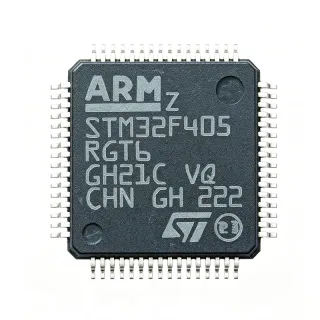
MSP430FR5989IPMR - 128KB FRAM 16MHz MCU | TI Flow Meters
MPN: MSP430FR5989IPMR ✓ Active| Qty | Unit Price | Extended |
|---|---|---|
| 1 | $5.12 | $5.12 |
| 10 | $4.61 | $46.10 |
| 100 | $3.95 | $395.00 |
| 500 | $3.52 | $1,760.00 |
| 1,000 | $3.18 | $3,180.00 |
| 3,000 | $2.96 | $8,880.00 |
Drop-in alternatives for MSP430FR5989IPMR — same package, pin-to-pin compatible. Different-package parts requiring PCB rework are excluded.
Quick Comparison Tool — Select alternative parts for side-by-side comparison:
MSP430FR5987IPMR
✅ Drop-In📋 Reference alternative (not in catalog)
MSP430FR5986IPMR
✅ Drop-In📋 Reference alternative (not in catalog)
MSP430FR6989IPMR
✅ Drop-In📋 Reference alternative (not in catalog)
MSP430FR68791IPN
⚡ Same Package📋 Reference alternative (not in catalog)
MSPM0G3207-Q1
⚡ Same Package✓ In Stock
Contact for price
View Datasheet →MSP430FR5989IPMR Maximum Ratings & Electrical Characteristics
| Core | MSP430 CPUXV2 16-bit RISC |
| Maximum Clock Frequency | 16 MHz |
| Non-Volatile Memory (FRAM) | 128 KB (128K x 8) |
| SRAM | 2 KB |
| Supply Voltage Range | 1.8 V to 3.6 V |
| Active Mode Current | Approx. 100 uA/MHz |
| Standby Current (LPM3 with VLO) | Approx. 0.4 uA |
| ADC Resolution | 12-bit |
| Security Accelerator | AES hardware accelerator |
| Sensing Interface | Extended Scan Interface 2 (rotary sensing) |
| Operating Temperature | -40C to +85C |
| Package | 64-LQFP (PM), 10x10 mm |
| Mounting Type | Surface Mount |
| Packaging | Tape & Reel (R suffix) |
| Data Bus Width | 16-bit |
| Timers | Multiple 16-bit timers with DMA and 32x32 hardware multiplier |
MSP430FR5989IPMR Pin Configuration
| Pin 1 | P1.0/TA0.1 — Digital I/O, Timer A0 capture/compare |
| Pin 10 | P3.0/SCAN0 — Digital I/O, Scan Interface 2 channel |
| Pin 13 | DVCC — Digital power supply (1.8V to 3.6V) |
| Pin 16 | AVCC — Analog power supply |
| Pin 22 | DVSS — Digital ground |
| Pin 24 | PJ.0/TDO/TDI — JTAG TDO/TDI, Spy-Bi-Wire data |
| Pin 25 | PJ.1/TMS — JTAG TMS, Spy-Bi-Wire clock |
| Pin 27 | RST/NMI — Reset input, non-maskable interrupt |
| Pin 28 | TEST/SBWTCK — Test mode, Spy-Bi-Wire test clock |
| Pin 30 | P6.0/A0 — Digital I/O, ADC input channel 0 |
| Pin 45 | P2.5/TA1.2 — Digital I/O, Timer A1 output |
| Pin 48 | XT1IN — Crystal oscillator 1 input (32kHz watch crystal) |
| Pin 49 | XT1OUT — Crystal oscillator 1 output |
| Pin 64 | P4.7 — Digital I/O |
Safe Operating Area (SOA) & Thermal Characteristics
No official SOA curve available for this digital IC. Always operate within absolute maximum ratings specified in the datasheet. Ensure adequate cooling and derate as needed.
Typical Applications
MSP430FR5989IPMR is suitable for 6 applications: Gas, Water and Heat Flow Meters, Rotary and Linear Position Sensing, Smart Grid and Secure Metering Infrastructure, Industrial Process Control Nodes, Battery-Powered IoT Sensor Nodes, Medical and Health Monitoring Devices.
Gas, Water and Heat Flow Meters
The MSP430FR5989IPMR is TI's designated MCU for flow metering, combining 0.4 uA standby current (LPM3 with VLO) with 100 uA/MHz active consumption so a single lithium cell can power a meter for over a decade. The 128KB FRAM enables frequent, low-power logging of consumption profiles without external EEPROM, while the hardware AES accelerator secures transmitted readings against tampering in smart-grid deployments. The 12-bit ADC digitizes sensor signals and the RTC with calendar mode timestamps consumption events. Placed as the single-system controller, it eliminates a separate security chip, reducing BOM cost.
Recommended
Rotary and Linear Position Sensing
The extended Scan Interface 2 makes the MSP430FR5989IPMR a dedicated rotary-sensing controller: it autonomously processes coil-sensor signals for rotational and linear position detection with minimal CPU intervention, cutting active energy versus software-scanned solutions. Per TI's product positioning, this suits tamper-detection in meters and mechanical position feedback in industrial equipment. The 128KB FRAM stores position history for diagnostics, and 0.4 uA standby keeps detection alive between events in battery-powered installations. Designers should allocate the scan-interface pins per datasheet SLAS704 and validate sensitivity with TI's reference designs.
Recommended
Smart Grid and Secure Metering Infrastructure
In smart-grid endpoints, measured consumption data must be encrypted before transmission. The MSP430FR5989IPMR integrates a hardware AES accelerator that offloads encryption from the 16MHz CPU, achieving secure data framing within tight energy budgets. Its 1.8V to 3.6V supply range supports battery or 3.3V-rail operation, and -40C to +85C temperature rating meets outdoor utility environments. FRAM endurance allows lifetime event logging without wear-out. Combined with a low-power RF or PLC companion device, it forms the core of a secure, long-life smart meter node with minimal external components.
Recommended
Industrial Process Control Nodes
Industrial sensor and control nodes benefit from the MSP430FR5989IPMR's blend of analog integration and low power. The 12-bit ADC and comparator sample process variables, DMA moves results to FRAM without CPU cycles, and the 32x32 hardware multiplier accelerates scaling math. At 100 uA/MHz active current, always-on monitoring is feasible even from loop-powered or energy-harvested supplies. The 64-pin LQFP provides ample GPIO for valve drivers, HMI buttons, and communication interfaces. Robust operation to +85C and SVS-based supply supervision ensure deterministic reset behavior on noisy factory power rails.
Recommended
Battery-Powered IoT Sensor Nodes
For wireless sensor nodes, the MSP430FR5989IPMR minimizes average power: 0.4 uA in standby with VLO, fast FRAM writes to buffer data between radio bursts, and an RTC to schedule wake-ups. Hardware AES secures uplinks without a separate crypto chip, important for constrained edge devices. The 64-LQFP 10x10mm footprint balances I/O availability with board area, and the 1.8V minimum supply extends battery cutoff headroom versus 2.0V-flash competitors. Developers use Spy-Bi-Wire debugging with just two pins, preserving GPIO for sensors and radio control signals in compact node designs.
Recommended
Medical and Health Monitoring Devices
Portable medical instruments such as dosimeters and diagnostic probes leverage the MSP430FR5989IPMR's low-noise analog integration and security features. The 12-bit ADC captures physiological or radiation sensor signals, and FRAM logs patient or dose data with encryption via the AES accelerator, supporting privacy requirements. Ultra-low sleep currents preserve coin-cell capacity in handheld instruments, while the RTC timestamps measurement sessions. The 10x10mm 64-LQFP package fits ergonomic handheld enclosures, and operation across -40C to +85C covers sterilization-adjacent storage conditions. Reference designs from TI demonstrate front-end configurations for precision sensor integration.
Recommended
Recommended Products Summary
Engineering reference data for MSP430FR5989IPMR — comparison, design guidance, and compliance information.
Selection Guide
Comparison with Alternatives
| Parameter | This Product | MSP430FR5987IPMR | MSP430FR5986IPMR | MSP430FR6989IPMR | MSP430FR68791IPN | MSPM0G3207-Q1 |
|---|---|---|---|---|---|---|
| Package | 64-LQFP (PM) 10x10mm | 64-LQFP (PM) - same footprint | 64-LQFP (PM) - same footprint | 64-LQFP (PM) - same footprint | 64-LQFP (PN) - verify pinout | LQFP-64 - not pin-compatible |
| Brand | Texas Instruments | Texas Instruments | Texas Instruments | Texas Instruments | Texas Instruments | Texas Instruments |
| Core / Speed | MSP430 CPUXV2 16-bit, 16 MHz | CPUXV2, 16 MHz | CPUXV2, 16 MHz | CPUXV2, 16 MHz | CPUXV2, 16 MHz | Arm Cortex-M0+, 80 MHz |
| Non-Volatile Memory | 128 KB FRAM | 128 KB FRAM | 128 KB FRAM | 128 KB FRAM | [DATA_NEEDED] | 128 KB Flash |
| Supply Voltage | 1.8 V to 3.6 V | 1.8 V to 3.6 V | 1.8 V to 3.6 V | 1.8 V to 3.6 V | [DATA_NEEDED] | 1.62 V to 3.6 V |
| AES Accelerator | Yes | Yes | Yes | No | [DATA_NEEDED] | AES hardware (M0+ variant) |
| Scan Interface 2 (Rotary Sensing) | Yes | No | No | No | [DATA_NEEDED] | No |
| LCD Driver | No | No | No | Yes | [DATA_NEEDED] | No |
Key Differentiators
- Only FR59xx family member with extended Scan Interface 2 (vs MSP430FR5987IPMR)
- Hardware AES accelerator (vs MSP430FR6989IPMR)
- FRAM instead of flash for non-volatile memory (vs MSPM0G3207-Q1)
Design Notes
Decouple each DVCC/AVCC pin with a 100nF ceramic capacitor placed within 2mm of the pin, plus a 10uF bulk capacitor near the supply entry. The SVS (supply voltage supervisor) resets the device below the minimum threshold; ensure brown-out behavior is characterized at your operating voltage. For battery designs, exploit LPM3 with VLO (0.4 uA) as the default sleep state and wake via RTC or port interrupts to keep average current in the single-digit uA range.
Route the 32kHz XT1 crystal traces short and guarded by ground to avoid oscillator startup issues; TI application note on MSP430 crystal layout recommends a guard ring and load capacitors matched to the crystal spec (typically 6-12.5 pF). Keep analog ADC traces away from digital clock lines on the 10x10mm LQFP breakout, and use a solid ground plane to protect 12-bit ADC accuracy.
The minimum supply voltage is restricted by SVS levels - do not assume full 1.8V operation if the SVS threshold is set higher. FRAM write protection and wait-state configuration must be handled in startup code; misconfigured FRAM access at 16MHz can corrupt writes. Debug via JTAG or Spy-Bi-Wire using the MSP-FET; locking the JTAG fuse permanently disables debugging, so apply only at end of production programming.
Compliance Information
RoHS and lead-free status per standard TI commercial part offering; detailed compliance certificates should be pulled from TI.com product quality pages.