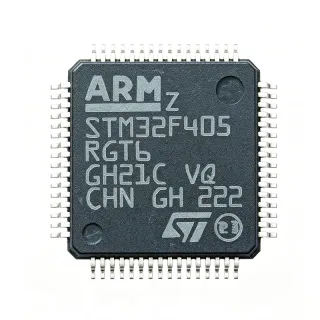
MSP430FR5994IRGZR - 16MHz 256KB FRAM MCU | TI | Low Power
MPN: MSP430FR5994IRGZR ✓ Active| Qty | Unit Price | Extended |
|---|---|---|
| 1 | $4.95 | $4.95 |
| 10 | $4.45 | $44.50 |
| 100 | $3.85 | $385.00 |
| 500 | $3.45 | $1,725.00 |
| 1,000 | $3.1 | $3,100.00 |
Drop-in alternatives for MSP430FR5994IRGZR — same package, pin-to-pin compatible. Different-package parts requiring PCB rework are excluded.
Quick Comparison Tool — Select alternative parts for side-by-side comparison:
MSP430FR59941IRGZR
✅ Drop-In ⚠️ 参数待验证📋 Reference alternative (not in catalog)
MSP430FR5992IRGZR
✅ Drop-In ⚠️ 参数待验证📋 Reference alternative (not in catalog)
MSP430FR5964IRGZR
✅ Drop-In📋 Reference alternative (not in catalog)
MSP430FR5994IRGZR Maximum Ratings & Electrical Characteristics
| Core | MSP430 CPUXV2 16-bit RISC |
| Maximum Clock Frequency | 16 MHz |
| Program Memory Size | 256 KB FRAM |
| SRAM Size | 8 KB |
| Data Bus Width | 16 bit |
| ADC Resolution | 12 bit |
| Hardware Accelerator | Low-Energy Accelerator (LEA) for DSP |
| Security Feature | AES accelerator |
| Communication Interfaces | UART, SPI, I2C |
| Peripherals | Comparator, DMA, Timers |
| Package | 48-VQFN (7x7 mm) |
| Mounting Type | Surface Mount |
| Operating Temperature | -40C to +85C (I grade, industrial) |
| Series | MSP430FR599x |
MSP430FR5994IRGZR 48-vqfn (7x7 mm) Pin Configuration Guide
Complete pinout information for MSP430FR5994IRGZR (48-vqfn (7x7 mm) package). This digital IC includes GPIO, communication interfaces (UART, SPI, I2C), and power pins. Refer to the manufacturer datasheet for alternate pin functions and configuration options. Essential for embedded system design and PCB layout.

No detailed pinout data available for MSP430FR5994IRGZR.
Refer to the datasheet for full pin configuration.
Safe Operating Area (SOA) & Thermal Characteristics
No official SOA curve available for this digital IC. Always operate within absolute maximum ratings specified in the datasheet. Ensure adequate cooling and derate as needed.
Typical Applications
MSP430FR5994IRGZR is suitable for 6 applications: Battery-Powered Vibration and Condition Monitoring, Portable Medical Monitoring Devices, Smart Metering and Data Logging, Industrial Sensor Nodes and IoT Edge Devices, Low-Power Audio and Acoustic Sensing, Handheld Test and Measurement Instruments.
Battery-Powered Vibration and Condition Monitoring
The MSP430FR5994IRGZR fits vibration and machine-health sensor nodes because its LEA accelerator executes FFT and FIR filtering at up to 40x the throughput of an Arm Cortex-M0+, per TI, letting the 16 MHz MSP430 core sleep while math completes. The 256KB FRAM stores both firmware and logged samples with near-zero write energy, avoiding flash erase cycles that waste battery budget in duty-cycled nodes. Typical designs sample the 12-bit ADC in bursts, stream data to LEA for spectral analysis, and transmit only computed features, minimizing radio-on time. Trade-off: the 16-bit CPU is slower than a 32-bit Cortex-M4 for general code, so keep control logic lean and delegate all vector math to LEA for best energy per sample.
Recommended
Portable Medical Monitoring Devices
Wearable and portable medical instruments benefit from the MSP430FR5994IRGZR's ultra-low-power MSP430 architecture, 256KB FRAM for secure patient data logging, and hardware AES for data protection. The 12-bit ADC digitizes biopotential or temperature channels directly, while LEA performs baseline filtering and feature extraction locally, reducing transmission of raw sensitive data. FRAM's instant non-volatile writes preserve event logs through battery replacement without capacitive ride-through circuits. The industrial -40C to +85C operating range suits sterilization-adjacent environments. Design consideration: medical designs must budget the 16 MHz CPU carefully; offload all DSP to LEA and validate interrupt latency against the application's real-time acquisition windows using TI's EnergyTrace profiling on the MSP-EXP430FR5994 LaunchPad.
Recommended
Smart Metering and Data Logging
Electricity, water, and gas meters require decades of battery life, tamper-resistant data storage, and frequent measurement capture, all strengths of the MSP430FR5994IRGZR. Its FRAM writes consume far less energy per byte than flash and have effectively unlimited endurance, so interval-load data can be recorded every few seconds for the meter's lifetime without memory wear-out. The 256KB capacity holds both the application firmware and years of compressed load profiles. Hardware AES supports authenticated firmware updates required by metering security standards. UART/SPI/I2C interfaces connect to communication modules, and DMA moves ADC samples without CPU intervention, keeping average current low during continuous metering operation.
Recommended
Industrial Sensor Nodes and IoT Edge Devices
Factory IoT nodes need local signal conditioning before data reaches the cloud, and the MSP430FR5994IRGZR serves this edge role with its LEA DSP accelerator performing FFT, correlation, and matrix operations on-chip. TI states LEA delivers up to 40x Cortex-M0+ DSP performance, enabling feature extraction such as spectral signatures without hosting raw data offsite. UART, SPI, and I2C link the MCU to radio modules, industrial sensors, and actuators, while DMA buffers streams during radio duty cycling. The 48-VQFN 7x7 mm package fits compact node PCBs. The 256KB FRAM supports field firmware updates and stored calibration tables that survive power interruptions instantly, a practical advantage over flash-based nodes during Brown-out events.
Recommended
Low-Power Audio and Acoustic Sensing
Acoustic event detection, leak detection, and simple audio analytics run well on the MSP430FR5994IRGZR because LEA executes the FIR filters and FFTs central to these workloads while the CPU remains in low-power modes. The 12-bit ADC samples microphone front ends directly for moderate-resolution applications, and 256KB FRAM buffers acoustic segments for burst processing or stores acoustic signature templates locally for always-on classification without radio transmission. This reduces system power compared with streaming raw audio. Design consideration: the 16 MHz CPU and 12-bit ADC suit detection and feature-extraction tasks rather than high-fidelity audio capture; use an external codec or higher-resolution ADC when signal quality requirements exceed 12-bit.
Recommended
Handheld Test and Measurement Instruments
Portable meters, gauges, and handheld analyzers benefit from the MSP430FR5994IRGZR's combination of long battery life, instant-on FRAM, and local DSP capability. Configuration settings, calibration constants, and logged results save to FRAM the instant they change, with no erase latency when the user powers the instrument off, improving field usability. LEA accelerates averaging, windowing, and transform computations for measurement display. UART/SPI/I2C connect to displays, front-end converters, and PC interfaces, while AES hardware protects calibration data from cloning in commercial products. The industrial temperature grade covers workshop and field conditions. The 48-VQFN package requires reflow assembly, so prototype using TI's LaunchPad before committing to custom PCBs.
Recommended
Recommended Products Summary
Engineering reference data for MSP430FR5994IRGZR — comparison, design guidance, and compliance information.
Selection Guide
Comparison with Alternatives
| Parameter | This Product | MSP430FR59941IRGZR | MSP430FR5992IRGZR | MSP430FR5964IRGZR |
|---|---|---|---|---|
| Package | 48-VQFN (7x7 mm) | 48-VQFN (RGZ) - same | 48-VQFN (RGZ) - same | 48-VQFN (RGZ) - same |
| Brand | Texas Instruments | Texas Instruments | Texas Instruments | Texas Instruments |
| Core / Frequency | MSP430 CPUXV2, 16 MHz | MSP430 CPUXV2, 16 MHz | MSP430 CPUXV2, 16 MHz | MSP430 CPUXV2, 16 MHz |
| FRAM Memory | 256 KB | 512 KB | 256 KB | 256 KB |
| SRAM | 8 KB | 8 KB | 4 KB | 8 KB |
| LEA DSP Accelerator | Yes | Yes | Yes | No |
| AES Hardware | Yes | Yes | Yes | Yes |
| ADC | 12-bit | 12-bit | 12-bit | 12-bit |
Key Differentiators
- LEA DSP accelerator included (vs MSP430FR5964IRGZR)
- Cost-optimized 256KB FRAM sizing (vs MSP430FR59941IRGZR)
- Full 8KB SRAM for LEA buffers (vs MSP430FR5992IRGZR)
Design Notes
The 48-VQFN 7x7 mm package has a 0.5 mm pitch and a central thermal pad that must be soldered to a grounded copper pour for both mechanical reliability and heat dissipation. Follow TI's QFN layout guidelines: use via arrays (typically 4x4 or larger) under the pad connected to the ground plane, keep the VQFN lead footprint per the datasheet land-pattern dimensions, and place 100 nF decoupling capacitors within 2 mm of each DVCC/AVCC pin pair. Pin 1 is identified by the package dot; verify orientation before stencil design.
MSP430FR599x devices support multiple power modes (LPM0-LPM4.5); the lowest-energy designs gate clocks aggressively and use LPM3 between samples. Estimated: at 16 MHz active operation the core draws on the order of hundreds of microamps per MHz-class figures per the family user's guide, so average system current is dominated by sensor front-end and radio duty cycle, not the MCU, in well-designed LPM3-heavy firmware. Use TI EnergyTrace on the MSP-EXP430FR5994 LaunchPad to profile real consumption before finalizing the battery budget.
Three frequent issues on FR599x designs: (1) FRAM wait states - code executing from FRAM above certain frequencies incurs wait states; consult the user's guide for the exact frequency thresholds and consider copying hot routines to SRAM. (2) LEA requires data in specific memory regions - buffers must be allocated in LEA-accessible RAM segments; use the TI LEA library allocation APIs rather than arbitrary linker placement. (3) Pin muxing on the 48-VQFN is heavily shared - run TI SYSCONFIG/PinMux before layout to detect conflicts between ADC, SPI, and timer functions.
Compliance Information
Compliance status for the orderable part number must be confirmed on the TI product detail page; the provided web data did not include explicit RoHS/REACH certificates.