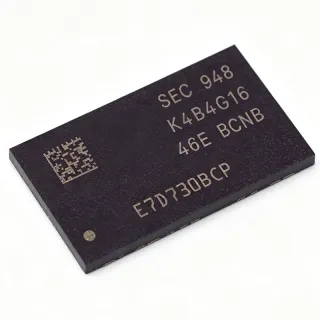
MT40A512M8RH-083E - 4Gb DDR4 512Mx8 2400MHz | Micron
MPN: MT40A512M8RH-083E ✓ Active| Qty | Unit Price | Extended |
|---|---|---|
| 1 | $5.08 | $5.08 |
| 10 | $4.7 | $47.00 |
| 100 | $4.3 | $430.00 |
| 500 | $3.95 | $1,975.00 |
| 1,000 | $3.6 | $3,600.00 |
| 3,000 | $3.3 | $9,900.00 |
Drop-in alternatives for MT40A512M8RH-083E — same package, pin-to-pin compatible. Different-package parts requiring PCB rework are excluded.
Quick Comparison Tool — Select alternative parts for side-by-side comparison:
MT40A512M8RH-083E IT:B
✅ Drop-In📋 Reference alternative (not in catalog)
MT40A512M8RH-083E AIT:B
✅ Drop-In📋 Reference alternative (not in catalog)
MT40A512M8RH-075E:B
✅ Drop-In✓ In Stock
$2.15 / Unit
View Datasheet →MT40A512M8RH-083E-IT
✅ Drop-In📋 Reference alternative (not in catalog)
MT40A512M8RH-083E Maximum Ratings & Electrical Characteristics
| Memory Type | DDR4 SDRAM |
| Density | 4 Gbit |
| Organization | 512M x 8 |
| Industry Speed Grade | DDR4-2400 |
| Clock Rate | 1.2 GHz |
| Internal Banks | 8 banks (2 groups of 4) |
| Prefetch | 8n-bit |
| Refresh | 64 ms, 8192-cycle refresh (to 95C) |
| VDD / VDDQ | 1.2 V +/-60 mV |
| VPP | 2.5 V, -125 mV/+250 mV |
| I/O Structure | 1.2 V pseudo open-drain |
| VREFDQ | On-die internal, adjustable generation |
| Operating Temperature | 0C to +95C |
| Package | 78-ball FBGA (9 x 10.5 mm) |
| FBGA Code | D9TGG |
| Marking Code | D9TGG |
| Data Strobe Preamble | Programmable |
| RoHS Status | Compliant |
MT40A512M8RH-083E 78-ball fbga (9 x 10.5 mm) Pin Configuration Guide
Complete pinout information for MT40A512M8RH-083E (78-ball fbga (9 x 10.5 mm) package). This digital IC includes GPIO, communication interfaces (UART, SPI, I2C), and power pins. Refer to the manufacturer datasheet for alternate pin functions and configuration options. Essential for embedded system design and PCB layout.

No detailed pinout data available for MT40A512M8RH-083E.
Refer to the datasheet for full pin configuration.
Safe Operating Area (SOA) & Thermal Characteristics
No official SOA curve available for this digital IC. Always operate within absolute maximum ratings specified in the datasheet. Ensure adequate cooling and derate as needed.
Typical Applications
MT40A512M8RH-083E is suitable for 6 applications: Desktop and Notebook Main Memory (UDIMM/SO-DIMM), Industrial Embedded Controllers, Networking Line Cards and Switches, Automotive Infotainment and Telematics, Test and Measurement Instruments, Edge AI and Smart Camera Modules.
Desktop and Notebook Main Memory (UDIMM/SO-DIMM)
The MT40A512M8RH-083E is a mainstream building block for consumer PC memory modules. Its 4Gb density in a x8 organization allows eight devices to populate a 64-bit module channel, yielding 4GB per rank with a single rank - ideal for SO-DIMMs in thin notebooks where PCB area and power are constrained. The 1.2V pseudo open-drain I/O reduces module idle power versus DDR3, and the DDR4-2400 speed grade matches most desktop and mobile memory controller defaults. On-die VREFDQ generation removes external reference circuitry from the module design. Designers should follow JEDEC module topology rules for fly-by address/command routing and per-DIMM termination (RTT_NOM/RTT_WR) settings, and verify SPD contents programmed to the module EEPROM match the 083E timing table in the Micron datasheet.
Recommended
Industrial Embedded Controllers
Industrial x86 and ARM controllers frequently specify soldered-down 4Gb DDR4 x8 components operating from 0C to +95C, which the -083E bin supports directly. The part's on-die adjustable VREFDQ reduces board component count in compact industrial controllers, and the 8-bank/2-group architecture sustains DDR4-2400 bandwidth for machine vision preprocessing, protocol stacks, and logging buffers. For enclosures that can drop below 0C, the footprint-identical MT40A512M8RH-083E IT:B (-40C to +95C) should be substituted at design time. Because DRAM retention and timing margins degrade near the temperature ceiling, designers should enable DDR4 temperature-compensated refresh and derate clock speed if Tcase approaches 95C. Memory training must be re-run whenever the vendor or speed bin changes on an existing platform.
Recommended
Networking Line Cards and Switches
Enterprise switches, routers, and NICs use DDR4 components for packet buffers, flow tables, and control-plane memory. The MT40A512M8RH-083E's 512M x 8 organization provides deep byte-addressable buffers that pair well with network processors and switch ASICs requiring x8 memory channels, and the DDR4-2400 rate supplies 19.2 GB/s peak bandwidth per 64-bit channel. The 78-ball FBGA (9 x 10.5 mm) suits high-density line-card layouts with multiple devices per rank. For telecom temperature ranges, the IT variant covers -40C to +95C. Designers must respect the 64ms/8192-cycle refresh requirement (tightened near 95C) since refresh stalls can affect worst-case packet latency, and should enable programmable strobe preambles to improve margins on long, heavily loaded fly-by buses typical of line cards.
Recommended
Automotive Infotainment and Telematics
Automotive IVI head units and telematics gateways demand DDR4 bandwidth for map rendering, media decode, and connectivity stacks. Micron provides automotive x8 DDR4 variants in this density (FBGA code D9TGX, IT temperature rating -40C to +95C) with product longevity commitments, and the standard commercial -083E is electrically identical for development boards and non-safety domains. The 4Gb x8 configuration lets a SoC with a 32-bit memory interface reach 2GB using eight devices, balancing bandwidth and board cost. Designers must account for under-hood thermal profiles: use the automotive/IT variant for production, place devices away from hot spots, and implement temperature-sensor-driven refresh control. AEC-style qualification documentation should be requested from Micron for production automotive programs rather than assuming it from the standard part.
Recommended
Test and Measurement Instruments
Oscilloscopes, logic analyzers, and arbitrary waveform generators use deep capture memory to buffer acquisition data. DDR4 components such as the MT40A512M8RH-083E provide low-cost per-gigabit buffering: a 64-bit-wide array of eight devices delivers 4GB and 19.2 GB/s peak bandwidth, sufficient to stream acquisition data away from the front-end at sustained rates when access patterns avoid bank conflicts. The x8 organization simplifies ECC implementation, which many instruments require for data integrity in long captures. Since instruments often idle at high temperatures in racks, thermal design should keep case temperature well below the 95C limit to preserve timing margins, and designers should exploit programmable strobe preambles for reliable training on long capture-bus traces. The 2.5V VPP rail needs its own low-noise supply regulator.
Recommended
Edge AI and Smart Camera Modules
Edge AI accelerators and smart cameras buffer frame data and neural network weights in DDR4. The MT40A512M8RH-083E offers 4Gb per device, and four devices on a 32-bit bus give 2GB at 9.6 GB/s - adequate for 1080p multi-stream inference pipelines with quantized models. Its 1.2V I/O lowers total memory power, directly improving thermal budgets in fanless camera housings, and on-die VREFDQ simplifies the compact power tree typical of camera modules. The 0C to +95C range covers most outdoor enclosures with passive cooling; for extreme cold, swap to the IT:B variant with no footprint change. Designers should place the FBGA devices close to the SoC, length-match DQS/DQ within the datasheet tolerance, and reserve solder-down land patterns compatible with both x8 and x16 siblings to preserve sourcing flexibility.
Recommended
Recommended Products Summary
Engineering reference data for MT40A512M8RH-083E — comparison, design guidance, and compliance information.
Selection Guide
Comparison with Alternatives
| Parameter | This Product | MT40A512M8RH-083E IT:B | MT40A512M8RH-083E AIT:B | MT40A512M8RH-075E |
|---|---|---|---|---|
| Package | 78-FBGA (9 x 10.5 mm) | 78-FBGA (9 x 10.5 mm) - same | 78-FBGA (9 x 10.5 mm) - same | 78-FBGA (9 x 10.5 mm) - same |
| Brand | Micron Technology | Micron Technology | Micron Technology | Micron Technology |
| Density / Organization | 4 Gbit, 512M x 8 | 4 Gbit, 512M x 8 | 4 Gbit, 512M x 8 | 4 Gbit, 512M x 8 |
| Speed Grade | DDR4-2400 (083E) | DDR4-2400 (083E) | DDR4-2400 (083E) | DDR4-2666 class (075E) |
| VDD / VDDQ | 1.2 V +/-60 mV | 1.2 V +/-60 mV | 1.2 V +/-60 mV | 1.2 V +/-60 mV |
| Operating Temperature | 0C to +95C | -40C to +95C | Automotive temperature range (-40C to +95C) | 0C to +95C |
| FBGA Marking Code | D9TGG | D9TGX-family (IT marking) | [DATA_NEEDED] | [DATA_NEEDED] |
| Refresh | 64 ms, 8192-cycle (to 95C) | 64 ms, 8192-cycle (to 95C) | 64 ms, 8192-cycle (to 95C) | 64 ms, 8192-cycle (to 95C) |
Key Differentiators
- Commercial temperature cost advantage (vs MT40A512M8RH-083E IT:B)
- Product longevity for long-lifecycle programs (vs MT40A512M8RH-083E)
- Headroom for platform upgrades (vs MT40A512M8RH-075E)
Design Notes
The MT40A512M8RH-083E requires three supply domains: VDD/VDDQ at 1.2V +/-60mV and VPP at 2.5V (-125mV/+250mV). VPP must be present during power-up because it drives internal charge pumps; sequencing VDD before VPP or leaving VPP floating can cause undefined states. Budget I/O termination current separately - pseudo open-drain I/O sinks current only on logic-low drives, so rail loading depends on data patterns. Estimated: a single x8 device at DDR4-2400 typically draws on the order of several hundred mW active; verify against the datasheet IDD table for your access pattern rather than using a single number.
DDR4 x8 solder-down layouts use fly-by routing for address/command with DQS-DQ length matching within package skew plus trace tolerance per the Micron 4Gb datasheet tables. Keep the 78-ball FBGA land pattern per the datasheet ball map for the x8 configuration; do not copy x4 or x16 footprints - the ball functions differ. Route DQ/DQS as tightly coupled pairs with solid reference planes, and place the series damping topology recommended in Micron DDR4 design guides (TN-family application notes on DDR4 board design) at the controller rather than per device when multiple ranks share the bus.
Three recurring mistakes with DDR4-2400 components: (1) treating the part as DDR3-pin-compatible - the ball map, 1.2V supply, and VPP requirement make DDR3 layouts unusable; (2) ignoring the 95C refresh boundary - beyond 85C the required refresh rate doubles (tREFI halves), and controllers without temperature-compensated refresh will corrupt data near 95C; (3) skipping memory training after substituting speed bins - an MT40A512M8RH-075E can replace the -083E, but the controller must be retrained, and the reverse substitution will fail at DDR4-2666 targets. Verify FBGA marking code D9TGG on received parts to detect counterfeit or remarked devices.
Compliance Information
RoHS compliance and lead-free construction are standard for Micron DDR4 components; AEC-Q100 applies to the automotive IT/AIT variant documentation rather than the standard commercial part. Verify REACH and conflict minerals declarations via Micron's official product compliance portal.