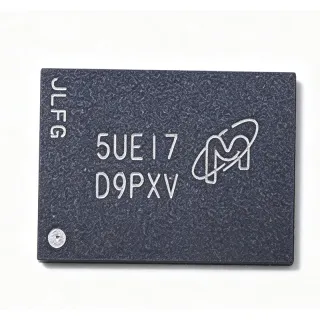
MT53E1G64D4HJ-046 - 64Gbit LPDDR4X DRAM 2.133GHz | Micron
MPN: MT53E1G64D4HJ-046 ✓ Active| Qty | Unit Price | Extended |
|---|---|---|
| 1 | $544.07 | $544.07 |
| 10 | $516.87 | $5,168.70 |
| 100 | $489.66 | $48,966.00 |
| 500 | $462.46 | $231,230.00 |
| 1,000 | $435.25 | $435,250.00 |
Drop-in alternatives for MT53E1G64D4HJ-046 — same package, pin-to-pin compatible. Different-package parts requiring PCB rework are excluded.
Quick Comparison Tool — Select alternative parts for side-by-side comparison:
MT53E1G64D4HJ-046 WT:C
✅ Drop-In📋 Reference alternative (not in catalog)
MT53E1G64D4HJ-046 AUT:C
✅ Drop-In📋 Reference alternative (not in catalog)
MT53E1G64D4HJ-046 AIT:C
✅ Drop-In📋 Reference alternative (not in catalog)
MT53E1G64D4HJ-046 AAT:A
✅ Drop-In📋 Reference alternative (not in catalog)
MT53E1G64D4HJ-046 WT:A
✅ Drop-In📋 Reference alternative (not in catalog)
MT53E1G64D4HJ-046 Maximum Ratings & Electrical Characteristics
| Memory Type | Mobile LPDDR4X SDRAM |
| Density | 64 Gbit |
| Organization | 1G x 64 |
| Interface | Parallel |
| Clock Frequency | 2.133 GHz |
| Access Time | 3.5 ns |
| Supply Voltage | 1.1 V / 1.8 V |
| Package | 556-WFBGA (12.4 x 12.4 mm) |
| Package Style | TFBGA, 556/841 ball, QDP |
| Operating Temperature | -30C to +85C |
| Built-in Temperature Sensor | Yes |
| Auto Precharge | Yes |
| Write Leveling | Yes |
| ZQ Calibration | Yes |
| AEC-Q100 | Qualified (automotive variants AUT/AIT/AAT) |
| Mounting Type | Surface Mount |
| RoHS Status | Compliant |
MT53E1G64D4HJ-046 tfbga, 556/841 ball, qdp Pin Configuration Guide
Complete pinout information for MT53E1G64D4HJ-046 (tfbga, 556/841 ball, qdp package). This digital IC includes GPIO, communication interfaces (UART, SPI, I2C), and power pins. Refer to the manufacturer datasheet for alternate pin functions and configuration options. Essential for embedded system design and PCB layout.

No detailed pinout data available for MT53E1G64D4HJ-046.
Refer to the datasheet for full pin configuration.
Safe Operating Area (SOA) & Thermal Characteristics
No official SOA curve available for this digital IC. Always operate within absolute maximum ratings specified in the datasheet. Ensure adequate cooling and derate as needed.
Typical Applications
MT53E1G64D4HJ-046 is suitable for 6 applications: Automotive ADAS Domain Controllers, 5G Networking and Edge Infrastructure, Industrial Edge-Compute Modules, Video Surveillance and Camera Pipelines, Automotive Infotainment and Cockpit, Test and Measurement Instruments.
Automotive ADAS Domain Controllers
The MT53E1G64D4HJ-046 in its AEC-Q100 qualified AUT/AIT/AAT ordering codes is a strong fit for ADAS domain controllers, where 8GB-class working memory must operate reliably from -30C to +85C. Its 2.133 GHz data rate supplies the bandwidth demanded by multi-camera fusion and sensor-processing SoCs, while the 1G x 64 organization simplifies 64-bit-wide bus designs. The built-in temperature sensor lets the memory controller trigger refresh-rate throttling as die temperature rises, preserving data integrity in engine-bay-adjacent enclosures. Used as the main DRAM hung off the SoC LPDDR4X controller with fly-by CA routing; the LPDDR4X low-VDDQ I/O reduces I/O power versus standard LPDDR4, easing thermal budgets in fanless automotive enclosures at the cost of tighter power-supply tolerance requirements.
Recommended
5G Networking and Edge Infrastructure
In 5G small cells, baseband units, and edge servers, the MT53E1G64D4HJ-046 provides 64Gbit of working memory with the 2.133 GHz throughput needed for packet processing and forward-error-correction workloads. The 3.5 ns access time and 1G x 64 organization keep latency-sensitive queues responsive, while the compact 12.4 x 12.4 mm WFBGA footprint allows dense memory population on line-card PCBs. The QDP quad-die stacking achieves this density without enlarging the package outline. Deployed as main memory beside the network processor, the part's auto precharge and write leveling functions reduce controller overhead; the trade-off is that LPDDR4X's lower VDDQ demands a tightly regulated power tree compared with conventional DDR4 SDRAM designs.
Recommended
Industrial Edge-Compute Modules
Industrial edge-AI modules such as SMARC and COM Express compact designs use the MT53E1G64D4HJ-046 to deliver 8GB-class memory for vision inference and predictive-maintenance workloads. Its industrial WT:C ordering code supports -30C to +85C operation, matching extended-temperature module specifications, and the built-in temperature sensor supports module-level thermal throttling policies in sealed enclosures. The 64-bit-wide bus maximizes bandwidth per SoC channel. In the circuit, the DRAM sits on the module's LPDDR4X bus with ZQ calibration resistor per Micron layout guidance; compared with mounting two smaller LPDDR4X parts, a single 64Gbit device saves board area and reduces routing complexity, though single-sourcing the die stack concentrates supply risk.
Recommended
Video Surveillance and Camera Pipelines
High-resolution IP camera SoCs (4K/8K) rely on the MT53E1G64D4HJ-046 to buffer multi-frame video streams; its 2.133 GHz interface sustains the sustained write bandwidth of simultaneous ISP capture and H.265 encode paths. The 64Gbit density accommodates multi-channel frame buffers plus analytics workloads without external expansion. The -046 speed bin's -30C to +85C rating covers outdoor camera enclosure environments, and the on-die temperature sensor enables enclosure-overheat protection. Electrically, the memory connects through the SoC LPDDR4X PHY with write-leveling enabled to compensate for the stub-heavy fanout typical of camera boards. Using LPDDR4X instead of DDR4L cuts memory I/O power substantially, extending PoE power budgets for camera deployments.
Recommended
Automotive Infotainment and Cockpit
Digital cockpit SoCs driving multiple displays plus Android workloads require the MT53E1G64D4HJ-046's 64Gbit density and high bandwidth; the AAT:C automotive ordering code supplies AEC-Q100 qualification demanded by tier-one OEM specifications. The 12.4 x 12.4 mm WFBGA package fits behind HMI boards with tight z-height constraints, and the built-in temperature sensor supports cockpit thermal policy when displays and amplifiers raise cabin electronics temperatures. In these designs the DRAM is typically populated as two x32 channels from a single x64 package die stack, or paired across two packages for 128-bit buses. LPDDR4X's low VDDQ reduces total platform power, a key metric for EV range, at the expense of stricter voltage-regulator accuracy.
Recommended
Test and Measurement Instruments
Portable and bench instruments - logic analyzers, spectrum analyzers, and signal generators - use the MT53E1G64D4HJ-046 as deep capture/working memory where 64Gbit of LPDDR4X bandwidth sustains high sample-rate streaming into memory. The 3.5 ns access time and 1G x 64 bus support continuous acquisition at multi-GSample rates when interleaved across channels. Industrial WT:C grading suits lab and field instruments, while the -30C to +85C range covers unconditioned environments. Designers place the DRAM adjacent to the acquisition FPGA/SoC with length-matched DQ groups; the device's ZQ calibration maintains output impedance across temperature drift. Compared with DDR4 SDRAM, LPDDR4X simplifies power sequencing in battery-powered portable instruments while providing comparable bandwidth per channel.
Recommended
Recommended Products Summary
Engineering reference data for MT53E1G64D4HJ-046 — comparison, design guidance, and compliance information.
Selection Guide
Comparison with Alternatives
| Parameter | This Product | MT53E1G64D4HJ-046 WT:C | MT53E1G64D4HJ-046 AUT:C | MT53E1G64D4HJ-046 AIT:C | MT53E1G64D4HJ-046 AAT:A |
|---|---|---|---|---|---|
| Package | 556-WFBGA (12.4 x 12.4 mm) | 556-WFBGA (12.4 x 12.4 mm) - same | 556-WFBGA (12.4 x 12.4 mm) - same | 556-WFBGA (12.4 x 12.4 mm) - same | 556-WFBGA (12.4 x 12.4 mm) - same |
| Brand | Micron Technology | Micron Technology | Micron Technology | Micron Technology | Micron Technology |
| Density | 64 Gbit | 64 Gbit | 64 Gbit | 64 Gbit | 64 Gbit |
| Organization | 1G x 64 | 1G x 64 | 1G x 64 | 1G x 64 | 1G x 64 |
| Clock Frequency | 2.133 GHz | 2.133 GHz | 2.133 GHz | 2.133 GHz | 2.133 GHz |
| Access Time | 3.5 ns | 3.5 ns | 3.5 ns | 3.5 ns | 3.5 ns |
| Grade / Qualification | Automotive (AAT code, AEC-Q100 qualified) | Industrial/commercial WT | Automotive AEC-Q100 | Industrial automotive | Automotive (rev A) |
| Operating Temperature | -30C to +85C | -30C to +85C | -30C to +85C | [DATA_NEEDED] | [DATA_NEEDED] |
| Stock / Price (as of 2026-09-04) | AAT:C: $544.07 (DigiKey, 0 in stock) | Out of stock / backorder unavailable (DigiKey) | Ships today (DigiKey) | Ships today (DigiKey CA) | [DATA_NEEDED] |
Key Differentiators
- AEC-Q100 automotive qualification available (vs MT53E1G64D4HJ-046 WT:C)
- Availability advantage of AUT:C code (vs MT53E1G64D4HJ-046 WT:C)
- Revision C silicon vs revision A (vs MT53E1G64D4HJ-046 WT:A)
Design Notes
The MT53E1G64D4HJ-046 uses separate 1.1V-class (VDD2/core) and 1.8V rails per Datasheets.com data. LPDDR4X I/O power savings come from a VDDQ rail below standard LPDDR4, so regulator output tolerance and transient response directly affect DQ eye margins at 2.133 GHz. Use a dedicated PMIC LPDDR4X rail with remote sense, sequence VDD2 before/at VDDQ per the Micron power-up sequence, and decouple every supply ball group with low-ESR ceramic capacitors on the layer immediately beneath the package.
Route the CA bus from the SoC to the 556-ball WFBGA following your SoC vendor's LPDDR4X layout guideline, keeping trace-length mismatch within the controller spec (typically tight skew budgets per byte lane). Enable write leveling at initialization - the device supports the write leveling function per LCSC feature data - to close timing across the fly-by topology. Keep the DRAM within short reach of the processor to minimize stubs, and reference DQ/CA traces to a continuous ground plane; avoid crossing plane splits under the memory bus.
The QDP (quad-die) stack concentrates four die in the 12.4 x 12.4 mm footprint, so heat extraction relies on the PCB: use thermal vias under the package center and solid copper pours to spread dissipation. The built-in temperature sensor allows the controller to raise refresh rate or throttle bandwidth when die temperature approaches limits - implement this firmware path rather than assuming worst-case ambient. Verify junction temperature in your enclosure using Micron thermal modeling guidance rather than assuming theta-JA from similar-population boards.
Compliance Information
RoHS compliant per LCSC and DigiKey listings. AEC-Q100 qualification applies to automotive ordering codes (AUT/AIT/AAT) per Datasheets.com classification; REACH, halogen-free, and conflict-minerals declarations not stated in provided data.