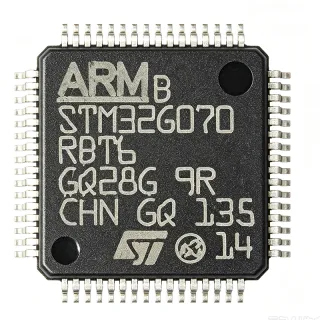
STM32L433RCT6 - Ultra-Low-Power ARM Cortex-M4 MCU | STMicroelectronics
MPN: STM32L433RCT6 ✓ Active| Qty | Unit Price | Extended |
|---|---|---|
| 1 | $8.5 | $8.50 |
| 10 | $7.65 | $76.50 |
| 100 | $6.8 | $680.00 |
| 500 | $6.12 | $3,060.00 |
| 1,000 | $5.44 | $5,440.00 |
Drop-in alternatives for STM32L433RCT6 — same package, pin-to-pin compatible. Different-package parts requiring PCB rework are excluded.
Quick Comparison Tool — Select alternative parts for side-by-side comparison:
STM32L433RCT6TR
✅ Drop-In📋 Reference alternative (not in catalog)
STM32L433RCT6P
✅ Drop-In📋 Reference alternative (not in catalog)
STM32L433RCT6Q
✅ Drop-In📋 Reference alternative (not in catalog)
STM32L432RCT6
✅ Drop-In📋 Reference alternative (not in catalog)
STM32L431RCT6
✅ Drop-In✓ In Stock
$3.1 / Unit
View Datasheet →LPC845
⚡ Same Package📋 Reference alternative (not in catalog)
RA2A1
⚡ Same Package📋 Reference alternative (not in catalog)
STM32L433RCT6 Maximum Ratings & Electrical Characteristics
| Core | ARM Cortex-M4 with FPU |
| Maximum Frequency | 80 MHz |
| Flash Memory | 256 KB |
| SRAM | 64 KB |
| Package | LQFP64 |
| Operating Voltage | 1.71 V to 3.6 V |
| Standby Current | 100 nA |
| ADC | 12-bit with hardware oversampling |
| DAC | 12-bit |
| Communication Interfaces | USART, SPI, I2C, USB |
| Real-Time Clock | Yes |
| Process Technology | 40 nm |
| Operating Temperature | -40C to +85C |
| Mounting Type | Surface Mount |
| RoHS Status | Compliant |
STM32L433RCT6 Pin Configuration
| Pin 1 | VBAT — Battery backup supply for RTC |
| Pin 2 | PC14 — GPIO / OSC32_IN |
| Pin 3 | PC15 — GPIO / OSC32_OUT |
| Pin 4 | PF0 — GPIO / OSC_IN |
| Pin 5 | PF1 — GPIO / OSC_OUT |
| Pin 6 | NRST — Reset (active low) |
| Pin 7 | PC0 — GPIO / ADC_IN10 |
| Pin 8 | PC1 — GPIO / ADC_IN11 |
| Pin 9 | PC2 — GPIO / ADC_IN12 |
| Pin 10 | PC3 — GPIO / ADC_IN13 |
| Pin 11 | VDD — Digital power supply |
| Pin 12 | VSS — Ground |
| Pin 13 | PC4 — GPIO / ADC_IN14 |
| Pin 14 | PC5 — GPIO / ADC_IN15 |
| Pin 15 | PB0 — GPIO / ADC_IN8 |
| Pin 16 | PB1 — GPIO / ADC_IN9 |
| Pin 17 | PB2 — GPIO / BOOT1 |
| Pin 18 | PB10 — GPIO / I2C2_SCL |
| Pin 19 | PB11 — GPIO / I2C2_SDA |
| Pin 20 | VDD — Digital power supply |
| Pin 21 | VSS — Ground |
| Pin 22 | PB12 — GPIO / SPI2_NSS |
| Pin 23 | PB13 — GPIO / SPI2_SCK |
| Pin 24 | PB14 — GPIO / SPI2_MISO |
| Pin 25 | PB15 — GPIO / SPI2_MOSI |
| Pin 26 | PC6 — GPIO / USART6_TX |
| Pin 27 | PC7 — GPIO / USART6_RX |
| Pin 28 | PC8 — GPIO / USART6_CK |
| Pin 29 | PC9 — GPIO / USART6_CTS |
| Pin 30 | PA0 — GPIO / ADC_IN0 / WKUP1 |
| Pin 31 | PA1 — GPIO / ADC_IN1 |
| Pin 32 | PA2 — GPIO / ADC_IN2 / USART2_TX |
| Pin 33 | PA3 — GPIO / ADC_IN3 / USART2_RX |
| Pin 34 | VDD — Digital power supply |
| Pin 35 | VSS — Ground |
| Pin 36 | PA4 — GPIO / ADC_IN4 / DAC_OUT1 |
| Pin 37 | PA5 — GPIO / ADC_IN5 / DAC_OUT2 |
| Pin 38 | PA6 — GPIO / ADC_IN6 |
| Pin 39 | PA7 — GPIO / ADC_IN7 |
| Pin 40 | PC10 — GPIO / USART4_TX |
| Pin 41 | PC11 — GPIO / USART4_RX |
| Pin 42 | PC12 — GPIO / USART5_TX |
| Pin 43 | PD2 — GPIO / USART5_RX |
| Pin 44 | PB3 — GPIO / SPI1_SCK |
| Pin 45 | PB4 — GPIO / SPI1_MISO |
| Pin 46 | PB5 — GPIO / SPI1_MOSI |
| Pin 47 | PB6 — GPIO / I2C1_SCL |
| Pin 48 | PB7 — GPIO / I2C1_SDA |
| Pin 49 | BOOT0 — Boot mode selection |
| Pin 50 | PB8 — GPIO / I2C1_SCL |
| Pin 51 | PB9 — GPIO / I2C1_SDA |
| Pin 52 | VDD — Digital power supply |
| Pin 53 | VSS — Ground |
| Pin 54 | PA8 — GPIO / USB_OTG_FS_SOF |
| Pin 55 | PA9 — GPIO / USB_OTG_FS_VBUS |
| Pin 56 | PA10 — GPIO / USB_OTG_FS_ID |
| Pin 57 | PA11 — GPIO / USB_OTG_FS_DM |
| Pin 58 | PA12 — GPIO / USB_OTG_FS_DP |
| Pin 59 | PA13 — GPIO / SWDIO |
| Pin 60 | PA14 — GPIO / SWCLK |
| Pin 61 | PA15 — GPIO / JTDI |
| Pin 62 | PB3 — GPIO / JTDO |
| Pin 63 | PB4 — GPIO / NJTRST |
| Pin 64 | VDD — Digital power supply |
Safe Operating Area (SOA) & Thermal Characteristics
No official SOA curve available for this digital IC. Always operate within absolute maximum ratings specified in the datasheet. Ensure adequate cooling and derate as needed.
Typical Applications
STM32L433RCT6 is suitable for 6 applications: Smart Meters, Wearable Devices, Medical Monitoring Equipment, Industrial Sensors, IoT Nodes, Portable Health Monitors.
Smart Meters
The STM32L433RCT6 is ideal for smart meters due to its ultra-low power consumption and rich analog peripherals. Its 12-bit ADC with hardware oversampling enables accurate energy measurement, while the low-power modes extend battery life. The device can operate for years on a single battery, making it perfect for remote metering applications. The Cortex-M4 core with FPU handles complex metering algorithms efficiently, and the multiple communication interfaces (USART, SPI, I2C) allow connectivity with communication modules for data transmission. The wide operating voltage range (1.71 V to 3.6 V) ensures compatibility with various battery chemistries, and the 256 KB flash provides ample storage for metering data and firmware updates.
Recommended
Wearable Devices
The STM32L433RCT6 is well-suited for wearable devices such as fitness trackers and smartwatches. Its ultra-low power consumption (100 nA standby) allows extended battery life, which is critical for wearables. The Cortex-M4 core with FPU enables efficient processing of sensor data, while the 12-bit ADC and DAC support analog sensor interfaces. The device's small LQFP64 package and wide operating voltage range make it easy to integrate into compact designs. The multiple low-power modes (Sleep, Low-power Run, Stop) allow the MCU to conserve energy when not actively processing, and the RTC enables timekeeping with minimal power draw. The USB interface supports charging and data transfer, and the SPI/I2C interfaces connect to sensors like accelerometers and heart rate monitors.
Recommended
Medical Monitoring Equipment
The STM32L433RCT6 is suitable for medical monitoring devices such as portable ECG monitors and glucose meters. Its low power consumption ensures long battery life for portable devices, and the high-performance Cortex-M4 core with FPU handles real-time signal processing. The 12-bit ADC with oversampling provides high-resolution data acquisition for biosignals, and the DAC can generate analog output for stimulation or calibration. The device's reliability and wide operating temperature range (-40C to +85C) make it suitable for medical environments. The multiple communication interfaces (USART, SPI, I2C, USB) allow data transfer to external displays or computers, and the 256 KB flash provides ample storage for patient data and firmware. The RTC enables accurate time-stamping of medical events.
Recommended
Industrial Sensors
The STM32L433RCT6 is ideal for industrial sensors that require low power and high reliability. Its ultra-low power modes allow battery-powered sensors to operate for years, and the wide operating voltage range (1.71 V to 3.6 V) ensures compatibility with industrial power supplies. The 12-bit ADC with oversampling enables precise measurement of analog signals from sensors like temperature, pressure, and flow. The Cortex-M4 core with FPU handles complex signal processing and calibration algorithms, while the multiple communication interfaces (USART, SPI, I2C) support wired or wireless connectivity. The device's robust design and wide temperature range make it suitable for harsh industrial environments. The 256 KB flash provides ample storage for sensor data and firmware updates.
Recommended
IoT Nodes
The STM32L433RCT6 is a perfect choice for IoT nodes due to its ultra-low power consumption and rich connectivity options. The device can run on battery power for extended periods, making it ideal for wireless sensor networks. The Cortex-M4 core with FPU enables efficient processing of sensor data, and the multiple communication interfaces (USART, SPI, I2C, USB) allow connection to various wireless modules (LoRa, BLE, Wi-Fi). The low-power modes (Sleep, Stop) reduce energy consumption when the node is idle, and the RTC enables scheduled wake-ups. The 12-bit ADC and DAC support analog sensors and actuators, and the 256 KB flash provides ample storage for firmware and data. The wide operating voltage range ensures compatibility with battery chemistries.
Recommended
Portable Health Monitors
The STM32L433RCT6 is well-suited for portable health monitors like pulse oximeters and blood pressure monitors. Its ultra-low power consumption extends battery life, and the high-performance Cortex-M4 core with FPU handles real-time signal processing. The 12-bit ADC with oversampling provides high-resolution data acquisition for biosignals, and the DAC can generate analog output for calibration. The device's small LQFP64 package and wide operating voltage range make it easy to integrate into handheld devices. The multiple communication interfaces (USART, SPI, I2C, USB) allow data transfer to smartphones or computers, and the 256 KB flash provides ample storage for patient data. The RTC enables accurate time-stamping of health measurements.
Recommended
Recommended Products Summary
Engineering reference data for STM32L433RCT6 — comparison, design guidance, and compliance information.
Selection Guide
Comparison with Alternatives
| Parameter | This Product | STM32L433RCT6TR | STM32L432RCT6 | STM32L431RCT6 | LPC845 | RA2A1 |
|---|---|---|---|---|---|---|
| Package | LQFP64 | LQFP64 | LQFP64 | LQFP64 | LQFP64 | LQFP64 |
| Brand | STMicroelectronics | STMicroelectronics | STMicroelectronics | STMicroelectronics | NXP Semiconductors | Renesas Electronics |
| Core | ARM Cortex-M4 with FPU | ARM Cortex-M4 with FPU | ARM Cortex-M4 with FPU | ARM Cortex-M4 with FPU | ARM Cortex-M0+ | ARM Cortex-M23 |
| Maximum Frequency | 80 MHz | 80 MHz | 80 MHz | 80 MHz | 30 MHz | 48 MHz |
| Flash Memory | 256 KB | 256 KB | 128 KB | 128 KB | 64 KB | 256 KB |
| SRAM | 64 KB | 64 KB | 64 KB | 64 KB | 16 KB | 32 KB |
| Standby Current | 100 nA | 100 nA | 100 nA | 100 nA | 1.5 uA | 300 nA |
| ADC Resolution | 12-bit | 12-bit | 12-bit | 12-bit | 12-bit | 12-bit |
Key Differentiators
- Ultra-low standby current of 100 nA (vs LPC845)
- Higher flash memory of 256 KB (vs STM32L432RCT6)
- Cortex-M4 core with FPU (vs RA2A1)
Design Notes
The STM32L433RCT6 operates from 1.71 V to 3.6 V. Use a low-dropout regulator (LDO) to provide a stable supply voltage. Decouple each VDD pin with a 100 nF ceramic capacitor and a 4.7 uF bulk capacitor. For the VBAT pin, connect a backup battery (e.g., CR2032) through a Schottky diode to prevent back-feeding. Ensure the power supply can handle peak currents during flash programming or high-frequency operation.
Place decoupling capacitors as close as possible to the VDD and VSS pins to minimize inductance. Use a solid ground plane to reduce noise and improve EMC performance. For the crystal oscillator pins (OSC_IN/OSC_OUT), keep traces short and shielded to avoid interference. Follow ST's layout guidelines in the datasheet for optimal performance.
Ensure the BOOT0 pin is properly configured to select the correct boot mode. If using the RTC, connect a 32.768 kHz crystal to OSC32_IN/OSC32_OUT and configure the RTC clock source. Do not exceed the absolute maximum ratings for VDD (3.6 V) and GPIO pins. When using the ADC, enable the internal voltage reference and calibrate the ADC for accurate readings.
Compliance Information
RoHS and REACH compliant per STMicroelectronics product page. Not AEC-Q100 qualified.