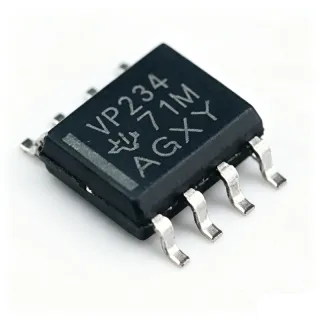
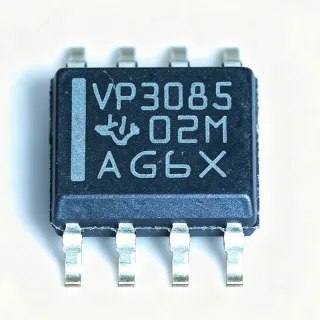
TCAN1051VDRQ1 - CAN FD Transceiver, Fault Protected | TI
MPN: TCAN1051VDRQ1 ✓ Active| Qty | Unit Price | Extended |
|---|---|---|
| 1 | $0.51 | $0.51 |
| 10 | $0.46 | $4.60 |
| 100 | $0.4 | $40.00 |
| 500 | $0.35 | $175.00 |
| 1,000 | $0.31 | $310.00 |
Drop-in alternatives for TCAN1051VDRQ1 — same package, pin-to-pin compatible. Different-package parts requiring PCB rework are excluded.
Quick Comparison Tool — Select alternative parts for side-by-side comparison:
TCAN1051GVDRQ1
✅ Drop-In ⚠️ 参数待验证✓ In Stock
$1.28 / Unit
View Datasheet →TCAN1051HVDRQ1
✅ Drop-In📋 Reference alternative (not in catalog)
TCAN1051GDRQ1
✅ Drop-In ⚠️ 参数待验证📋 Reference alternative (not in catalog)
TJA1051T/3/1
✅ Drop-In✓ In Stock
$0.52 / Unit
View Datasheet →MCP2561-E/SN
✅ Drop-In📋 Reference alternative (not in catalog)
TLE7251VSJ
✅ Drop-In📋 Reference alternative (not in catalog)
TCAN1051VDRQ1 Maximum Ratings & Electrical Characteristics
| Product Type | Automotive fault protected CAN FD transceiver |
| Protocol | CAN with Flexible Data-Rate (CAN FD) |
| Number of Drivers/Receivers | 1/1 |
| Duplex | Half duplex |
| I/O Level Shifting | Yes (VIO secondary supply input) |
| Silent Mode | Yes (STB pin, listen-only standby) |
| Fault Protection | Bus fault protected (CANH/CANL) |
| Operating Temperature | -55C to +125C |
| Package | SOIC (D), 8 pins |
| Mounting Type | Surface Mount |
| Automotive Qualification | AEC-Q100 qualified (Q1) |
| RoHS Status | Compliant |
| Application Domain | Automotive, industrial CAN networking |
TCAN1051VDRQ1 Pin Configuration
| Pin 1 | TXD — Transmit data input from CAN controller (VIO-referenced levels) |
| Pin 2 | GND — Ground reference |
| Pin 3 | VCC — Transceiver supply voltage |
| Pin 4 | RXD — Receive data output to CAN controller (VIO-referenced levels) |
| Pin 5 | VIO — Secondary supply for I/O level shifting of TXD/RXD |
| Pin 6 | CANL — CAN bus low-level line |
| Pin 7 | CANH — CAN bus high-level line |
| Pin 8 | STB — Standby (silent mode) control input |
Safe Operating Area (SOA) & Thermal Characteristics
No official SOA curve available for this digital IC. Always operate within absolute maximum ratings specified in the datasheet. Ensure adequate cooling and derate as needed.
Typical Applications
TCAN1051VDRQ1 is suitable for 6 applications: Automotive Body and Powertrain ECUs, EV Battery Management Systems (BMS), Industrial Automation Field Bus, CAN Diagnostic Gateways and Data Loggers, Building Control and Elevator Networks, Agricultural and Off-Highway Vehicles.
Automotive Body and Powertrain ECUs
Body control modules, door zones, and powertrain controllers communicate over 500 kbps Classical CAN or CAN FD networks where the TCAN1051VDRQ1 excels. Its AEC-Q100 qualification across -55C to +125C covers under-hood and exterior mounting locations, while integrated fault protection on CANH/CANL keeps a single shorted or grounded node from dragging down the whole bus - a common field failure in harness-damaged vehicles. The VIO supply lets a single transceiver footprint serve both 3.3V and 5V MCU platforms, and the STB pin enables listen-only operation for diagnostic gateways that must observe traffic without driving the bus.
Recommended
EV Battery Management Systems (BMS)
In electric vehicle battery packs, the TCAN1051VDRQ1 provides the communication link between battery management controllers and cell-monitoring slaves. The high-voltage TCAN1051H variants are preferred at 24V/48V rails, while the standard V version serves 12V-domain BMS masters. Its bus fault protection is essential in packs where wiring harness faults, coolant leaks, or connector corrosion can short the CAN pair to pack potential. The wide -55C to +125C rating covers cell-adjacent mounting, and CAN FD's higher data-phase rate accelerates cell-voltage and temperature polling cycles across dozens of daisy-chained modules, reducing worst-case fault detection latency.
Recommended
Industrial Automation Field Bus
Factory automation nodes - drives, I/O modules, and sensors - rely on CANopen and similar CAN-based field buses. The TCAN1051VDRQ1's fault protection survives the miswiring and ground-potential differences common in industrial cabinets, and its standby mode helps meet energy-efficiency targets for nodes parked in an idle machine section. The VIO level-shifting supply allows direct connection to modern 3.3V industrial MCUs without level translators, saving board area and BOM cost. CAN FD capability future-proofs the design for higher-throughput motion control traffic where Classical CAN's 8-byte frames and 1 Mbps ceiling become the bottleneck.
Recommended
CAN Diagnostic Gateways and Data Loggers
Diagnostic gateways and fleet data loggers connect to vehicle CAN buses and must tolerate electrically hostile ports. The TCAN1051VDRQ1's integrated bus fault protection guards against shorted OBD-II cables and aftermarket accessory faults. In listen-only logging applications, the STB pin provides silent mode so the logger never ACKs or disturbs production traffic. The VIO input allows direct interface to 1.8V-3.3V edge-computing loggers, and the wide temperature rating suits loggers taped inside engine bays for extended durability testing campaigns across hot and cold climates.
Recommended
Building Control and Elevator Networks
Elevator controllers, HVAC controllers, and fire-alarm panels use CAN-based networking over long building runs where the TCAN1051VDRQ1's robust receivers and fault protection maintain communication despite ground potential shifts between floors. Its standby mode suits intermittently powered nodes such as door controllers on standby power. The VIO input simplifies design when panel MCUs range from legacy 5V parts to modern 3.3V controllers on the same PCB platform. CAN FD support accommodates growing telemetry traffic in smart-building retrofits where video and sensor data increasingly share the controller network backbone.
Recommended
Agricultural and Off-Highway Vehicles
Tractors, harvesters, and construction equipment implement ISOBUS over CAN, exposing connectors to mud, moisture, and implement misconnection. The TCAN1051VDRQ1's fault tolerance handles implement-side shorts and intermittent connector faults that frequently damage unprotected transceivers. The -55C to +125C AEC-Q100 rating survives cold-soak starts and engine-bay heat. Its CAN FD capability aligns with the industry migration toward ISOBUS extensions requiring higher bandwidth for camera and guidance data. The VIO supply eases integration across the mixed 3.3V/5V controller generations found in agricultural electronics platforms.
Recommended
Recommended Products Summary
Engineering reference data for TCAN1051VDRQ1 — comparison, design guidance, and compliance information.
Selection Guide
Comparison with Alternatives
| Parameter | This Product | TCAN1051GVDRQ1 | TCAN1051HVDRQ1 | TJA1051T/3 | MCP2561-E/SN |
|---|---|---|---|---|---|
| Package | SOIC-8 (D) | SOIC-8 (D) - same | SOIC-8 (D) - same | SOIC-8 - same footprint | SOIC-8 - same footprint |
| Brand | Texas Instruments | Texas Instruments | Texas Instruments | NXP Semiconductors | Microchip Technology |
| CAN FD Support | Yes (Flexible Data-Rate) | Yes, up to 5 Mbps | Yes (CAN FD) | No (Classical CAN only) | No (Classical CAN only) |
| VIO Level-Shifting Supply | Yes (pin 5) | Yes (pin 5) | Yes (pin 5) | No dedicated VIO pin | Yes (VIO pin) |
| Silent / Standby Mode | Yes (STB pin) | Yes (STB pin) | Yes (STB pin) | No standby pin | STBY pin (standby) |
| Operating Temperature | -55C to +125C | -55C to +125C | -55C to +125C | -40C to +125C | -40C to +125C |
| Automotive Qualification | AEC-Q100 (Q1) | AEC-Q100 (Q1) | AEC-Q100 (Q1) | AEC-Q100 qualified | [DATA_NEEDED] |
| Approx. Unit Price (qty 1) | $0.51 (as of 2026-09-03) | [DATA_NEEDED] | [DATA_NEEDED] | [DATA_NEEDED] | [DATA_NEEDED] |
Key Differentiators
- Full CAN FD support with fault protection (vs TJA1051T/3)
- Dedicated VIO level-shifting supply (vs TCAN1051GDRQ1)
- Wider temperature range (vs MCP2561-E/SN)
- Automotive Q1 ordering pedigree (vs TLE7251VSJ)
Design Notes
Place a 100nF ceramic decoupling capacitor within 2 mm of each supply pin (VCC and VIO) with a solid ground return via to the ground plane. The CANH/CANL traces should be routed as a closely-coupled differential pair with matched lengths, kept away from switching regulator nodes and ignition transients. Terminate the bus at both physical ends with a resistor equal to the cable characteristic impedance (typically 120 ohms); stub length from the transceiver to the trunk should be minimized to preserve signal integrity at CAN FD data-phase rates.
Do not substitute the non-V TCAN1051GDRQ1 on a board where TXD/RXD are driven below 5V logic levels - the G variant lacks the VIO level-shifting supply and its input thresholds are referenced to VCC, causing unreliable TXD recognition with 3.3V or 1.8V controllers. Similarly, when replacing with the NXP TJA1051 or Microchip MCP2561, note that pin 8 functions differ (STB vs STBY vs N.C.) and CAN FD frames are not supported by these Classical CAN parts, which will fail on FD networks.
The transceiver draws load current proportional to bus traffic because the dominant-state driver current flows through the 60-ohm effective termination load. Estimated: with a 5V VCC and typical dominant driver current in the tens-of-mA range, average supply current in a heavily loaded network is dominated by bus activity, not the IC quiescent current. Use standby mode (STB) in nodes that are logically idle to cut system-level consumption; wake-up behavior should be validated against your CAN controller's wake pattern configuration.
Compliance Information
AEC-Q100 automotive qualification confirmed via TI TCAN1051V-Q1 product page (-55 to 125C, SOIC D package). RoHS/lead-free per standard TI automotive Q1 portfolio; formal certificates available from TI.com.