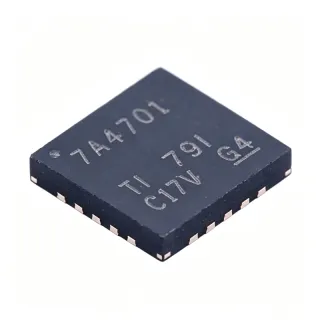
TMP411BDGKR - ±1°C Remote/Local Temp Sensor | Texas Instruments
MPN: TMP411BDGKR ✓ Active| Qty | Unit Price | Extended |
|---|---|---|
| 1 | $1.95 | $1.95 |
| 10 | $1.76 | $17.60 |
| 100 | $1.45 | $145.00 |
| 500 | $1.22 | $610.00 |
| 1,000 | $1.02 | $1,020.00 |
Drop-in alternatives for TMP411BDGKR — same package, pin-to-pin compatible. Different-package parts requiring PCB rework are excluded.
Quick Comparison Tool — Select alternative parts for side-by-side comparison:
TMP411ADGKR
✅ Drop-In✓ In Stock
$0.38 / Unit
View Datasheet →TMP411CDGKR
✅ Drop-In📋 Reference alternative (not in catalog)
TMP431BDGKR
✅ Drop-In📋 Reference alternative (not in catalog)
ADT7461ARMZ
✅ Drop-In📋 Reference alternative (not in catalog)
ADM1032ARMZ
✅ Drop-In📋 Reference alternative (not in catalog)
TMP411BDGKR Maximum Ratings & Electrical Characteristics
| Sensor Type | Remote and Local Digital Temperature Sensor |
| Local Channel Accuracy | ±1°C |
| Remote Channel Accuracy | ±1°C |
| Resolution | 11-bit (0.125°C remote) |
| Supply Voltage Range | 2.7 V to 5.5 V |
| Operating Temperature Range | -40°C to +125°C |
| Interface | I2C / SMBus |
| N-Factor Correction | Yes (programmable) |
| Series Resistance Correction | Yes |
| Alert Output | ALERT/THERM, programmable limits |
| Bus Address | 3 selectable addresses via ADD pin |
| Package | 8-pin VSSOP (MSOP-8, DGK) |
| Mounting Type | Surface Mount |
| Register Compatibility | Pin and register compatible with ADT7461 and ADM1032 |
| Typical Applications | CPU/FPGA/GPU thermal monitoring, industrial controls, power supplies |
| RoHS Status | Compliant |
TMP411BDGKR 8-pin vssop (msop-8, dgk) Pin Configuration Guide
Complete pinout information for TMP411BDGKR (8-pin vssop (msop-8, dgk) package). Learn about pin numbering, functions, and connection diagrams. Refer to the manufacturer datasheet for exact footprint and soldering guidelines. Common applications include circuit design and PCB assembly.
No detailed pinout data available for TMP411BDGKR.
Refer to the datasheet for full pin configuration.
Safe Operating Area (SOA) & Thermal Characteristics
No official SOA curve available for this component. Always operate within absolute maximum ratings specified in the datasheet. Ensure adequate cooling and derate as needed.
Typical Applications
TMP411BDGKR is suitable for 6 applications: CPU and GPU Die Temperature Monitoring, FPGA and ASIC Thermal Supervision, Server and Data Center Thermal Management, Power Supply Over-Temperature Protection, Industrial Control and Automation Systems, Networking and Telecom Equipment.
CPU and GPU Die Temperature Monitoring
The TMP411BDGKR is designed to read the on-die thermal diode of CPUs and GPUs, where its ±1°C remote accuracy and 11-bit (0.125°C) resolution allow the system controller to track junction temperature closely as load changes. The programmable N-factor correction matches the specific transistor beta of the processor die, while series-resistance correction cancels PCB trace errors over long remote-diode routings. Placed near the socket with D+/D- routed as a tightly coupled pair, the device streams measurements over SMBus at up to three selectable addresses, and the ALERT/THERM output can throttle clocks or trip a hard shutdown threshold without host intervention.
Recommended
FPGA and ASIC Thermal Supervision
High-end FPGAs and ASICs expose diode-connected transistors specifically for external thermal monitoring, and the TMP411BDGKR's combination of N-factor correction and ±1°C remote accuracy makes it a strong fit. Its 2.7V to 5.5V supply range allows direct connection to common 3.3V I/O rails, and the register-compatible architecture with ADT7461 gives board designers vendor flexibility. The 0.125°C LSB resolution resolves small temperature gradients during bitstream reconfiguration or workload bursts, while the ADD pin address selection permits monitoring multiple FPGA zones on a single SMBus. Series-resistance correction relaxes trace-resistance budgets in dense boards, simplifying routing around the device.
Recommended
Server and Data Center Thermal Management
In servers, the TMP411BDGKR monitors processor inlet temperature and hot spots that panel sensors cannot reach, feeding fan-control loops with 11-bit data. The ALERT/THERM pin implements autonomous over-temperature protection: programmable limits assert the output to force fan ramps or emergency shutdown even if the BMC is busy. SMBus operation with three selectable addresses supports multiple sensors per chassis, and pin/register compatibility with ADT7461 and ADM1032 simplifies second-source strategies across server generations. The -40°C to +125°C industrial range and ±1°C accuracy over that span keep readings trustworthy in thermally harsh rack environments with restricted airflow.
Recommended
Power Supply Over-Temperature Protection
Power supplies and DC-DC converter assemblies accumulate heat near inductors and MOSFETs, and the TMP411BDGKR can watch these hotspots via a low-cost diode-connected transistor placed at the thermal point while the sensor IC sits in a cooler, electrically quiet area. Its ±1°C remote accuracy and 0.125°C resolution enable precise derating curves, and the programmable THERM threshold drives shutdown or fan boost directly from hardware. The 2.7V to 5.5V supply suits both 3.3V control sections and 5V housekeeping rails, and N-factor correction keeps readings accurate across different small-signal transistor choices used in production.
Recommended
Industrial Control and Automation Systems
Industrial PLCs, motor drives, and edge controllers use the TMP411BDGKR to protect processors and power stages across -40°C to +125°C ambient conditions. The ±1°C channel accuracy supports control algorithms that must derate output power predictably with temperature, while the SMBus interface integrates with existing supervisory microcontrollers. The ALERT/THERM output provides hardware-level protection independent of firmware state, valuable in safety-oriented designs. Three bus addresses allow a single controller to poll several monitoring points — cabinet ambient, power module, and processor die — without an I2C multiplexer, and the small MSOP-8 footprint suits dense I/O boards.
Recommended
Networking and Telecom Equipment
Routers, switches, and base-station hardware run 24/7 with limited airflow, making continuous die-level monitoring essential. The TMP411BDGKR reads the thermal diodes of network processors and FPGAs with ±1°C accuracy, and its series-resistance correction tolerates the longer D+/D- traces typical of large line cards. SMBus telemetry integrates with shelf managers in telecom racks, while the ALERT/THERM pin provides local, fail-safe throttling. The device's 2.7V to 5.5V supply operates from standard card rails, and its register compatibility with ADT7461 lets multi-vendor BOM strategies qualify one firmware driver across both suppliers.
Recommended
Recommended Products Summary
Engineering reference data for TMP411BDGKR — comparison, design guidance, and compliance information.
Selection Guide
Comparison with Alternatives
| Parameter | This Product | TMP411ADGKR | TMP411CDGKR | TMP431BDGKR | ADT7461ARMZ | ADM1032ARMZ |
|---|---|---|---|---|---|---|
| Package | 8-pin VSSOP (MSOP-8, DGK) | 8-pin VSSOP (MSOP-8, DGK) - same | 8-pin VSSOP (MSOP-8, DGK) - same | 8-pin VSSOP (MSOP-8, DGK) - same | MSOP-8 - same footprint | MSOP-8 - same footprint |
| Brand | Texas Instruments | Texas Instruments | Texas Instruments | Texas Instruments | Analog Devices | Analog Devices |
| Local/Remote Accuracy | ±1°C / ±1°C (B grade) | [DATA_NEEDED] | C-grade, relaxed vs ±1°C | ±1°C (B grade, TMP431 family) | ±1°C typical class (verify grade) | [DATA_NEEDED] |
| Resolution | 11-bit (0.125°C remote) | 11-bit | 11-bit | 12-bit capable (TMP431 family) | Up to 11-bit | Up to 11-bit |
| Supply Voltage Range | 2.7 V to 5.5 V | 2.7 V to 5.5 V | 2.7 V to 5.5 V | 2.7 V to 5.5 V | 3.0 V to 5.5 V (verify) | 3.0 V to 5.5 V (verify) |
| N-Factor Correction | Yes (programmable) | Yes | Yes | Yes (TMP431 family) | Extended range supported | Limited vs TMP411 |
| Series Resistance Correction | Yes | Yes | Yes | Yes | [DATA_NEEDED] | [DATA_NEEDED] |
| Interface / Addressing | I2C/SMBus, 3 addresses (ADD pin) | I2C/SMBus, 3 addresses | I2C/SMBus, 3 addresses | I2C/SMBus, address pins | SMBus/I2C, address pin | SMBus/I2C, fixed/pin address |
| Operating Temperature | -40°C to +125°C | -40°C to +125°C | -40°C to +125°C | -40°C to +125°C | -40°C to +120°C (verify) | -40°C to +120°C (verify) |
Key Differentiators
- Programmable N-factor correction (vs ADM1032ARMZ)
- Series-resistance correction (vs TMP431BDGKR)
- Pin and register compatibility with ADT7461/ADM1032 (vs ADT7461ARMZ)
- Trade-off: lower maximum resolution than TMP431 family (vs TMP431BDGKR)
Design Notes
Route the D+ and D- remote-diode traces as a closely coupled differential pair and avoid running them alongside fast digital or switching-regulator lines. The TMP411's series-resistance correction cancels trace resistance (a major advantage over parts without it), but noise coupling still causes misreads. Place 1000 pF (typical, per manufacturer guidance) across D+/D- at the sensor side to filter noise, and keep the IC away from hot components if accurate local-channel readings are required.
Use 2.2k to 10k pull-up resistors on SDA and SCL sized to the SMBus bus capacitance; for a heavily loaded chassis bus with several devices, prefer 2.2k at 3.3V. The ADD pin must be tied to GND, V+, or SDA to select one of the three addresses — never leave it floating. Power the TMP411 from a quiet analog or filtered digital rail; supply ripple from nearby DC-DC converters can degrade remote-channel accuracy.
When substituting a pin-compatible part (ADT7461, ADM1032, TMP431), do not assume identical register defaults: offset registers, N-factor settings, and conversion-rate defaults can differ and silently shift reported temperatures. Verify the remote diode's N-factor against the datasheet correction table, and confirm the ALERT/THERM pin's configured polarity and mode in firmware before relying on it as a hardware protection trip point.
Compliance Information
RoHS compliant per distributor listings and TI product page. REACH, halogen-free, and conflict-minerals statements not found in provided data — consult TI product folder.