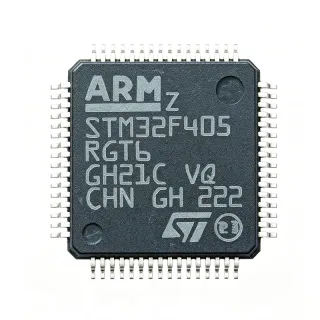
AM13E23019 - 200MHz Cortex-M33 Motor Control MCU 512KB | TI
MPN: AM13E23019 ✓ Active| Qty | Unit Price | Extended |
|---|---|---|
| 1 | $2.95 | $2.95 |
| 10 | $2.66 | $26.60 |
| 100 | $2.3 | $230.00 |
| 500 | $2.05 | $1,025.00 |
| 1,000 | $1.85 | $1,850.00 |
Drop-in alternatives for AM13E23019 — same package, pin-to-pin compatible. Different-package parts requiring PCB rework are excluded.
Quick Comparison Tool — Select alternative parts for side-by-side comparison:
AM13E23018
✅ Drop-In📋 Reference alternative (not in catalog)
AM13E23017
✅ Drop-In📋 Reference alternative (not in catalog)
XAM13E23019GTPDT
✅ Drop-In📋 Reference alternative (not in catalog)
XAM13E23019GTPT
✅ Drop-In📋 Reference alternative (not in catalog)
AM13E23019 Maximum Ratings & Electrical Characteristics
| Core Processor | Arm Cortex-M33 (Armv8-M) |
| Core Frequency | 200 MHz |
| Flash Memory | 512 KB |
| Data Bus Width | 32 bit |
| Supply Voltage | 3.3 V |
| Ambient Operating Temperature | -40C to +105C |
| Trigonometric Math Unit (TMU) | Yes |
| Edge AI Acceleration | Yes |
| Hardware Security | Yes (secure boot, cryptographic acceleration) |
| Analog Peripherals | High-performance ADCs and comparators |
| Primary Application | Real-time motor control |
| Package Options (family) | 48-pin QFN; 48/64/80/100/128-pin QFP |
| Mounting Type | Surface Mount |
| Datasheet Document | SPRSPC3A (February 2026, revised August 2026) |
AM13E23019 [data_needed: package of am13e23019] Pin Configuration Guide
Complete pinout information for AM13E23019 ([data_needed: package of am13e23019] package). This digital IC includes GPIO, communication interfaces (UART, SPI, I2C), and power pins. Refer to the manufacturer datasheet for alternate pin functions and configuration options. Essential for embedded system design and PCB layout.
![[data_needed: package of am13e23019] package pinout diagram for AM13E23019](/assets/package-diagrams/default.svg?v=1788069619)
No detailed pinout data available for AM13E23019.
Refer to the datasheet for full pin configuration.
Safe Operating Area (SOA) & Thermal Characteristics
No official SOA curve available for this digital IC. Always operate within absolute maximum ratings specified in the datasheet. Ensure adequate cooling and derate as needed.
Typical Applications
AM13E23019 is suitable for 6 applications: BLDC Motor Field-Oriented Control, PMSM Servo Drives for Robotics, Stepper Motor Drives in Industrial Automation, Predictive Maintenance and Condition Monitoring, Appliance and HVAC Blower Motor Control, Power Tools and E-Mobility Drives.
BLDC Motor Field-Oriented Control
The AM13E23019 fits BLDC FOC because its 200MHz Cortex-M33 core with DSP instructions and hardware FPU executes current and speed loops well within typical 16-20kHz PWM periods, while the Trigonometric Math Unit (TMU) accelerates the Park/Clarke transforms and sin/cos lookups that otherwise consume significant CPU time. Integrated high-performance ADCs sample phase currents, and PWM timers generate the complementary drive signals with minimal external circuitry, per the AM13E230x datasheet. In a typical topology the MCU reads shunt or in-line current sensors each PWM cycle, runs the FOC pipeline with TMU-offloaded trigonometry, and updates PWM duty within the same cycle, enabling higher loop bandwidth and lower torque ripple than software-only trigonometry on a comparable Cortex-M0+ part. The 512KB flash holds sensorless observers and startup ramps alongside the application code.
Recommended
PMSM Servo Drives for Robotics
Robot joint and servo drives benefit from the AM13E23019's deterministic real-time control: the 200MHz Cortex-M33 closes current loops while hardware security supports secure firmware updates on deployed robots. The TMU reduces trigonometric computation latency in the position-referenced FOC used by permanent magnet synchronous motors, supporting the high PWM frequencies and fast torque response robotics demands. Per the AM13E230x datasheet, integrated analog peripherals reduce BOM count in compact joint controllers, and the -40C to +105C ambient range covers industrial factory floors. The 3.3V single-supply operation simplifies power tree design alongside 24V or 48V motor buses with a DC-DC stage. Because the same 512KB flash hosts both the servo control stack and an anomaly-detection edge AI model, engineers can add predictive maintenance without a second processor, cutting cost and board area in dense multi-axis designs.
Recommended
Stepper Motor Drives in Industrial Automation
Stepper drives in 3D printers, CNC machines, and lab automation use the AM13E23019 for microstepping tables, where the TMU accelerates the sin/cos phase-current profiles applied at each microstep. The 200MHz core executes the motion planner and the current-control loop on a single device, and 512KB flash stores motion profiles and communication stacks. Per the AM13E230x datasheet, the MCU's integrated comparators provide fast overcurrent protection trips independent of CPU load, an important safety behavior during stall or jam events. Operating from 3.3V with an extended -40C to +105C ambient range suits sealed controller enclosures. Typical topology pairs the MCU's PWM outputs with an external dual H-bridge or integrated stepper driver; the MCU generates the two quadrature phase currents while monitoring back-EMF for stall detection, improving reliability over open-loop stepper systems at no added processor cost.
Recommended
Predictive Maintenance and Condition Monitoring
The AM13E23019's edge AI capability enables on-device condition monitoring: vibration and current-signature features are classified locally, flagging bearing wear, misalignment, or cavitation without streaming raw data to the cloud. The 200MHz Cortex-M33 with DSP instructions executes feature extraction (FFT, RMS, spectral kurtosis) in real time, while the 512KB flash accommodates compact quantized inference models alongside the application. Per TI's product page, edge AI is a headline feature of this motor control MCU, positioning it for smart factory equipment where downtime cost is high and connectivity is intermittent. Because the same device can also run the motor control loop, one chip delivers both control and monitoring, reducing BOM cost versus a separate AI coprocessor. The -40C to +105C ambient range and 3.3V supply integrate into existing industrial sensor and drive electronics.
Recommended
Appliance and HVAC Blower Motor Control
Household appliances, fans, and HVAC blowers increasingly use sensorless FOC for efficiency and acoustic performance, and the AM13E23019 is a cost-optimized fit: TI describes the AM13x family as highly integrated and low-cost, so single-chip control at consumer price points is practical. The TMU offloads the trigonometry in sensorless sliding-mode or flux observers, and the integrated ADCs and comparators handle DC-bus and phase-current sensing with minimal external parts, per the AM13E230x datasheet. The 512KB flash leaves room for multiple motor profiles and OTA update frameworks, while hardware security protects firmware IP and supports authenticated updates - increasingly required by connected appliance platforms. Single 3.3V supply and -40C to +105C operation cover typical appliance environments. The result is quieter, more efficient variable-speed operation with lower system cost than discrete control solutions.
Recommended
Power Tools and E-Mobility Drives
Cordless power tools, e-bikes, and light e-mobility drives require high torque density and fast protective response, both strengths of the AM13E23019. The 200MHz real-time core closes FOC current loops at high PWM frequency for smooth, high-torque starts, and the integrated fast comparators implement cycle-by-cycle overcurrent limiting independent of software latency, per the AM13E230x datasheet. The TMU keeps trigonometric overhead low even during rapid speed transients typical of trigger-controlled tools. The 512KB flash supports field-weakening, start-up algorithms, and connected-feature firmware (Bluetooth stacks typically run on a companion wireless MCU), while hardware security supports anti-counterfeiting authentication of battery packs. Operation from 3.3V across -40C to +105C ambient covers enclosed motor housings. System cost benefits from the AM13x family's low-cost, high-integration positioning in TI's real-time MCU portfolio.
Recommended
Recommended Products Summary
Engineering reference data for AM13E23019 — comparison, design guidance, and compliance information.
Selection Guide
Comparison with Alternatives
| Parameter | This Product | AM13E23018 | AM13E23017 | XAM13E23019GTPDT |
|---|---|---|---|---|
| Brand | Texas Instruments | Texas Instruments | Texas Instruments | Texas Instruments |
| Package | AM13E230x family packages (48-pin QFN / QFP) - confirm per OPN | Same family package options | Same family package options | Same die, variant ordering suffix |
| Core | Arm Cortex-M33, 200 MHz | Arm Cortex-M33, 200 MHz | Arm Cortex-M33, 200 MHz | Arm Cortex-M33, 200 MHz |
| Flash | 512 KB | [DATA_NEEDED] | [DATA_NEEDED] | 512 KB |
| TMU | Yes | Yes | Yes | Yes |
| Edge AI | Yes | Family feature - confirm per OPN | Family feature - confirm per OPN | Yes |
| Supply Voltage | 3.3 V | 3.3 V | 3.3 V | 3.3 V |
| Operating Temperature | -40C to +105C | -40C to +105C | -40C to +105C | [DATA_NEEDED] |
Key Differentiators
- Largest flash configuration in the AM13E230x family (vs AM13E23017)
- Trigonometric Math Unit offloads FOC math (vs AM13E23018)
- Cost-optimized Arm ecosystem option in TI's real-time portfolio (vs TMS320F2800153-Q1)
Design Notes
Decouple the 3.3V supply with low-ESR ceramic capacitors (for example 100nF at each supply pin plus 10uF bulk) placed as close as possible to the AM13E23019 power pins. Motor control applications impose heavy transient currents on the digital core as PWM outputs switch simultaneously; insufficient local decoupling shows up as ADC noise and degraded current-loop accuracy. Follow the power supply recommendations in the AM13E230x datasheet (SPRSPC3A) for the exact package you select.
Estimated: sustained 200MHz real-time control workloads keep the core active with no low-power-mode duty cycling, so internal power dissipation stays near its worst case. Verify junction temperature using the package theta_JA from the SPRSPC3A datasheet for your chosen package (48-pin QFN or QFP options have different thermal performance), especially in sealed enclosures approaching the +105C ambient limit.
Route motor-phase current sense lines to the ADC differentially or with careful guard trace layout, keeping the sense resistor Kelvin connections directly at the device pins. Keep PWM outputs away from analog ADC inputs to prevent switching noise coupling into current-loop feedback; this directly determines achievable torque ripple and loop bandwidth in FOC designs using the TMU-offloaded transforms.
Compliance Information
Compliance data not present in provided web data. Verify RoHS/REACH status on TI's quality page for the specific orderable part number.