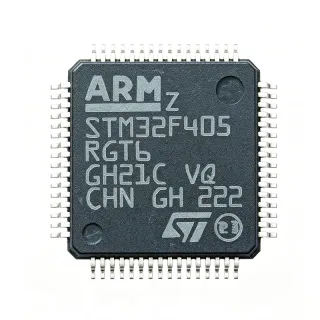
MSP430FR5994IPMR - 16MHz 256KB FRAM MCU | Texas Instruments
MPN: MSP430FR5994IPMR ✓ Active| Qty | Unit Price | Extended |
|---|---|---|
| 1 | $6.42 | $6.42 |
| 10 | $5.72 | $57.20 |
| 100 | $5.11 | $511.00 |
| 500 | $4.66 | $2,330.00 |
| 1,000 | $4.21 | $4,210.00 |
Drop-in alternatives for MSP430FR5994IPMR — same package, pin-to-pin compatible. Different-package parts requiring PCB rework are excluded.
Quick Comparison Tool — Select alternative parts for side-by-side comparison:
MSP430FR5989IPMR
✅ Drop-In✓ In Stock
$6.3 / Unit
View Datasheet →MSP430FR59941IPM
✅ Drop-In✓ In Stock
$5.35 / Unit
View Datasheet →MSP430FR6989IPMR
✅ Drop-In ⚠️ 参数待验证📋 Reference alternative (not in catalog)
MSP430FR5969IPMR
✅ Drop-In ⚠️ 参数待验证📋 Reference alternative (not in catalog)
MSP430FR59721IPM
✅ Drop-In ⚠️ 参数待验证📋 Reference alternative (not in catalog)
MSP430FR5994IPMR Maximum Ratings & Electrical Characteristics
| Core | MSP430 CPUXV2 16-bit RISC |
| Maximum Clock Frequency | 16 MHz |
| Program Memory | 256 KB FRAM |
| SRAM | 8 KB |
| Data Bus Width | 16 bit |
| ADC Resolution | 12 bit |
| Hardware Accelerators | LEA (Low-Energy Accelerator), AES256 |
| Communication Interfaces | UART, SPI, I2C |
| DMA Channels | Yes (DMA controller) |
| Comparators | Yes |
| Timers | Yes (Timer peripherals) |
| Package | 64-LQFP (10x10 mm, PM) |
| Mounting Type | Surface Mount |
| Series | MSP430FR599x FRAM |
MSP430FR5994IPMR 64-lqfp (10x10 mm, pm) Pin Configuration Guide
Complete pinout information for MSP430FR5994IPMR (64-lqfp (10x10 mm, pm) package). This digital IC includes GPIO, communication interfaces (UART, SPI, I2C), and power pins. Refer to the manufacturer datasheet for alternate pin functions and configuration options. Essential for embedded system design and PCB layout.

No detailed pinout data available for MSP430FR5994IPMR.
Refer to the datasheet for full pin configuration.
Safe Operating Area (SOA) & Thermal Characteristics
No official SOA curve available for this digital IC. Always operate within absolute maximum ratings specified in the datasheet. Ensure adequate cooling and derate as needed.
Typical Applications
MSP430FR5994IPMR is suitable for 6 applications: Battery-Powered Sensor Nodes, Building Automation and Metering, Portable Medical Devices, Edge Signal Processing / DSP Offload, IoT and Secure Connectivity Endpoints, Industrial Data Loggers.
Battery-Powered Sensor Nodes
The MSP430FR5994 fits battery-powered sensor nodes because its MSP430 CPUXV2 core at 16 MHz combined with multiple low-power modes minimizes average current, while the 256KB FRAM stores long data histories without wear-out concerns. FRAM writes consume far less energy than flash writes, so periodic sensor logging costs microjoules per record. The 12-bit ADC and comparators handle direct sensor interfaces, and LEA can run FFT or FIR filtering locally so only events, not raw waveforms, are transmitted. Placed in a duty-cycled topology (sleep in LPM, wake on timer or comparator interrupt), the node achieves multi-year battery life. The trade-off versus simpler MCUs is slightly higher unit cost, offset by eliminating external memory and reducing radio transmission energy through on-board processing.
Recommended
Building Automation and Metering
Metering and building-automation endpoints benefit from the MSP430FR5994's combination of FRAM non-volatility, AES256 security, and low-power operation. Energy meters must log consumption continuously; FRAM's byte-writable unified memory records usage with no erase cycles and survives power loss instantly. The AES256 accelerator encrypts metering data and authenticates firmware for smart-grid compliance without loading the 16-bit CPU. The 12-bit ADC samples current and voltage channels, and LEA can compute RMS and harmonic content efficiently. UART and I2C connect to communication modules (RF, PLC, or wired). Designs requiring an integrated segment-LCD driver should instead select the pin-compatible MSP430FR5989, which shares the same footprint but adds an 8x40 LCD controller, enabling PCB reuse across display and non-display meter variants.
Recommended
Portable Medical Devices
Portable and wearable medical instruments - pulse oximeters, glucose meters, portable ECG front ends - use the MSP430FR5994 because it merges analog acquisition, secure data handling, and signal processing in one low-power die. The 12-bit ADC digitizes biopotential or optical signals, and LEA applies FIR/FFT filtering with up to 40x Cortex-M0+ throughput per TI, enabling real-time feature extraction while the CPU sleeps. AES256 protects patient data at rest in the 256KB FRAM, supporting privacy requirements, and FRAM endures the frequent logging typical of continuous monitoring. Ultra-low active current and deep LPM states extend coin-cell or Li-ion run time. Designers should follow TI's analog-front-end reference designs and budget FRAM endurance and partitioning per the MSP430FR599x datasheet (Rev. D).
Recommended
Edge Signal Processing / DSP Offload
The defining application for MSP430FR5994 is edge digital signal processing: the Low-Energy Accelerator (LEA) executes 16-bit and 32-bit vector math - FFT, FIR, matrix multiplication, and convolution - while the CPU remains in a low-power mode, coordinated through DMA. TI states LEA delivers up to 40x the signal-processing performance of Arm Cortex-M0+ MCUs on these kernels, and crucially requires no DSP programming expertise since TI provides a LEA math library. A typical chain is: ADC sampling at kHz rates, DMA streaming into SRAM, LEA computing spectral features, then UART/I2C reporting results. This suits vibration sensors, acoustic event detectors, and condition-monitoring probes. The trade-off: LEA covers common kernels only; algorithms outside the library fall back to slower CPU code.
Recommended
IoT and Secure Connectivity Endpoints
IoT endpoints that must authenticate and encrypt traffic use the MSP430FR5994's hardware AES256 accelerator, which offloads cryptographic computation from the 16-bit CPU and reduces both latency and energy per transaction. The 256KB FRAM accommodates communication stacks, TLS-style session state, and OTA image buffering - FRAM's byte-writability makes firmware-in-place updates practical without external flash. UART, SPI, and I2C interfaces connect to Wi-Fi, BLE, Sub-1 GHz, or LoRa modules; the MCU handles sensing locally and forwards compact, encrypted payloads. Ultra-low sleep current suits battery or energy-harvesting deployments. For designs needing more connectivity processing power, TI's MSP432E401Y (Arm Cortex-M4 with Ethernet) serves as an upstream gateway companion rather than a replacement.
Recommended
Industrial Data Loggers
Industrial data loggers recording temperatures, pressures, or process variables over months use the MSP430FR5994 because FRAM eliminates the flash-wear bottleneck: byte-granular writes with very high endurance permit logging every sample without erase cycles or wear-leveling complexity, and data survives instant power loss. The 256KB unified memory holds long histories plus a robust logging firmware with OTA-update capability, and the 12-bit ADC plus comparators interface directly to sensor outputs. UART/SPI/I2C link to external storage, displays, or fieldbus modules, while DMA moves samples without CPU intervention to keep average current minimal. Compliance-sensitive installations benefit from the AES accelerator for signed records. Partition FRAM code/data regions deliberately per TI's segmentation guidance to keep calibration data safe across updates.
Recommended
Recommended Products Summary
Engineering reference data for MSP430FR5994IPMR — comparison, design guidance, and compliance information.
Selection Guide
Comparison with Alternatives
| Parameter | This Product | MSP430FR5989IPMR | MSP430FR59941IPM | MSP430FR6989IPMR | MSP430FR5969IPMR |
|---|---|---|---|---|---|
| Package | 64-LQFP (10x10 mm, PM) | 64-LQFP (10x10 mm, PM) - same | 64-LQFP (10x10 mm, PM) - same | 64-LQFP (10x10 mm, PM) - same | 64-LQFP (10x10 mm, PM) - same |
| Brand | Texas Instruments | Texas Instruments | Texas Instruments | Texas Instruments | Texas Instruments |
| Program Memory | 256 KB FRAM | 256 KB FRAM | 256 KB FRAM | 256 KB FRAM | 128 KB FRAM |
| SRAM | 8 KB | 8 KB | 8 KB | 8 KB | 2 KB |
| LEA DSP Accelerator | Yes | Yes | Yes | Yes | No |
| LCD Controller | No | Yes (8x40 segments) | No | Yes (8x40 segments) | No |
| AES256 Accelerator | Yes | Yes | Yes | Yes | No |
| Max CPU Frequency | 16 MHz | 16 MHz | 16 MHz | 16 MHz | 16 MHz |
Key Differentiators
- LEA hardware DSP accelerator (vs MSP430FR5969IPMR)
- No LCD controller keeps cost down (vs MSP430FR5989IPMR)
- Full 256KB FRAM with 8KB SRAM (vs MSP430FR6989IPMR)
Design Notes
Partition FRAM deliberately. The unified FRAM of the MSP430FR5994 allows code and data anywhere in the 256KB space, but constants placed in information segments and logging regions must not overlap the code image, or a firmware update will erase logged data or vice versa. Follow TI's FRAM segmentation guidance in the MSP430FR599x datasheet (Rev. D): define a fixed data region excluded from reflash, and account for write endurance in your logging rate budget.
Keep the CPU asleep and let LEA + DMA work. The low-power advantage of this device comes from offloading FFT/FIR/matrix kernels to the Low-Energy Accelerator while the CPUXV2 core sits in LPM; polling the CPU during computation wastes the architecture's benefit. Ensure the 12-bit ADC reference and analog supply are clean, and sequence power rails so DVCC is stable before releasing the device from reset (RST/NMI pin handling per datasheet).
The 64-LQFP (10x10 mm) PM package places power pins to support a solid ground plane. Place 100 nF ceramic decoupling capacitors at each DVCC/AVCC pin pair as close to the package as possible, plus bulk capacitance near the supply entry. Tie AVSS and DVSS to a low-impedance ground plane; keep the ADC reference path short and away from switching signals (UART/SPI traces) to preserve 12-bit accuracy.
Compliance Information
IPMR suffix denotes standard TI green/RoHS package; verify exact REACH and conflict-minerals declarations via TI's official quality/environmental documentation for this ordering part number.