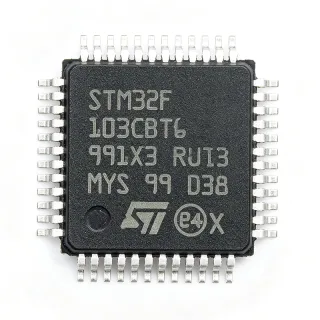
ATMEGA161-8AC - 8-bit AVR MCU 16KB Flash 8MHz | Microchip
MPN: ATMEGA161-8AC ✗ End of Life| Qty | Unit Price | Extended |
|---|---|---|
| 1 | $11.2 | $11.20 |
| 10 | $10.15 | $101.50 |
| 100 | $9.3 | $930.00 |
| 500 | $8.6 | $4,300.00 |
| 1,000 | $7.95 | $7,950.00 |
ATMEGA161-8AC Overview
An 8-bit AVR microcontroller is a reduced-instruction-set (RISC) processor that combines program Flash, data SRAM, and EEPROM on a single die, forming the entry point of the broader microcontroller and embedded processing hierarchy. AVR devices execute most of their 130 instructions in a single clock cycle, which is why the ATMEGA161-8AC delivers up to 8 MIPS at its 8MHz maximum clock rate.
Key features include the Advanced RISC AVR core with 32 x 8 general-purpose working registers, fully static operation, 16KB self-programmable Flash, two USARTs for dual serial channels, and a 5V supply range up to 5.5V maximum. The commercial temperature grade (suffix AC) targets cost-sensitive 0C to 70C environments, while the gull-wing TQFP terminals support automated surface-mount assembly.
Architecturally, the device uses the Harvard memory structure typical of the AVR ATmega family, separating program and data buses to achieve single-cycle instruction throughput. In-System Programmable Flash allows firmware updates after board assembly, and the 512-byte EEPROM retains calibration data through power cycles.
Typical applications include industrial control panels, legacy serial communication bridges using the dual USARTs, and consumer embedded products where an 8MHz, 5V-tolerant MCU remains sufficient.
When designing around this device, note that the ATMEGA161 is a legacy part succeeded by the pin-compatible ATmega162 family; new designs should evaluate the successor while the ATMEGA161-8AC serves maintenance of existing boards.
This page synthesizes distributor inventory data, drop-in alternative analysis, and practical design notes not found in the manufacturer datasheet, giving engineers a single decision-ready reference.
Drop-in alternatives for ATMEGA161-8AC — same package, pin-to-pin compatible. Different-package parts requiring PCB rework are excluded.
Variants in this series
Same-series models that are drop-in compatible with ATMEGA161-8AC (same form factor and footprint) — differing in Package, Core Architecture, General Purpose Registers, Flash Memory, I/O Pins.
Quick Comparison Tool — Select alternative parts for side-by-side comparison:
ATMEGA162-16AU
✅ Drop-In ⚠️ 参数待验证✓ In Stock
$2.45 / Unit
View Datasheet →ATMEGA162V-8AU
✅ Drop-In ⚠️ 参数待验证📋 Reference alternative (not in catalog)
ATMEGA16-16AU
✅ Drop-In✓ In Stock
$4.41 / Unit
View Datasheet →ATMEGA161-8AI
✅ Drop-In ⚠️ 参数待验证✓ In Stock
$5.05 / Unit
View Datasheet →ATMEGA161-8AT
✅ Drop-In ⚠️ 参数待验证📋 Reference alternative (not in catalog)
ATMEGA161-8AC Maximum Ratings & Electrical Characteristics
| Core Architecture | AVR 8-bit RISC |
| Flash Program Memory | 16 KB (8K x 16) |
| SRAM | 1 KB |
| EEPROM | 512 B |
| Maximum Clock Frequency | 8 MHz |
| Peak Throughput | 8 MIPS (most instructions single-cycle) |
| Instruction Set | 130 powerful instructions |
| General Purpose Registers | 32 x 8 |
| Supply Voltage (Maximum) | 5.5 V |
| Package | 44-TQFP (10x10 mm), gull-wing terminals |
| Mounting Type | Surface Mount |
| Temperature Grade | Commercial (suffix AC) |
| USART Channels | 2 |
| Programmability | In-System Programmable (ISP) Flash |
| Operating Mode | Fully static operation |
ATMEGA161-8AC 44-tqfp (10x10 mm), gull-wing terminals Pin Configuration Guide
Pin configuration for ATMEGA161-8AC (44-tqfp (10x10 mm), gull-wing terminals package). This digital IC includes GPIO, communication interfaces (UART, SPI, I2C), and power pins. Refer to the manufacturer datasheet for alternate pin functions and configuration options. Essential for embedded system design and PCB layout.

No detailed pinout data available for ATMEGA161-8AC.
Refer to the datasheet for full pin configuration.
Typical Applications
ATMEGA161-8AC is suitable for 6 applications: Industrial Control Panels, Dual-Channel Serial Communication Bridges, Legacy Firmware Maintenance, Consumer Embedded Products, Data Logging and Metering Nodes, Educational and Prototyping Platforms.
Industrial Control Panels
The ATMEGA161-8AC fits industrial control and monitoring panels where a 5V-tolerant, fully static 8-bit AVR with 16KB Flash is sufficient. Its 130-instruction AVR core executes most instructions in a single cycle, providing deterministic timing for relay sequencing, keypad scanning, and LED indication at 8MHz (8 MIPS). The 512-byte EEPROM stores calibration constants and setpoints across power cycles, while 1KB SRAM handles state machines and communication buffers. The 44-TQFP gull-wing package withstands standard reflow assembly used in industrial board builds. Because the part is obsolete, use it for sustaining existing panels; new panel designs should adopt the pin-compatible ATMEGA162-16AU to keep the same footprint with double the clock ceiling and active lifecycle support from Microchip.
Recommended
Dual-Channel Serial Communication Bridges
The distinguishing feature of the ATMEGA161-8AC for serial bridging is its pair of independent USARTs, a capability the mainstream ATmega16 lacks. A bridge node can simultaneously service two serial buses - for example, forwarding between a field terminal and a backhaul link - with each USART buffered in the 1KB SRAM. At 8MHz the core sustains typical UART rates (up to 115.2 kbps) with headroom for protocol framing in the 16KB Flash. The In-System Programmable Flash allows protocol firmware updates without desoldering the device, valuable for deployed gateways. For new bridge designs, the ATMEGA162-16AU preserves the dual-USART architecture and 44-TQFP footprint while raising the clock to 16MHz, easing timing margins on high-baud-rate channels.
Recommended
Legacy Firmware Maintenance
A large installed base of ATmega161-based boards still requires replacement MCUs during repair and refurbishment. The ATMEGA161-8AC serves this exact role: it is the commercial-grade, 44-TQFP variant that drops onto the existing land pattern with no PCB rework, and its 16KB ISP Flash accepts the original firmware image via the AVR ISP programming interface. Its 512-byte EEPROM preserves stored parameters when replacing a failed device only if contents are re-programmed after swap. Buyers should verify RoHS status for the specific date code when mixing with lead-free assemblies. When broker stock runs out, the pin-compatible ATMEGA161-8AI (industrial grade) or ATMEGA162 family are the recommended substitution paths documented on this page.
Recommended
Consumer Embedded Products
Cost-driven consumer products - small appliances, toy controllers, simple metering displays - historically used the ATMEGA161-8AC where an 8MHz, 5.5V-max 8-bit MCU met the requirement at minimal cost. The single-cycle AVR core gives responsive button handling and display refresh at low clock rates, keeping EMI and power consumption low, and fully static operation allows clock throttling in sleep-oriented designs. The 44-TQFP offers 32 general I/O-class lines across four ports plus PE0-PE1, enough for a segment LCD driver logic, keypad matrix, and status indicators without external expansion. For new consumer designs, Microchip's active ATmega16 and ATmega162 parts in the same 44-TQFP package provide equivalent function with guaranteed supply and modern compliance documentation.
Recommended
Data Logging and Metering Nodes
The ATMEGA161-8AC suits simple logging nodes: the 512-byte EEPROM accumulates configuration and rolling event counters that survive power loss, while 1KB SRAM provides working buffers for ADC-derived or serial-captured readings. One USART can stream logs to a host while the second accepts a configuration terminal, an arrangement impossible on single-USART peers like the ATMEGA16-16AU. At 8MHz the fully static core permits aggressive power-down between samples in battery-backed meters. Flash self-programming allows in-field firmware fixes. Designers should budget SRAM carefully - 1KB is small for large circular buffers. For expanded memory or faster sampling, migrate to the pin-compatible ATMEGA162-16AU, which doubles throughput and offers more SRAM within the identical 44-TQFP footprint.
Recommended
Educational and Prototyping Platforms
The ATmega161 architecture remains useful in teaching embedded C and AVR assembly: its 130-instruction RISC set, 32 registers, and transparent Harvard memory map illustrate core microcontroller concepts without peripheral clutter. The 44-TQFP package on a breakout board exposes four 8-bit ports plus PE0-PE1 for breadboard experiments, and the 16KB ISP Flash supports hundreds of reprogram cycles for coursework. Dual USARTs let one channel host a debug console while the other connects to lab peripherals, simplifying instrumented labs. However, because the ATMEGA161-8AC is obsolete, educators should standardize on the pin-compatible ATMEGA162-16AU or the widely supported ATMEGA16-16AU, both available on XAIPART, to guarantee student kit supply for coming semesters.
Recommended
Recommended Products Summary
Engineering reference data for ATMEGA161-8AC — comparison, design guidance, and compliance information.
Selection Guide
Comparison with Alternatives
| Parameter | This Product | ATMEGA162-16AU | ATMEGA162V-8AU | ATMEGA16-16AU | ATMEGA161-8AI |
|---|---|---|---|---|---|
| Package | 44-TQFP (10x10 mm) | 44-TQFP (10x10 mm) - same | 44-TQFP (10x10 mm) - same | 44-TQFP (10x10 mm) - same | 44-TQFP (10x10 mm) - same |
| Brand | Microchip Technology | Microchip Technology | Microchip Technology | Microchip Technology | Microchip Technology |
| Flash Memory | 16 KB | 16 KB | 16 KB | 16 KB | 16 KB |
| Maximum Clock Frequency | 8 MHz | 16 MHz | 8 MHz | 16 MHz | 8 MHz |
| USART Channels | 2 | 2 | 2 | 1 | 2 |
| SRAM | 1 KB | 1 KB | 1 KB | 1 KB | 1 KB |
| Lifecycle Status | Obsolete | Active | Active | Active | Obsolete |
| Temperature Grade | Commercial | Industrial (-40C to +85C) | Industrial (-40C to +85C) | Industrial (-40C to +85C) | Industrial (-40C to +85C) |
Key Differentiators
- Dual USARTs in the legacy ATmega lineup (vs ATMEGA16-16AU)
- True 8MHz drop-in legacy availability (vs ATMEGA162-16AU)
- Supply risk vs successor (vs ATMEGA162V-8AU)
Design Notes
Do not start new designs with the ATMEGA161-8AC - the family is obsolete and supply depends on finite broker inventory (e.g., 3,680 pieces at Heisener as of 2026-09-16). For repair work, confirm the date code's RoHS status before mixing with lead-free assemblies. When migrating firmware to the ATmega162 successor, audit register-level differences (timer and USART control registers changed slightly between families) against the ATmega162 datasheet before reflashing deployed hardware.
The device's maximum supply voltage is 5.5V per distributor parametric data; operate from a regulated 5V rail with 100nF ceramic decoupling at each VCC/GND pair of the 44-TQFP and a 10uF bulk capacitor near the regulator. The AVR core is fully static, so clock can be stopped for power savings, but brown-out behavior on legacy AVR parts is basic - add an external supervisor on the RESET line for reliable operation in electrically noisy industrial environments.
The 44-TQFP (10x10 mm) has 0.8mm lead pitch; use a standard TQFP-44 footprint with solder-mask-defined pads and route the crystal traces (XTAL1/XTAL2) short and guarded by ground for stable 8MHz operation. Gull-wing terminals allow inspection after reflow - verify with AOI to catch bridging on the fine-pitch port pins. Expose programming pads for the ISP interface (MOSI, MISO, SCK, RESET) on production boards to enable in-system firmware updates.
Compliance Information
Compliance status not stated in verified distributor listings for this legacy Atmel part; request Microchip product status documentation for the specific date code.