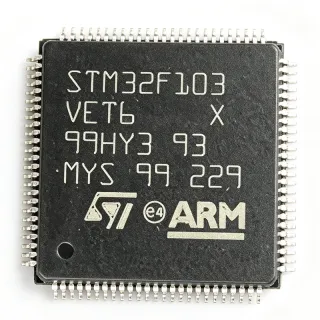
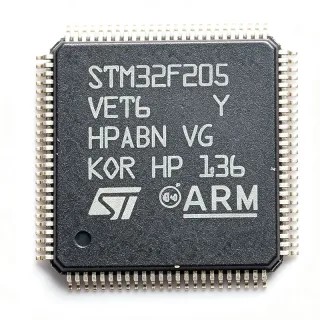
STM32H743VIT6 - 480MHz Cortex-M7 MCU 2MB Flash | ST
MPN: STM32H743VIT6 ✓ Active| Qty | Unit Price | Extended |
|---|---|---|
| 1 | $10.85 | $10.85 |
| 10 | $9.95 | $99.50 |
| 100 | $9.12 | $912.00 |
| 500 | $8.55 | $4,275.00 |
| 1,000 | $7.98 | $7,980.00 |
STM32H743VIT6 Overview
A microcontroller unit (MCU) is a single-chip computer integrating a processor core, memory, and peripherals on one die. Within the embedded systems hierarchy, MCUs sit below application processors but above simple 8-bit controllers, and the STM32H7 family represents the flagship high-performance tier of the widely adopted STM32 platform from STMicroelectronics.
Key features of the STM32H743VIT6 include the 480 MHz Cortex-M7 core with double-precision FPU and DSP instructions, 2 MB of on-chip dual-bank flash supporting execute-in-place, and up to 1 MB of SRAM for data-intensive workloads. The 46 communication and analog interfaces enable connectivity-rich designs without external bridge chips.
Technically, the STM32H7 series implements the Armv7-E architecture with AXI and AHB bus fabrics, ART Accelerator and L1 cache for maximizing core utilization from flash, and an ecosystem of timers, ADCs, DACs, and digital communication peripherals. Multiple low-power modes balance the high 480 MHz performance against battery-sensitive duty cycles.
Typical applications include industrial automation and motor control (leveraging high-resolution timers and fast ADCs), consumer and industrial HMI with graphical displays (driven by the processing headroom and memory), and communication gateways using the rich UART, SPI, CAN, and Ethernet-class peripheral mix.
Design consideration: the LQFP-100 14x14 mm footprint balances I/O density with hand-solderability for prototyping; verify power-supply decoupling per the ST datasheet because 480 MHz core operation demands low-impedance rails. Firmware built with STM32CubeIDE/CubeH7 carries forward across family variants.
This page synthesizes verified distributor data, drop-in same-family alternatives, and practical sourcing guidance not consolidated in the ST datasheet alone.
Drop-in alternatives for STM32H743VIT6 — same package, pin-to-pin compatible. Different-package parts requiring PCB rework are excluded.
Variants in this series
Same-series models that are drop-in compatible with STM32H743VIT6 (same form factor and footprint) — differing in Communication Interfaces, Flash Memory, SRAM, Timers, Package.
Quick Comparison Tool — Select alternative parts for side-by-side comparison:
STM32H753VIT6
✅ Drop-In ⚠️ 参数待验证📋 Reference alternative (not in catalog)
STM32H743VGT6
✅ Drop-In ⚠️ 参数待验证📋 Reference alternative (not in catalog)
STM32H742VIT6
✅ Drop-In ⚠️ 参数待验证✓ In Stock
$8.5 / Unit
View Datasheet →STM32H750VBT6
✅ Drop-In ⚠️ 参数待验证✓ In Stock
$8.2 / Unit
View Datasheet →STM32H743VIT3
✅ Drop-In ⚠️ 参数待验证📋 Reference alternative (not in catalog)
STM32H743VIT6 Maximum Ratings & Electrical Characteristics
| Core Processor | ARM Cortex-M7 32-bit RISC |
| Core Frequency | 480 MHz |
| Flash Memory | 2 MB (2M x 8) |
| RAM | Up to 1 MB |
| Supply Voltage | 3.3 V |
| Package | 100-LQFP (14x14 mm) |
| Mounting Type | Surface Mount |
| Communication & Analog Interfaces | 46 |
| Series | STM32H7 |
| Data Bus Width | 32 bit |
| Packaging | Tray |
STM32H743VIT6 100-lqfp (14x14 mm) Pin Configuration Guide
Pin configuration for STM32H743VIT6 (100-lqfp (14x14 mm) package). This digital IC includes GPIO, communication interfaces (UART, SPI, I2C), and power pins. Refer to the manufacturer datasheet for alternate pin functions and configuration options. Essential for embedded system design and PCB layout.

No detailed pinout data available for STM32H743VIT6.
Refer to the datasheet for full pin configuration.
Typical Applications
STM32H743VIT6 is suitable for 6 applications: Industrial Automation and Motor Control, HMI and Graphical Display Systems, Communication Gateways and Protocol Converters, Test and Measurement Instrumentation, IoT Edge Nodes and Smart Sensing, Medical and Portable Diagnostic Devices.
Industrial Automation and Motor Control
The STM32H743VIT6 fits industrial automation because its 480 MHz Cortex-M7 core and 2 MB flash execute field-oriented control algorithms with ample loop-rate margin, while its fast ADCs and high-resolution timers within the 46 communication and analog interfaces enable precise current sensing and PWM generation. In a typical drive, the MCU samples phase currents, computes control loops, and drives gate-driver ICs over dedicated timer outputs, with CAN or Ethernet-class links connecting to the factory network. Performance consideration: at 480 MHz the part sustains multi-kHz control loops with interrupt headroom for protocol stacks, but layout must keep power switching noise away from the ADC reference pins.
Recommended
HMI and Graphical Display Systems
Human-machine interfaces benefit directly from the STM32H743VIT6's combination of 480 MHz processing, up to 1 MB of on-chip RAM, and 2 MB of flash - enough to drive graphical UIs, decode images, and run application logic on a single chip. Its interface breadth supports SPI/parallel display connections and touch controllers, and ST's TouchGFX ecosystem targets the H7 family specifically. In practice the MCU renders UI layers and communicates with PLCs or sensors via UART/CAN. Trade-off: for very large frame buffers, external SDRAM is typically added since internal RAM alone may not hold full-resolution framebuffers, adding modest BOM cost.
Recommended
Communication Gateways and Protocol Converters
The STM32H743VIT6's 46 communication and analog interfaces make it a natural protocol gateway: multiple UARTs, SPI/I2C buses, and CAN controllers run concurrently while the 480 MHz core handles protocol translation, buffering, and light TLS-grade processing. Typical designs bridge industrial CAN networks to Ethernet-adjacent backends or aggregate sensor buses into a single upstream link, with the 2 MB dual-bank flash storing multiple firmware images and configuration sets. Design consideration: dual-bank flash supports safe in-field firmware updates - a gateway that must never brick benefits from bank-swap bootloading at the cost of dedicating one flash bank.
Recommended
Test and Measurement Instrumentation
Bench and portable instruments exploit the STM32H743VIT6's high core frequency, fast on-chip ADCs, and DSP-enhanced Cortex-M7 for real-time signal processing such as digital filtering, FFT analysis, and trigger decision logic. The up-to-1 MB SRAM buffers capture windows locally, and 2 MB flash retains calibration tables and instrument firmware. A typical instrument architecture pairs this MCU with front-end analog conditioning and a host interface for data upload. Performance consideration: the Art Accelerator and cache keep compute-dense DSP loops running near peak core throughput from flash, but determinism-critical code should be placed in tightly coupled memory for consistent timing.
Recommended
IoT Edge Nodes and Smart Sensing
As an IoT edge node, the STM32H743VIT6 performs local analytics - anomaly detection, sensor fusion, or lightweight inference - before transmitting summaries upstream, reducing bandwidth and cloud cost. Its rich peripheral set directly interfaces MEMS sensors, and its processing headroom executes filter pipelines and protocol stacks concurrently without an external co-processor. Power-sensitive nodes duty-cycle the part through STM32H7 low-power modes between sampling events. Trade-off: the H743VIT6 is a performance-first part; ultra-low-power always-on nodes may prefer smaller STM32 L-series devices, using the H743 where local compute density justifies its consumption.
Recommended
Medical and Portable Diagnostic Devices
Portable medical diagnostics use the STM32H743VIT6 for signal acquisition and on-device analysis - for example biosignal sampling where fast ADCs and the DSP-enhanced Cortex-M7 run digital filtering and feature extraction locally, keeping patient data processing inside the device. The 2 MB flash stores calibration and analysis firmware, while multiple UART/SPI interfaces connect to display modules and printers found in point-of-care instruments. Design consideration: medical designs must pair the MCU with isolated interfaces and rigorously follow the ST datasheet's power and layout guidance; verify the exact temperature-grade suffix (VIT6 standard grade) against the required operating environment specification.
Recommended
Recommended Products Summary
Engineering reference data for STM32H743VIT6 — comparison, design guidance, and compliance information.
Selection Guide
Comparison with Alternatives
| Parameter | This Product | STM32H753VIT6 | STM32H743VGT6 | STM32H742VIT6 | STM32H750VBT6 |
|---|---|---|---|---|---|
| Package | 100-LQFP (14x14 mm) | 100-LQFP (14x14 mm) - same | 100-LQFP (14x14 mm) - same | 100-LQFP (14x14 mm) - same | 100-LQFP (14x14 mm) - same |
| Brand | STMicroelectronics | STMicroelectronics | STMicroelectronics | STMicroelectronics | STMicroelectronics |
| Core / Frequency | Cortex-M7 @ 480 MHz | Cortex-M7 @ 480 MHz | Cortex-M7 @ 480 MHz | Cortex-M7 @ 480 MHz | Cortex-M7 @ 480 MHz |
| Flash Memory | 2 MB | 2 MB | 1 MB | 2 MB | 128 KB |
| RAM | Up to 1 MB | Up to 1 MB | Up to 1 MB | Up to 1 MB | Up to 1 MB |
| Hardware Crypto Acceleration | No | Yes (AES/HASH/CRYP) | No | No | No |
| Pin-to-Pin Compatibility | Reference | Pin-compatible | Pin-compatible | Pin-compatible | Pin-compatible |
| Best Fit Use Case | General high-performance embedded | Security/crypto-intensive designs | Cost-optimized with <=1 MB code | Reduced-feature industrial builds | External-flash / lowest-cost H7 |
Key Differentiators
- Double flash density for code-heavy applications (vs STM32H743VGT6)
- Cost-effective general-purpose flagship vs crypto variant (vs STM32H753VIT6)
- Retains onboard flash vs external-memory architecture (vs STM32H750VBT6)
Design Notes
A 480 MHz Cortex-M7 demands a low-impedance, well-decoupled 3.3 V supply. Follow the ST datasheet power scheme exactly for the STM32H7 series: place decoupling capacitors on every VDD/VSS pair and on the VCAP pins per the reference design, and confirm whether your board uses the internal regulator or external supply configuration appropriate for this package option. Inrush and rail sag during 480 MHz wake-up from low-power modes are common pitfalls - verify with an oscilloscope on first power-up.
The 100-pin LQFP 14x14 mm has 0.5 mm pin pitch: use solder-mask-defined pads per IPC-compatible footprints from the ST layout reference, with thermal-relief-free ground connections. Place the 0.1 uF decoupling capacitors within 2 mm of their pins and route the crystal traces short and guarded. Allocate a solid ground plane; the high core frequency makes return-path integrity directly affect EMI and ADC noise performance in mixed-signal sections of the board.
Do not confuse suffix codes: VIT6 vs VGT6 differ in flash (2 MB vs 1 MB), and temperature-grade suffixes matter for outdoor or automotive-adjacent builds. Firmware size must fit the ordered variant - CubeMX projects built on 2 MB will not link on a G-density part. Also, H7-family pin functions are heavily multiplexed: lock pin assignments in CubeMX early and re-check alternate-function tables in the datasheet before PCB routing, since peripheral instances exposed on pins vary with package pin count.
For fast peripherals (parallel display, high-speed SPI/QSPI toward external memory), keep clock and data trace lengths matched and controlled-impedance where practical. Use the internal L1 cache and Art Accelerator to run performance code from flash, but place timing-critical ISRs and DSP buffers in tightly coupled memory (TCM) for deterministic latency. Estimated: moving hot loops from cached flash to TCM typically removes tens of nanoseconds of non-deterministic access per fetch, which matters for multi-MHz control loops.
Compliance Information
Compliance declarations not included in the provided verified data; confirm via the official ST compliance certificate for the STM32H743VIT6 orderable part number. The part is in active production per distributor lifecycle data.